
Three brothers escaped East Germany across fourteen years, using three completely different solutions: an inflatable mattress across the Elbe, a steel cable stretched over the Berlin Wall, and an ultralight aircraft that landed inside East Berlin long enough to collect the last brother.
Three brothers, three different border problems
The Bethke brothers are often compressed into a single phrase: three brothers who escaped over the Berlin Wall. It is memorable, but it is not quite accurate.
Only two of the three Bethke escapes directly involved the Berlin Wall. Ingo Bethke left East Germany in 1975 by crossing the fortified inner German border at the Elbe. Eight years later, Holger Bethke escaped from an East Berlin rooftop on a steel cable. In 1989, Ingo and Holger flew ultralight aircraft from West Berlin into East Berlin, collected their brother Egbert, and returned west.
The sequence matters because the methods were not variations on one trick. Each solved a different border problem.
Ingo had to cross a mined frontier and a wide river. Holger and his friend Michael Becker had to bridge the empty space between buildings on opposite sides of the Berlin Wall. Egbert’s rescue required something stranger still: an aircraft had to enter East Berlin, land, take him aboard, and leave before the authorities understood what was happening.
Across fourteen years, the brothers turned family separation into a continuing engineering problem.
Ingo Bethke: across the Elbe, 1975
Ingo Bethke was the eldest of the three brothers. He had also served as an East German border guard, giving him experience with the system he later intended to cross.
In his later account of the escape, he described choosing the Elbe near Lenzen in Brandenburg. On the opposite bank lay Lower Saxony and West Germany.
The date was 22 May 1975.
The frontier was not simply a riverbank. Before reaching the Elbe, Ingo had to get through border barriers and a mined strip. His retrospective description included wire cutters, an inflatable air mattress and a block of wood that he used while feeling his way through the dangerous ground.
These details come chiefly from Ingo’s own account more than three decades later, so they deserve a different evidentiary weight from a contemporaneous border report. The broad mechanism, however, is consistently preserved: he breached the border barrier, crossed the mined ground, reached the Elbe and used an inflatable mattress to get across the river.
His later recollection puts the river at roughly 200 meters wide at his crossing point and says the crossing itself took about half an hour. Fog helped conceal him. When he reached the western bank, the first Bethke brother was out.
It was an escape shaped by knowledge of the border from inside. The decisive advantage was not a spectacular machine but familiarity with the terrain and the security system.
Ingo was free. Holger and Egbert were still in East Germany.

Holger Bethke: build a bridge the guards cannot see
By 1983 the problem was different.
Holger Bethke was living in East Berlin. His intended route crossed the Berlin Wall itself, but he was not planning to climb it, tunnel under it or smash through a checkpoint.
He and his friend Michael Becker planned to cross above the border on a cable.
The location was Bouchéstraße in Treptow, where buildings on the eastern side stood across the border from buildings in West Berlin. The men developed a system that depended on a light line first and a much heavier line second.
According to a detailed reconstruction based on the East German security file and later participant accounts, Holger and Becker trained physically and practiced the mechanics before the attempt. The final equipment included a bow, fishing line, a steel cable and homemade roller arrangements that could carry their weight across the gap.
On 30 March 1983 they entered the attic of Bouchéstraße 33 disguised as workmen. They then waited.
The delay was part of the method. Daylight and ordinary building traffic were liabilities. The escape needed darkness and a quiet period in which men carrying unusual equipment to a roof would not attract attention.
They remained inside for nearly twelve hours. In the early morning of 31 March, the operational sequence began.
A fishing line was attached to an arrow. The idea was to shoot the light line across the border first. Once somebody on the western side had it, the fishing line could be used to pull over a stronger steel cable.
The first shots did not complete the job. A later reconstruction says the third arrow succeeded.
The identity of the person waiting on the western side is one of the few meaningful source conflicts in the story. The current Chronicle of the Wall page attributes the west-side assistance to Becker’s brother. A more detailed reconstruction published after examination of the Stasi file identifies Ingo Bethke as the western helper and describes him using a car to tension the cable. Because the latter account is more specific about its documentary basis, it carries substantial weight, but the conflict should not be hidden.
What is secure is the mechanism. The light line crossed first. A steel cable followed.
The cable was fixed on the eastern side and tightened from the western side. The reported cable was about six millimeters thick and roughly 105 meters long.
Holger went first.
Suspended below the cable with the roller device, he moved from the East Berlin rooftop toward the West. The cable sagged under weight, and the last part of the crossing required effort rather than a clean gravity-powered slide.
He reached the western building. Michael Becker followed. The operation had now moved two men across the border without breaking through the Wall at ground level.
A locked attic door on the western side created one final complication. According to the detailed reconstruction, police were called from the West to get the men out of the building.
Holger had escaped East Germany. Eight years after Ingo’s flight across the Elbe, two Bethke brothers were in the West. Egbert remained behind.

The last brother
Egbert Bethke was the middle brother by age: born after Ingo and before Holger. Some later retellings have called him the youngest, but Holger was younger.
By the late 1980s the East German security apparatus was aware that Egbert wanted to leave. A Stasi record discussed in later archival reporting, dated 27 April 1988, described his intention to seek permission to emigrate and the possibility that he might otherwise attempt an illegal departure.
For Ingo and Holger, that meant the third problem could not be solved merely by sending instructions from the West. They began preparing an extraction by air.
The brothers sold a pub in Cologne and acquired two small ultralight aircraft. Sources disagree on the precise aircraft model, so the safest description is also the most useful: open, light, two-seat ultralights suitable for very short flights and capable of operating from relatively modest spaces.
They learned to fly them.
They also altered their appearance. The aircraft were given camouflage-style paint and Soviet red stars, and the brothers wore military-looking clothing and radio helmets.
The idea was deception by hesitation. If East German guards saw the aircraft only briefly, the Soviet markings might make them pause before treating the machines as hostile or unauthorized western intruders. That was the intention.
There is no strong evidence that the stars themselves caused the escape to succeed. In fact, the available reporting suggests the relevant border personnel did not identify and react to the aircraft quickly enough for the markings to become the decisive factor.
The first attempt does not get airborne
Before the successful rescue, the brothers tried to start the operation once and were interrupted in West Berlin. Here the sources disagree on the date.
One detailed later reconstruction gives 11 May 1989. Another well-researched account places the aborted attempt on 14 May, when West Berlin police discovered men assembling two motorized ultralights in the Hasenheide area.
The exact day does not need to be forced. What matters is that the first attempt in mid-May was interrupted before the rescue flight began. The brothers still had the aircraft. Egbert was still waiting.
They tried again less than two weeks later.
Dawn over Berlin, 26 May 1989
The successful attempt began before sunrise on 26 May.
The aircraft were brought to a sports ground in the Britzer Mühle area of West Berlin. The plan required two pilots rather than one.
One aircraft would actually land inside East Berlin and pick up Egbert. The other would remain airborne, watch the operation and provide a measure of redundancy if something went wrong. A later reconstruction using the brothers’ video recording gives a takeoff time of about 4:22 a.m., with Ingo departing first and Holger following seconds later.
They crossed into East Berlin. The intended pickup area was near the Soviet Memorial in Treptow. The landing site was not empty. A circus had occupied part of the area, creating an obstacle the planners had not expected.
Ingo landed anyway. Egbert had been waiting nearby.
The surviving video-based chronology makes the pickup astonishingly brief. Ingo touched down at about 4:28 a.m. Egbert boarded. Roughly a minute and a half later, the ultralight was moving again.
Holger remained overhead.
By the time border guards reported hearing an engine, the escape was already progressing in a direction that confused the normal logic of the frontier. An unauthorized aircraft was not merely fleeing from East to West. It had come from the West, entered East Berlin, landed, and then turned back.
The illuminated border itself became a navigation aid. The aircraft headed west along the line of the divided city.
A detailed reconstruction based on the surviving recording places them near the Axel Springer building at about 4:34 a.m. They continued past central Berlin landmarks and crossed safely into the western sector.
Around 4:37, the ultralights landed near the Reichstag. Egbert Bethke was in West Berlin. All three brothers were now free.
What the Soviet stars did — and did not do
The red stars painted onto the 1989 aircraft have become one of the most repeated details of the Bethke story. The brothers clearly intended the markings to create uncertainty. That does not prove they fooled East German guards into believing Soviet military aircraft were operating over Berlin. The successful rescue was also helped by timing, darkness moving toward dawn, the unusual flight path, the small size of the machines, the speed of the pickup and the fact that the border response had only minutes to interpret something outside normal patterns.
The safest conclusion is that the Soviet-style markings were part of the brothers’ deception plan. Their actual causal effect is unknown. That distinction is important because an escape can involve a clever idea without that idea necessarily being the reason it worked.
Three escapes, not one perfected method
Taken together, the Bethke escapes can look like a progression toward ever more elaborate technology. That is only partly true. Ingo’s 1975 escape used simple equipment but depended heavily on prior border knowledge and willingness to cross mined ground and a river.
Holger’s 1983 escape was a technical construction problem. A narrow line had to cross first so that a load-bearing cable could follow. The men then had to trust that system with their own weight high above the border.
The 1989 rescue was an operational timing problem. An aircraft had to enter a prohibited zone, find a pickup site, land in East Berlin, load Egbert and leave before security forces could build an accurate picture of what was happening.
Each plan worked because it attacked a different limitation in the border system. The frontier could be mined, watched, illuminated and patrolled. It could not be equally strong in every dimension at every moment.
The Wall was still there
The timing of Egbert’s escape gives the story a final layer of irony.
On 26 May 1989, the Berlin Wall still functioned as a guarded frontier. The Bethke rescue required aircraft, disguises, planning and the acceptance of extraordinary risk.
Less than six months later, on 9 November 1989, East Germany opened the Berlin Wall crossings amid the political crisis that was already transforming the country. That later event can make the May escape look unnecessary in retrospect. It was not unnecessary to the people planning it.
They did not know in advance that the border regime would collapse before the end of the year. Their decisions were made inside the conditions of May 1989, not with knowledge of November.
The objects survived the escape
The story did not end with family reunion.
The brothers had filmed the 1989 operation, and contemporary West German reporting quickly turned the rescue into a media event. The footage became part of how the escape was remembered.
The aircraft also survived as historical objects. One of the ultralights associated with the rescue has since entered Germany’s national museum culture and was included in the House of the History of the Federal Republic of Germany’s renewed permanent exhibition in Bonn. That survival matters because the Bethke story is unusually material. An air mattress, a cable and an ultralight seem almost absurdly different as escape devices.
They belong together only because the same family kept confronting the same political division.
What common retellings get wrong
The first mistake is geographical.
Ingo did not escape “over the Berlin Wall.” His 1975 route crossed the inner German border at the Elbe.
The second mistake is family order.
Egbert is sometimes called the youngest brother. The reported birth years place Ingo first, Egbert second and Holger third.
The third mistake is false technical precision. The sources do not agree on the exact ultralight model used in 1989, and the best article does not need to choose a model merely to sound authoritative. The fourth is treating the Soviet stars as a proven masterstroke.
They were an intentional disguise element. Whether they actually prevented a guard from firing or directly delayed a response is not established.
The fifth is imagining the three escapes as a single perfected system. They were separate solutions, separated by years, terrain and technology.
Why the Bethke brothers matter
Many escape histories are stories of one opening used once. The Bethke story is different. Ingo learned enough about one border environment to cross a mined river frontier. Holger and Michael Becker converted urban geometry into a temporary bridge over the Berlin Wall.
Ingo and Holger then reversed the normal direction of escape traffic entirely, flying from the West into East Berlin to collect Egbert. The family did not discover a universal weakness in the East German border. They discovered three different ones. That is why the case belongs as one story.
The continuity is not the equipment. It is the problem-solving.
Escape reconstruction
How the escape unfolded
An evidence-aware sequence of the principal stages.
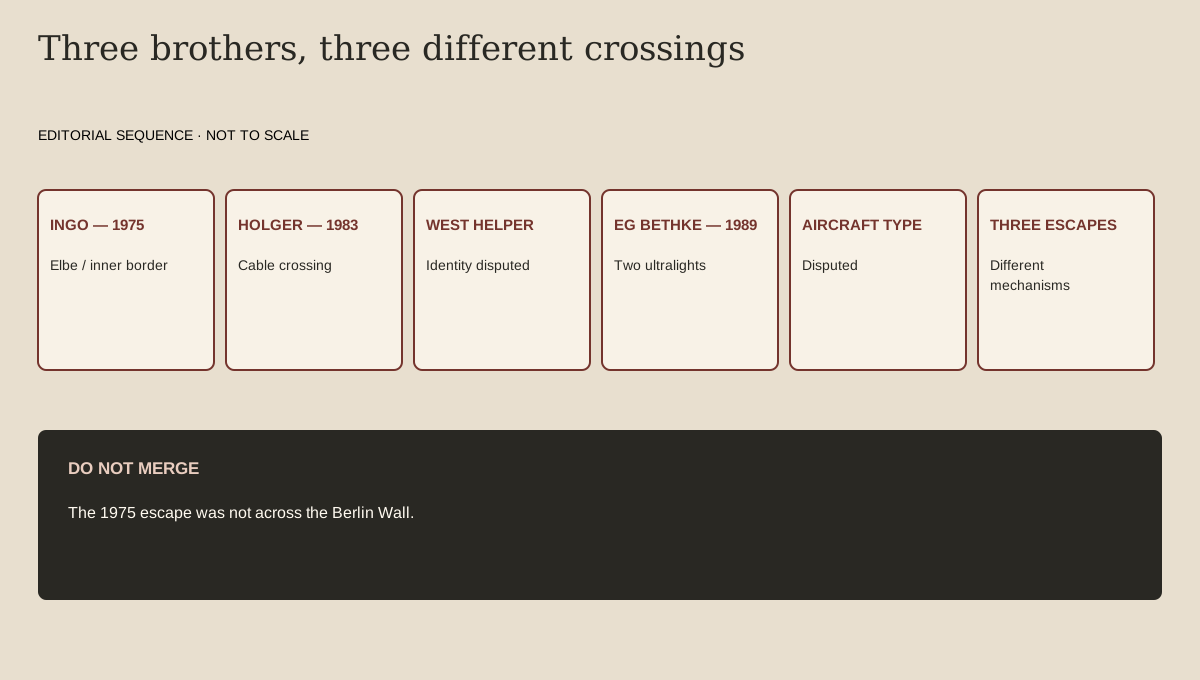
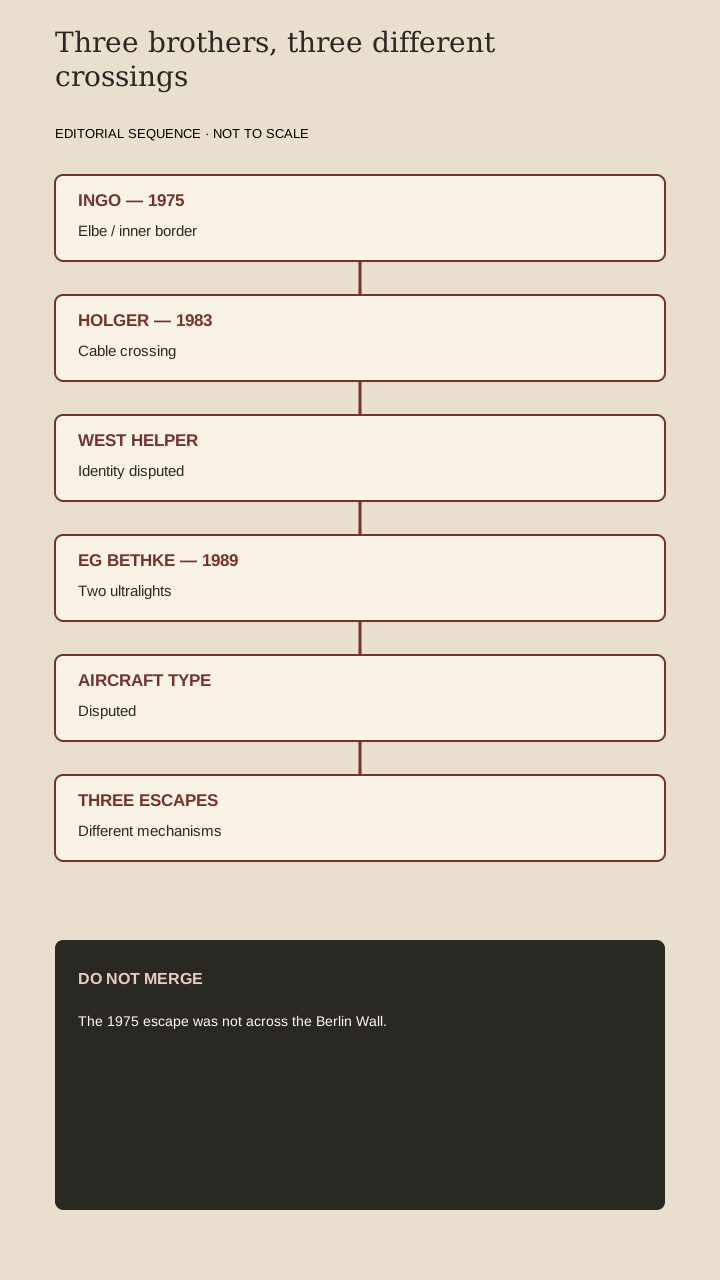
Simplified editorial reconstruction; not to scale. See adjacent text for evidence qualifications and unresolved details.
Material evidence
Tools of Escape
The objects used in an escape reveal how a plan worked under constraint.
- 011975 barrier crossing
Wire cutters and wooden probe
Ingo later described using cutting tools to breach fencing and a wooden block or probe to help negotiate the mined ground before reaching the Elbe.
- 021975 river crossing
Inflatable air mattress
Ingo used an inflatable mattress as flotation for the Elbe crossing into West Germany.
- 031983 pilot line
Bow and fishing line
The 1983 plan used an arrow to carry a light line across the border so that a much heavier cable could then be pulled over.
- 041983 load-bearing crossing
Steel cable and roller devices
Holger and Becker suspended themselves from a tensioned steel cable and traversed the space between the East and West Berlin buildings.
- 051989 extraction
Two ultralight aircraft
The 1989 operation used two small aircraft, allowing one pilot to perform the East Berlin pickup while the other remained airborne.
Problem → response
Escape was a sequence of problems
Each response solved a practical obstacle while often creating the next one.
- 01→
Obstacle
Fortified and mined Elbe border
Ingo’s 1975 route required reaching the river through border barriers and dangerous mined ground before confronting the Elbe itself.
Response
He relied on prior border knowledge, simple tools and a flotation device rather than attempting a checkpoint crossing.
- 02→
Obstacle
No physical route across the Wall at Bouchéstraße
Holger and Becker faced a guarded border strip separating eastern and western buildings.
Response
They created a temporary aerial connection: a light line first, then a tensioned steel cable capable of carrying their weight.
- 03→
Obstacle
A pickup had to occur inside East Berlin
Egbert could not simply board an aircraft in the West; one of the pilots had to enter East Berlin, locate him, land and leave quickly.
Response
The brothers used two ultralights before dawn, kept one aircraft airborne, and limited the ground pickup to roughly a minute.
- 04→
Obstacle
Unexpected occupation of the intended 1989 landing area
A circus occupied part of the Treptow pickup area when the aircraft arrived.
Response
Ingo adjusted to the available ground, landed, collected Egbert and took off again.
The final accounting
Outcome
Ingo reaches West Germany
Ingo’s 1975 Elbe crossing ended with his arrival in Lower Saxony.
Holger and Michael Becker reach West Berlin
The 1983 cable operation carried both men from the East Berlin building to the western side.
Egbert is extracted from East Berlin
The 1989 ultralight operation brought Egbert to West Berlin and reunited the three Bethke brothers in the West.
Evidence discipline
What the record supports
Status labels distinguish secure conclusions from uncertainty and rejected claims. Color is never the only signal.
MYTH
All three Bethke brothers escaped over the Berlin Wall.
Ingo’s 1975 escape crossed the inner German border at the Elbe. Holger’s 1983 cable crossing and Egbert’s 1989 extraction directly involved divided Berlin.
Sources: SRC-003, SRC-002, SRC-004, SRC-006WELL-SUPPORTED
Ingo crossed the Elbe on an inflatable mattress in May 1975.
The broad method and date are consistent across later historical treatments, while detailed dimensions, timing and minefield technique are preserved chiefly in Ingo’s retrospective account.
Sources: SRC-003, SRC-006DISPUTED
Ingo Bethke was the west-side helper in the 1983 cable escape.
A detailed reconstruction based on the Stasi file and participant accounts identifies Ingo and describes him tensioning the cable with a car. The current Chronicle of the Wall page instead says Michael Becker’s brother was waiting on the western side. The helper’s identity therefore remains contested.
Sources: SRC-001, SRC-002MYTH
Egbert was the youngest Bethke brother.
Archival-based reporting gives birth years of 1954 for Ingo, 1956 for Egbert and 1959 for Holger, making Holger the youngest.
Sources: SRC-006DISPUTED
The exact ultralight model used in 1989 is securely established by the public sources.
Strong later sources give conflicting model identifications. The secure description is therefore the generic term ‘ultralight aircraft,’ without a specific model designation.
Sources: SRC-004, SRC-006, SRC-013DISPUTED
The aborted first 1989 ultralight attempt occurred on one securely documented date.
Later accounts give 11 May and 14 May 1989. The event is therefore dated to mid-May 1989.
Sources: SRC-004, SRC-006UNKNOWN
Soviet red stars painted on the ultralights prevented East German guards from firing.
The brothers’ intention to create hesitation or confusion is well supported. The available evidence does not establish that the markings directly caused a guard to withhold fire or were decisive to the successful extraction.
Sources: SRC-004, SRC-006, SRC-013Selected chronology
Selected chronology
Ingo escapes across the Elbe
Ingo Bethke crosses the fortified inner German border and uses an inflatable mattress to traverse the Elbe into West Germany.
Holger and Becker enter the Bouchéstraße attic
Disguised as workmen, Holger Bethke and Michael Becker enter Bouchéstraße 33 at about 1:30 p.m. and wait for darkness.
Cable crossing to West Berlin
A line is shot across the border, a steel cable is pulled into place, and Holger and Becker traverse it to the western building.
Planning begins for Egbert’s extraction
Later archival reporting dates the serious development of the ultralight-rescue plan to the late 1980s.
Stasi records Egbert’s intention to leave
A security report later discussed from the archival file records Egbert’s intention to seek departure and the possibility of an illegal exit if refused.
First ultralight attempt is interrupted
West Berlin police encounter the group before the planned extraction can begin. Sources disagree on the precise day.
Egbert is extracted by air
Ingo and Holger fly two ultralights into East Berlin; Ingo lands, collects Egbert, and the group returns to West Berlin near the Reichstag.
Berlin Wall crossings open
Less than six months after Egbert’s rescue, the East German government’s border-control crisis culminates in the opening of the Berlin Wall crossings.