
Bernd Böttger’s successful escape from East Germany began on the night of 8 September 1968 at Graal-Müritz on the Baltic coast. He entered the water with a self-built motorized device designed to pull him through the sea while he remained largely below the surface. Several hours later, in the early morning of 9 September, he reached the Danish lightship Gedser Rev and climbed aboard.
That sequence is secure. Much of the dramatic detail that later grew around it is not equally secure. Retellings disagree over the exact distance, simplify the date to either 8 or 9 September, and repeat vivid episodes from later recollections as though they were contemporary records. The history is strong enough without doing that. Böttger had already been caught preparing an earlier maritime escape, his first device had been confiscated, and the second machine carried him out of a state that treated unauthorized departure as a criminal act.
At a Glance
Who: Bernd Böttger, a mechanically skilled East German from Sebnitz who had studied engineering before leaving school without a degree.
Control: The German Democratic Republic restricted emigration and criminalized unauthorized departure as well as preparation for escape.
First attempt: Arrested near Redewisch/Boltenhagen in July 1967 before he could set out across the Baltic; his first propulsion device was confiscated.
Successful escape: Late 8 September to early 9 September 1968, from Graal-Müritz to the Danish lightship Gedser Rev.
Method: A self-built underwater propulsion motor later widely known as an Aqua-Scooter.
Outcome: Böttger reached Danish protection and then West Germany. His device subsequently attracted commercial interest.
The Baltic as a Closed Border
The Baltic Sea looked open in a way the Berlin Wall did not. That did not make it an open frontier. After the Wall went up in August 1961, East German authorities expanded a maritime security system intended to prevent citizens from leaving without permission. Coastal observation posts, border troops, naval forces, police, customs, state-security personnel, and civilian reporting all contributed to the effort.
The East German legal system reinforced that physical control. A 1957 passport law made unauthorized departure punishable and allowed the state to prosecute attempted or prepared escapes. In 1968 the new criminal code continued that policy under the offense of unlawful border crossing. Böttger’s first attempt fell under the earlier passport-law regime.
Thousands nevertheless tried to leave by sea between 1961 and 1989. Historical counts vary with methodology and surviving records, but both parliamentary exhibition research and more recent scholarship agree on the broad picture: only a minority succeeded, thousands were intercepted or arrested, and many people died. The Baltic route therefore cannot be understood as an easier substitute for the land border. It exchanged fences and walls for surveillance, exposure, cold water, navigation problems, and the possibility of interception at sea.
The Danish lightship Gedser Rev became part of that geography. It served at Gedser Reef from 1921 until 1972 and lay between Denmark and the East German coast. Denmark’s National Museum says the lightship became the salvation of roughly fifty refugees from the Eastern Bloc during the Cold War. For someone trying to cross the Baltic, reaching the ship could mean reaching Danish protection before reaching Danish land.
Böttger’s First Machine
Böttger was born in 1940 and came from Sebnitz in Saxony. Later biographical accounts describe a young man with strong mechanical interests who trained as a chemical worker, studied at an engineering school in Magdeburg, experimented with machines, and learned to dive. The documentation becomes especially relevant once his engineering interests intersect with his intention to leave the DDR.
His central idea was not to build a conventional boat. He developed a compact motorized propulsion unit that could pull a swimmer through the water. Parliamentary and museum-oriented sources generally describe it as an underwater motor; later journalism and commercial history made “Aqua-Scooter” the enduring name. Technical accounts provide extensive specifications, but the historical point does not require a construction manual. Böttger was trying to reduce the physical burden of a long swim while keeping himself less conspicuous than a normal powered craft.
He tried to put that idea into practice in 1967. The specialist exhibition Über die Ostsee in die Freiheit places him at Redewisch near Boltenhagen on 7 July, observing the coastal security environment before departure. He was arrested before he could begin the crossing. Authorities found his diving equipment and the first version of the propulsion device, which was confiscated.
The punishment that followed is less cleanly reported than later summaries suggest. The exhibition transcribes a judgment for eight months’ imprisonment suspended on a two-year probationary period after a period of pretrial detention. Other retellings say simply that Böttger spent eight months in prison or give a release date in March 1968. Those claims do not fit together neatly enough to justify a precise custody total. What matters for the escape chronology is that the first plan failed, the state took the device, and Böttger later built another one.
Building Again
The second machine was not merely the same object recovered from storage. The first had been confiscated. Böttger therefore had to construct a replacement if he still intended to leave by sea. Later technical descriptions say he refined the propulsion system and worked to reduce its noise, but those accounts are much more detailed than the institutional summaries and were written after the event.
The distinction between documented mechanism and later engineering reconstruction is useful here. It is well supported that the second device used a small combustion engine to drive a propeller and that Böttger held onto or was towed by the unit while wearing diving equipment. It is also clear that the machine could operate with him partly submerged for hours. Exact fuel capacity, component dimensions, exhaust arrangements, and other construction details add little to the historical argument and are unnecessary for understanding the escape.
By September 1968 Böttger had another working device. Instead of returning to the western Baltic coast near Boltenhagen, where his first attempt had ended in arrest, he chose Graal-Müritz east of Rostock as the starting point for the successful attempt. Later accounts describe him arriving at a campsite that afternoon and waiting until late evening before going to the beach.
The Night of 8–9 September
The date is often presented inconsistently because Böttger crossed midnight while at sea. Sources centered on his departure call the escape 8 September 1968. The Federal Agency for Civic Education, describing his rescue, gives 9 September. Both can be correct when the event is reconstructed as an overnight passage.
Specialist accounts place his departure at roughly 10:00 to 10:30 p.m. on 8 September. Böttger entered the Baltic wearing a wetsuit and fins and used the motorized unit to pull himself away from the East German coast. He was alone.
Later narratives supply a much richer middle section. They say Böttger oriented himself by the stars, shut off the motor when an East German vessel passed nearby, submerged to avoid detection, restarted the device, and continued northward. Some versions add exact weather, physical distress, and remembered dialogue. Those details may preserve genuine recollections, but they come through later reconstructions rather than a contemporary escape log written by Böttger while events unfolded.
The better-supported account is therefore narrower. Böttger spent several hours in the Baltic using the self-built device and was not intercepted by East German authorities. In the early morning he reached the area of the Danish lightship Gedser Rev. The later specialist reconstruction places his arrival at about 4:00 a.m., approximately five and a half hours after departure.
Distance figures are less reliable. One established exhibition account gives twelve nautical miles, while other educational and biographical treatments produce figures closer to 27 or 30 kilometers. The endpoints are much firmer than the mileage. Böttger left from Graal-Müritz and reached Gedser Rev; there is no reason to turn varying retrospective calculations into a false single number.
Aboard the Gedser Rev
The lightship mattered because it was Danish. Built in 1895 and stationed at Gedser Reef from 1921, Gedser Rev functioned as a navigational aid in one of the Baltic’s heavily traveled shipping areas. During the Cold War, its position also made it an accidental refuge for people escaping East Germany.
Later accounts from the crew describe hearing Böttger call from the water and bringing him aboard with his unusual machine. Exact dialogue has been repeated frequently, including versions in which he introduced himself and described the apparatus as his “submarine.” Those lines are memorable, but they belong to the recollection tradition and are not necessary to establish what happened.
Once aboard, Böttger was beyond East German custody. Danish museum history confirms the lightship’s role in receiving East Bloc refugees, and multiple German sources identify it as the endpoint of his crossing. He was later taken to Danish land and continued onward to West Germany.
That makes the lightship—not Gedser town itself—the correct endpoint for the escape. Böttger did not swim all the way onto a Danish beach. He reached a Danish vessel positioned offshore, and the vessel’s nationality changed the political meaning of his situation immediately.
What the Aqua-Scooter Changed
The escape attracted attention because the machine worked. West German coverage quickly turned Böttger and the compact propulsion device into a story about invention as well as flight. The terminology also shifted. What earlier accounts called an underwater motor or miniature submarine became known widely as an Aqua-Scooter.
Böttger later worked on commercial development of the concept in West Germany. Museum documentation from Pinneberg connects the later ILO Aqua-Scooter with the prototype he had used in the Baltic, and the German Bundestag’s exhibition on maritime escapes singled out his underwater motor as one of the most notable original escape devices.
The invention should not overshadow the system it was designed to defeat. Böttger did not build an unusual watercraft because the Baltic happened to interest him. He built it in a political environment where legal emigration was restricted, unauthorized departure was criminalized, and the coastline was monitored to prevent escapes. The first attempt had already demonstrated what happened when the state detected him before he entered the water.
His later life also accumulated a more sensational claim. Böttger died during a diving trip in Spain in August 1972, and his brother eventually suspected the East German State Security service of involvement. Later reporting says Berlin prosecutors closed the post-reunification investigation in 1995 because they saw no promising investigative leads. No evidence used here establishes that Böttger was murdered, and his death should not be retrofitted into the escape as a proven Stasi revenge story.
What Can Be Said with Confidence
The central reconstruction is unusually solid even after the dramatic embellishments are removed. Böttger developed an underwater propulsion device to support a maritime escape, was caught with an earlier version in 1967, and lost that machine to the East German authorities. He then built a replacement.
Late on 8 September 1968 he entered the Baltic at Graal-Müritz. Early on 9 September, after several hours in the water, he reached the Danish lightship Gedser Rev and escaped East German control. The exact path through the sea, precise distance, and many of the near-miss details survive mainly through later narrative sources and should remain qualified.
That is enough to make the case remarkable. The decisive historical fact is not that Böttger built a futuristic-looking gadget. It is that a man whose first attempt had already ended in arrest responded by engineering another way across a border the DDR had made both legally and physically difficult to cross—and that, on the second attempt, the machine carried him to Danish protection.
Evidence discipline
What the record supports
Status labels distinguish secure conclusions from uncertainty and rejected claims. Color is never the only signal.
WELL-SUPPORTED
Böttger’s successful escape occurred on 8 September 1968.
The crossing began late on 8 September. Sources giving 9 September generally refer to his early-morning arrival and rescue, so the most precise identity is the night of 8–9 September.
Sources: SRC-004, SRC-005, SRC-007, SRC-008MYTH
Böttger escaped all the way to the Danish mainland under his own power.
The secure endpoint of his self-propelled crossing was the Danish lightship Gedser Rev offshore; he was later transferred to land.
Sources: SRC-004, SRC-006, SRC-008DISPUTED
The exact distance of Böttger’s crossing is known.
Later sources give non-equivalent figures including about 12 nautical miles, roughly 27 km, and about 30 km. The endpoints and approximate duration are stronger than any one distance figure.
Sources: SRC-004, SRC-009LATER CLAIM
Böttger definitely evaded a specific East German patrol vessel by shutting down and submerging.
This near-miss appears prominently in later specialist and journalistic reconstructions, but the detailed episode depends on recollection rather than an independently verified contemporary operational record.
Sources: SRC-007, SRC-008, SRC-009DISPUTED
Böttger served exactly eight months in prison after the 1967 attempt.
The specialist exhibition reproduces a judgment described as eight months imprisonment suspended with two years’ probation after pretrial detention, while later retellings say he spent eight months imprisoned. The custody chronology is internally inconsistent across the later source tradition.
Sources: SRC-004, SRC-007, SRC-009UNKNOWN
Böttger was murdered by the Stasi in 1972.
His brother later suspected Stasi involvement, but later reporting records that prosecutors closed the investigation for lack of promising leads. The evidence used here does not establish homicide.
Sources: SRC-008, SRC-009Documentary reconstruction
Failed attempt and successful Baltic crossing
A case-local editorial visual separates the documented sequence from uncertainty without implying exact modern geography or operational detail.
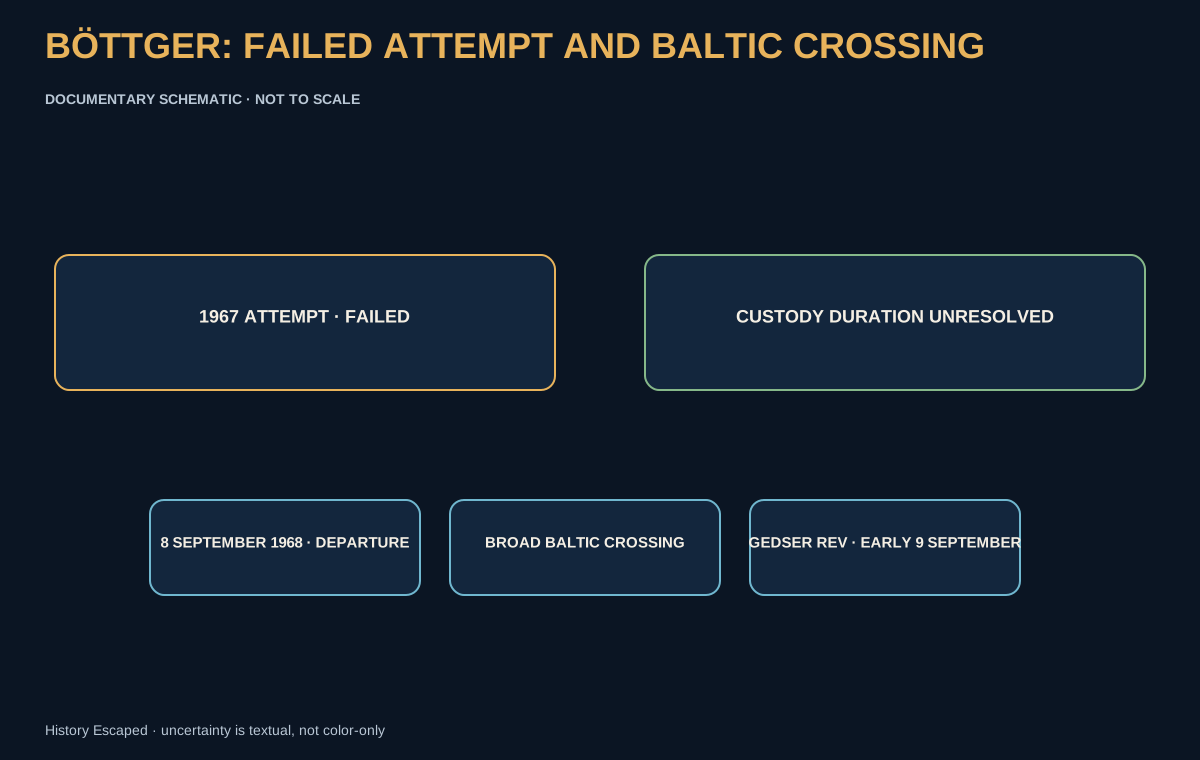
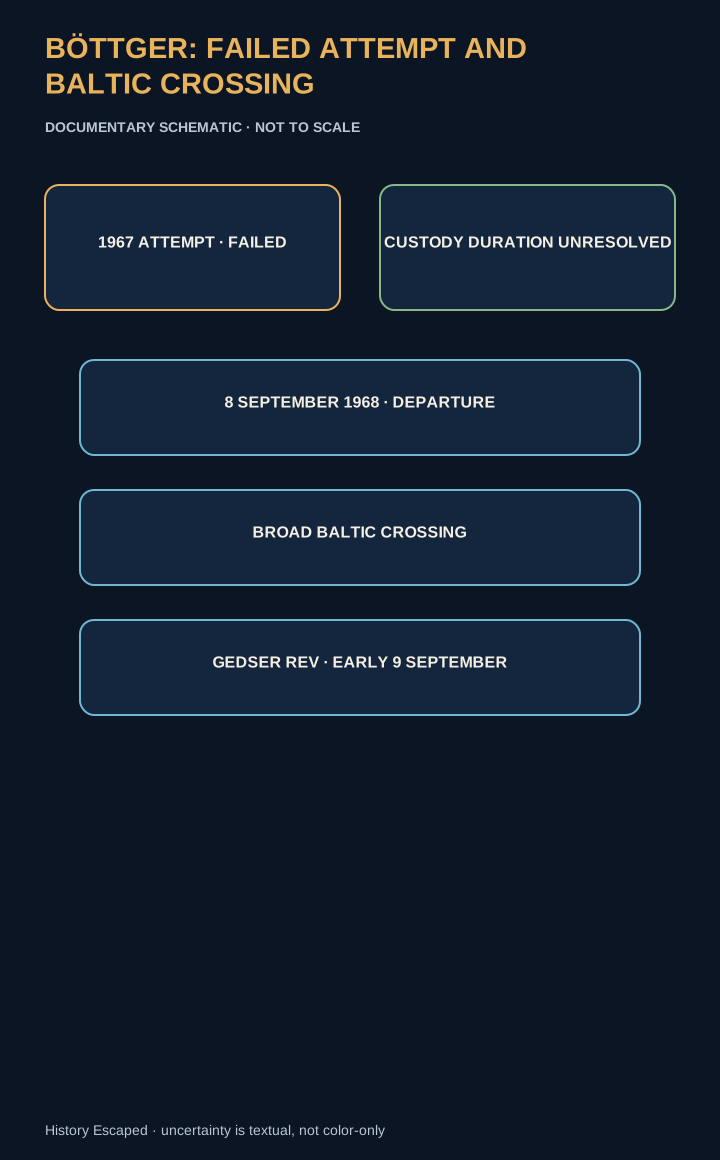
Simplified editorial reconstruction based on the cited historical record; not to scale. Uncertainty is stated directly in the visual and adjacent text.