
Operation Acid Gambit lasted only minutes inside Cárcel Modelo, but the rescue of Kurt Muse had been shaped by months of detention and by the political crisis that brought the United States and Manuel Noriega’s regime to war. Muse was an American citizen who had lived much of his life in Panama. By the late 1980s he had joined Panamanian associates in a clandestine radio campaign against Noriega’s rule. In April 1989 Panamanian authorities arrested him. He remained in custody until the opening hours of 20 December.
That night, as the wider U.S. intervention known as Operation Just Cause began, U.S. Army special operations forces landed on the roof of the prison, reached Muse’s cell, brought him back to the roof, and attempted to fly him out. The first phase worked with extraordinary speed. Then the helicopter carrying Muse went down.
The rescue ended not with a clean flight back to base but with wounded rescuers, a defensive position in the streets of Panama City, and a final ground extraction by armored U.S. forces.
At a Glance
Who: Kurt Muse, U.S. citizen, former Army officer, businessman, and participant in an anti-Noriega clandestine radio network.
Detained: April 1989.
Held: Cárcel Modelo, Panama City.
Rescue: Early 20 December 1989, during the opening of Operation Just Cause.
Rescue force: U.S. Army 1st Special Forces Operational Detachment-Delta, supported by the 160th Special Operations Aviation Regiment and other U.S. forces.
Prison phase: About six minutes from rooftop landing until Muse was ready for extraction.
Complication: The MH-6 carrying Muse and rescuers crash-landed/was forced down after leaving the prison under fire.
Final extraction: U.S. armored ground forces recovered Muse and the rescue party.
Outcome: Muse survived and entered U.S. custody; no member of the rescue party aboard his helicopter was killed.
The Voice of Liberty
Muse’s road to Cárcel Modelo began with radio. The Noriega regime increasingly restricted opposition media as Panama’s political crisis deepened. The U.S. State Department later reported that opposition media had been closed and that the government used detention, intimidation, and abuse against political opponents.
Muse and a small network of Panamanian associates participated in unauthorized broadcasting that later accounts call The Voice of Liberty. The U.S. Army’s profile of Muse says the station encouraged Panamanians to vote against Noriega’s political order and at one point broadcast over a Noriega speech. That activity makes Muse difficult to describe with a single neutral label.
He was not simply a tourist caught in a foreign prison. He was engaged in clandestine political activity against the government then exercising power in Panama. At the same time, the legal basis and treatment of his detention were heavily disputed by the United States.
Later accounts also disagree over how closely he was connected to U.S. intelligence.
An Army-produced retrospective about the doctor who visited Muse calls him an undercover CIA contact. Brent Scowcroft later referred to Noriega having a “CIA person” in jail when discussing Muse. Other public descriptions identify him as an American businessman and opposition-radio organizer, and Muse has resisted the uncomplicated label of CIA informant.
The most defensible history does not need to settle his employment status. He was part of a clandestine anti-Noriega network and had U.S. intelligence connections described differently by later sources.
Arrest and Detention
Panamanian authorities arrested Muse in April 1989. The U.S. State Department’s human-rights report for that year says he was subjected to sleep deprivation, intimidation, and interrogation and was held without charge in solitary confinement until 20 December. The same report describes a wider system in which the Noriega regime frequently disregarded constitutional protections for political detainees. That contemporary government report conflicts with some later summaries saying Muse was convicted.
The difference should not be hidden. Panamanian authorities publicly alleged serious offenses against state security, while U.S. officials challenged both his treatment and the regime’s refusal to transfer custody under treaty arrangements. For the purpose of the escape history, the secure fact is simpler: Muse was imprisoned for months under Noriega’s security apparatus, largely isolated from normal life and subject to coercive interrogation.
His later recollections describe sleeping on a concrete floor, seeing little direct sunlight, and hearing or learning of violence against other prisoners. U.S. Army accounts likewise describe harsh conditions and lengthy interrogation without sleep.
Prisoner or Hostage?
By late 1989, American planners increasingly treated Muse as more than an ordinary detainee.
Muse and later U.S. military accounts say a Panamanian guard had orders to kill him if American forces tried to rescue him or if U.S. intervention began. A 2010 Army profile describes a guard kept near him with instructions to kill him immediately if U.S. forces came.
No public written Panamanian execution order has emerged in the reviewed public record. That matters. The threat is well supported by repeated retrospective testimony, but its documentary footing is different from the State Department’s contemporaneous account of Muse’s detention.
The practical consequence was clear either way. Once Washington decided to launch Operation Just Cause, leaving Muse in Cárcel Modelo while fighting erupted around the prison risked his death. His rescue became one of the opening objectives.
Operation Just Cause Begins
Operation Acid Gambit cannot be separated from the larger intervention.
On 17 December 1989 President George H. W. Bush authorized military action in Panama after a long deterioration in U.S.-Noriega relations and the killing of a U.S. Marine officer during a confrontation with Panamanian forces. The Army’s official campaign history describes a rapid joint operation involving more than 26,000 U.S. service members.
Among the targets in Panama City were the headquarters and security infrastructure associated with Noriega’s Panamanian Defense Forces. Cárcel Modelo stood in that battlespace.
The rescue was therefore launched while other U.S. forces were simultaneously attacking and isolating nearby military objectives. Noise, fire, armed resistance, and confusion around the prison were not accidental background. They were part of a city entering combat.
Six Minutes Inside the Prison
The best-supported public account of the rescue is straightforward. Soldiers from 1st Special Forces Operational Detachment-Delta arrived on the roof aboard MH-6 Little Bird helicopters flown by the 160th Special Operations Aviation Regiment. They entered the prison from above, moved to Muse’s location, engaged armed resistance, forced access to his cell, gave him protective equipment, and took him back upward. The Association of the United States Army gives the elapsed time from landing to Muse being brought back to the roof ready for extraction as approximately six minutes. That is the origin of the “six minutes” phrase later associated with Muse’s memoir.
It does not mean the entire rescue—from first approach to final safety—lasted six minutes. At the point when Muse reached the helicopter, the most dangerous part of his extraction was still ahead.
The Helicopter Goes Down
The MH-6 carrying Muse and members of the rescue force had difficulty leaving the prison area and came under fire. Public Army accounts agree that the aircraft ended up on a Panama City street rather than completing the planned flight to safety. Some sources describe the event as a crash; others emphasize a hard or forced landing followed by another attempt to depart and renewed fire. The distinction is less important than the result.
Muse survived. The pilots survived. Several rescuers were wounded or injured. The rescue force then had to protect Muse on the ground while fighting continued nearby.
This is the part of Acid Gambit that the six-minute label can obscure. The prison assault had succeeded. The extraction had not yet succeeded.
Ground Recovery
The contingency ended with conventional ground forces. A U.S. Army account says an M113 armored personnel carrier from the 5th Infantry Division reached Muse and the rescue group after the helicopter went down. USSOCOM’s later public commemoration similarly summarizes the sequence: Muse was rescued from the prison, put aboard an MH-6, the helicopter crashed, everyone aboard survived, and an armored vehicle carried him to safety. The rescue therefore crossed organizational lines.
Special operations forces freed Muse from the prison. Special operations aviators attempted the air extraction. When that failed, conventional armored forces completed the recovery. That combination is historically more important than trying to assign the story to one unit alone.
What Happened to the Rescuers?
No one aboard Muse’s extraction helicopter was killed. The exact wounded count varies depending on which later account is used and how gunshot wounds, crash injuries, and minor injuries are counted. A participant-written Air Commando history records multiple gunshot and crash injuries while stating that Muse and the two pilots were unharmed. The sources do not support one stable wounded total. The secure conclusion is that several members of the rescue party were wounded or injured, but they maintained control of Muse until ground forces reached them.
That outcome is one reason the operation became prominent in U.S. special-operations institutional memory.
What Acid Gambit Did—and Did Not—Mean
Muse’s rescue was a tactical success inside a much larger and more controversial event. The Bush administration gave several public reasons for Operation Just Cause, including protecting U.S. citizens, defending treaty rights connected to the Panama Canal, supporting the Panamanian government that U.S. officials regarded as legitimately elected, and bringing Noriega to justice on U.S. criminal charges.
The intervention also killed Panamanians, damaged civilian areas, and generated lasting debate over U.S. power and international law. Acid Gambit should not be used to settle that debate by itself.
The rescue can be historically evaluated on its own terms: an American political detainee faced danger as war began around his prison; U.S. forces reached him rapidly; the planned air extraction failed; and a ground recovery still brought him out alive. That is enough.
The White House Aftermath
In February 1990, Muse and his family met President Bush at the White House. The Bush Presidential Library’s official photo record identifies a contact sheet showing Muse presenting the president with framed Panamanian and American flags under the words “Just Cause.” By then the operation had already begun turning into institutional memory. The Army’s Airborne and Special Operations Museum later incorporated an MH-6 Little Bird into its Operation Just Cause display and explicitly connects that aircraft type with Muse’s rescue.
Muse himself continued to tell the story and later co-authored Six Minutes to Freedom.
Those later commemorations are useful, but they also tend to smooth out the operation.
The historical rescue was not six uninterrupted minutes of perfection. It was six minutes to get Muse out of his cell and back to the roof, followed by an extraction emergency that forced the rescuers to improvise until armored forces reached them.
What the Sources Actually Establish
The strongest documentary core is unusually clear for a special-operations rescue.
Muse was arrested in April 1989 and held for months in Cárcel Modelo. The State Department documented coercive interrogation and solitary confinement. The rescue occurred on 20 December, as Operation Just Cause began.
U.S. Army sources establish the basic mechanism: special operations personnel landed on the prison roof, penetrated to Muse’s cell, brought him back to the roof in roughly six minutes, and attempted to extract him by MH-6.
The helicopter carrying Muse did not complete that flight.
It went down under fire. Muse survived. Several rescuers were injured. An armored U.S. ground element completed the extraction.
Other parts of the story require more caution.
Muse’s exact legal status under Panamanian law is disputed in U.S. sources. His precise relationship to the CIA is described inconsistently. The execution threat is strong retrospective testimony but lacks a public written order. Later operator accounts provide far more tactical detail than is necessary to understand the history.
The most accurate reconstruction therefore avoids both extremes.
Muse was neither an apolitical bystander nor a label that can be reduced confidently to “CIA operative.” He was an American deeply involved in clandestine opposition activity against Noriega, detained under a regime whose political-prisoner practices were documented as abusive, and made the object of a high-risk U.S. rescue when the wider conflict turned into war.
Acid Gambit succeeded because freeing him from the cell was only one part of the problem. When the planned air exit failed, the rescue continued until Muse was actually safe.
Evidence discipline
What the record supports
Status labels distinguish secure conclusions from uncertainty and rejected claims. Color is never the only signal.
DOCUMENTED
Muse was held in Cárcel Modelo from April until 20 December 1989.
The 1989 State Department human-rights report and later Army sources agree on the broad detention period.
Sources: SRC-001, SRC-003DISPUTED
Muse had been convicted through a normal, settled criminal process before his rescue.
Muse’s later biography and some military retellings say convicted, while the contemporaneous U.S. State Department report says he was held without charge. U.S. officials also disputed Panama’s legal basis for detention.
Sources: SRC-001, SRC-004DISPUTED
Muse can be described without qualification as a CIA operative.
Some U.S. retrospective sources call him an undercover CIA contact or CIA person, while other official accounts identify him primarily as an American citizen/businessman involved in clandestine opposition radio. His exact intelligence status is not consistently defined in the public record.
Sources: SRC-008, SRC-004WELL-SUPPORTED
A guard had orders to kill Muse if the United States attempted a rescue.
Muse and multiple later U.S. Army/special-operations accounts consistently preserve the threat, although no public written Panamanian execution order was found.
Sources: SRC-003, SRC-008MYTH
The entire rescue lasted six minutes.
About six minutes elapsed from rooftop landing to readiness for extraction. The helicopter crash and armored ground recovery occurred afterward.
Sources: SRC-002, SRC-010, SRC-011MYTH
The helicopter crash caused the rescue to fail.
The planned air exit failed, but Muse remained under U.S. protection and an armored ground force completed the extraction.
Sources: SRC-003, SRC-011MYTH
No one aboard Muse’s extraction helicopter survived the crash.
Public U.S. sources agree that all aboard survived; Muse and the pilots were unharmed while several rescuers were wounded or injured.
Sources: SRC-003, SRC-007, SRC-011Evidence diagram
Six minutes did not end the rescue
The prison extraction phase ended before the failed air extraction and armored ground recovery.
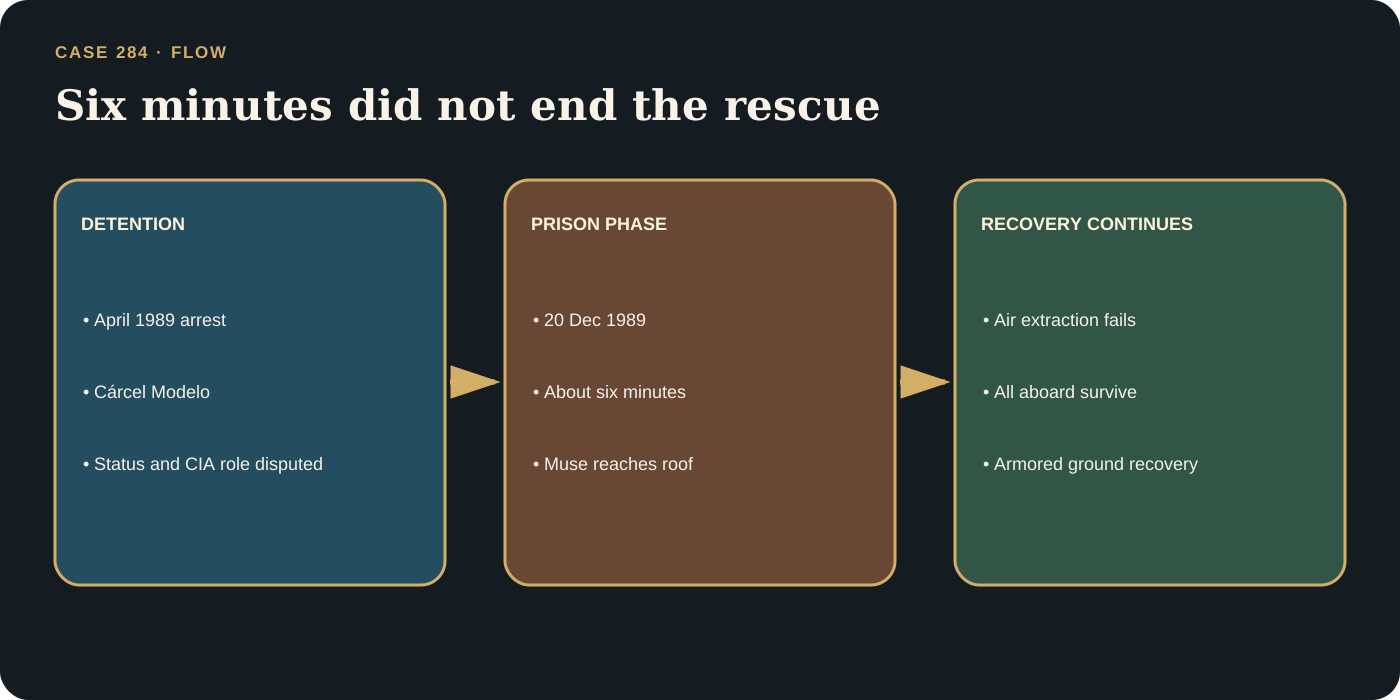
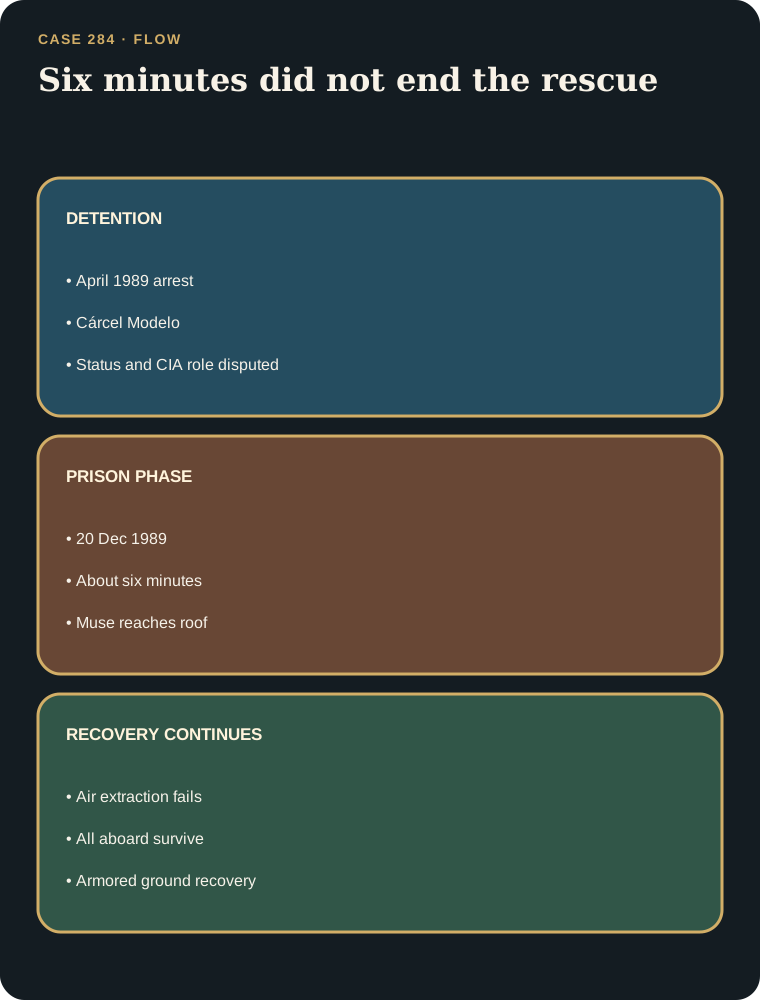
The prison extraction phase ended before the failed air extraction and armored ground recovery.