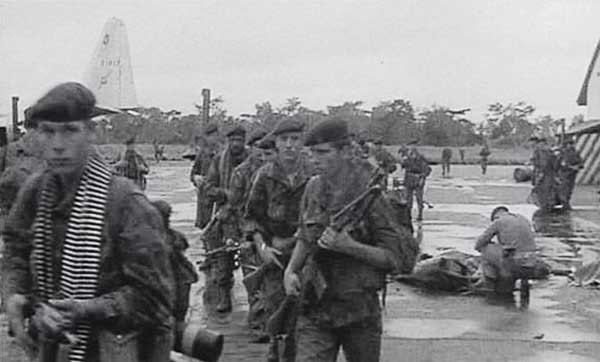
By the time Belgian paratroopers descended on Stanleyville on 24 November 1964, the city had already become one of the most dangerous points in the Congo Crisis. Simba rebels controlled the regional capital, foreign civilians had been placed under guard or concentrated as hostages, and the Congolese government’s Western-backed ground forces were closing in. Rebel leaders had threatened reprisals if Stanleyville were attacked.
Operation Dragon Rouge was designed to break that equation quickly. Belgian para-commandos would be carried across Africa by U.S. Air Force C-130s, seize Stanleyville’s airfield, move into the city, locate civilians in immediate danger, and evacuate them. At almost the same time, Colonel Frédéric Vandewalle’s Congolese government column—an improvised force containing Congolese troops, Katangans, foreign mercenaries, Belgian advisers, and U.S.-supported aviation—was approaching Stanleyville overland.
The rescue saved a very large number of people. It did not save everyone, and it cannot be understood honestly if the wider Congolese war disappears behind the rescued expatriates.
At a Glance
- Date: 24 November 1964
- Place: Stanleyville, Republic of the Congo (today Kisangani, Democratic Republic of the Congo)
- Airborne assault: 340 Belgian para-commandos in the initial U.S. C-130 drop, according to the U.S. Army’s detailed study
- Rescued or evacuated at Stanleyville: about 1,600 hostages and refugees in Thomas Odom’s reconstruction
- Hostage deaths: 33 in Odom’s Dragon Rouge count, or 61 if killings on the Rive Gauche are included
- U.S. role: strategic airlift, crews and logistical support; U.S. intelligence and covert aviation were also involved in the wider campaign
- Ground-force context: Vandewalle’s government column reached Stanleyville during the same operation
- Outcome: most threatened foreign civilians in Stanleyville were evacuated, while other hostages elsewhere in rebel territory remained at risk
From Rebellion to Hostage Crisis
The Simba rebellion emerged from the unresolved political and military crises that followed Congolese independence from Belgium in 1960. In 1964, insurgent forces swept across much of the eastern Congo and captured Stanleyville in August. Their leaders proclaimed a rival revolutionary government opposed to the Léopoldville authorities.
The rebellion was never simply a contest between an established national government and an isolated band of hostage-takers. The central government under Prime Minister Moïse Tshombe relied heavily on outside support. Belgian military advisers, white mercenaries, former Katangan forces, U.S. assistance, and CIA-supported aircraft all became part of the effort to roll back Simba territorial gains.
The rebels’ treatment of civilians and political opponents was also brutal. Executions and other violence were reported in areas under Simba control. Foreign residents became bargaining instruments as government forces advanced.
The hostage denominator is harder to describe than later summaries suggest. Odom’s U.S. Army study says more than 1,600 foreigners were living in Stanleyville when the Simbas took the city, including Belgians, other Westerners, Indians, and Pakistanis. Not all of them were held together at one moment or in one building. By late October, rebel authorities imposed broader restrictions and arrests on foreigners, while several hundred people were concentrated at places such as the Hotel Victoria.
That distinction matters. “1,600 hostages at the Victoria Hotel” is not an accurate description of the situation.
Why Belgium and the United States Chose an Airborne Rescue
Diplomatic and humanitarian efforts continued through the autumn. The International Committee of the Red Cross obtained access to Stanleyville but could not secure a general evacuation. U.S. records show repeated concern that an advancing government column could trigger killings before it reached the hostages.
By mid-November, Washington and Brussels had a contingency plan. Foreign Relations of the United States records it as a Belgian operation supported logistically by the United States. The American military contribution centered on long-range C-130 transport and supporting personnel; the Belgian commander retained responsibility for the final assault decision once the force was forward-deployed.
That official definition was politically important. U.S. planners explicitly wanted American personnel kept out of street fighting and wanted the operation presented as a limited humanitarian extraction rather than a Western seizure of a Congolese city.
The distinction was harder to sustain in practice because Dragon Rouge was timed against the movement of Vandewalle’s ground force. The plan sought to have the airborne force and the government column arrive close enough together that neither would leave a prolonged military vacuum.
This has produced a lasting dispute over purpose. Contemporary U.S. and Belgian documents repeatedly describe the paradrop as a hostage rescue and show efforts to limit the paratroopers’ role after evacuation. Historian Alanna O’Malley argues that the humanitarian rationale cannot be separated from the broader Western objective of defeating the rebellion and preserving political influence in the Congo.
The record supports keeping both levels visible. Dragon Rouge genuinely rescued hostages. It was also carried out inside a wider Western-backed counteroffensive whose political aims extended beyond those hostages.
The Drop on Stanleyville
Before dawn on 24 November, U.S. aircraft carried the Belgian assault force from Kamina toward Stanleyville. Odom’s reconstruction gives 340 troops in the initial airborne element, delivered by five C-130s.
The first task was to establish an airfield through which reinforcements and evacuation aircraft could operate. Once that was accomplished, Belgian units moved toward known or suspected hostage concentrations in the city.
A full tactical reconstruction adds little historical value here. The important sequence is secure without reproducing drop geometry, weapon positions, or building-clearing procedures: the airfield was seized, additional personnel and vehicles were brought in, the para-commandos moved toward central Stanleyville, and evacuation began through the airport.
The Belgian units were commanded by Colonel Charles Laurent. U.S. documents show that their formal mission was rescue and evacuation; Vandewalle’s arriving ground force was assigned the separate task of securing the city for the Congolese government.
The separation was real enough to matter operationally, but the two actions were not historically independent. They converged on the same city on the same day.
Avenue Sergeant Ketele
The worst moment of the rescue unfolded before the para-commandos could reach one major group of hostages.
Several hundred people had been held at the Hotel Victoria. On the morning of the paradrop, a large group was marched into the street. When the fighting and aircraft made clear that an assault was under way, Simba guards opened fire on the hostages.
Odom places roughly 260 people in this group. By the time the Belgian troops reached Avenue Sergeant Ketele, eighteen were dead and about forty were severely wounded. Some of the wounded later died.
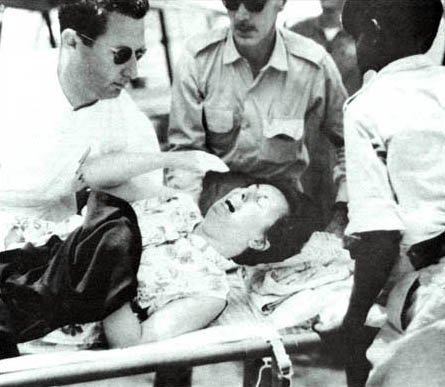
Among the dead was American physician and missionary Paul Carlson. Carlson had previously been accused by rebel authorities of being an American military officer or spy, an allegation U.S. officials repeatedly denied. He had already become the subject of international appeals before 24 November.
The rescue therefore did not “prevent the massacre” in any absolute sense. It interrupted a killing already under way and brought surviving hostages under protection.
The same caution applies to photographs from the scene. One famous U.S. military photograph showing a Belgian paratrooper lying beside dead hostages has often been read as a spontaneous combat image. The surviving Commons description records later testimony that the soldier posed briefly at the photographer’s request after the area had already been secured. Even genuine documentary photographs can acquire misleading implications when their staging is forgotten.
Evacuation
Survivors began reaching the airfield during the morning. U.S. aircraft carried wounded people and other evacuees to Léopoldville while the Belgian force continued searching the parts of Stanleyville within its assigned area.
Odom’s final accounting gives 1,600 hostages and refugees rescued in Dragon Rouge.
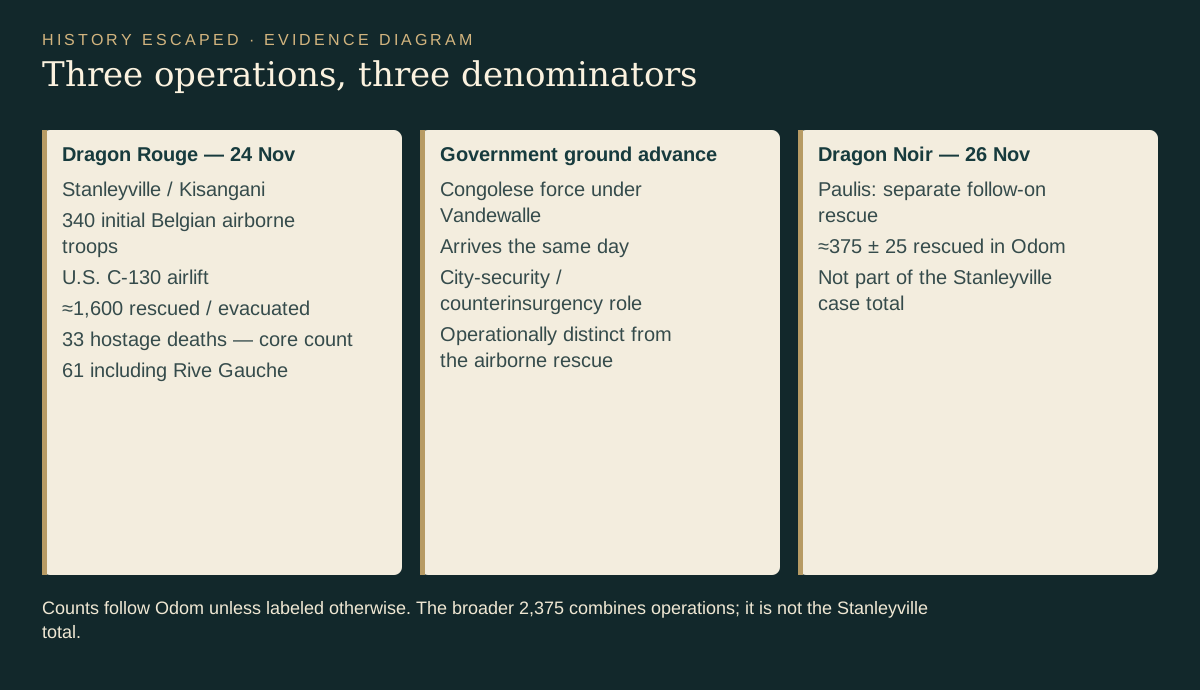
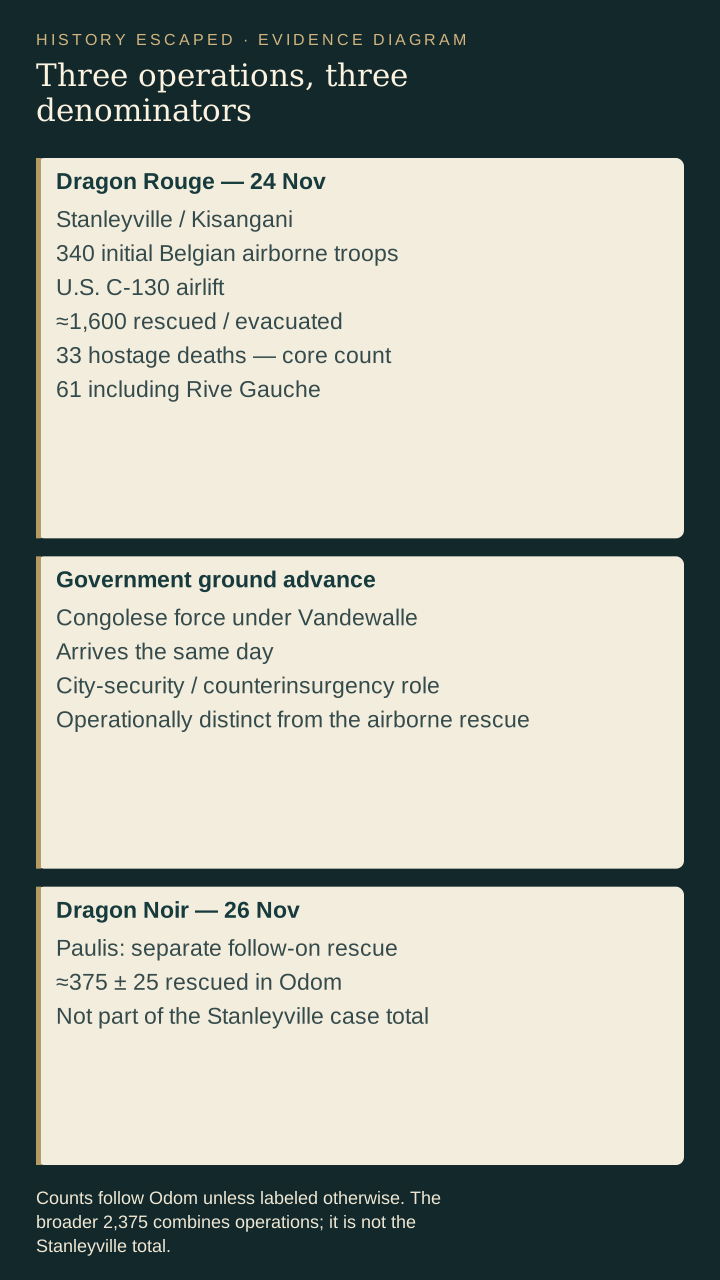
That number should not be confused with 2,375, a figure frequently attached to “Dragon Rouge” in commemorative accounts. The larger total commonly combines Stanleyville with the subsequent Dragon Noir operation at Paulis and, in some versions, additional evacuations around the Dragon missions.
For this case, the Stanleyville denominator is the relevant one.
Nationality also complicates the familiar shorthand that the operation “rescued Europeans.” Many of those evacuated were Belgian or other European nationals, but Stanleyville’s foreign community also included Americans, Indians, Pakistanis, and others. U.S. public-diplomacy officials were sufficiently concerned about the racial framing that they explicitly ordered photographers and information officers to show non-European evacuees and Congolese civilians as well.
The rescue’s humanitarian reach was broader than its later white-hostage iconography suggests.
How Many Hostages Died?
The answer depends on what is being counted.
Odom’s detailed results appendix counts about twenty Belgians and two Americans killed at Avenue Sergeant Ketele, with five additional deaths among roughly forty wounded Belgians. It also identifies fatalities elsewhere in Stanleyville. His overall assessment gives 33 dead hostages associated with Dragon Rouge, or 61 if twenty-eight people killed on the Rive Gauche—the south bank of the Congo River—are included.
The Rive Gauche became its own controversy. Laurent’s para-commandos did not cross the river during the core Dragon Rouge mission, while Vandewalle’s forces also delayed a serious crossing. Odom argues that hostages there were the losers in a disagreement over responsibility. When government forces crossed later, they recovered twenty-eight bodies and found a small number of survivors.
This is why a single figure such as “24 hostages killed” should not be treated as the only legitimate total. Different histories include different zones, moments, and deaths from wounds.
The strongest presentation is denominator-first: at the main Stanleyville rescue sites, dozens were killed; Odom counts 33, rising to 61 when the Rive Gauche killings are included.
Belgian and American Roles
Dragon Rouge is sometimes described as a joint U.S.-Belgian assault. That is broadly true, but it can imply identical military roles that the planning documents do not support.
Belgium supplied and commanded the para-commando force that entered Stanleyville. The United States supplied the long-range C-130 airlift, crews, support personnel, and other logistical capabilities that made the operation possible. Washington retained political control over whether U.S. support would be committed, but U.S. documents classified the mission as Belgian-led once launched.
At the same time, American involvement in the broader Congo campaign went beyond transport aircraft. CIA-supported aviation and personnel were part of the anti-Simba effort, and the government ground column that reached Stanleyville was itself a multinational and irregular formation.
Those overlapping roles help explain the political reaction after the rescue.
Rescue or Intervention?
Belgium and the United States emphasized that the mission had been authorized by the Congolese government and was narrowly humanitarian. Their records show genuine efforts to withdraw the para-commandos quickly rather than convert the rescue force into an occupation contingent.
Many African governments rejected that framing.
On 28 November, the Organization of African Unity’s ad hoc commission strongly condemned foreign military intervention in the Congo by the United States, Belgium, Britain, and others who had enabled it. The commission called for an end to foreign intervention and mercenary activity, a cease-fire, amnesty, and an African-led political process.
Washington responded by insisting that the Stanleyville and Paulis missions were humanitarian rescues carried out with Congolese authorization.
Neither position should be erased. In a newly independent former Belgian colony, the arrival of Belgian paratroopers aboard American aircraft could not be separated politically from the history of colonial rule or from the Cold War alignment of the Léopoldville government. At the same time, foreign civilians were genuinely under threat, executions had already occurred, and the airborne force did evacuate roughly 1,600 people from Stanleyville.
The controversy is part of the history, not an obstacle to telling it.
Beyond the Foreign Hostages
The concentration on expatriate hostages can distort the scale of violence in the Congo.
Congolese civilians, officials, teachers, political opponents, and suspected collaborators were killed during the Simba rebellion. Government troops, mercenaries, and allied forces were also accused of serious abuses as rebel-held territory was retaken. Sciences Po’s chronology of mass violence in the Congo warns that surviving documentation is too uneven to produce a complete accounting of killings by the different forces.
A rescue history should therefore avoid implying that the foreign hostages represented the principal human cost of the conflict. Their peril was real and unusually well documented because multiple governments mobilized to save them. Congolese victims were far more numerous and often far less completely recorded.
That imbalance in the archive is itself historically important.
After Stanleyville
The hostage problem did not end when the Stanleyville aircraft departed.
Hundreds of foreigners remained in rebel-held areas. Two days later, Belgian troops carried out Dragon Noir at Paulis, again using U.S. transport aircraft. Odom estimates roughly 375 people rescued there, while hostages were killed before and during the operation.
Other planned airborne rescues were not executed. In several areas that remained under Simba control, foreign hostages and Congolese civilians were subsequently killed.
Dragon Rouge therefore succeeded at its immediate objective without producing a clean ending to the hostage crisis or to the rebellion. The Belgian force withdrew, Vandewalle’s ground troops retained Stanleyville for the central government, and the wider counterinsurgency continued.
The case is best understood at that scale. On 24 November 1964, a long-range Belgian-American airborne operation reached a city where mass killing was an immediate possibility and removed most of the people it had been sent to save. It also entered an African civil war already shaped by colonial legacies, mercenary warfare, covert intervention, and Cold War competition.
Both histories happened at once.
Evidence diagram
Three operations, three denominators
Counts follow Odom unless labeled otherwise. The broader 2,375 combines operations; it is not the Stanleyville total.
- 01
Deploy the Belgian rescue force
Belgian para-commandos were transported to the Congo by U.S. C-130 aircraft after U.S.-Belgian political authorization. DOCUMENTED. Sources: SRC-002, SRC-003.
- 02
Seize an evacuation airfield
The initial Belgian airborne element secured Stanleyville’s airfield so additional forces and evacuation aircraft could operate. DOCUMENTED. Sources: SRC-001.
- 03
Move toward hostage concentrations
Belgian units advanced from the airfield toward central Stanleyville after receiving information on where civilians were being held. DOCUMENTED. Sources: SRC-001.
- 04
Interrupt hostage killings
At Avenue Sergeant Ketele, Belgian forces reached survivors of a large hostage group after Simba guards had already opened fire. DOCUMENTED. Sources: SRC-001, SRC-004.
- 05
Evacuate survivors
Hostages, refugees, and wounded civilians were moved to the airfield and flown out while searches continued in the Belgian rescue sector. DOCUMENTED. Sources: SRC-001, SRC-004.
- 06
Transfer city security
Vandewalle’s ground force assumed responsibility for securing Stanleyville as the Belgian para-commandos concentrated on evacuation and follow-on rescue planning. DOCUMENTED. Sources: SRC-001.
Counts follow Odom unless labeled otherwise. The broader 2,375 combines operations; it is not the Stanleyville total.
Problem → response
Escape was a sequence of problems
Each response solved a practical obstacle while often creating the next one.
- 01→
Obstacle
Scattered and moving hostages
Foreign civilians were not concentrated in one secure site, and information about their locations changed as the crisis developed.
Response
Rescuers relied on pre-operation intelligence, civilians encountered after landing, and rapid searches rather than a single fixed hostage objective.
- 02→
Obstacle
Threat of retaliatory killing
Rebel leaders had threatened to kill foreigners if government or foreign forces attacked Stanleyville.
Response
The airborne mission was designed for speed and was coordinated against the approaching ground offensive.
- 03→
Obstacle
Civil-war overlap
A rescue force and a government counteroffensive were converging on the same city, creating both operational and political ambiguity.
Response
Belgian and U.S. planners formally separated the para-commandos’ rescue mission from Vandewalle’s city-security role, though the two operations remained historically intertwined.
- 04→
Obstacle
Rive Gauche hostages
Hostages remained across the Congo River outside the core Belgian rescue sector.
Response
Neither Laurent nor Vandewalle crossed promptly; Odom identifies the delayed crossing as a major unresolved failure of responsibility.
The final accounting
Outcome
Rescued or evacuated at Stanleyville
Approximate Odom count for Dragon Rouge itself.
Hostage deaths in core Dragon Rouge accounting
Odom’s principal Stanleyville casualty denominator; rises to 61 when Rive Gauche killings are included.
Belgian combat deaths in Dragon Rouge
One Belgian Air Force member killed and one para-commando later dying of wounds in Odom’s appendix.
Selected chronology
Selected chronology
Stanleyville falls to Simba forces
Simba forces captured Stanleyville and made it the center of a rival revolutionary government.
Restrictions on Westerners intensify
Rebel authorities placed Belgians and Americans under broad house arrest as the military situation deteriorated.
U.S.-Belgian contingency plan formalized
U.S. records describe a Belgian airborne rescue supported by American C-130 transport and timed in relation to Vandewalle’s advance.
Dragon Rouge begins
U.S. C-130s delivered the initial Belgian airborne force onto Stanleyville’s airfield.
Hostages shot at Avenue Sergeant Ketele
Simba guards opened fire on a large group of hostages before Belgian troops reached them; survivors were brought under protection and evacuated.
Ground column enters Stanleyville
Vandewalle’s government force reached the city and later assumed responsibility for security outside the Belgian rescue mission.
Dragon Noir at Paulis
A separate Belgian-American airborne rescue was launched at Paulis. Its rescue and casualty totals do not belong in the Stanleyville case denominator.
OAU condemns foreign intervention
The OAU ad hoc commission condemned the intervention and called for withdrawal of foreign military involvement and mercenaries alongside an African-led political process.
Evidence discipline
What the record supports
Status labels distinguish secure conclusions from uncertainty and rejected claims. Color is never the only signal.
MYTH
Operation Dragon Rouge rescued 2,375 people at Stanleyville.
The 2,375 figure is a broader Dragon-operations total used in commemorative accounts and commonly combines Stanleyville with Dragon Noir at Paulis and/or additional evacuations. Odom gives about 1,600 rescued at Stanleyville in Dragon Rouge.
Sources: SRC-001DISPUTED
Exactly 24 hostages were killed during Dragon Rouge.
Different histories use different geographic and temporal denominators. Odom counts 33 dead hostages in the core Dragon Rouge accounting and 61 if the Rive Gauche killings are included.
Sources: SRC-001MYTH
All 1,600 foreigners in Stanleyville were held together at the Hotel Victoria.
More than 1,600 foreigners lived in Stanleyville when the city fell, but hostage custody was dispersed and changed over time. Several hundred were concentrated at the Hotel Victoria, not the entire foreign population.
Sources: SRC-001DISPUTED
Dragon Rouge was purely a humanitarian operation with no relationship to the government counteroffensive.
U.S. and Belgian planning documents explicitly define the para-commandos’ mission as rescue and seek quick withdrawal, but it was timed with Vandewalle’s advance. O’Malley argues that the intervention also served wider Western military and political objectives.
Sources: SRC-002, SRC-003, SRC-008MYTH
Dragon Rouge was merely a disguised attempt to capture Stanleyville and the hostage danger was not genuine.
Hostage threats, prior killings, the Avenue Sergeant Ketele shooting, and contemporary rescue planning establish a genuine immediate danger. The existence of broader intervention objectives does not erase the rescue function.
Sources: SRC-001, SRC-002, SRC-004, SRC-008LATER CLAIM
The famous photograph of a Belgian paratrooper lying beside dead hostages was an unposed combat image.
The Commons record for the U.S. Air Force photograph states that the soldier later acknowledged posing briefly for the photographer after the area was secured. The bodies were genuine; the soldier’s placement was reportedly staged.
Sources: SRC-001