
Nick Rowe’s Vietnam POW Escape: Five Years of Captivity, One Opening to Freedom
On 31 December 1968, an Army helicopter crew flying over the Mekong Delta saw a man in black clothing emerge into open ground and signal from below. He looked enough like a Viet Cong fighter that the crew initially treated him as a possible enemy. Then Major David E. Thompson, the flight commander, ordered the aircraft down.
The man was Major James “Nick” Rowe. He had been a Viet Cong prisoner since October 1963.
At a Glance
Captured: October 29, 1963
Escaped and recovered: December 31, 1968
Captivity: More than five years; roughly 62 months
Location: Mekong Delta and U Minh Forest region, South Vietnam
Unit at capture: Operational Detachment A-23, 5th Special Forces Group
Captured with: Captain Humbert “Rocky” Versace and Master Sergeant Daniel Pitzer
Prior escape attempts: Three unsuccessful attempts before the final escape
Final sequence: Forced movement → guard group splits → Rowe escapes one guard → signals U.S. helicopter → aerial recovery
Later significance: Major architect of the U.S. Army’s high-risk Special Forces SERE program
A Young Special Forces Officer in the Mekong Delta
Rowe graduated from West Point in 1960 and joined Special Forces the following year. By the summer of 1963 he was in South Vietnam with Operational Detachment A-23 at Tan Phu, a small Special Forces team advising Civilian Irregular Defense Group forces in the Mekong Delta.
Army sources describe Rowe as the assistant detachment commander or executive officer, with intelligence responsibilities. Those titles are not contradictory in the context of a small Special Forces detachment where officers often carried several jobs.
On October 29, Rowe joined Captain Humbert “Rocky” Versace and Master Sergeant Daniel Pitzer on an operation with a CIDG force toward the village of Le Coeur. The patrol found that the Viet Cong had moved out, pursued them, and entered an ambush. By the end of the fighting, all three Americans were prisoners.
Captivity Becomes a System
The next five years were not spent in one fixed prison. Rowe was moved among improvised camps in the U Minh region, where guards could use dense terrain, isolation, and mobility to make rescue extraordinarily difficult.
Army histories describe repeated food deprivation, disease, medical neglect, interrogation, political indoctrination, physical abuse, torture, and long periods of close confinement. Bamboo cages became one of the enduring images of his imprisonment, but captivity conditions changed over time and should not be reduced to a single cage or one unchanging camp.
Rowe also understood that his professional background made him dangerous to his captors if they learned what he actually knew. He had served in a Special Forces detachment with intelligence responsibilities and therefore possessed information that went far beyond the cover story he tried to maintain.
The Engineer Story
For years, Rowe concealed much of his true role by presenting himself as an engineer rather than acknowledging the full extent of his Special Forces background. Army accounts say the deception survived repeated interrogation and even technical questioning intended to test whether his story was plausible.
The deception mattered because resistance in captivity was not only a matter of refusing to speak. It involved managing what an interrogator believed, protecting information, and trying to preserve enough control over one’s identity to survive another day.
Late in captivity, that protection failed. Army institutional biographies state that Rowe’s captors received biographical material that exposed his Special Forces role. Several Army accounts attribute the information to material assembled in the United States and passed through antiwar channels, although the complete documentary path is not publicly established in the sources available today.
What is secure is that the captors learned enough to understand that Rowe had lied about his military background. From that point, he had good reason to believe his situation had become much more dangerous.
Rocky Versace and Dan Pitzer
Rowe’s first years as a prisoner were also shaped by the other Americans captured with him. Versace became famous for defying his captors, invoking the prisoner-of-war code, and repeatedly trying to escape despite wounds and severe deprivation.
The Viet Cong executed Versace on September 26, 1965. Decades later, his conduct in captivity became the basis for a posthumous Medal of Honor.
Pitzer survived. He remained in captivity until November 1967, when he was released to American custody. Rowe then spent much of his final year with little or no American companionship, an isolation that Army histories describe as especially severe.
Three Attempts That Did Not Work
Rowe did not wait passively for December 1968. Army sources agree that he attempted escape three times before his successful fourth effort.
Those failures had consequences. Recapture meant tighter control and harsher treatment, and the repeated experience taught Rowe that desire alone could not produce an escape. An opening had to exist outside the prisoner as well: guards had to be distracted, terrain had to permit movement, and friendly recovery had to be possible before the captors reestablished control.
The detailed chronology of every failed attempt comes mainly from Rowe’s memoir and later retellings. The broad fact is better supported than every individual sequence, so the three attempts are best understood as part of his long pattern of resistance rather than as separate adventure episodes.
A Diary Hidden Inside Captivity
Rowe preserved another form of resistance on paper. The U.S. Army Special Operations History Office holds the diary he kept during captivity, written on paper his captors had supplied for statements and other controlled purposes.
Its contents are striking because much of it has little to do with physical escape. Rowe copied remembered portions of the Code of Conduct and his oath of office, recorded Vietnamese words, wrote poetry and song lyrics, argued with political ideas, and designed houses and automobiles in his imagination.
During a period of severe illness, he built an elaborate imaginary place called the Hacienda del Sol. Army historians interpret the diary as a way of keeping his mind active when his physical environment had become painfully restricted.
That artifact later helps explain Rowe’s influence on SERE better than any dramatic retelling of his final minutes. His experience convinced him that survival in captivity depended on mental structure, identity, preparation, and resistance to exploitation as much as it depended on wilderness skills.
December 22: The Captivity System Starts to Move
The final escape became possible because the environment around Rowe changed.
Army Intelligence history dates the beginning of that change to December 22, 1968, when B-52 strikes near the camp forced his captors to move. For the next ten days, the group stayed mobile while trying to avoid South Vietnamese troops and American aircraft.
Mobility created danger for the guards as well as for Rowe. A fixed camp could impose routine, confinement, and layers of control. A group moving under threat had to divide attention among the prisoner, friendly ground forces, aircraft, concealment, and its own survival.
This did not guarantee an escape. It weakened the structure that had prevented one.
New Year’s Eve
The Silver Star citation for Rowe provides the clearest official account of December 31. Around 9 a.m., American helicopters were firing into an area roughly 300 meters from his location while the captors were monitoring reports that South Vietnamese infantry were searching nearby.
The guard group included a cadre member and five guards, with one man assigned closely to Rowe. As the captors moved into reeds and tried to avoid the searching forces, Rowe persuaded them to divide into smaller groups.
That left him with one guard.
Rowe kept the man moving through dense vegetation while creating an opportunity to disable his weapon. He then overpowered the guard and moved away from the immediate captivity site.
The important feature is not the exact technique. It is that five years of confinement briefly collapsed into a one-guard problem while friendly forces were already close enough to matter.
Two Hundred Meters to Open Ground
The Silver Star citation places Rowe’s movement from the disabled guard to a grassy area at roughly 200 meters.
That was a short distance compared with many famous overland escapes. It may have been the most dangerous distance of his captivity.
Rowe was still inside territory where communist forces were present. He was wearing black clothing that could make him appear to be one of the fighters American aircraft were hunting. He also had to make himself visible, which meant trading concealment from his former captors for exposure to armed aircraft.
He signaled.
The Helicopter Crew Had to Decide
Major David E. Thompson was flying with the 7th Squadron, 1st Cavalry. Army Intelligence history states that his crew initially saw a man in black pajamas and considered firing.
Thompson held them back and landed.
Accounts emphasize Rowe’s beard as one clue that the man below might not be a local Viet Cong fighter. The beard did not perform the rescue by itself; it helped an American crew reinterpret what it was seeing quickly enough to make a different decision.
Once the helicopter was down, the uncertainty ended. The apparent enemy fighter was an American major who had disappeared into captivity more than five years earlier.
Escape, Evasion, Recovery
Rowe’s case is often described simply as an escape. That is correct, but incomplete.
He first broke control of his guard. He then conducted a short evasion through the immediate terrain. Finally, friendly aviation recovered him almost immediately because U.S. forces were already operating in the area.
This combination makes the case unusual. Rowe did not spend days walking toward friendly lines after leaving the guard. The same military pressure that disrupted his captors also placed a recovery platform overhead at the moment he reached open ground.
The successful escape therefore depended on both personal action and battlefield circumstance.
More Than Five Years—But How Many Days?
Modern Army sources do not use one perfectly consistent numerical description of Rowe’s imprisonment. Several call it 62 months or five years and two months. The Army Special Operations History Office has also published a feature titled “1,903 Days as a POW.”
The documented capture and recovery dates, however, run from October 29, 1963, through December 31, 1968. Counted inclusively, that interval is 1,891 calendar days.
The difference does not alter the history, but it is a useful reminder that even official commemorative materials can contain inherited numerical inconsistencies. “More than five years” and “roughly 62 months” are the most dependable descriptions.
The First Hours Back
The rescue photograph now distributed through the Defense Visual Information Distribution Service shows Rowe at Ca Mau after recovery, still wearing the black clothing of captivity. It is an unusually powerful image because it is not a reenactment and does not require an imagined jungle scene to explain what happened.
Rowe had been promoted while missing, so the officer who returned was a major rather than the first lieutenant captured in 1963. His return began a new process of medical care, intelligence debriefing, military reintegration, and public attention.
The long captivity also produced a question that followed him home: what could the Army teach before capture that might make another soldier better prepared for the same kind of ordeal?
Five Years to Freedom
Rowe answered part of that question publicly in Five Years to Freedom, published in 1971. The memoir drew on his captivity experience and the diary he had managed to preserve.
Like any retrospective memoir, it should be read as both evidence and interpretation. Rowe could describe what he remembered, feared, intended, and believed in a way institutional records cannot, but memoir detail should not automatically be treated as an independently verified event log.
The book nevertheless became one of the most important records of Army captivity in Vietnam. It also helped preserve the link between Rowe’s POW experience and the training work he later undertook.
Rowe Did Not Invent SERE
The phrase “father of SERE” is common in tributes to Rowe, but it can create the wrong chronology.
American survival training and prisoner-resistance doctrine existed long before 1981. The Armed Forces Code of Conduct had been established in 1955, and other U.S. services already maintained survival and resistance programs.
Rowe’s contribution was narrower and still substantial. He became the central architect of the Army’s modern high-risk SERE program for Special Forces and other personnel whose duties carried a serious risk of capture and exploitation. That distinction gives him proper credit without erasing the earlier institutional history.
1981, 1982, and 1986
The SERE chronology is often compressed into one date, but the institutional record preserves several milestones. Multiple Army and Defense Intelligence Agency sources state that Rowe was recalled to active duty in 1981 and assigned the mission of developing the Army high-risk program at Fort Bragg.
A DIA building-dedication speech supplies a second date. One of Rowe’s former students recalled beginning a SERE Instructor Qualification Course on September 19, 1982, at Camp Mackall, a course designed and led by Rowe.
Army Special Warfare history supplies a third milestone: the formal SERE Level-C Course developed under Rowe began its first iteration in March 1986. Taken together, the sources support a developmental sequence rather than one simple founding date:
1981 — recall and development
1982 — instructor qualification and program stand-up
1986 — first formal Level-C iteration identified in Army training history
What Rowe Brought Into the Course
Rowe’s captivity affected what the course treated as survival. Wilderness skills mattered, but Army descriptions of his program repeatedly emphasize:
- avoiding capture;
- resisting exploitation after capture;
- maintaining the Code of Conduct;
- preserving identity and judgment under stress;
- recognizing opportunities to escape;
- returning to friendly control with enough physical and psychological coherence to continue functioning.
The diary makes that philosophy visible decades before the course existed. Rowe had used memory, language, imagination, faith, self-discipline, and written thought to keep parts of his identity outside the control of his captors.
The later Army program institutionalized lessons drawn from that experience in a controlled training environment rather than trying to reproduce the actual cruelty of captivity.
A Legacy That Should Not Swallow the Escape
Rowe’s SERE work is important enough that it can easily dominate his biography. The 1968 escape deserves to remain its own historical event.
He survived long enough for an opportunity to appear. He recognized that the guard system had changed. He broke contact, exposed himself to friendly aircraft, and was recovered.
The later training program did not cause the escape. The escape and the five years preceding it became evidence from which Rowe later built a training philosophy, and keeping that order clear prevents the later SERE legacy from rewriting the 1968 event.
Evidence, Myth and What the Sources Support
Was Rowe captured on October 29, 1963?
DOCUMENTED
Army institutional histories consistently identify October 29, 1963, as the capture date.
Did he remain a prisoner until December 31, 1968?
DOCUMENTED
Yes. The rescue date is securely documented by Army histories, his Silver Star citation, and the rescue record.
Was he a POW for exactly 1,903 days?
DISPUTED
The Army Special Operations History Office uses “1,903 Days” in a feature title, but the documented capture and recovery dates produce 1,891 calendar days inclusive. Other Army accounts use 62 months or five years and two months.
Did Rowe make three unsuccessful escape attempts before 1968?
DOCUMENTED
Army Intelligence and Military Intelligence Hall of Fame biographies explicitly describe the December 31 escape as his fourth attempt.
Did Rowe spend every day in one bamboo cage?
MYTH
No. He endured long periods of close bamboo confinement, but the POW camps and conditions changed during more than five years of captivity.
Did Rowe maintain a hidden diary?
DOCUMENTED
Yes. The U.S. Army Special Operations History Office preserves and digitizes the diary.
Did his captors eventually learn that he was a Special Forces officer?
WELL-SUPPORTED
Army institutional biographies consistently state that information reached the captors that contradicted Rowe’s engineering cover story.
Is the precise claim that American antiwar activists personally exposed Rowe completely documented in the public record?
LATER CLAIM
Army biographies repeat this explanation, but the open sources reviewed here do not establish the full transmission chain independently.
Was Rowe definitely being moved for execution on December 31?
WELL-SUPPORTED
Several Army biographies describe him as being moved toward execution, and Rowe believed his captors intended to kill him after his true role was exposed. The same period also involved repeated movement to avoid U.S. air and South Vietnamese ground operations.
Did Rowe have to walk for days after escaping?
MYTH
No. His successful evasion was short because American aircraft were already operating nearby.
Did his beard save him?
MYTH
Army history says the beard helped the helicopter crew realize the man in black clothing might be an American, but the recovery also depended on Rowe signaling, Thompson withholding fire, and the crew landing to investigate.
Did Nick Rowe invent SERE?
MYTH
No. U.S. military survival and prisoner-resistance training predated him.
Did Rowe play a central role in the Army’s high-risk SERE program?
DOCUMENTED
Yes. Army and DIA histories identify him as the principal developer of the Fort Bragg / Camp Mackall program after his 1981 return to active duty.
Did the modern Army course simply begin in 1981?
MYTH
1981 marks Rowe’s recall and development mission. A SERE Instructor Qualification Course is documented in 1982, while Army training history dates the first formal Level-C iteration to March 1986.
Why the Escape Worked
Rowe’s successful escape did not come from discovering a weakness that had been available for five years. The captivity system itself changed during the final ten days.
Air attacks and ground searches forced his captors to move. Movement forced them to divide attention. Guard groups separated. Friendly aircraft were close enough for recovery.
Rowe then used the opening that existed on December 31 and had not existed in the same way before.
The result was a rare kind of POW escape: five years of endurance ending in a very short break between captivity and rescue.
Documentary reconstruction
How changing captivity conditions opened the final opportunity
A case-local visual focused on the historical question that the surviving evidence can answer.
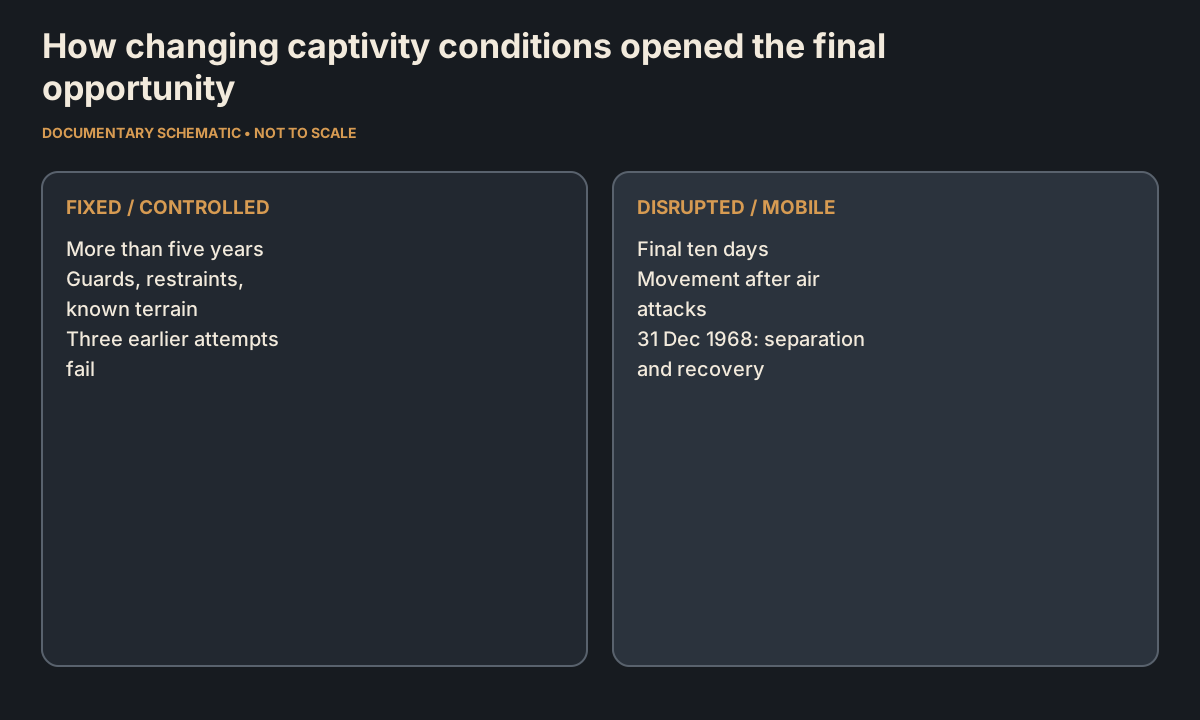
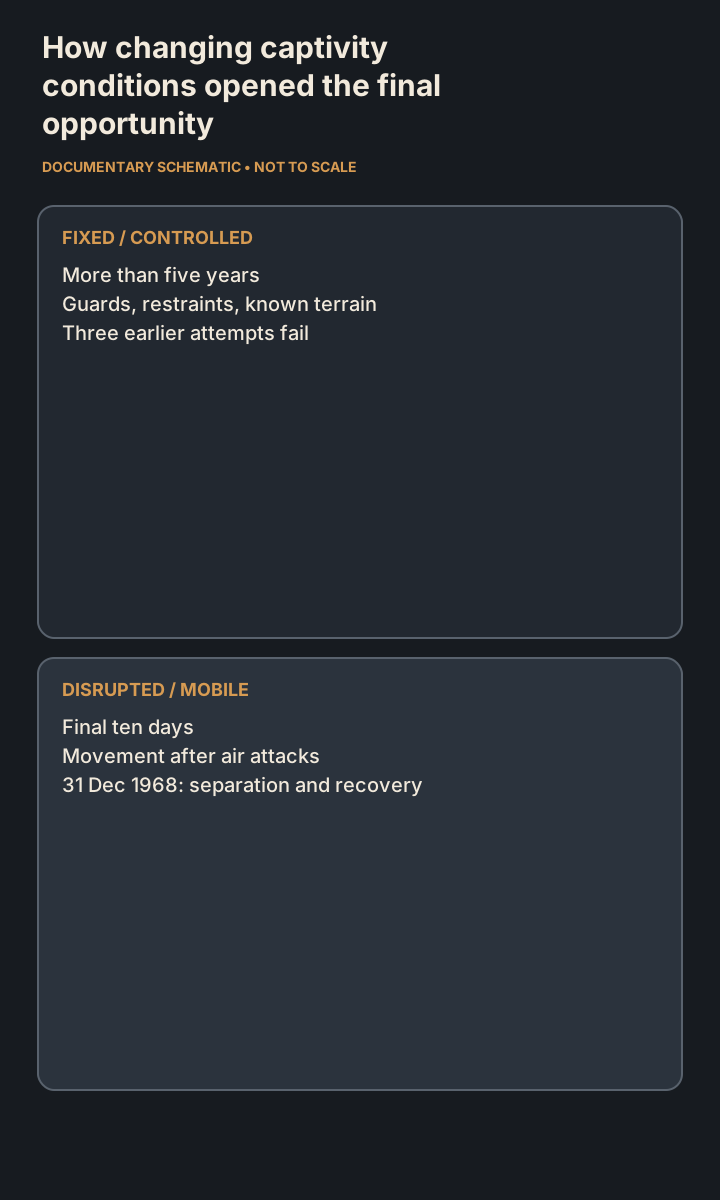
Simplified documentary reconstruction; not to scale. Evidence qualifications are written directly into the visual and explained in the adjacent text.
Evidence discipline
What the record supports
Status labels distinguish secure conclusions from uncertainty and rejected claims. Color is never the only signal.
DOCUMENTED
Rowe was captured on October 29, 1963, and recovered on December 31, 1968.
Army institutional histories and award documentation consistently establish the capture and recovery dates.
Sources: SRC-002, SRC-003, SRC-005DISPUTED
Rowe was a POW for exactly 1,903 days.
The Army Special Operations History Office uses 1,903 Days in a feature title, but the documented dates produce 1,891 calendar days inclusive. Other Army sources use roughly 62 months or five years and two months.
Sources: SRC-002, SRC-004DOCUMENTED
Rowe made three unsuccessful escape attempts before the successful December 1968 escape.
Army Intelligence and Military Intelligence Hall of Fame biographies explicitly identify the December 31 escape as his fourth attempt.
Sources: SRC-002, SRC-003MYTH
Rowe spent his entire captivity in one identical bamboo cage.
Bamboo confinement was an important part of his imprisonment, but the captors moved camps and conditions changed over more than five years.
Sources: SRC-002, SRC-011DOCUMENTED
Rowe kept a diary during captivity.
The U.S. Army Special Operations History Office preserves the handwritten diary and has published images and analysis of it.
Sources: SRC-004WELL-SUPPORTED
Rowe's captors eventually learned enough about his true Special Forces role to undermine his engineering cover story.
Multiple Army institutional biographies agree that outside biographical information exposed important facts he had concealed.
Sources: SRC-002, SRC-003LATER CLAIM
The full transmission chain proving that named American antiwar activists directly exposed Rowe is independently established in the public record.
Army biographies repeat that explanation, but the open documentary record does not establish each link in the transmission chain.
Sources: SRC-002, SRC-003WELL-SUPPORTED
Rowe was being moved toward execution when the final escape opportunity developed.
Several Army biographies say the captors intended to execute him after his true role was exposed, while the Silver Star and Army Intelligence accounts independently document that the group was also moving under heavy military pressure.
Sources: SRC-003, SRC-005MYTH
Rowe had to evade for several days after escaping his guard.
The successful evasion was short because American aircraft were already operating close to the captivity area.
Sources: SRC-002, SRC-005MYTH
Rowe's beard alone saved him from being fired on by the helicopter crew.
Army history says the beard helped the crew reconsider his identity, but recovery also depended on his signaling, Major Thompson's decision to withhold fire, and the crew landing to investigate.
Sources: SRC-002, SRC-012MYTH
Nick Rowe invented SERE.
U.S. military survival and prisoner-resistance doctrine predated Rowe, including the Armed Forces Code of Conduct established in 1955. Rowe's specific historical role was developing and institutionalizing the Army's modern high-risk SERE program.
Sources: SRC-013, SRC-006, SRC-007DOCUMENTED
Rowe was recalled to active duty in 1981 to develop the Army high-risk SERE program.
Multiple Army and DIA institutional sources use 1981 for his recall and development mission.
Sources: SRC-003, SRC-006, SRC-007MYTH
The formal Army Level-C course began in 1981.
1981 marks Rowe's recall and development mission; an instructor qualification course is documented in 1982, and Army training history dates the first formal Level-C iteration to March 1986.
Sources: SRC-006, SRC-007, SRC-014