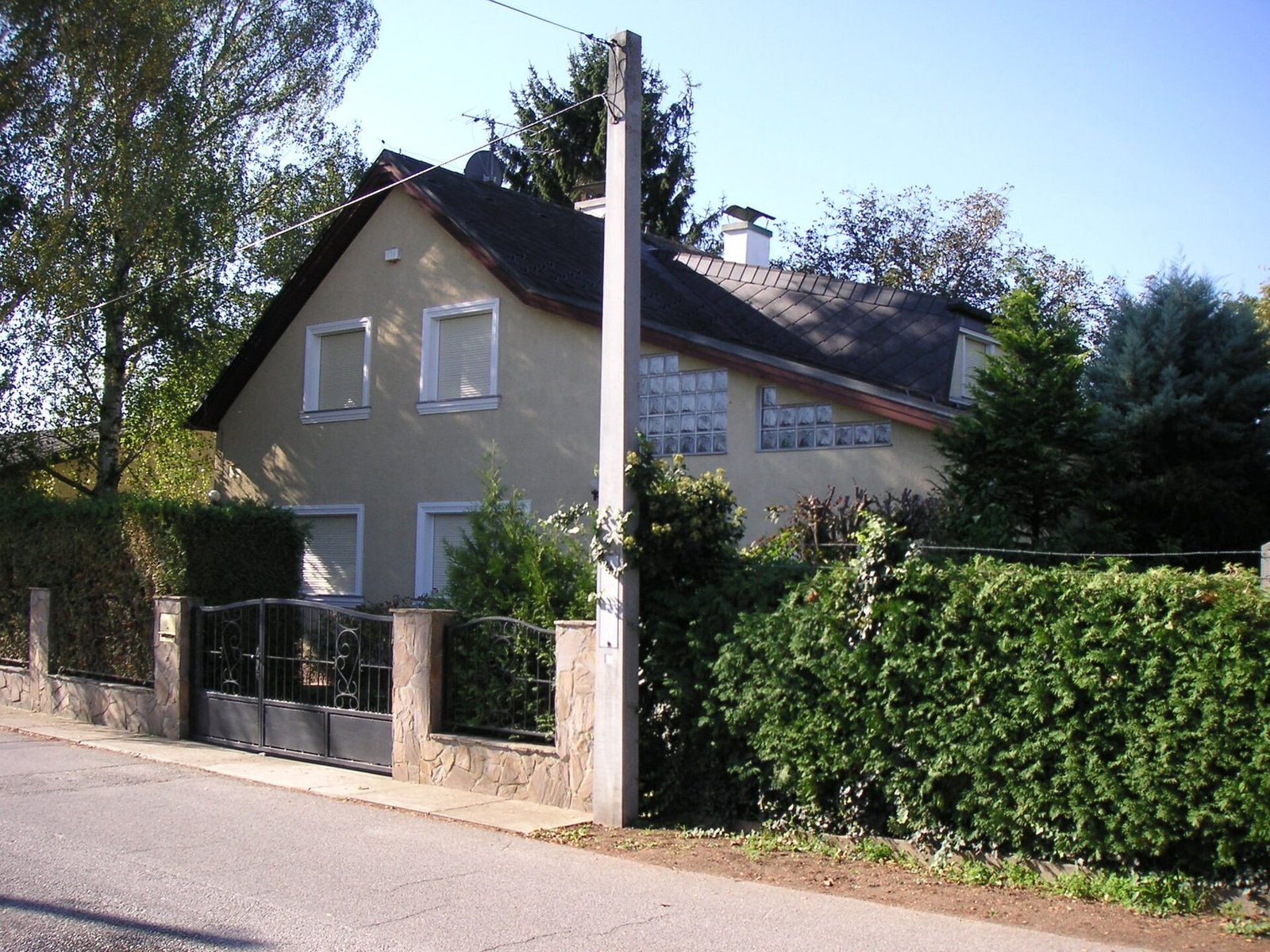
Natascha Kampusch escaped on 23 August 2006 because a routine task created a brief gap in Wolfgang Priklopil’s control. She was outside his house in Strasshof an der Nordbahn, cleaning a vehicle with a vacuum cleaner, when he stepped away to take a mobile-phone call. The noise gave her a moment in which he was no longer close enough to stop her. She left the vacuum running and ran.
That brief sequence is one of the most securely documented parts of an otherwise heavily mythologized case. Kampusch described it within days of regaining her freedom and again in her first televised interview. Contemporary Austrian police gave essentially the same account. What followed was equally rapid: she reached a neighboring property, police were called, and her identity was confirmed. Priklopil fled and died by suicide later that day.
The surrounding case is harder to compress. Kampusch had been abducted at age ten on 2 March 1998 and held for 3,096 days. Her confinement changed over time: the earliest phase centered on a concealed underground room, while later years included work inside the house, time in the garden, and occasional closely controlled trips outside the property. Those later freedoms led outsiders to ask why she had not escaped earlier. Kampusch’s own explanation is essential: physical access to the outside world did not mean she was free from threats, coercion, surveillance or the psychological consequences of years of captivity.
After 2006, another story grew around the case. Investigators and politicians argued over whether police had missed chances to find her, whether Priklopil had an accomplice, and whether official mistakes had later been concealed. Serious investigative failures were eventually documented. The most important was that a useful 1998 lead pointing toward Priklopil was not properly pursued. Yet repeated investigations did not produce evidence sufficient to establish a second kidnapper. An international cold-case review completed in 2013 concluded that Priklopil had very likely acted alone.
The result is a case with an unusually clear escape and an unusually complicated investigative aftermath. Keeping those two things separate is necessary to understand both.
At a Glance
- Abducted: 2 March 1998, while walking to school in Vienna
- Age at abduction: 10
- Captor: Wolfgang Priklopil
- Primary place of captivity: a private house in Strasshof an der Nordbahn, Lower Austria
- Duration: 3,096 days between abduction and escape
- Escape: 23 August 2006
- Immediate opportunity: Priklopil stepped away during a phone call while Kampusch was vacuuming a vehicle
- First secure refuge: a neighboring home, whose resident contacted police
- Captor’s outcome: Priklopil died by suicide later on 23 August
- Major later finding: police missed significant leads during the original investigation
- Accomplice question: repeatedly reinvestigated; no second participant was established, and a 2013 international review concluded Priklopil had very likely acted alone
The Abduction
Kampusch disappeared on the morning of 2 March 1998 while walking to school in Vienna. A witness saw a child being pulled toward or into a white delivery van. The disappearance triggered a large investigation, and the vehicle description became one of its most important early clues.
Priklopil, a communications technician living in Strasshof an der Nordbahn, owned a white van and was among the people police checked. That fact would become crucial after Kampusch escaped, because later reviews concluded that investigators had possessed information that should have brought much closer attention to him.
The abduction itself was not a mystery after 2006. Kampusch consistently identified Priklopil as the man who took her. The more durable controversy was whether anyone else participated. One young witness had reported an impression of two men around the van, and that discrepancy later became the foundation for years of speculation.
Kampusch, however, repeatedly said that Priklopil acted alone. Later prosecutorial and cold-case reviews examined the possibility of accomplices at length without establishing one.
A Captivity That Changed Over Time
The concealed room beneath Priklopil’s property became the defining image of the case. During the earliest period, Kampusch was kept there under severe isolation. The space had no normal window to the outside world and could be hidden behind barriers within the house.
Yet it is misleading to describe all eight years as if Kampusch never left that room. Over time, Priklopil permitted or compelled her to spend increasing amounts of time elsewhere on the property. She did domestic work, worked in the garden and eventually accompanied him on some trips outside the house.
Those facts were sometimes treated after her escape as evidence that she must have been free to leave sooner. Kampusch rejected that interpretation. Years of confinement had been reinforced with threats, control over food and movement, violence, surveillance and claims about what would happen if she sought help. On excursions, Priklopil remained the person controlling where she went and what she was permitted to do.
In her later account, Kampusch described trying to signal for help on at least one outing and receiving no response. Whether every such remembered episode can be independently reconstructed is less important than the wider distinction: being outside a locked cellar did not make her legally or practically free.
That distinction is essential to the escape. By August 2006, she had more physical access to the house and garden than in the first years, but those openings were still controlled. The escape became possible when control briefly failed.
23 August 2006
The strongest reconstruction begins in the garden or driveway area of the Strasshof property. Kampusch was cleaning Priklopil’s vehicle with a vacuum cleaner. Priklopil received a telephone call.
The vacuum was loud enough that he moved away in order to hear. Kampusch was suddenly outside without him immediately beside her.
Her first public statement after the escape described the same essential decision later repeated in interviews: she recognized the moment as an opportunity, left the vacuum running and fled. In her first major television interview she explained that the possibility might not come again.
The broad sequence is secure. Some retellings differ over whether the vehicle was described as a car, BMW, van or another service vehicle, and later accounts add precise times and distances. Those details are less important than the evidence shared across the strongest sources: she was cleaning a vehicle; Priklopil moved away because of a phone call and the vacuum noise; she ran while his attention was elsewhere.
Kampusch moved through neighboring gardens and sought help. Contemporary accounts say at least one person did not respond to her request. She then reached a neighboring house and persuaded the resident to call police.
The later popular line that she announced herself with the words “I am Natascha Kampusch” appears in multiple early reports. It is plausible and well attested in journalism, but an exact quotation is not necessary to establish what happened. What is secure is that she identified herself as the girl who had disappeared in 1998 and that police responded within minutes.
Verification
The first hours after the escape required authorities to answer an extraordinary question: was the young woman really the missing ten-year-old from eight years earlier?
Her family recognized her. Police also had physical identifying information from before the abduction, and her identity was then confirmed through DNA testing. Investigators searched Priklopil’s property and found the concealed space in which she had been held.
The confirmation transformed the old missing-person case almost immediately. Austrian authorities had spent years investigating possibilities that assumed Kampusch might be dead. Interior Minister Liese Prokop acknowledged after the escape that investigators had effectively been searching for a body.
Kampusch had survived within a relatively short distance of Vienna.
Priklopil’s Death
Priklopil discovered that Kampusch was gone and fled. Later on 23 August, he died after going onto railway tracks in Vienna.
His death prevented a criminal trial and deprived investigators of the possibility of obtaining a full account from the person who had committed the abduction. It also helped create the conditions for later speculation. Without cross-examination, a trial record or a confession tested against other evidence, unresolved details became easier to fill with theories.
Subsequent reviews nonetheless treated his death as suicide. The 2013 international cold-case evaluation revisited the circumstances, including the train driver’s evidence, and found no basis for the theory that Priklopil had been murdered.
That conclusion matters because claims about his death sometimes became intertwined with claims that a larger network had participated in the kidnapping. The surviving evidence did not substantiate that larger theory.
The Lead Police Missed
The most consequential criticism of the original investigation concerns what happened in 1998, not after the escape.
A police officer supplied information that pointed toward Priklopil as a possible suspect. Later official review found that this lead did not receive the follow-up it deserved. Investigators checked limited information associated with him but did not develop the lead into the kind of detailed scrutiny that might have exposed inconsistencies.
The 2008 evaluation commission established that Priklopil did not possess the alibi that officials later publicly suggested he had. The commission concluded that relevant investigative approaches had not been fully exhausted and identified serious procedural shortcomings.
This is one of the most painful counterfactuals in the case. It cannot be stated as a certainty that a better 1998 investigation would immediately have found Kampusch. Police had thousands of tips and hundreds of vehicle or suspect checks, and hindsight changes the apparent importance of any one clue.
But the failure was not imaginary. Independent review concluded that information pointing toward the eventual kidnapper existed and was not handled properly. The historical record therefore supports saying that authorities missed a potentially important opportunity, while stopping short of claiming they certainly would have rescued Kampusch in 1998 if one officer had acted differently.
Why the Case Kept Reopening
The escape did not settle every question. The original witness report suggesting two men near the van continued to attract attention. Priklopil had personal and business contacts whose statements were scrutinized. Investigators also examined phone records, finances and conflicting recollections.
In January 2010, prosecutors said the evidence did not support the claim that another person had participated in the kidnapping. They also reported that the original young witness accepted an explanation for how she might have perceived two men when only one was present.
That did not end the dispute.
A parliamentary subcommittee reviewed the investigation and in June 2012 reached a much more critical conclusion about the quality of the official work. It asked two broad questions: had police and prosecutors worked with the necessary care and professionalism, and had they adequately followed all important questions? Its answer to both was no.
The committee did not establish a second kidnapper. Instead, it concluded that unresolved issues and investigative shortcomings were serious enough to justify another review by external cold-case specialists. It specifically recommended international participation.
That distinction is often lost. Finding that an investigation was inadequate is not the same thing as proving the alternative theory the investigation failed to disprove.
The International Cold-Case Review
Austria followed the parliamentary recommendation. A new team worked through an enormous investigative record with participation from Austrian specialists and experts from Germany’s Bundeskriminalamt and the FBI.
The review was intended to approach the file again without simply relying on the assumptions of the earlier investigation. Investigators revisited forensic evidence, witness accounts, the alleged accomplice question and the circumstances of Priklopil’s death.
When the findings were presented in April 2013, the conclusion was cautious rather than absolute. German BKA president Jörg Ziercke said the evaluation indicated with high probability that Priklopil had carried out the kidnapping alone. He also stressed that absolute scientific proof was impossible because Priklopil was dead.
No forensic evidence establishing another perpetrator was found in the house or vehicle. The review found no substantiated connection to the criminal networks that had featured in some public theories. It also reaffirmed suicide as the explanation for Priklopil’s death.
The proper evidence status is therefore not “every accomplice theory was mathematically disproven.” It is that repeated official and international investigations failed to establish an accomplice, while the final major cold-case evaluation judged a lone perpetrator highly probable.
Kampusch and the Story Told About Her
The years after the escape generated another kind of distortion. Kampusch did not always speak about Priklopil in the simple language expected of a public victim. She could describe his cruelty and criminality while also explaining that eight years of forced dependence had created a complicated human relationship.
Much of the press interpreted this through the label “Stockholm syndrome.” Kampusch later objected strongly to that framing. She argued that adapting to the person controlling nearly every aspect of her life was a survival strategy rather than proof that she could not understand her own experience.
Her objection is historically important because public reaction repeatedly treated emotional complexity as evidence against her credibility. Sympathy, grief, anger and survival adaptation were turned into competing explanations when they could coexist.
The source record does not require a retrospective diagnosis. It is enough to document that journalists and some specialists used the Stockholm-syndrome label, while Kampusch herself rejected it as a way of denying her authority over her own story.
That is especially relevant to the escape. She did not need to have hated Priklopil every second of every day in order to want freedom. The decisive evidence is behavioral: when a real opening appeared on 23 August 2006, she used it.
What “3,096 Days” Means
The title of Kampusch’s memoir turned the duration into the number most closely associated with the case. From 2 March 1998 to 23 August 2006, 3,096 days elapsed.
The number is useful because it conveys scale, but it can also flatten the changing conditions within captivity. Kampusch was ten when she was abducted and eighteen when she escaped. A substantial part of her childhood and adolescence unfolded under Priklopil’s control.
The ending was not the gradual loosening of a lawful restriction. It was a self-liberation from an abduction that had never ceased. Greater movement inside the house, work in the garden and supervised trips did not transform captivity into consent.
This is why the final opportunity matters. The physical barrier that held Kampusch in 2006 was not simply the hidden room beneath the property. It was the larger system of coercion Priklopil had built around her. For a few minutes, his control of that system weakened enough for her to get beyond it.
What the Case Establishes
Several parts of the history are secure.
Kampusch was abducted by Wolfgang Priklopil on 2 March 1998. She was held in his control until 23 August 2006. That day, while cleaning his vehicle, she escaped when a telephone call pulled his attention away. A neighbor summoned police, and her identity was verified. Priklopil fled and died by suicide later the same day.
The investigation that had failed to find her contained serious mistakes. A lead involving Priklopil was inadequately pursued in 1998, and later official reviews criticized the professionalism and completeness of parts of the investigation.
The claim that those failures prove a larger kidnapping conspiracy is not supported at the same level. Prosecutors did not establish an accomplice, and the international cold-case review concluded in 2013 that Priklopil was highly likely to have acted alone.
That combination is less dramatic than either extreme version of the story. It allows for genuine police failures without turning every mistake into evidence of a cover-up, and it recognizes unresolved historical limits without replacing them with speculation.
Most importantly, it keeps the decisive act where it belongs. Kampusch’s captivity ended because she recognized a brief opening and ran.
Evidence discipline
What the record supports
Status labels distinguish secure conclusions from uncertainty and rejected claims. Color is never the only signal.
DOCUMENTED
Kampusch escaped while Priklopil was distracted by a phone call as she vacuumed his vehicle.
The mechanism appears in immediate police reporting, Kampusch's own first public statement and her first television interview.
Sources: SRC-001, SRC-003, SRC-004MYTH
Because Kampusch was sometimes taken outside the hidden room, she was free to leave before 23 August 2006.
Later movement occurred under coercive control, threats and supervision. Physical access to outside spaces did not end the kidnapping.
Sources: SRC-003, SRC-010DOCUMENTED
Police had information pointing toward Priklopil in 1998 and failed to pursue it adequately.
The 2008 evaluation commission identified serious failures in the handling of a lead concerning Priklopil and found that relevant investigative approaches had not been fully exhausted.
Sources: SRC-005, SRC-006DISPUTED
The police failures prove that authorities deliberately covered up Priklopil's involvement.
Official reviews documented serious errors, but the 2008 commission did not substantiate a political cover-up, and later criticism of investigative quality does not itself prove deliberate concealment.
Sources: SRC-005, SRC-006, SRC-008DISPUTED
Priklopil had a proven accomplice in the kidnapping.
A witness's early two-person impression and other anomalies fueled repeated inquiry, but prosecutors did not establish a second participant and the 2013 international review concluded a lone perpetrator was highly probable.
Sources: SRC-007, SRC-008, SRC-009MYTH
Priklopil was murdered after Kampusch escaped.
The 2013 cold-case review revisited his death and retained suicide as the supported explanation.
Sources: SRC-009DISPUTED
Kampusch's complex feelings toward Priklopil establish that she had Stockholm syndrome.
The label was widely applied in public commentary, but Kampusch rejected it as reductive and described adaptation and empathy as survival strategies. No retrospective diagnosis is necessary to reconstruct the escape.
Sources: SRC-010Evidence diagram
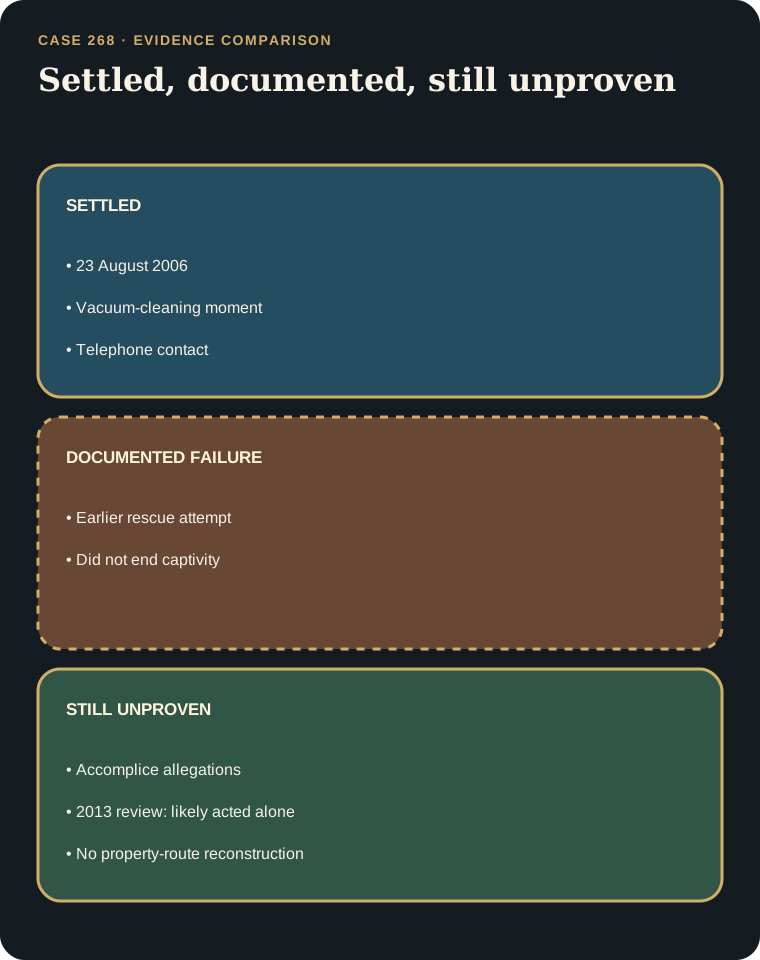
Settled facts, documented failure, unproven claims
The record distinguishes the documented escape and failed rescue attempt from allegations that later investigation did not establish.
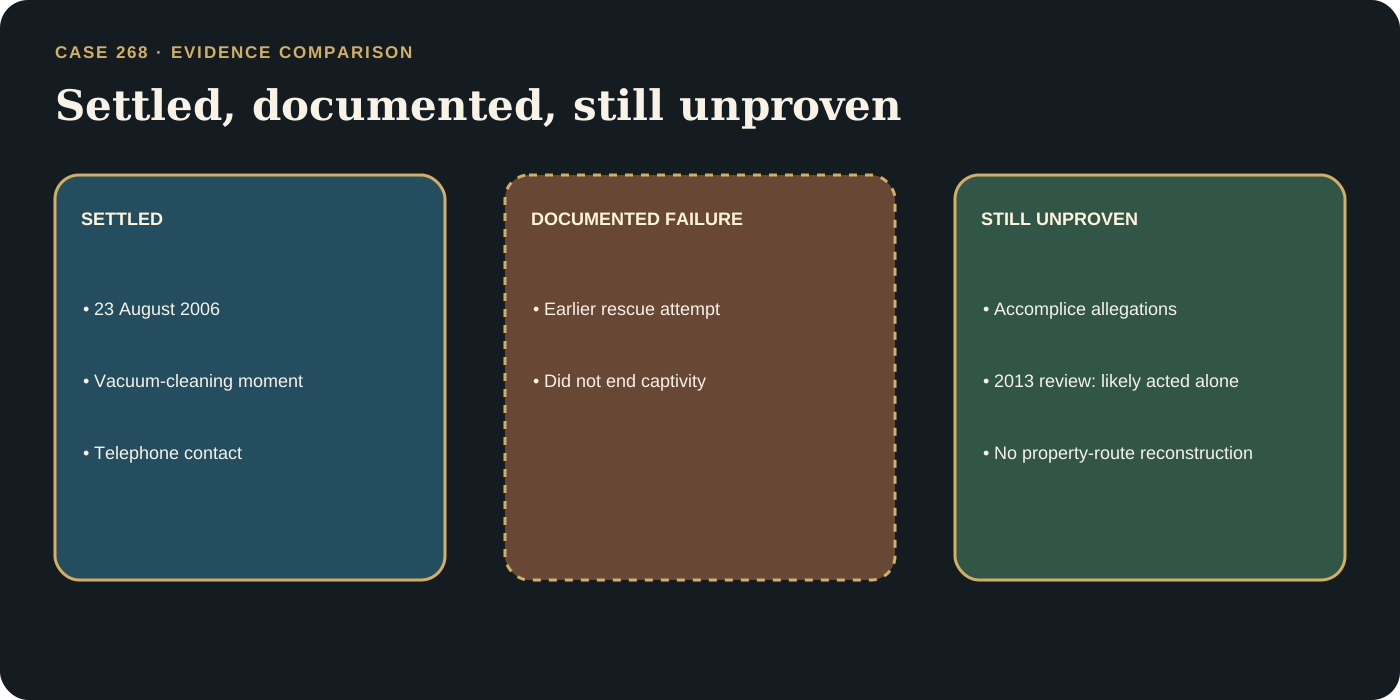
The record distinguishes the documented escape and failed rescue attempt from allegations that later investigation did not establish.