
Steven Stayner left Kenneth Parnell's cabin near Manchester, California, on the night of 1 March 1980 with a five-year-old boy beside him. By the time they reached Ukiah around midnight, Stayner had spent more than seven years living under the identity his abductor had imposed on him. Timothy White had been captive for sixteen days.
The escape is often told as a sudden act of heroism: Parnell kidnapped another child, Steven recognized what would happen, and he immediately decided to save him. That is broadly true, but it compresses a much longer process of coercion, adaptation, doubt, and resistance.
Stayner later testified that Timothy's arrival was a major trigger because he did not want another child to experience what he had experienced. Trial testimony also showed that other pressures had been building after Parnell moved him to an isolated cabin near Manchester. The escape was both a rescue of Timothy and Steven's own break from an identity and captivity that had shaped most of his childhood.
At a Glance
- Steven Stayner abducted: 4 December 1972, Merced, California
- Timothy White abducted: 14 February 1980, Ukiah, California
- Escape: 1 March 1980, reaching Ukiah around midnight
- Steven's age: 14
- Timothy's age: 5
- Starting point: Parnell's one-room cabin near Manchester on the Mendocino coast
- Destination: Ukiah, roughly 40 miles away by road
- Broad method: Leave while Parnell was at his night job, obtain a ride into Ukiah, and seek police help
- Immediate outcome: Both boys identified; Parnell arrested within hours
Seven years under another identity
Steven Gregory Stayner was seven years old when he disappeared while walking home from school in Merced on 4 December 1972. Kenneth Parnell, aided in the original kidnapping by Ervin Murphy, took Steven away from his family and eventually passed him off as his own child. Parnell renamed him "Dennis Parnell" and repeatedly told him stories designed to make return seem impossible, including claims that his parents no longer wanted him or that Parnell had legitimate authority over him.
The captivity did not resemble a locked-cell imprisonment. Steven attended school at points, played sports, met other children, and moved with Parnell through several Northern California communities. That later allowed Parnell's defense to suggest that Steven could simply have left.
Such a description mistakes physical mobility for freedom. At trial, Steven testified that Parnell had repeatedly sexually abused him and had manipulated him into accepting their situation as normal. He also said Parnell told him he was a legal guardian and supplied false explanations about Steven's original family. A child living for years under those conditions could have opportunities to walk away while still believing, fearing, or feeling that meaningful escape was impossible.
The imposed identity became so entrenched that the story of his recovery later became associated with Steven's uncertainty about parts of his own name. The historically important point is not a dramatic quotation. It is that recovering his identity required more than reaching a road.
Resistance before the final escape
Steven was not entirely passive during those years. Court documents made public after his return recorded his statement that Parnell had tried to involve him in finding other children. Steven said he intentionally "messed things up" rather than successfully lure a child for Parnell.
That matters because it shows resistance before March 1980. Steven's final decision did not emerge from nowhere.
By late 1979 or early 1980, Parnell had moved with Steven from the Comptche area to a remote one-room cabin outside Manchester. During cross-examination in Parnell's later trial, Steven agreed that the move made ordinary adolescent life more restricted. Seeing friends became harder, familiar activities disappeared, and the school situation changed.
Defense lawyers used those facts to argue that dissatisfaction with life, rather than captivity itself, prompted Steven to go. The evidence supports a different conclusion. Those changes weakened the structure that had helped normalize the false family life, while Timothy's arrival forced Steven to confront directly what Parnell had done to him.
Timothy White is abducted
On Valentine's Day 1980, five-year-old Timothy White disappeared while walking from kindergarten toward his babysitter's home in Ukiah. Contemporary reporting and the later criminal trial established 14 February as the kidnapping date. Parnell was ultimately convicted of Timothy's abduction.
When Timothy arrived at the Manchester cabin, Steven saw a much younger child suddenly occupying the place Steven himself had once occupied. Stayner later described Timothy as sad and frightened. In court, he explained his decision in direct moral terms: he did not want what happened to him to happen to somebody else.
Timothy's presence therefore changed the problem. Escaping alone would mean abandoning a five-year-old child to Parnell. Staying would mean watching the captivity repeat. Steven chose a third option: take Timothy with him.
Waiting for Parnell to go to work
Parnell was working nights at the Palace Hotel in Ukiah. On 1 March, while Parnell was away at work, Steven and Timothy left the cabin near Manchester. Contemporary accounts place the escape in darkness and rain.
The broad route is secure, but some fine details come mainly from later reconstructions. The boys got from the remote Manchester area to Ukiah by accepting a ride or hitchhiking. Time magazine, reporting within weeks, described the trip as about forty miles.
Later accounts often emphasize Steven carrying Timothy when the younger boy became tired. That detail is plausible and deeply embedded in the story, but it is not necessary to the historical core.
Their vulnerability outside the cabin was substantial. Steven was fourteen, Timothy was five, and neither had an independent adult support network waiting for them.
Their plan was not an elaborate disappearance. Steven's objective was to get Timothy back to people who could identify and protect him.
Ukiah
The boys reached Ukiah around midnight. They first tried to use Timothy's memory to reconnect him with home. When that failed, the police station became the safest remaining option.
A contemporary Washington Post account described Steven telling Timothy to go into the station and identify himself. Timothy approached, became frightened, and ran back toward Steven. Officer Bob Warner had already noticed the child and followed.
Both boys were brought inside. Police quickly established Timothy's identity. Steven then revealed that he too was a long-missing child.
Within hours, police arrested Parnell at the Ukiah hotel where he was working. The contrast was extraordinary. Steven and Timothy had traveled roughly forty miles from the cabin into the same city where Parnell was spending his night shift. The successful escape ended not with an anonymous disappearance but with Steven deliberately placing both of them into the hands of law enforcement.
Why Steven had not left earlier
The question followed Steven for years: if he had attended school and sometimes moved without physical restraints, why had he stayed? It is a question that can easily become victim-blaming.
Parnell had taken Steven at seven, altered his identity, misrepresented his family's wishes, subjected him to repeated abuse, and occupied the role of parent through the most formative years of childhood. Escape required Steven to reject both an adult authority figure and the life story that figure had constructed around him.
His later testimony did not present the answer as simple. He acknowledged ordinary experiences within captivity, including sports and friendships. He also described the manipulation and abuse.
At the 1981 trial, defense counsel highlighted occasions when Steven might physically have left and argued that conditions became less attractive only after the move to Manchester. Steven agreed that isolation and dissatisfaction contributed to his thinking.
That does not turn captivity into consent. It shows why the final escape emerged from several pressures at once: growing independence as a teenager, increased isolation, doubts about Parnell, and finally Timothy's kidnapping.
A rescue and an escape
Timothy was not simply luggage in Steven's own flight. Steven's later testimony consistently placed concern for Timothy at the center of his decision. Contemporary reporting quoted him saying that he did not want the younger child to go through what he had gone through.
Yet calling the event only a rescue can also obscure Steven's own liberation. For seven years he had been "Dennis Parnell" in much of his daily life. The trip to Ukiah ended that imposed identity and reopened a relationship with a family he had been taught to believe he had lost.
This dual character is what makes the case unusual. Steven was simultaneously a captive escaping and an older child taking responsibility for a younger captive. Neither role cancels the other.
What happened in court
The escape immediately reopened Steven's 1972 case. Parnell was first tried for Timothy White's kidnapping. Steven testified in that case, including about Parnell's previous efforts to involve him in obtaining other children. A jury convicted Parnell in June 1981, and he received a seven-year sentence for Timothy's kidnapping.
A separate trial then addressed Steven's abduction. Steven testified again, this time publicly describing prolonged abuse and the coercive structure of his life with Parnell.
Parnell was convicted in connection with Steven's kidnapping as well. Because of California sentencing rules then in force, the additional punishment was much smaller than many observers expected. Contemporary and later reporting credited the Stayner case with helping spur changes allowing fuller consecutive punishment in similar kidnapping cases.
The legal record is also a reminder that the public story and criminal charges were not identical. Parnell's sexual abuse of Steven was central to Steven's testimony and to understanding his motive for protecting Timothy, even though the prosecution history around those offenses was limited by jurisdictional and statute-of-limitations problems.
After the headlines
The reunion did not turn seven years of captivity into a clean ending. Steven returned to a family that had never stopped searching for him, but both he and his relatives had changed. Later reporting described years of difficulty adjusting to family life, authority, publicity, and the psychological consequences of what had happened.
Steven married and had two children. He died in a motorcycle collision near Merced on 16 September 1989 at age twenty-four.
Timothy White grew up, became a Los Angeles County sheriff's deputy, married, and had children. He died in 2010 at thirty-five from an apparent pulmonary embolism.
The two remained linked publicly by a single night in 1980. That connection can overshadow the separate lives they built afterward, just as the hero label can overshadow the fact that Steven was himself still a child when he made the decision.
What the record securely supports
The strongest facts require little embellishment. Steven Stayner was abducted at age seven in 1972 and held under a false identity for more than seven years. Parnell sexually abused him and manipulated his understanding of his family and legal status. Timothy White was abducted on 14 February 1980 and brought into the same environment.
On 1 March, while Parnell was working in Ukiah, Steven left the Manchester-area cabin with Timothy. They traveled roughly forty miles to Ukiah and reached police around midnight. Timothy was identified, Steven disclosed his own identity, and Parnell was arrested within hours.
Steven later said he acted because he did not want Timothy to suffer what he had suffered. Trial testimony adds an important layer: other pressures had already been building, especially after the move to isolated Manchester.
That is enough. The case does not need a sentimental claim that trauma instantly transformed into heroism, or a skeptical claim that Steven could always have left whenever he wished.
A fourteen-year-old who had spent half his life under an abductor's control recognized that another child had entered the same system. He took that child out with him.
Evidence discipline
What the record supports
Status labels distinguish secure conclusions from uncertainty and rejected claims. Color is never the only signal.
MYTH
Steven could simply have left at any time because he attended school and sometimes moved without physical restraints.
Trial testimony documented childhood abduction, identity manipulation, false claims of legal authority, repeated abuse, and long-term coercive control. Physical opportunities to leave do not establish voluntary residence.
Sources: SRC-003, SRC-004DISPUTED
Timothy White's arrival was the only reason Steven began thinking about escape.
Stayner consistently identified protecting Timothy as a decisive reason for leaving, but cross-examination also showed that isolation, loss of friends and activities, and dissatisfaction after the move to Manchester had already been building.
Sources: SRC-003, SRC-004MYTH
Steven had never resisted Parnell before March 1980.
A police-interview transcript reported in contemporary court coverage said Stayner intentionally sabotaged earlier attempts by Parnell to enlist him in obtaining other children.
Sources: SRC-009MYTH
Timothy White was abducted on 13 February 1980.
Multiple contemporary trial and news sources identify Valentine's Day, 14 February 1980, as the kidnapping date.
Sources: SRC-001, SRC-005MYTH
Steven's March 1980 escape can be understood only as his own self-rescue.
Stayner deliberately took Timothy with him and repeatedly said that preventing the younger boy from suffering as he had was central to the decision. The event was simultaneously self-escape and rescue of another child.
Sources: SRC-001, SRC-003, SRC-007MYTH
The escape erased the consequences of Steven's captivity once he returned home.
Later reporting documented substantial difficulties with adjustment, family life, authority, and the long-term effects of abuse and public exposure.
Sources: SRC-006, SRC-007Evidence diagram
Captivity, escape, and bringing Timothy to safety
The chronology centers Steven's decision to leave prolonged coercive captivity while protecting Timothy.
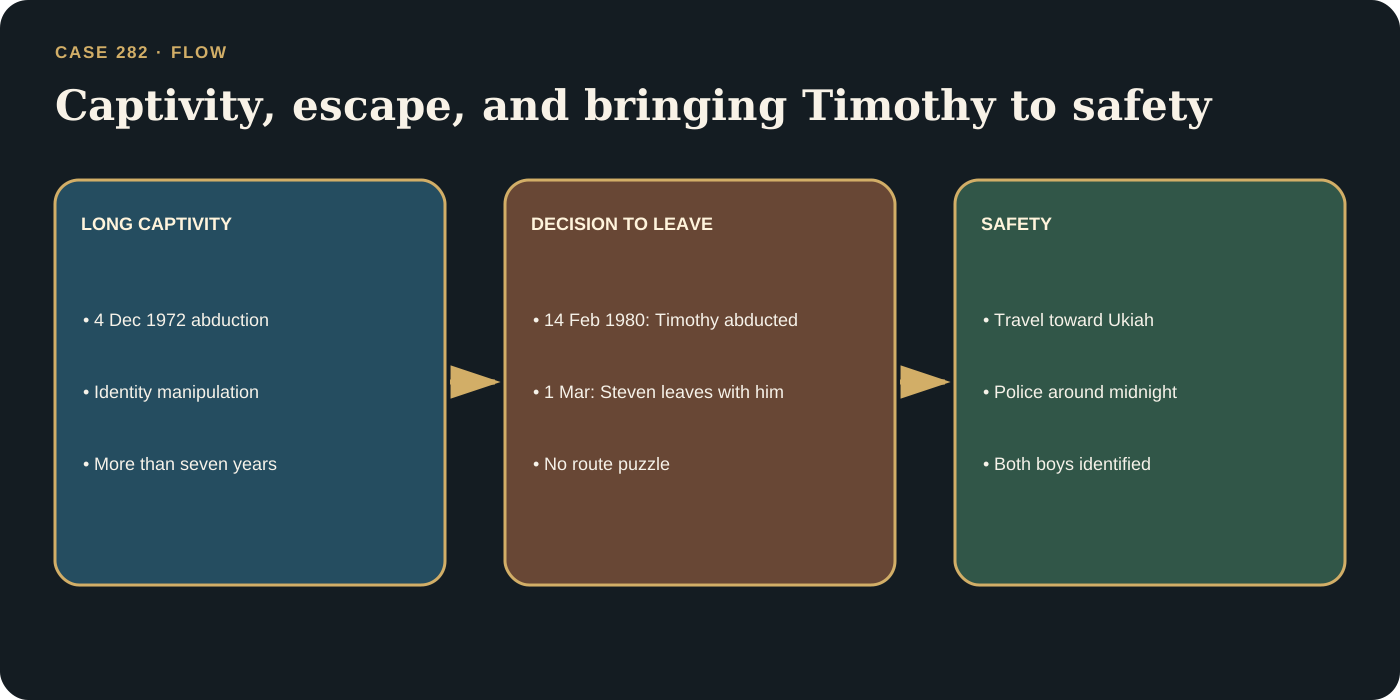
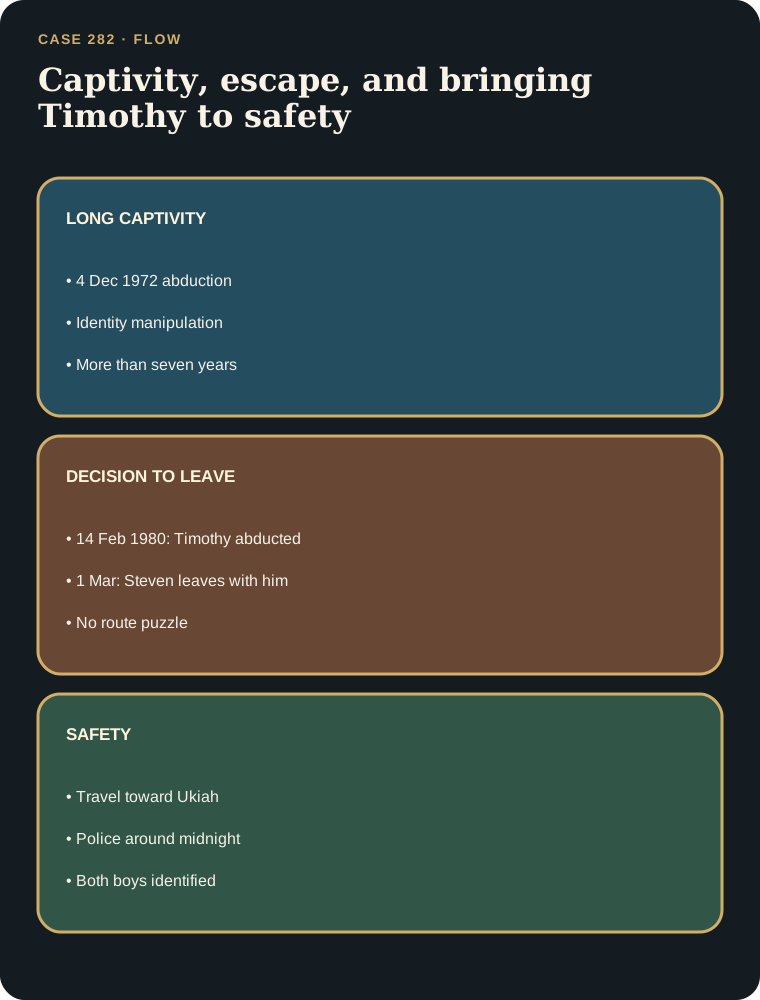
The chronology centers Steven's decision to leave prolonged coercive captivity while protecting Timothy.