
For nearly eight years, Shin Sang-ok and Choi Eun-hee lived inside an unusual form of captivity. They were not ordinary prisoners for all of that time. They were famous filmmakers given access to studios, budgets, travel, and eventually Kim Jong-il himself. Yet their movements remained controlled, their public statements could be dictated by the state, and the possibility of punishment never disappeared. The privileges were part of the trap.
On 13 March 1986, during an authorized trip to Vienna, the balance finally shifted. Shin and Choi used the relative freedom of overseas travel to separate themselves from their North Korean minders, reached a taxi, and directed it toward the United States Embassy. Contemporary reports confirm that they entered the embassy and asked for American assistance. They never returned to North Korea.
Their escape was brief. The captivity behind it was not.
Two disappearances in Hong Kong
By 1978, Shin and Choi were already major figures in South Korean cinema. Choi had been one of the country's leading actresses, while Shin had become one of its most prolific directors and producers. Their marriage had broken down, but their professional histories remained closely linked.
Choi disappeared first. While in Hong Kong in January 1978, she was taken by North Korean agents and transported to North Korea. Shin went to Hong Kong months later while trying to learn what had happened to her. He too disappeared and was taken north.
The circumstances produced years of competing explanations. South Korean authorities said the pair had been abducted. North Korea later presented them publicly as willing defectors. Shin and Choi themselves appeared outside North Korea and repeated the voluntary-defection story before their 1986 escape.
That public version cannot be read at face value. Later evidence, including the couple's secret recordings of Kim Jong-il, their post-escape testimony, specialist human-rights research, and a later South Korean investigation, strongly supports the conclusion that they had been taken against their will. The United Nations has also documented overseas abduction and enforced disappearance as part of a much broader pattern of North Korean state practice, although its general findings should not be mistaken for case-specific proof of every detail in Shin and Choi's story.
Captivity without a conventional cell
Their experiences after arrival were not identical.
Choi was treated as a valuable captive and, compared with ordinary detainees, lived in privileged conditions. Shin's early treatment was harsher. Accounts collected by the Committee for Human Rights in North Korea describe him trying to escape, being sent to a labor camp, suffering severe deprivation, and attempting to starve himself. For years the two were kept apart and did not know the other's fate.
By 1983, that changed. Kim Jong-il brought them together and increasingly drew them into North Korea's film industry. This was not a simple transition from captivity to freedom. It was a change in the form of control.
Kim had long taken an unusually active interest in cinema. A scholarly study by Kim Suk-young reproduces material from a secret recording made by Shin and Choi in Kim's office on 19 October 1983. In that conversation, Kim discussed North Korean cinema's technical weaknesses and its difficulty learning from foreign film industries. The recording helps explain why two highly experienced South Korean filmmakers were useful to him.
Shin and Choi were given resources that North Korean filmmakers rarely enjoyed. They made films, traveled within the socialist bloc, attended festivals, and acquired a degree of professional freedom. Choi later recalled that they were treated well in material terms but could not truly pursue their careers freely. That distinction matters. Comfortable conditions and creative opportunity did not erase the coercion that had brought them there or the state's ability to prevent them from leaving.
Their improving status did, however, create the opening on which an escape could eventually depend.

The problem: getting far enough from North Korea
Escaping inside North Korea would have meant defeating a security system designed to prevent unauthorized movement and then crossing a heavily controlled international frontier. Shin had already learned the consequences of trying to get away.
Foreign travel changed the geometry of the problem.
As the filmmakers became more trusted, they were permitted to travel abroad for film-related work. North Korean officials still accompanied them, but the couple now moved through countries in which a U.S. diplomatic mission could potentially offer refuge. Their captivity had acquired a weak point: the regime wanted the benefits of sending them overseas without fully relinquishing control.
Shin and Choi also prepared for the possibility that outsiders might doubt them. Their earlier public appearances had portrayed them as voluntary defectors. Their real story sounded extraordinary, and North Korea could argue that they were simply changing sides again. Secretly recording Kim Jong-il gave them evidence that could help establish the nature of their relationship with him and the circumstances under which they had been working.
The recordings did not document every moment of the 1978 abductions. They did, however, provide unusually direct evidence of Kim's involvement with the couple and his preoccupation with the shortcomings of North Korean cinema. Years later, a former U.S. official involved with the tapes recalled that American authorities subjected them to credibility analysis before accepting them as genuine.
Vienna, 13 March 1986
In March 1986, Shin and Choi were traveling in Europe in connection with film work. Contemporary reporting places them in Budapest on 12 March and in Vienna by the following day.
The core of what happened next is unusually secure even though later accounts differ in some of the dramatic details.
Shin had arranged contact connected to a meeting with a Japanese journalist. That provided a plausible reason to move separately from some of the North Korean officials watching them. Once in a taxi, the couple directed the driver toward the U.S. Embassy rather than continuing with the expected itinerary.
Specialist and later journalistic accounts describe North Korean minders following in another vehicle and the couple reaching the embassy before they could be stopped. Some retellings turn the sequence into a full cinematic car chase, complete with precise maneuvers and narrowly timed pursuit. Contemporary reporting confirms the taxi, the embassy, and the successful break from custody, but does not securely establish every later dramatic embellishment. The secure reconstruction is simpler: Shin and Choi exploited a temporary separation from their minders, changed destination, reached the American mission, and got inside.
The date is firm. On 18 March, the Los Angeles Times reported that the U.S. Embassy in Vienna had confirmed the couple sought American assistance there on 13 March. UPI reporting from the same week likewise placed them at the embassy and quoted Shin as saying that he was not a socialist and wanted to live quietly in the West.
Once inside the embassy, the essential escape was over. Whatever authority North Korean officials exercised over them in hotels, cars, studios, and airports did not extend through the doors of a U.S. diplomatic mission.
North Korea's counterclaim
Pyongyang did not accept the couple's account.
Within days, the North Korean Embassy in Vienna accused Shin of taking roughly $3 million that had been provided for a film project about Genghis Khan. A statement carried by the official Korean Central News Agency described the asylum bid as a fabricated maneuver connected to the money.
That accusation belongs in the historical record because it was North Korea's immediate public explanation for the escape. It should not, however, be treated as a neutral account of why Shin and Choi left. The claim came from the government whose custody they had just escaped, and later evidence strongly supports the involuntary nature of their original transfer to North Korea.
There is a second complication. Before 1986, Shin and Choi had themselves publicly said that they had defected voluntarily. Taken in isolation, those statements appear to support North Korea's version. But the couple later said they made such declarations while still under state control. Their subsequent escape, secret recordings, descriptions of imprisonment, and the broader evidentiary record make those earlier statements poor evidence of genuine consent.
Why the escape worked
The decisive factor was not a hidden tunnel, forged passport, or physical breach. It was a change in jurisdiction.
For years, North Korea had controlled the couple by controlling their location. When Shin was treated as a conventional prisoner, escape attempts failed and brought punishment. Later, Kim Jong-il's desire to use the pair as internationally credible filmmakers required granting them more movement. Each trip outside North Korea reduced the regime's monopoly over the physical environment around them.
The couple still needed an opportunity when their minders could not immediately intervene. Vienna supplied it. A legitimate meeting gave them movement. A taxi gave them speed and the ability to change destination. The U.S. Embassy gave them a place where the officials following them could no longer simply take them back.
Trust was therefore both the regime's method of control and its vulnerability. Shin and Choi could not have reached Vienna as ordinary prisoners. They reached it because their usefulness had won them privileges. Those privileges finally created enough distance between captivity and sanctuary for a short dash to matter.
What happened after the embassy
The couple came under U.S. protection. Their emergence created an immediate international argument over what the previous eight years had meant.
Shin and Choi described separate abductions, years of confinement and supervision, and their eventual work for Kim Jong-il. North Korea denied the kidnapping narrative and attacked Shin's motives. American officials examined the couple and the recordings they had carried out. Over time, their account became broadly accepted by researchers and institutions examining the case.
They also returned to public life. Choi later spoke openly about the paradox of their North Korean years: material privilege and serious artistic opportunities existed alongside the fact that they had not been free to leave. Shin continued working in film after the escape. The pair eventually returned permanently to South Korea.
The films they made in North Korea, especially Pulgasari, helped keep the story in popular culture. That legacy can distort the escape itself. It is easy to tell the episode as an eccentric story about a movie-obsessed dictator and two kidnapped celebrities. The stranger elements are real, but the underlying structure was familiar to victims of coercive state power: abduction, isolation, controlled movement, compelled public statements, punishment for resistance, and freedom only when outside jurisdiction created an opening.
What the story gets wrong when it becomes a movie plot
The most persistent simplification is that Shin and Choi somehow became free because Kim Jong-il let them make films. They did not. Their increased status made life less restrictive and gave them access to international travel, but the fact that they fled to an embassy when they had the chance is itself evidence of the difference between privilege and liberty.
Another simplification is that the escape happened at the North Korean border. In reality, the pair had already traveled hundreds of miles beyond North Korea with official permission. The decisive boundary was diplomatic rather than geographic: getting from supervised movement in Vienna to a place where North Korean minders could not lawfully reclaim them.
Finally, the escape should not be reconstructed more precisely than the evidence allows. Later accounts supply a pursuit, a following car, a hurried arrival, and other vivid details. The broad sequence is well supported. The exact choreography is not equally secure in every source.
That restraint does not make the event less remarkable. After eight years in a system designed to control not only where Shin Sang-ok and Choi Eun-hee went but also what story they told about how they had arrived there, the final break depended on a few minutes in a foreign city—and on reaching the right door before the people watching them could stop it.
Escape reconstruction
How the escape unfolded
An evidence-aware sequence of the principal stages.
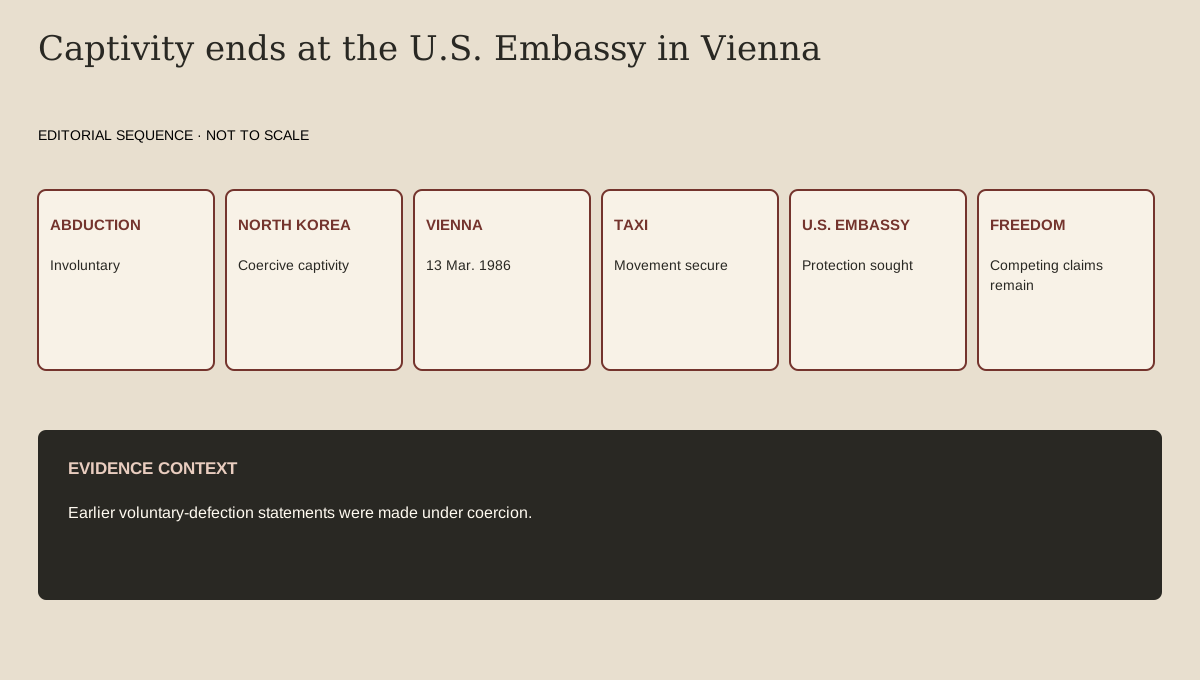
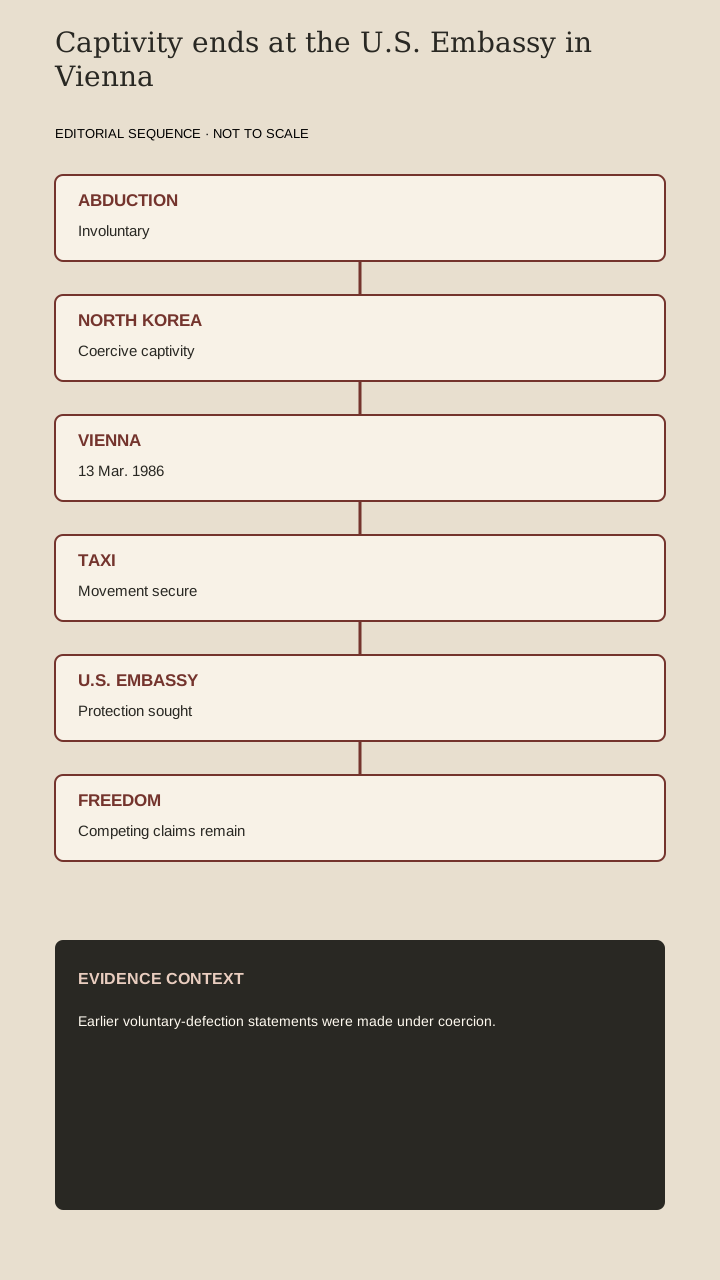
Simplified editorial reconstruction; not to scale. See adjacent text for evidence qualifications and unresolved details.
Evidence discipline
What the record supports
Status labels distinguish secure conclusions from uncertainty and rejected claims. Color is never the only signal.
MYTH
Shin Sang-ok and Choi Eun-hee voluntarily defected to North Korea in 1978.
North Korea publicly promoted this account and the couple repeated it while under North Korean control. Their later testimony, specialist abduction research, secret recordings, and subsequent escape strongly support involuntary abduction and captivity.
Sources: SRC-001, SRC-003, SRC-005WELL-SUPPORTED
Kim Jong-il sought to use Shin and Choi's filmmaking expertise to improve North Korean cinema.
Kim's sustained involvement with the filmmakers, the work he gave them, and the secret 1983 recording in which he discussed North Korean cinema's technical weakness make the film-industry motive strongly supported, though no single source should be treated as proving every detail of the original abduction order.
Sources: SRC-001, SRC-002, SRC-005, SRC-007MYTH
The couple's privileged film work meant they were no longer captives.
Their conditions improved markedly and they received substantial professional privileges, but movement remained supervised and they used the first viable diplomatic opportunity to leave North Korean control permanently.
Sources: SRC-001, SRC-005, SRC-006MYTH
The 1986 escape was a border crossing out of North Korea.
Shin and Choi were already abroad with official permission. Their decisive move was from supervised travel in Vienna into the protection of the U.S. Embassy.
Sources: SRC-003, SRC-004DISPUTED
Every dramatic detail of a high-speed Vienna car chase is documented by contemporary sources.
The taxi diversion, embassy destination, and successful escape are well supported. Pursuit by minders appears in later institutional and journalistic accounts, but contemporary reports do not establish every cinematic detail repeated in later retellings.
Sources: SRC-001, SRC-003, SRC-004, SRC-005DISPUTED
Shin fled primarily because he had embezzled about $3 million from North Korea.
This was North Korea's immediate public accusation after the embassy escape. It conflicts with the couple's captivity account and does not explain the broader evidence supporting their involuntary abduction and controlled detention.
Sources: SRC-004, SRC-001, SRC-005Selected chronology
Selected chronology
Choi Eun-hee disappears in Hong Kong
Choi is abducted while in Hong Kong and taken to North Korea.
Shin Sang-ok is taken
Shin disappears in Hong Kong months after Choi and is transported to North Korea.
The filmmakers are reunited
After years held separately, Shin and Choi are brought together and begin working more directly within Kim Jong-il's film program.
A secret recording of Kim Jong-il
Shin and Choi secretly record Kim Jong-il discussing North Korean cinema and its shortcomings, creating evidence later used to support their account.
Arrival in Vienna
Contemporary reporting places the couple in Vienna after traveling from Budapest while under North Korean supervision.
Escape to the U.S. Embassy
Shin and Choi break from their minders, reach the U.S. Embassy in Vienna by taxi, and seek American assistance.
North Korea issues a counterclaim
North Korea publicly accuses Shin of taking about $3 million intended for a film project and portrays the asylum request as a financial maneuver.