Amina Ali Nkeki's return from Boko Haram captivity in May 2016 was initially presented by Nigerian authorities as a military rescue. Her own later account was different. She said that she and the man she called her husband fled the Boko Haram camp themselves and that thoughts of her mother gave her the courage to run.
That distinction matters. Amina's freedom was made possible by escape, followed by discovery and recovery by local vigilantes and security forces near the fringes of Sambisa Forest. It was not a conventional commando rescue in which troops reached a known captive and removed her from a guarded compound.
Amina had been missing for more than two years. She was one of the students abducted from Government Secondary School in Chibok on the night of 14–15 April 2014, an attack that drew worldwide attention to Boko Haram's campaign of abduction and violence against women and girls in northeastern Nigeria. Her reappearance on 17 May 2016 became the first confirmed return of one of the girls who had remained missing after the immediate escapes in 2014.
At a Glance
- Abducted: Night of 14–15 April 2014
- Regained freedom: By 17 May 2016
- Captivity: A little over two years
- Captor: Boko Haram
- Broad escape: Amina later said she fled the camp with Mohammed Hayatu, the man she called her husband
- Discovery: Local vigilantes/Civilian Joint Task Force members encountered them near the Sambisa Forest–Damboa area
- With Amina: Her infant daughter and Mohammed Hayatu
- Immediate outcome: Family identification, medical/security processing, transfer through Maiduguri, then Abuja
- Critical source issue: Early Army statements called the event a rescue; Amina later said they escaped from Boko Haram without the military extracting them
The Chibok abduction
On the night of 14 April 2014, Boko Haram fighters entered the Government Secondary School at Chibok in Borno State while students had gathered for examinations. Nigeria's presidential fact-finding process, cited by Human Rights Watch, concluded that 276 students were abducted. Fifty-seven escaped relatively soon afterward, leaving 219 unaccounted for at that stage. Subsequent lists and later reporting sometimes used slightly different totals as identities were reviewed, but the scale of the abduction is not in dispute.
The kidnapping became an international symbol through the Bring Back Our Girls campaign. Yet Chibok was also part of a much larger pattern.
Human Rights Watch and Amnesty International documented hundreds and later thousands of abductions of women and girls by Boko Haram across northeastern Nigeria. Former captives described forced labor, coercive conversion, forced marriage, sexual violence, threats, and participation in military activities. Those findings establish the broader system in which Amina was held; they should not be used to invent specific acts against her that she did not herself describe.
Amina later said that the Chibok girls were initially kept together for about a year. She then described some girls as being sent into marriages and said that she herself was "given" to a man she referred to as her husband.
That statement is sufficient to establish coercive circumstances around the arrangement. The private details of the relationship do not need to be reconstructed.
Two years beyond public view
Very little reliable information about Amina's individual movements during captivity reached the outside world before 2016. That absence is important. Boko Haram repeatedly moved captives through forest camps and other controlled areas. Human Rights Watch interviews with other abducted women and girls described multiple camps in and around Sambisa Forest and the Gwoza hills, but those accounts cannot be turned into Amina's personal itinerary.
By 2016 Nigerian forces had increased pressure on Boko Haram positions and supply routes. Some early reports linked Amina's flight to an attack on the camp where she was being held.
Her later interview supplied the more direct account of agency: she said that she escaped with Mohammed Hayatu and remembered her mother as she made the decision to run. The exact day and hour they left the camp are not securely recorded. What is secure is that they were outside Boko Haram control when local vigilantes encountered them on 17 May.
Found near the forest
Contemporary reports differ over the precise place where Amina was found. Army statements and Reuters reporting placed the recovery near Damboa. Other accounts used names including Baale, Balle, Kaya, or Kulakaisa and described the location as being on the fringes of Sambisa Forest. The changing place-names reflect rushed reporting, local spelling variations, and the difference between a village, a wider administrative area, and the forest edge.
No exact route is needed to understand the event. Amina's brother told reporters that she initially tried to hide when she encountered the vigilantes. Members of the Civilian Joint Task Force recognized that she might be one of the missing Chibok students and brought her toward her home community for identification.
Her family confirmed who she was. The moment was historically important because Amina was not simply another newly liberated civilian from the insurgency. She was the first of the Chibok girls who had remained missing after the early 2014 escapes to reappear alive in public view.
Escape or rescue?
The language became politically contested almost immediately. The Nigerian Army announced that troops and the Civilian Joint Task Force had "rescued" Amina. Early military reporting also briefly misidentified the recovered girl before correcting the name.
Family and activist accounts emphasized that Amina had already fled Boko Haram when the vigilantes found her. Her brother said she had run away from the camp and was hiding when the local fighters encountered her.
Amina herself later removed much of the ambiguity. In an August 2016 interview, she said that she had escaped Boko Haram with the man she called her husband.
The most accurate reconstruction therefore separates three stages: flight from Boko Haram captivity; discovery by local vigilantes; transfer into Nigerian military and government care. Security forces were part of the recovery and protection process. They were not, on the strongest first-person evidence, the force that physically broke her out of the Boko Haram camp.
Mohammed Hayatu and an unresolved status
The man with Amina was identified as Mohammed Hayatu. Nigerian military statements initially treated him as a suspected Boko Haram fighter and, in some reports, a commander. He was taken into custody for interrogation.
Other contemporary accounts complicated that label. A vigilante commander described him as another person held by Boko Haram, and later reporting said Hayatu claimed that he too had originally been abducted.
Amina consistently referred to him as her husband and later said that they had escaped together. That is enough to establish his role in her flight.
It is not enough to settle every question about his earlier status within Boko Haram. The historical record used here does not justify presenting him simultaneously as a proven commander, her original abductor, and a willing escape helper without qualification.
The circumstances of a relationship formed inside prolonged captivity are inherently coercive and complex. A survivor's own language deserves to be preserved without turning it into proof that captivity was voluntary.
From Chibok to Abuja
After identification, Amina entered a rapid sequence of military, medical, and political processing. She was moved through Damboa and Maiduguri, received medical attention, and was flown to Abuja. On 19 May she met President Muhammadu Buhari.
Buhari publicly promised medical, psychological, educational, and reintegration support. He also said that information from Amina could help efforts to locate the other missing girls.
The public attention created a second controversy. Within weeks, Amina's relatives and the Bring Back Our Girls movement complained that they had little information about where she and her child were being kept or how the promised rehabilitation process was being managed. They argued that recovery from captivity required privacy, family access, and transparent care rather than political display.
Those criticisms do not erase the need for medical or security support. They show that regaining physical freedom from Boko Haram did not immediately restore ordinary control over her own movements and public identity.
Her own account
Amina gave one of her first major interviews in August 2016. The interview is valuable because it shifts the center of the story away from competing government and activist claims. In her own words, she had escaped Boko Haram with the man she called her husband. She spoke about her mother as a source of courage and sent a message of patience and hope to the other Chibok girls.
She also described the girls being kept together for roughly their first year of captivity before some were separated for marriages. The interview came only three months after more than two years of captivity and after intense public exposure. Its clearest value for the escape chronology is Amina's own description of agency: she understood herself as someone who had fled Boko Haram, not as someone physically extracted from the camp by the Army. That first-person distinction outweighs the public-relations value of the word "rescue."
What her escape did—and did not—show
Amina's reappearance created renewed hope that many of the missing Chibok students might still be alive. It also exposed how little reliable information authorities had about the captives' locations and circumstances. Early reporting around Amina included conflicting names, places, and descriptions of who had rescued whom.
Her case did not prove that the remaining captives were all together or that a single military operation could recover them. Information attributed to Amina in the first days after her return was filtered through family members, activists, soldiers, and journalists and should be treated cautiously.
Nor should her story be separated from the many non-Chibok women and girls abducted by Boko Haram. Human Rights Watch and Amnesty documented a much larger population of victims whose cases attracted far less international attention. What Amina's escape did prove was narrower and more important: after more than two years, at least one of the girls still missing from Chibok had survived captivity and had found a way out.
Reconstructing the event without taking it away from her
The central facts can be stated without graphic detail. Amina Ali Nkeki was abducted at Chibok in April 2014 and remained in Boko Haram captivity for more than two years. By 17 May 2016 she had fled the group's control with Mohammed Hayatu and her infant daughter. Local vigilantes found them near the Sambisa Forest–Damboa area, Amina's family confirmed her identity, and Nigerian security forces moved her into medical and government care.
Early institutions competed over the language of rescue. Amina later described the decisive act herself: she escaped.
The wider Chibok story belongs to the history of Boko Haram, failed state protection, global advocacy, military recovery efforts, and survivor reintegration. Amina's individual escape, however, begins with her own act of flight from captivity.
Evidence discipline
What the record supports
Status labels distinguish secure conclusions from uncertainty and rejected claims. Color is never the only signal.
MYTH
The Nigerian military physically rescued Amina from inside the Boko Haram camp.
The Army used rescue language, but Amina later said she escaped Boko Haram with Mohammed Hayatu, and her family said she had already fled when local vigilantes found her.
Sources: SRC-001, SRC-002, SRC-003, SRC-007DOCUMENTED
Amina escaped Boko Haram captivity before being found by vigilantes.
Amina stated this directly in her August 2016 interview, and contemporary family reporting independently described her as having run away before discovery.
Sources: SRC-001, SRC-002DISPUTED
The exact village where Amina was first found can be stated with certainty.
Contemporary reporting uses several place-names—Baale/Balle, Kaya, Kulakaisa, and the Damboa/Sambisa area. The secure geography is the broader Sambisa Forest–Damboa fringe.
Sources: SRC-002, SRC-003, SRC-004DISPUTED
Mohammed Hayatu was conclusively established in 2016 reporting as a Boko Haram commander who originally abducted Amina.
The Nigerian military treated him as a suspected Boko Haram fighter or commander, while other contemporary accounts said he claimed to have been abducted himself. Amina's secure statement is that he was the man she called her husband and escaped with.
Sources: SRC-001, SRC-003, SRC-010MYTH
Amina's relationship formed under ordinary free circumstances.
Amina was a captive of Boko Haram and later said that after the girls had been held together for about a year, some were sent into marriages and she was given to the man she called her husband.
Sources: SRC-001MYTH
General evidence of sexual violence against Boko Haram captives proves specific acts against Amina.
Human Rights Watch and Amnesty documented sexual violence and forced marriage among Boko Haram captives broadly, but those findings cannot be automatically assigned to an individual survivor without her testimony or other case-specific evidence.
Sources: SRC-005, SRC-006MYTH
Amina was the first Chibok student ever to escape Boko Haram.
Fifty-seven students escaped relatively soon after the 2014 abduction. Amina was the first of the students who remained missing after that immediate period to return publicly in 2016.
Sources: SRC-005Evidence diagram
Escape, discovery, and recovery
Amina's own escape came before vigilante discovery, family identification, and government care.
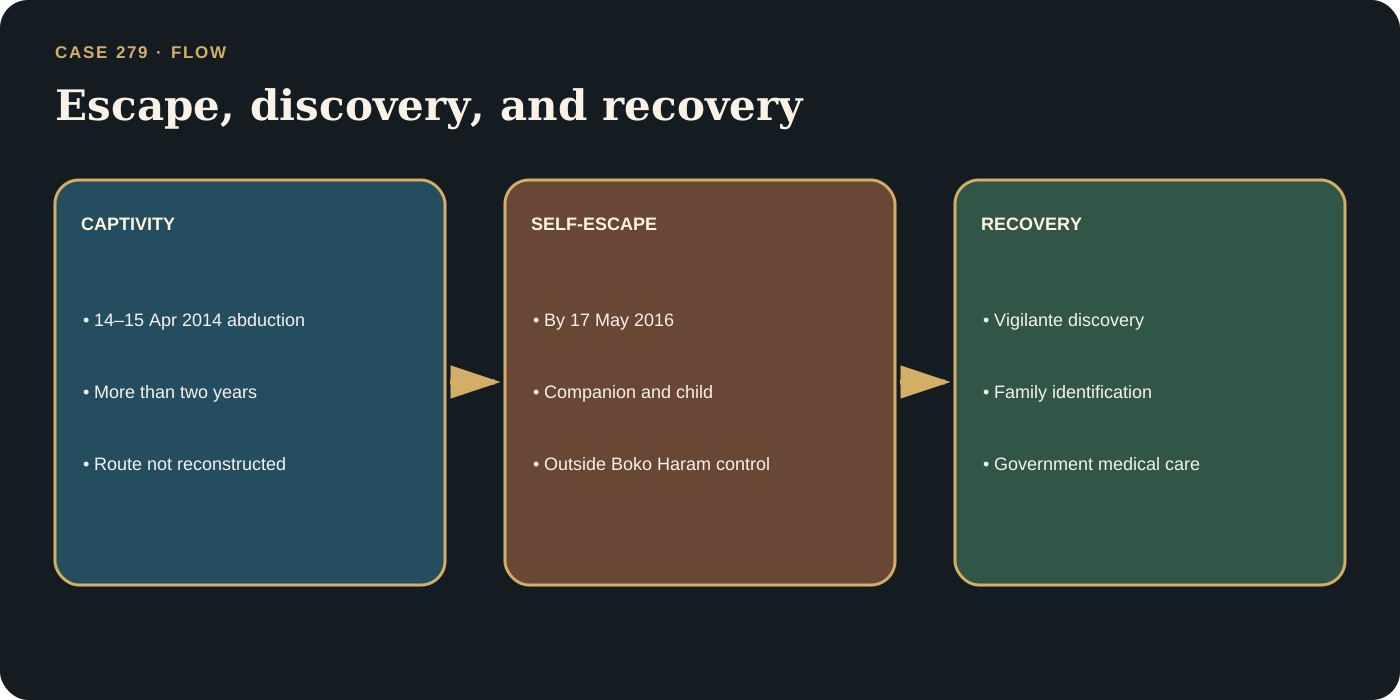
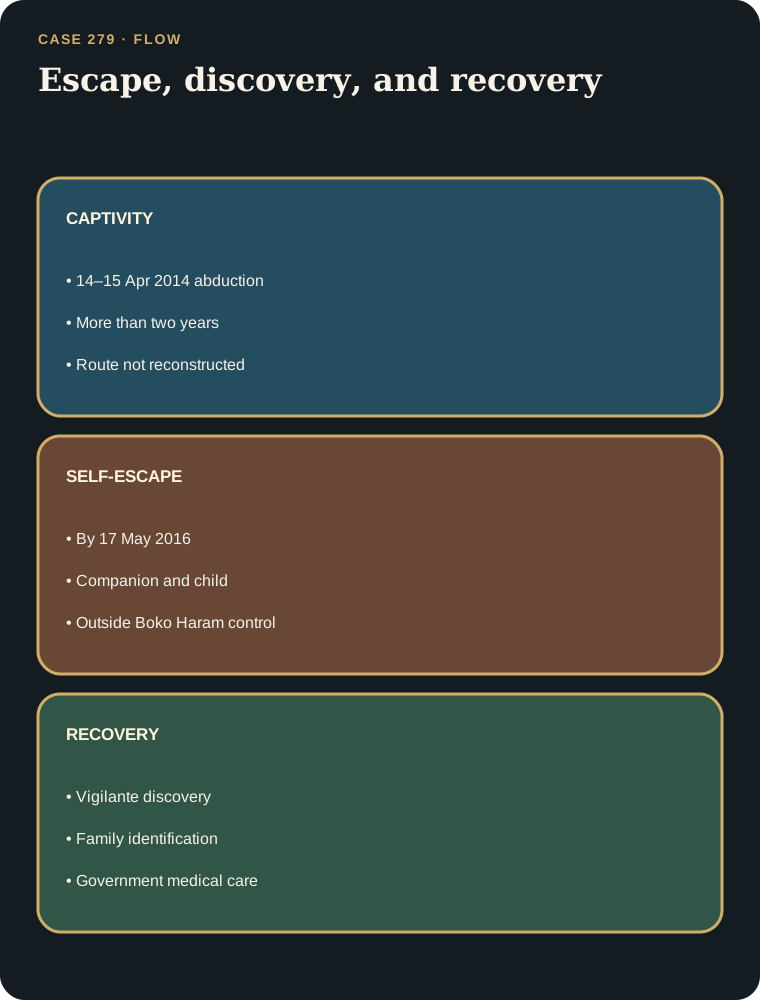
Amina's own escape came before vigilante discovery, family identification, and government care.