
Witold Pilecki’s Escape from Auschwitz: The Three-Man Breakout of 1943
Witold Pilecki did not enter Auschwitz because he expected to spend years there. He entered because the Polish underground needed someone inside.
On 19 September 1940, Pilecki deliberately allowed himself to be caught in a German roundup in Warsaw. He carried identity papers in the name Tomasz Serafiński. Three days later he was registered at Auschwitz as prisoner 4859.
His mission was to learn what was happening inside the new German concentration camp, establish underground contacts, and create a resistance organization. By the spring of 1943, that mission had changed. Auschwitz had expanded.
Mass murder of Jews was underway at Auschwitz II-Birkenau. Prisoners were dying through executions, starvation, disease, forced labor, and the camp’s systematic violence. Members of the underground organization Pilecki had helped build were themselves being killed, transferred, or exposed.
Information had already gone out of the camp. What Pilecki now wanted was to get himself out. He intended to report personally to the Home Army, explain what the resistance inside Auschwitz had become, and press for an armed operation to help liberate the prisoners. He would not escape alone.
The plan depended on two other prisoners: Jan Redzej and Edward Ciesielski. And it depended on getting away from the strongest part of Auschwitz before the escape even began.
He Had Entered Auschwitz Deliberately
Pilecki’s story is often compressed into one sentence:
He volunteered for Auschwitz.
That shorthand is not completely wrong. It is incomplete. Pilecki did not walk to the camp gates and offer himself to the SS. He volunteered for a Polish underground mission that required him to be arrested.
In September 1940, Auschwitz was still relatively new. German authorities had established the camp earlier that year, initially using it heavily for Polish political prisoners.
The Polish underground wanted reliable information. Pilecki accepted the assignment. He entered a roundup in Warsaw and allowed the Germans to take him. At Auschwitz he became Tomasz Serafiński, prisoner 4859.
The assumed identity protected his real name. It also produced an unusual consequence after the escape: Pilecki would eventually meet the real Tomasz Serafiński whose identity he had used. That came later. Inside Auschwitz, survival came first.
Building Resistance Inside the Camp
Pilecki helped organize a clandestine network known as the Związek Organizacji Wojskowej, or ZOW. Its purpose was not simply to prepare one dramatic uprising. The underground had to operate every day. Members tried to:
- support prisoners;
- distribute food and clothing;
- share information;
- build contacts across the camp;
- send reports outside;
- maintain links to the Polish resistance;
- and prepare for possible armed action if an outside attack ever came.
Information moved out through several channels. That point matters because another popular version of Pilecki’s story is misleading. He did not spend two and a half years inside Auschwitz while the outside world knew nothing, then suddenly escape carrying the first news of the camp. Reports had already left.
The Auschwitz-Birkenau State Museum records that a report written by Pilecki reached Home Army headquarters in April 1942 through an escapee. Other messages had travelled through underground channels before that. Pilecki’s own escape was important for a different reason. A man who had helped organize the resistance could now speak directly.
Why Leave in 1943?
By the spring of 1943, the risks around the underground were increasing. Pilecki feared that the organization could be exposed. Prisoners with low numbers—men who had survived inside the camp for unusually long periods—could also be transferred away, breaking networks built over years. And Pilecki had become frustrated by the absence of the kind of outside military action the underground had hoped might eventually support a camp uprising.
He wanted to reach Home Army command. He wanted to explain the situation personally. He also wanted authorization for an armed attempt to free prisoners. To do that, he first had to solve the escape problem.
The main camp perimeter was not the answer.
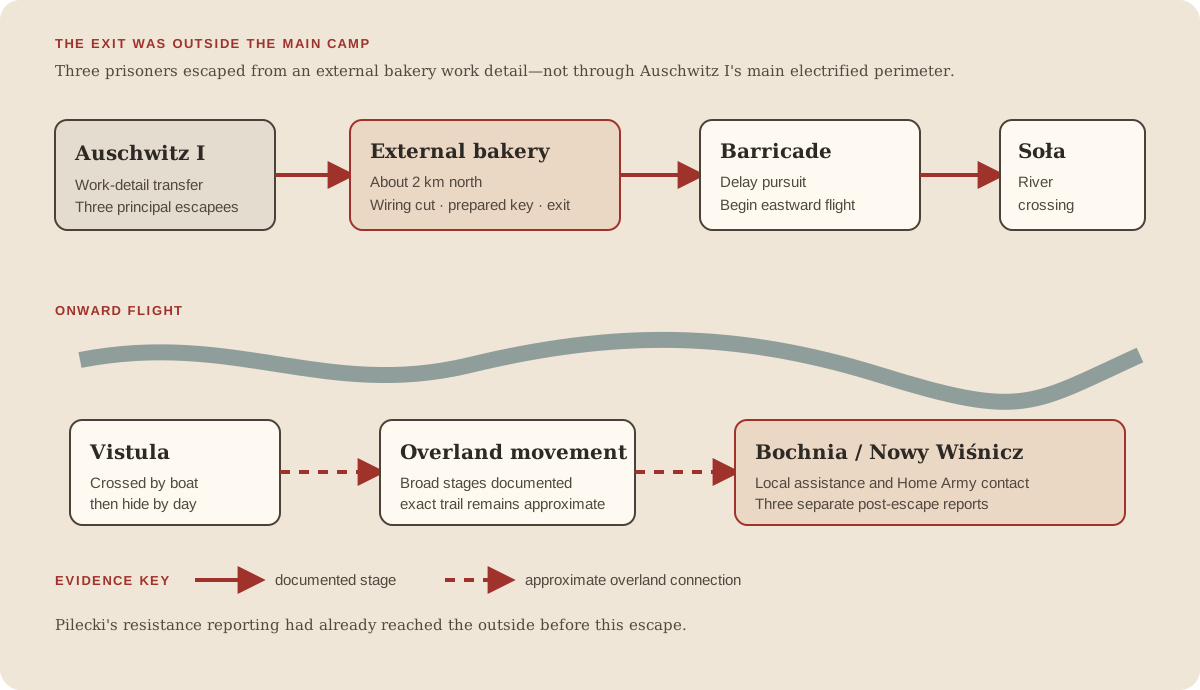
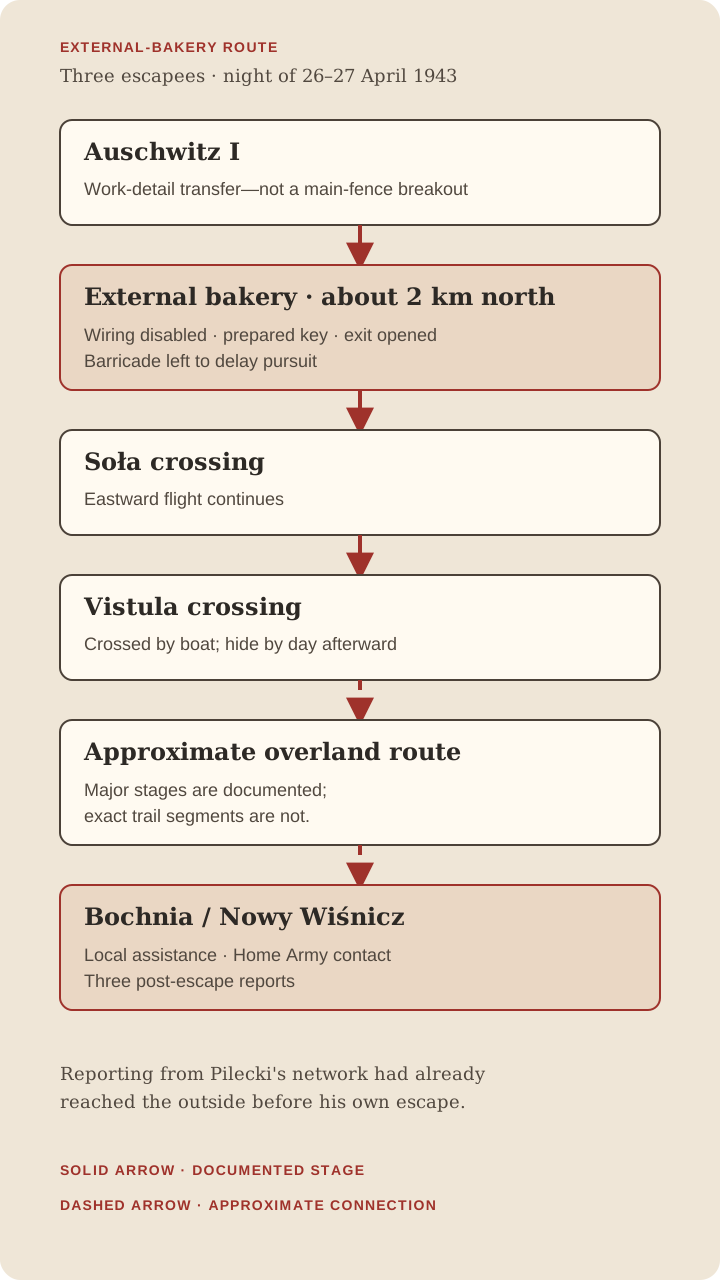
Escape route
The bakery breakout and the route east
The escape began outside Auschwitz I at a work-detail bakery, then became an overland flight across two rivers toward underground contacts.
- 01
External work detail
The three men reached a bakery about two kilometres north of Auschwitz I.
- 02
Breakout
They disabled wiring, opened the bakery exit and left a barricade behind them.
- 03
Rivers
The flight crossed the Soła and then the Vistula by boat.
- 04
Overland
The broad route continued toward Bochnia and Nowy Wiśnicz; exact trail segments remain approximate.
- 05
Underground contact
Local assistance reconnected Pilecki with the Home Army and enabled three post-escape reports.
Simplified editorial route based on Auschwitz Museum, IPN, Home Army Museum and archival evidence; not to scale. Major stages are documented, while portions of the overland route are approximate.
The Bakery
The opportunity lay outside Auschwitz I. A bakery work detail operated about two kilometers north of the main camp. Prisoners assigned to the bakery left the central camp under guard. At night, those workers could be locked inside the building with a much smaller SS guard presence than they faced at the main perimeter.
That changed the security problem. Instead of defeating the electrified fences and guard system of Auschwitz I, the escapees would need to defeat a building door. Jan Redzej was already connected with the bakery work command. Pilecki and Edward Ciesielski needed to get there too.
Through underground contacts and work-assignment maneuvering, they succeeded. The three men could now prepare from inside the building they intended to leave.
Redzej’s Key
The bakery door was heavily secured. The details are preserved in the Auschwitz Museum’s reconstruction and in the escapees’ own later accounts. Redzej obtained or prepared a key that could work the relevant lock. English retellings describe it in different ways:
- copied key;
- false key;
- prepared key;
- bump key.
The surviving evidence does not require one modern locksmith term. What matters is that Redzej had a key prepared for the escape and had worked out how the door mechanism could be defeated. The key would matter again after the men had already escaped the bakery.
Civilian Clothes Under the Stripes
Getting out of the bakery would not make three men in Auschwitz prisoner uniforms invisible. The fugitives therefore prepared clothing for the second stage. IPN research records that Pilecki and Ciesielski wore civilian clothes beneath their striped uniforms. Redzej also had civilian clothing prepared, altered in the camp system.
The plan was not sophisticated disguise in the cinematic sense. It was an attempt to stop looking immediately recognizable as escaped concentration-camp prisoners once they were beyond the immediate security zone. The striped clothing could be discarded. The civilian layer could remain.
Easter Monday
The men chose Easter Monday, 26 April 1943. The timing was deliberate. They hoped the holiday would reduce or loosen part of the SS routine. That evening the bakery workers left the main camp.
Pilecki’s own later report remembers the significance of crossing the camp gate knowing that this time he did not intend to return. The bakery party moved into the town and divided between work sites. Pilecki, Redzej, and Ciesielski reached the larger bakery. The final preparation now had to happen while guards remained inside the building.
Cut the Alarm
The escape required more than opening the door. If the guards could immediately telephone or trigger an alarm, the fugitives would begin their run with the surrounding security system already mobilized. Ciesielski worked on the communication lines. Auschwitz Museum material states that the men cut telephone and alarm-bell wires during their work.
Redzej prepared the door. The guard situation remained dangerous. The men could not simply announce that they were finished and walk out. They had to wait for an interval in which attention shifted enough to let them attack the door mechanism.
The Door Opens
Shortly after midnight, the situation improved. One of the SS men was less attentive. The prisoners moved. Ciesielski completed the work on the communications.
Redzej dealt with the bolts and door hardware. Pilecki joined him at the exit. The three forced the door. It opened.
They ran. This was the instant most often treated as “the escape.” It was only the start.
Barricade the Bakery
The men did one more thing before disappearing into the night. They obstructed or barricaded the bakery exit from the outside. The purpose was simple. The guards had to lose time getting out.
Every minute spent behind the door was a minute the fugitives could use to widen the distance between themselves and the bakery. The SS guards eventually emerged. Shots were fired after the escapees. The gunfire did not stop them.
They continued east.
The Soła
The fugitives now needed to break the visual identity imposed by the camp. After reaching the Soła area, they discarded or altered the identifying parts of their prison clothing. Pilecki and Ciesielski could remove the striped layer and continue in the civilian clothes they had worn underneath. Redzej removed identifying camp markings from his own clothing.
The river and darkness now separated them further from the bakery. But they were still inside German-controlled territory. Auschwitz was behind them. Freedom was not yet secure.
The Vistula
The next major barrier was the Vistula. The fugitives found a boat. Here the prepared key from the bakery appears again in the escape tradition. IPN and Home Army Museum material record that one of the boats was secured and that Redzej still possessed the tool used at the bakery, allowing the men to release the boat’s fastening.
They crossed the Vistula. That solved the immediate river problem. It did not solve pursuit.
Hide by Day
Once the immediate night movement had carried them away from the camp, the fugitives needed concealment. They reached woodland and rested through daylight before continuing. This stage of the escape is less spatially exact than the bakery breakout. The surviving institutional accounts establish the broad direction and major locations.
They do not justify drawing every turn of a modern hiking route. The men moved through occupied Poland toward areas where Polish underground contacts could help them. Along the way, local civilians provided assistance. IPN research identifies people including Father Jan Legowicz and forester Kazimierz Buczek among those who helped the fugitives.
Their assistance is important. The escape did not become safe merely because the three men had crossed two rivers.
Across the General Government Border
The fugitives continued through the region around Alwernia, then toward routes associated in the sources with Tyniec, Wieliczka, the Niepołomice Forest, Bochnia, and Nowy Wiśnicz. The exact sequence should be displayed as an approximate historical route rather than a turn-by-turn reconstruction. After several days, they reached the Bochnia area. They now had what they had lacked since leaving the bakery:
a connection to an organized underground network.
Meeting Tomasz Serafiński
One of the strangest documented consequences of the escape came in Nowy Wiśnicz. Pilecki had lived inside Auschwitz under the name Tomasz Serafiński. Now he met the real Tomasz Serafiński. Serafiński was involved with the Home Army in the region.
The encounter connected Pilecki directly into local underground structures and helped provide the protection he needed after the escape. Pilecki remained in the area for much of the summer. The man whose identity had helped him enter Auschwitz now became part of the world that sheltered him after he escaped it.
Three Reports, Not One
Once outside, Pilecki, Redzej, and Ciesielski did something historically important. They wrote. The Auschwitz-Birkenau State Museum states that each of the three men prepared an independent report about Auschwitz. That matters because the evidence did not depend only on Pilecki’s memory.
The three escapees provided separate accounts to the Home Army. Pilecki’s own 1943 document became known as Report W. He prepared it in hiding and later brought it to Warsaw. The report described:
- conditions inside the camp;
- the underground organization;
- German crimes against prisoners;
- mass murder;
- the developing extermination of Jews;
- and the resistance network Pilecki had helped create.
But this was not the first information he had ever sent. That distinction should stay visible.
What Had Already Reached the Outside
Pilecki’s underground had been reporting before April 1943. The Auschwitz Museum records that information from his organization reached the Polish underground and then London. A report written by Pilecki was brought out by escapee Stanisław Jaster in 1942. Pilecki’s own escape therefore did not suddenly break a complete wall of silence.
It changed the quality of the available testimony. Instead of a clandestine message or report carried by someone else, the Home Army could question one of the central organizers directly. Pilecki could also argue for action in person.
The Liberation Plan
Pilecki wanted more than the preservation of a historical record. He wanted Auschwitz attacked. The underground inside the camp had considered the possibility of revolt tied to outside military action. Once free, Pilecki pressed that idea with Home Army contacts.
The proposal was not approved. Auschwitz Museum material describes the Home Army command as judging the plan unrealistic. That decision reflected the scale of the problem. An attack would have had to overcome an SS garrison, the camp’s security system, nearby German forces, communications, and the danger of reprisals and mass killing.
Pilecki had escaped in order to argue for liberation. His argument did not produce the assault he wanted.
What Pilecki Reported—and What Later Research Changed
Pilecki’s reports are extraordinary sources. They were written by a prisoner who had spent years inside the camp and had built a network specifically designed to gather information. That does not mean every wartime number in them became the final historical answer. Pilecki estimated the number of people killed at Auschwitz far above the figure accepted by historians today.
Modern research by the Auschwitz-Birkenau State Museum estimates that approximately 1.1 million people were murdered at Auschwitz, approximately 1 million of them Jews. Pilecki did not have access to postwar German records, deportation data from across Europe, demographic studies, surviving camp records, or decades of historical reconstruction. He was trying to estimate mass murder from within the system committing it.
The responsible conclusion is not that his reporting was worthless. It is that wartime intelligence and final historical demography are different forms of evidence.
The Three Men After the Escape
The escape did not end their involvement in the Polish resistance. Pilecki, Redzej, and Ciesielski all continued underground activity. All three became involved in the Warsaw Uprising of 1944. Jan Redzej was killed during the uprising.
Pilecki survived the uprising and German captivity, later served with Polish forces in Italy, and returned to Poland after the war on an intelligence mission. The communist security authorities arrested him in 1947. After torture and a political trial, he was sentenced to death. He was executed in Warsaw on 25 May 1948.
Edward Ciesielski also suffered postwar communist repression; his death sentence was ultimately commuted. The three men had escaped Auschwitz. Their later histories were not simple stories of safety.
Evidence discipline
What the record supports
Status labels distinguish secure conclusions from uncertainty and rejected claims. Color is never the only signal.
DOCUMENTED
Pilecki volunteered for an underground mission that required him to allow himself to be arrested and deported to Auschwitz.
IPN records that Pilecki deliberately entered a German roundup in Warsaw in September 1940 under the identity Tomasz Serafiński in order to infiltrate Auschwitz for the Polish underground.
Sources: SRC-006, SRC-007MYTH
Pilecki volunteered directly to the SS to become an Auschwitz prisoner.
He volunteered to the Polish underground for an infiltration mission and then allowed German authorities to arrest him during a Warsaw roundup.
Sources: SRC-006MYTH
Pilecki entered Auschwitz in September 1940 specifically to report the fully developed Holocaust extermination complex of later years.
His initial mission was to gather intelligence and organize resistance in the newly established camp. Auschwitz's role in mass extermination of Jews expanded later, and his reporting evolved as the camp changed.
Sources: SRC-006, SRC-005MYTH
Pilecki escaped Auschwitz alone.
Jan Redzej and Edward Ciesielski escaped with him and performed essential parts of the bakery breakout.
Sources: SRC-001, SRC-002, SRC-009MYTH
The escapees broke through the main Auschwitz I perimeter.
They first transferred into an external bakery work detail about two kilometers north of the main camp and escaped from the bakery building.
Sources: SRC-001DOCUMENTED
Telephone and alarm wiring was disabled during the bakery escape.
Auschwitz Museum and Home Army Museum material identifies the cutting of the communication/alarm wiring as a key part of the breakout.
Sources: SRC-001, SRC-009WELL-SUPPORTED
Jan Redzej prepared a key used at the bakery exit.
Institutional sources consistently credit Redzej with obtaining or preparing the key. Modern translations differ on the precise locksmith term.
Sources: SRC-001, SRC-008MYTH
Pilecki's April 1943 escape was the first time information from his Auschwitz resistance network reached the outside.
Auschwitz Museum records reports and messages associated with Pilecki reaching Polish underground channels before his escape, including a report delivered to Home Army headquarters in 1942.
Sources: SRC-002, SRC-011MYTH
There was only one document known as the Pilecki Report.
Pilecki produced multiple reports, including the 1943 Report W and a much longer 1945 account. Redzej and Ciesielski also wrote independent reports after the escape.
Sources: SRC-002, SRC-007, SRC-011MYTH
Pilecki's wartime estimate of deaths at Auschwitz is identical to the current accepted historical victim count.
Pilecki's wartime estimate was higher. Modern Auschwitz Museum research estimates approximately 1.1 million people were murdered at Auschwitz, including approximately 1 million Jews.
Sources: SRC-003, SRC-005MYTH
The fact that Pilecki's wartime estimate was too high undermines the evidence of mass murder at Auschwitz.
The modern victim total rests on extensive postwar archival, demographic, deportation, and camp research. The difference demonstrates the limitations of wartime estimation from inside the camp, not uncertainty about the documented extermination.
Sources: SRC-005Evidence, Myth and What the Sources Actually Say
Did Witold Pilecki really volunteer for Auschwitz?
WELL-SUPPORTED, WITH REQUIRED CONTEXT
He volunteered for a Polish underground mission that required him to allow himself to be arrested and deported to the camp. He did not volunteer to the SS at Auschwitz itself.
Did Pilecki enter Auschwitz specifically to report the Holocaust as it was later understood?
MYTH / ANACHRONISTIC
Pilecki entered in September 1940 to gather intelligence and organize resistance in the newly established camp.
Auschwitz later became a central site of the Holocaust. His reports evolved with what he witnessed, including mass murder of Jews.
Did Pilecki escape alone?
MYTH
No. Jan Redzej and Edward Ciesielski escaped with him and were essential to the plan.
Did the three men break through the main Auschwitz fence?
MYTH
No. They used the bakery work detail outside the main camp, then escaped directly from the bakery building.
Was the bakery inside Auschwitz I?
MISLEADING IF STATED THAT WAY
The bakery was an external work site approximately two kilometers north of the main camp. The prisoners reached it as part of a guarded work detail.
Did Redzej have a duplicate key?
WELL-SUPPORTED
Institutional sources state that Redzej prepared or obtained a key used in opening the bakery door. The exact modern locksmith terminology varies in translation.
Were the alarm and telephone lines disabled?
DOCUMENTED
Yes. The Auschwitz Museum states that the escapees cut the relevant communication/alarm wires during the bakery shift.
Did guards shoot at the escapees?
DOCUMENTED IN THE ESCAPE ACCOUNTS
Shots were fired after the men fled the bakery. All three escaped.
Did they swim across both major rivers?
MYTH / OVER-SIMPLIFIED
They crossed the Soła and later used a boat to cross the Vistula. Do not casually state that they swam both.
Was Pilecki’s escape the first time information from his Auschwitz network reached the outside world?
MYTH
No. Reports and messages associated with Pilecki’s resistance network had already left the camp before April 1943.
Did Pilecki escape because the outside world had completely ignored every earlier report?
OVER-SIMPLIFIED
He was frustrated by the lack of armed intervention and wanted to make his case directly, but information from Auschwitz was already moving through Polish underground and exile channels.
Was there one single document called “the Pilecki Report”?
MYTH / OVER-SIMPLIFIED
Pilecki produced multiple reports. The 1943 Report W is distinct from his much longer 1945 account. Redzej and Ciesielski also wrote independent post-escape reports.
Are Pilecki’s wartime victim estimates the same as the modern accepted Auschwitz death toll?
NO
His wartime estimates were higher. Current Auschwitz Museum research estimates approximately 1.1 million people murdered, including approximately 1 million Jews. That correction reflects decades of broader historical research, not doubt about the documented extermination carried out at Auschwitz.
Problem → response
Escape was a sequence of problems
Each response solved a practical obstacle while often creating the next one.
- 01→
Obstacle
Auschwitz I perimeter
The central camp was protected by electrified fencing, guards, towers, and the wider security zone.
Response
The escapees shifted the breakout to the external bakery work detail rather than attack the main perimeter directly.
- 02→
Obstacle
Locked bakery doors
Prisoners working overnight at the bakery were locked inside.
Response
Redzej prepared a key and the group manipulated the door bolts and hardware.
- 03→
Obstacle
Immediate alarm capability
The guards could use the bakery's telephone/alarm connections to summon help.
Response
Ciesielski disabled the relevant wires.
- 04→
Obstacle
SS guards inside the bakery
Two SS men supervised the prisoners during the night work.
Response
The fugitives waited for a favorable interval, forced the exit, then barricaded the door outside to delay pursuit.
- 05→
Obstacle
Recognizable prisoner clothing
Striped camp clothing would immediately identify the men as fugitives.
Response
They prepared civilian clothing and discarded or altered prisoner markings after the breakout.
- 06→
Obstacle
Soła and Vistula rivers
Major waterways obstructed movement away from Auschwitz.
Response
The men crossed the Soła and later obtained a boat for the Vistula.
- 07→
Obstacle
Daylight pursuit
Continuing openly after daybreak would increase the chance of recognition and capture.
Response
The fugitives used woodland concealment and continued movement after resting.
- 08→
Obstacle
German-controlled occupied territory
Leaving the immediate Auschwitz zone did not place the fugitives in free territory.
Response
They relied on civilian helpers and eventually Home Army contacts to move toward safer hiding places.
Why the Escape Worked
The main camp perimeter was too strong. The men moved the escape problem to the bakery. The bakery door was locked. Redzej prepared a way to open it.
The guards could call for help. Ciesielski disabled communications. Prison uniforms would expose them. They prepared civilian clothing.
The guards were still inside the building. The fugitives barricaded the exit after leaving. The surrounding camp zone remained dangerous. They moved at night and crossed the Soła.
The Vistula blocked the route. They found a boat and used the same escape preparation to help release it. Daylight increased the chance of discovery. They hid.
Movement through occupied territory required help. Local people assisted them. Getting away from Auschwitz was not enough. They reached the Home Army.
Pilecki had entered the camp to build a resistance network and send information out. By April 1943, the final use of that network was to help carry its organizer back in the opposite direction.
Selected chronology
Infiltration, resistance, escape and reporting
Pilecki enters a Warsaw roundup
As part of a Polish underground mission, Pilecki deliberately allows himself to be arrested by the Germans while using the identity Tomasz Serafiński.
Registered at Auschwitz
Pilecki is registered under the name Tomasz Serafiński and receives prisoner number 4859.
ZOW resistance network develops
Pilecki helps build the clandestine military organization that supports prisoners, gathers intelligence, and communicates with the Polish underground.
Information reaches London
Auschwitz Museum material records that information based on Pilecki's early underground reporting reached London through Polish clandestine channels.
Pilecki report reaches Home Army headquarters
A report written by Pilecki is delivered from Auschwitz to Home Army headquarters, demonstrating that information from his network was already reaching the outside before his own escape.
The three men report for bakery work
Pilecki, Redzej, and Ciesielski enter the external bakery work detail prepared for the escape.
Breakout from the bakery
The escapees disable communications, open the bakery door, barricade the building, and run east.
German escape notices sent
Auschwitz authorities notify police and SS offices that prisoners including Tomasz Serafiński, the identity used by Pilecki, have escaped.
Escape across occupied Poland
The fugitives cross the Soła and Vistula, hide, receive local help, cross into the General Government, and reach the Bochnia / Nowy Wiśnicz area.
Pilecki prepares a detailed report
While in hiding in the Nowy Wiśnicz region, Pilecki drafts the 1943 Report W describing Auschwitz and the underground organization.
Pilecki reaches Warsaw
Pilecki reaches Home Army headquarters and reports on Auschwitz while continuing to advocate for action on behalf of the prisoners.
The escapees fight in the Warsaw Uprising
Pilecki, Redzej, and Ciesielski continue resistance activity; Redzej is killed during the uprising.
Pilecki produces a fuller Auschwitz account
While in Italy after the war in Europe, Pilecki dictates a much longer narrative distinct from the 1943 Report W.
Pilecki is executed
Following arrest, torture, and a political trial by communist authorities in Poland, Pilecki is executed in Warsaw.