
Kazimierz Piechowski’s Auschwitz Escape: The SS-Uniform Car Breakout of 1942
On 20 June 1942, four Polish prisoners walked out of the main Auschwitz camp as a work detail, entered an SS supply area, changed into stolen SS uniforms, armed themselves, took a Steyr 220 from the SS garage, and drove toward the outer checkpoint.
Their plan depended on a dangerous inversion of the camp’s security system. The same uniforms, weapons, vehicle, routines, and visible rank that normally enforced captivity would be used to make the escapees look like the people entitled to pass.
The four were Kazimierz Piechowski, Eugeniusz Bendera, Stanisław Gustaw Jaster, and Józef Lempart. All four cleared Auschwitz. None was returned to the camp as a recaptured escapee.
The story is often retold as a few minutes of audacity at a barrier. That misses the engineering of the escape. The decisive work came earlier: learning the rhythms of the SS supply depot, gaining access to a vehicle, preparing a hidden entry point, improvising keys, arranging insignia, building a plausible four-man work detail, and assigning roles to men whose jobs gave them different kinds of access.
It is also a story surrounded by embellishment. The escape car was not Rudolf Höss’s personal car. Reliable sources agree that it was a Steyr 220 from the SS garage, but survivor accounts disagree over its exact administrative assignment. Likewise, the precise words Piechowski supposedly shouted at the final barrier come from later recollection, not a contemporaneous transcript.
The escape itself needs no invention.
Auschwitz Was Designed to Make Escape Cost More Than One Life
By the summer of 1942, escape from Auschwitz was possible but exceptionally dangerous.
The camp complex combined fences, guards, controlled work movements, prisoner counts, patrols, and an outer security system. The physical barriers were only part of the problem. The SS also used punishment and collective retaliation to deter flight. Across Auschwitz’s history, captured escapees could be tortured and killed, while relatives, helpers, or other prisoners might also suffer reprisals.
Most known successful escapes from the Auschwitz complex occurred from outside labor detachments or subcamps rather than from the heavily guarded main camp. Piechowski’s group faced a harder problem: they needed first to move legitimately out of the prisoner compound and into an SS-controlled service area before they could attempt the deception that would carry them beyond the wider guard system.
Piechowski had been imprisoned at Auschwitz since 20 June 1940—exactly two years before the escape. He was prisoner no. 918, one of the early Polish political prisoners sent to the camp. Before his arrest he had been a scout and had attempted to leave occupied Poland in order to reach Polish forces abroad.
By 1942 he and the other future escapees were working in or around the Hauptwirtschaftslager, usually abbreviated HWL, the main SS garrison equipment and supply repository. That assignment mattered. It brought them into a space where SS clothing, weapons, vehicles, tools, and administrative routines could be observed.
The escape was not a sudden rush for an open gate. It was built from familiarity.
Four Men With Different Access
The strongest reconstruction comes from the Auschwitz-Birkenau Memorial’s detailed lesson on the escape, which incorporates later testimonies by Bendera and Lempart as well as surviving camp records.
Eugeniusz Bendera was central because he worked as a mechanic and knew the SS garage. In his postwar testimony, he described preparing access to vehicles and selecting a Steyr 220 that he had worked on. He also described making improvised keys that could open internal doors.
Kazimierz Piechowski supplied another crucial capability. He spoke German well enough to impersonate authority, and later recalled arranging SS insignia through prisoners connected with tailoring work. He would become the most visible actor at the final checkpoint because the disguise only worked if guards accepted the apparent rank structure inside the car.
Stanisław Gustaw Jaster and Józef Lempart completed the four-man group. Both worked in the same broader SS supply environment, and both helped turn the plan from an individual flight into a coordinated operation.
Piechowski later recalled that the immediate catalyst came when Bendera told him he had been warned that the SS intended to kill him. That may well explain the urgency, but it should be treated as a later recollection, not as a fact independently established by surviving German records.
The same caution applies to another frequently repeated element. Piechowski later said the men deliberately created a fictitious four-person Rollwagenkommando, a small prisoner transport detail, partly so that no real work group would be left behind for collective punishment. The Auschwitz Memorial’s reconstruction confirms that the four presented themselves as a work detail assigned to remove rubbish. The broader anti-reprisal rationale is best attributed to Piechowski’s later testimony rather than stated as a documented SS-era record.
Escape sequence
How four prisoners turned a work detail into an apparent SS departure
The diagram explains the documented sequence without inventing a measured layout or precise checkpoint choreography.
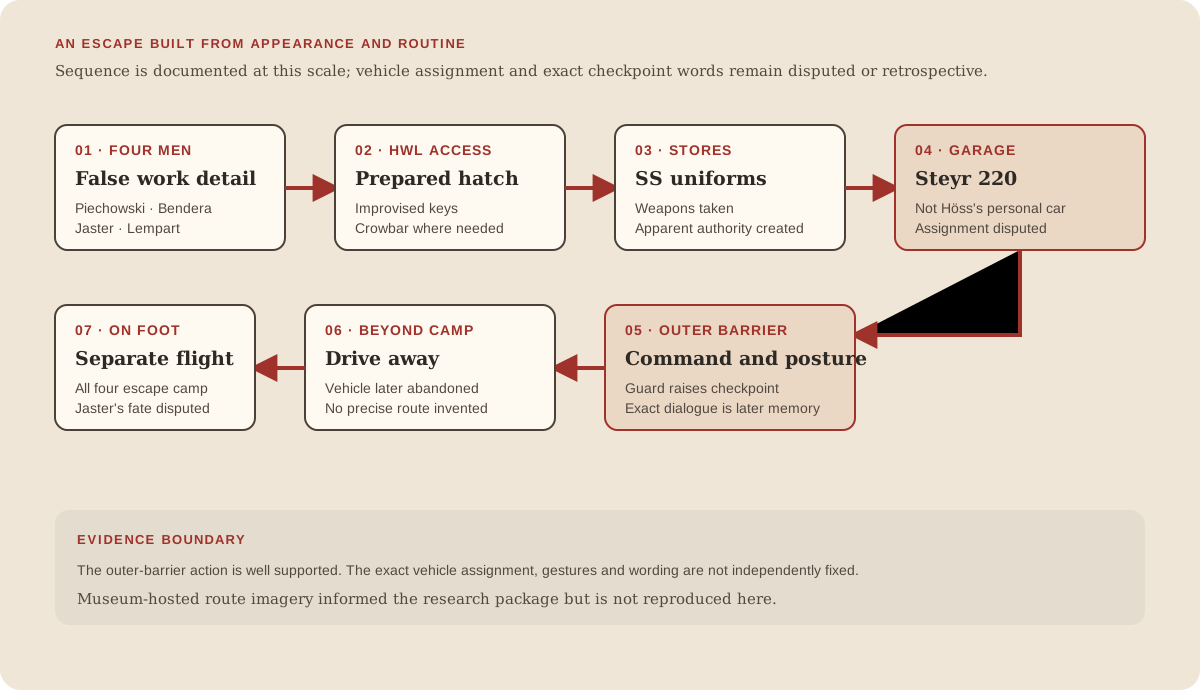
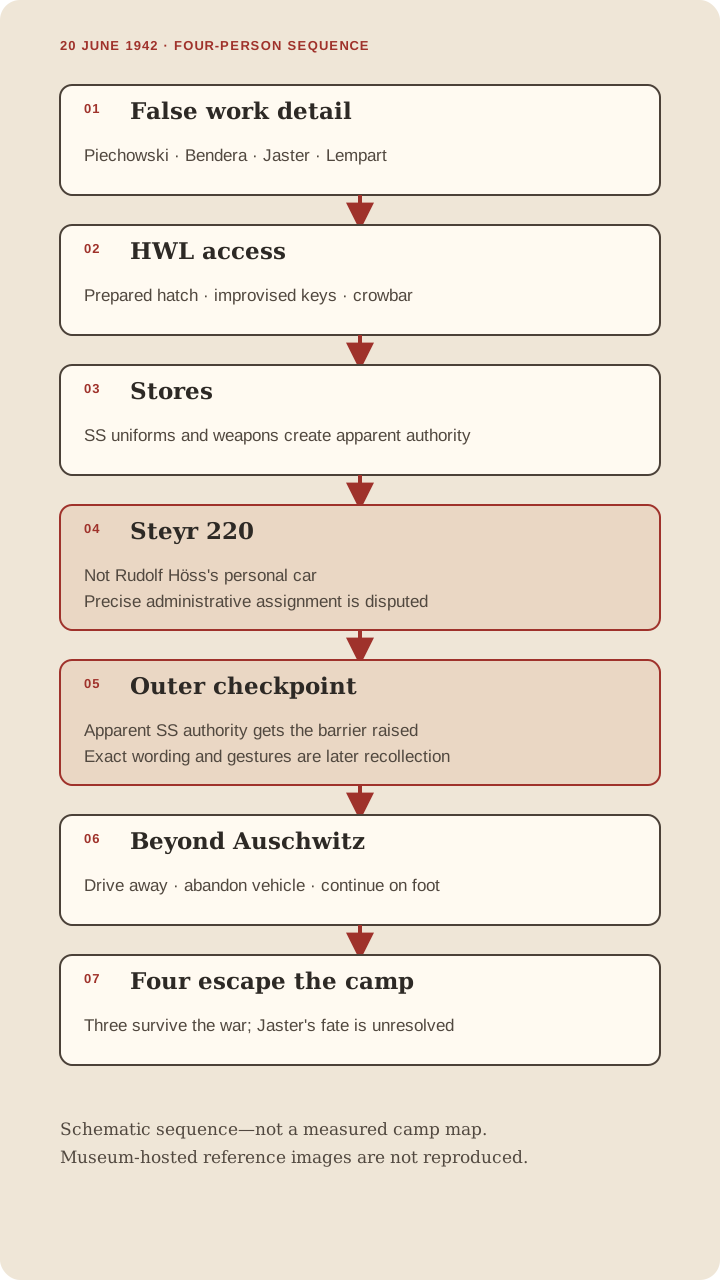
- 01
Work detail
Four prisoners adopted a false HWL work-detail pretext.
- 02
Access
A prepared hatch and improvised keys opened the supply route; a crowbar was used where a key was insufficient.
- 03
Impersonation
They obtained SS uniforms and weapons.
- 04
Vehicle
They took a Steyr 220 from the SS garage; its precise administrative assignment remains disputed.
- 05
Barrier
Apparent authority and German-language command caused the outer checkpoint to be raised.
- 06
Beyond Auschwitz
The men abandoned the car and continued the escape on foot.
How the four-man escape unfolded on 20 June 1942. Sequence based on Auschwitz-Birkenau Memorial archival reconstruction and survivor testimony. Positions are schematic, not a measured map; later recollections differ on vehicle assignment and exact checkpoint dialogue.
The Plan Was Built Around Saturday Routine
The date was useful.
According to the survivor accounts used by the Auschwitz Memorial, normal work in the SS supply facilities eased earlier on Saturday. The escapees intended to exploit that reduced activity while still moving through the camp in a form that looked ordinary.
Earlier on 20 June, Piechowski prepared an access point in the HWL area by loosening or removing the fastening that prevented a hatch from being opened. After the men were returned to the prisoner camp around midday, they regrouped and then approached the gate as a four-man work detail.
This first deception was essential.
They were still dressed as prisoners. If guards checked the supposed work assignment too carefully, the escape could end before the uniforms or car ever entered the story. Piechowski later recalled reporting the group as a Rollwagen work detail with himself as foreman. The guard let them pass.
From there the four moved toward the SS supply complex.
The HWL itself was closed. The prepared hatch gave them a way into the basement or coal-storage area. Once inside, the men still faced locked internal spaces. Bendera’s testimony describes improvised keys used to open doors. At the weapons store, where a padlock presented a different obstacle, they used a crowbar.
Now the deception changed form.

From Prisoners to the Appearance of SS Men
Inside the storeroom, the men put on SS uniforms and took weapons. Survivor testimony also mentions ammunition and other supplies. Piechowski had prepared insignia so that his uniform would signal officer status.
The visual hierarchy mattered.
Four men simply wearing German clothing were not enough. At a guarded barrier, the driver, passengers, weapons, posture, language, and apparent rank all had to tell the same story quickly enough that a real SS guard would obey before he had reason to investigate.
Bendera, meanwhile, went to the garage.
His work as a mechanic made his movement around vehicles less conspicuous than it would have been for another prisoner. He brought the Steyr 220 to the supply building, then changed from prisoner clothing into SS uniform. The other men loaded weapons and climbed into the car.
The popular version of the story often says they stole Rudolf Höss’s car, or the commandant’s own car. That version does not survive close source comparison.
Bendera’s 1962 testimony, as presented by the Auschwitz Memorial, explicitly rejected the idea that the vehicle belonged to Höss and associated the Steyr with HWL chief Paul Kreutzmann. Piechowski, interviewed decades later, also rejected the Höss story but remembered the assignment differently: he said Kreutzmann had another car and that the Steyr used in the escape was at the disposal of the camp leadership.
The safest conclusion is therefore narrow: the escapees took a Steyr 220 from the SS garage; it was not Rudolf Höss’s personal car; its exact administrative assignment is reported differently by the two principal survivor accounts. That uncertainty does not affect the mechanism of the escape.

The Outer Barrier
Once the car began moving, the men were no longer trying to slip unseen through the camp system. They were trying to be seen and misread.
An SS vehicle carrying armed men in SS uniforms was expected to receive different treatment from a group of prisoners. The escape depended on guards interpreting the scene according to the camp’s own hierarchy.
The Auschwitz Memorial’s reconstruction states that at the checkpoint of the outer or “large guard chain,” Piechowski used the authority of the senior-looking uniform and German commands to make the guard raise the barrier.
Later retellings often turn this into the most theatrical moment of the story. Piechowski himself, in interviews many decades afterward, supplied vivid details: a barrier that remained down, mounting tension, a shouted command, and his hand moving toward a holster. Those recollections are valuable testimony, but the exact wording and second-by-second choreography should not be presented as if someone recorded them on 20 June 1942.
What is secure is more important. The barrier was raised. The Steyr passed through. Four prisoners who had entered the SS supply area in camp clothing were now beyond the Auschwitz guard system dressed as their captors.
Getting Out of Auschwitz Was Not the End
The car could only solve the first part of the problem.
German authorities reacted to the disappearance, and surviving Auschwitz records document the escape. The four men still needed distance, civilian clothing or cover, food, safe contacts, and ways to avoid a search.
The Auschwitz Memorial states that the Steyr later failed near Maków Podhalański, after which the escapees continued on foot. Piechowski’s much later recollection gives additional detail about getting lost and ultimately abandoning the damaged vehicle. Because the exact road sequence varies in retelling, a modern reconstruction should not draw a precise GPS-style route from the camp to the abandonment point unless each segment can be independently established.
The group eventually divided.
Piechowski and Bendera reached the Kielce region. Piechowski joined the Home Army (Armia Krajowa) and spent the remainder of the war with partisan forces. Bendera survived under false papers and worked as a mechanic connected with Organisation Todt in occupied Soviet territory before returning to Poland.
Lempart found shelter in the area near Maków Podhalański and survived the war.
Jaster’s role after the escape was historically important in another way. He carried a report from Witold Pilecki’s Auschwitz resistance network toward Home Army headquarters, helping move information from inside the camp to the Polish underground.
Jaster later joined the underground unit Kosa-Osa and disappeared in Warsaw in 1943. Older postwar accounts accused him of being a Gestapo agent and betraying fellow resistance members. Modern archival scholarship has challenged the certainty with which that accusation was repeated. The Auschwitz Memorial itself describes the circumstances of his death as not fully explained.
Jaster cannot be labeled a traitor as established fact.
Reprisals: A More Complicated Outcome Than the Legend
Escape stories from concentration camps can become distorted when success is measured only by whether the escapees themselves stayed free.
Auschwitz’s system of punishment made flight dangerous for people who never attempted to leave. The Museum’s detailed lesson notes that, for reasons that remain unclear, this escape did not produce the kind of major camp-wide reprisal that might have been expected.
That does not mean there were no consequences for anyone else.
Jaster’s parents were later imprisoned in Auschwitz and both died there. Broader Auschwitz history also shows that the SS sometimes punished relatives or other prisoners after escapes. The evidence does not support saying that there were no reprisals. The four-man escape did not trigger a known major collective punishment across the camp, while the consequences for individual family members were severe.
Evidence discipline
What the record supports
Status labels distinguish secure conclusions from uncertainty and rejected claims. Color is never the only signal.
DOCUMENTED
The escape took place on 20 June 1942 and involved Piechowski, Bendera, Jaster and Lempart.
The Auschwitz Memorial identifies the four men and date, and the event is supported by surviving camp records referenced in its educational reconstruction.
Sources: SRC-001, SRC-002MYTH
The escape car was Rudolf Höss's personal car.
Both Bendera's postwar testimony and Piechowski's later interview reject the Höss-car story. The vehicle was a Steyr 220 taken from the SS garage.
Sources: SRC-001, SRC-005DISPUTED
The Steyr 220 was specifically Paul Kreutzmann's assigned vehicle.
Bendera's testimony and the Auschwitz Memorial associate the Steyr with HWL chief Paul Kreutzmann. Piechowski later recalled that Kreutzmann had a different car and that the Steyr was at the disposal of camp leadership. The exact administrative assignment should therefore remain qualified.
Sources: SRC-001, SRC-005WELL-SUPPORTED
Piechowski used the apparent authority of an SS officer at the final barrier and the guard raised it.
Institutional reconstruction and Piechowski's later testimony agree on the mechanism. The exact wording of his shouted command and the second-by-second gestures come from later recollection.
Sources: SRC-001, SRC-005, SRC-009LATER CLAIM
Bendera initiated the escape because he had learned that he was marked for death.
Piechowski described this warning in a later interview. The research set used here does not independently document the alleged death list.
Sources: SRC-005MYTH
The escapees sent Rudolf Höss a mocking thank-you letter for the car.
Piechowski explicitly rejected this wartime/postwar story in his later interview.
Sources: SRC-005DISPUTED
Stanisław Jaster was a Gestapo informer responsible for betraying the Kosa-Osa underground.
The accusation became established in parts of postwar historiography, but later archival scholarship has challenged the evidentiary basis and the Auschwitz Memorial describes Jaster's death as not fully explained.
Sources: SRC-001, SRC-007Evidence, Memory, and the Parts That Became Legend
The Piechowski escape is unusually well suited to careful reconstruction because several kinds of evidence survive together: camp records documenting the disappearance, institutional historical work, survivor testimony, and later interviews. They do not all have the same evidentiary weight.
Was it Rudolf Höss’s car?
No.
Both Bendera’s testimony and Piechowski’s later interview reject that popular claim. They disagree over whether the Steyr was specifically associated with Paul Kreutzmann or more generally assigned to camp leadership, but neither supports the familiar “Höss’s car” version.
Did Piechowski shout a dramatic threat at the final guard?
The use of SS authority to get the barrier raised is well supported. The exact words are later recollection.
Piechowski gave vivid versions of the exchange many years after the event. They should be presented as testimony, not as a verbatim contemporaneous record.
Did the four send Höss a mocking thank-you letter afterward?
Piechowski said this was a myth.
In his later interview he specifically rejected the story that the escapees sent Höss a note thanking him for the car.
Was Bendera escaping because he had learned he was marked for death?
That is a later claim from Piechowski’s recollection.
It is plausible and important to the way Piechowski remembered the plan’s origin, but the surviving evidence used here does not independently document such a list.
Was Stanisław Jaster a Gestapo informer?
Disputed.
The accusation became influential in later historiography, but modern research by historian Daria Czarnecka has shown how the image of Jaster as a traitor was constructed and repeatedly reproduced, and the surviving archival picture does not justify presenting the charge as settled fact.
Why the Escape Worked
The escape succeeded because it attacked the camp’s procedures rather than its strongest defenses.
The men did not try to overpower the entire guard system. They moved through successive layers by appearing to belong there.
Their work assignments provided knowledge and access. Bendera’s mechanical role connected the group to the garage. The prepared hatch solved the problem of entering a closed building. Improvised keys solved ordinary internal locks; a crowbar solved the lock that keys could not. Stolen uniforms and weapons changed how the men would be interpreted. The Steyr changed them from prisoners moving on foot into an apparently legitimate SS party. Piechowski’s German and visible rank gave the final deception an authority the checkpoint guard was conditioned to recognize.
The plan also divided risk into stages. Failure at any one stage could have been fatal, but no single stage required the four men to defeat Auschwitz by force.
That is what makes the case more than a story about nerve at a gate. It was an escape built from two years of forced familiarity with the system that imprisoned them.
What Came After
Piechowski survived the war, but freedom from Nazi captivity did not end his imprisonment.
After returning to Poland, he was arrested by the communist security apparatus because of his unregistered Home Army service and was sentenced to ten years in prison. He served seven years. He later completed engineering studies, worked at the Gdańsk Shipyard, wrote about his Auschwitz experience, and became a prominent witness to the camp’s history. He died in 2017.
The 1942 escape also entered documentary and popular culture, most notably through Marek Tomasz Pawłowski’s film Uciekinier (The Escapee).
Its enduring power is easy to understand. Four prisoners drove through a system built to hold and kill them while dressed in the uniform of the organization that controlled it.
But the strongest version of the story is not the most embellished one. It is the documented sequence: a false work detail, a prepared hatch, improvised keys, a forced weapons-store lock, stolen uniforms and weapons, a Steyr 220 from the SS garage, and a final act of impersonated authority at the barrier. The legend is extraordinary.
The evidence is better.
Selected chronology
Work detail, impersonation and escape
Piechowski enters Auschwitz
Kazimierz Piechowski is imprisoned at Auschwitz and receives prisoner number 918.
The four-man escape begins
Piechowski, Bendera, Jaster and Lempart leave the main camp as a work detail and enter the HWL supply area.
Uniforms, weapons and vehicle are taken
The men enter the stores, change into SS uniforms, take weapons and depart in a Steyr 220 from the SS garage.
The outer checkpoint is passed
The disguised prisoners use the apparent authority of an SS vehicle and senior uniform to get the barrier raised and leave the guarded Auschwitz zone.
Jaster carries Pilecki's report
Stanisław Jaster takes a report produced by Witold Pilecki's Auschwitz resistance network toward Home Army headquarters.
Jaster dies in disputed circumstances
Jaster disappears and dies after joining the Polish underground; later accusations against him remain contested in modern historiography.