
Mikhail Bakunin escaped Siberia in 1861 by going in what looked like the wrong direction.
Western Europe lay thousands of miles to the west. Bakunin instead traveled east from Irkutsk toward the Amur River and the Pacific coast. He crossed from Russian transport to an American merchant ship, moved through newly opened Japanese ports, sailed to California, crossed Panama, reached New York and Boston, crossed the Atlantic, and arrived in London before the year was over.
It was one of the nineteenth century's most geographically extraordinary political escapes. It was also unlike the prison breaks for which the word "escape" is usually reserved. Bakunin did not cut bars or climb a wall. He turned the limited freedom of political exile into a route beyond the Russian Empire.
At a Glance
- Escape period: 17 June–27 December 1861, using New Style/Gregorian dates
- Starting point: Irkutsk, Eastern Siberia, Russian Empire
- Escapee: Mikhail Alexandrovich Bakunin
- Status: Political exile under imperial supervision
- Core method: Use authorized eastward travel as cover, then leave Russian-controlled transport for foreign shipping
- Pacific route: Russian Far East → Japan → San Francisco
- American route: San Francisco → Panama → New York → Boston/Cambridge → New York
- Final leg: New York → Liverpool → London
- Outcome: Successful escape; Bakunin rejoined Alexander Herzen and Nikolai Ogarev in London
Twelve years away from political life
By 1861 Bakunin had been removed from European revolutionary politics for more than a decade.
He had participated in the revolutionary upheavals of 1848 and in the Dresden uprising of May 1849. Arrested afterward, he passed through Saxon and Austrian custody, received death sentences that were commuted, and was ultimately handed over to the Russian Empire in 1851. He spent years in the Peter and Paul Fortress and then Shlisselburg Fortress.
In 1857 the Russian government changed the form of his punishment. Bakunin was sent into permanent exile in Siberia rather than kept in a fortress cell.
Siberian exile was coercive, but it did not necessarily mean close imprisonment. The Russian Empire used exile in different ways, and Bakunin's social background, family connections, and personal relationships gave him freedoms that many other exiles did not possess. He first lived in the Tomsk region and later obtained permission to move to Irkutsk.
There he entered a world very different from his years behind stone walls. He married Antonia Kwiatkowska. He found work. He met officials, merchants, and members of the expanding society of Eastern Siberia. Most importantly for the future escape, he became familiar with the transformation taking place along the Amur and the Russian Pacific frontier.
The geography that was supposed to isolate him from Europe eventually provided another way back to it.

Why escape east?
A direct journey west would have taken Bakunin toward the administrative heart of the Russian Empire. Roads, settlements, and officials would carry him through territory in which his identity as a political exile could become a barrier at almost any stage.
The east offered a different possibility.
During the 1850s, Russian expansion had dramatically increased traffic along the Amur and toward the Pacific. Governor-General Nikolay Muravyov-Amursky championed that expansion. Bakunin, who was related to Muravyov through family connections and knew him personally, followed developments in the region closely.
At the same time, Japan was being drawn into a new international maritime system. Hakodate and Yokohama were among the ports opened to foreign shipping under the treaties of the 1850s. American merchant vessels now appeared in waters that had previously offered a political exile in Siberia little practical connection to the wider world.
If Bakunin could reach the Pacific under legitimate cover, the direction of travel could change completely. What began as an authorized journey inside the Russian Empire could become passage on a foreign ship.
The escape depended on reaching that transition before the bureaucracy understood what he was doing.
Permission became the first escape tool
By 1861 Muravyov was no longer governor-general. His successor, Mikhail Korsakov, inherited an Eastern Siberian administration in which Bakunin still possessed valuable personal connections.
Bakunin sought permission to travel down the Amur toward the coast. The journey could be explained as legitimate business. He obtained commercial commissions and money from Siberian merchants, and Korsakov issued documentation giving him broad ability to use transport on the river system, on the understanding that he would return before navigation closed for the season.
Whether Korsakov suspected that Bakunin intended never to return remains uncertain.
There is no strong evidence that the governor-general knowingly authorized an escape. What can be established is that the permission was real and that Bakunin used it in a way the authorities had not formally intended.
That distinction explains why this was not a simple case of slipping away unnoticed. Bakunin began the journey openly.
He left Irkutsk on 17 June 1861 by the Gregorian calendar. Many biographies give 5 June instead. They are not describing different departures: the Russian Empire was using the Julian calendar, twelve days behind the Gregorian calendar in the nineteenth century.
The calendar problem follows Bakunin through much of the story and has helped make the chronology look less stable than it actually is.
Across Siberia toward the Amur
Older reconstructions place Bakunin first on an overland route through Kyakhta and then toward Sretensk, where river transport could carry him into the Amur system. The precise day-by-day course is less secure than the larger journey, but the direction is clear.
He was moving toward Nikolaevsk, near the mouth of the Amur.
The trip itself was immense. Siberia had already served the imperial government as the geography of punishment: distance was part of the sentence. Bakunin now used the empire's growing eastern transport network to convert that distance into momentum.
He did not yet need to present himself as a fugitive. His permission and business pretext allowed him to travel as someone who was expected eventually to come back.
By early July according to the Old Style chronology used in the classic biographies, he had reached Nikolaevsk. From there the problem changed. An official letter that made travel on the Amur possible did not automatically give him permission to leave Russian territory.
The Pacific was close, but the decisive boundary had not yet been crossed.
From Russian transport to an American ship
Bakunin obtained passage on the Russian government vessel Strelok, which was moving along the Siberian coast toward the Kastri area.
The surviving reconstructions differ slightly over the exact place at which he shifted vessels. That uncertainty matters on a map, but it does not undermine the basic event. Somewhere along the Russian Pacific coastal route, before the foreign ship finally departed Russian waters, Bakunin transferred to the American merchant sailing ship Vickery.
The Vickery was engaged in trade in the region and was heading toward Japanese ports.
This was the point at which the escape became much more difficult for Russian officials to reverse. Bakunin had moved from a journey theoretically governed by an imperial travel permit to a foreign vessel capable of carrying him beyond Russian jurisdiction.
Yet he was not instantly safe.
The Vickery still called at a Russian port, Olga, before leaving for Japan. Bakunin's confidence in moving among local officials during this phase became part of the legend of the escape, and later writers have debated whether some authorities were negligent, sympathetic, or quietly willing to let him go.
The evidence does not permit a clean answer. What is clear is that nobody stopped the ship from carrying him away.
Japan: beyond Siberia, but not beyond danger
Paul Avrich's New Style chronology places Bakunin's arrival in Japan on 16 August 1861.
Hakodate, on Hokkaido, was one of the Japanese ports recently opened to foreign vessels. Its significance in the escape was practical rather than symbolic. Bakunin had reached an international port where American shipping could move him farther from Russian control.
A famous later account places him in an extraordinary encounter there. According to Japanese and biographical reconstructions, Bakunin found himself at a shipboard meal with Iosif Goshkevich, the Russian consul. Rather than flee the encounter, Bakunin allegedly explained that his travels were authorized and that he intended eventually to return to Siberia by way of China.
The episode is plausible and has been treated seriously in specialist writing, but it does not rest on the same documentary foundation as the later Pacific crossing. The conversation should therefore remain what the evidence makes it: a striking later-supported episode, not a stenographic record.
More secure is the fact that Russian officials were attempting to trace him. Communication was slow. Orders and warnings had to travel through the same world of ships and dispatches that Bakunin himself was exploiting.
In a later age, telegraph connections could have collapsed the time between suspicion in Siberia and action in a foreign port. In 1861, distance still delayed information.
Bakunin moved south to Yokohama.
Yokohama and the opening of a Pacific route
Yokohama in 1861 was only a few years into its existence as an international treaty port. It was a rapidly developing foreign settlement linked to American and European maritime commerce.
For Bakunin, that commercial network supplied the next essential connection. On 17 September 1861, he boarded the American ship Carrington for San Francisco.
This leg is unusually well documented because another passenger, the English clergyman Frederick Pemberton Koe, kept a diary. Robert M. Cutler later published the relevant portions of that diary and demonstrated how valuable it is for the escape story.
Koe's account matters for more than color. It is the rare surviving testimony of someone who was physically traveling with Bakunin between Japan and the United States. It also records Bakunin speaking about the Siberian escape as something he had planned in advance.
On the Carrington, Bakunin was no longer relying on a Russian permit. He was crossing the Pacific as an international passenger.
The geography of the escape had changed again.
Four weeks across the Pacific
The Carrington took roughly four weeks to reach California.
Bakunin arrived at San Francisco in mid-October; Avrich's reconstruction gives 15 October 1861. A Bakunin letter from the city is often dated 3 October in editions preserving the Old Style calendar, another apparent contradiction resolved by the twelve-day difference.
From San Francisco, Bakunin immediately wrote to Herzen and Ogarev in London.
His letter provides one of the clearest first-person summaries of the escape. He reported that he had escaped Siberia, traveled along the Amur and the coasts and straits of the Russian Far East, crossed Japan, and reached San Francisco.
It also reveals a new problem. He was running out of money.
The escape nearly becomes a financial problem
Bakunin had financed the early journey partly through commercial advances and the resources available to him in Siberia. By California, those funds were exhausted.
Frederick Koe helped him.
Bakunin told Herzen and Ogarev that a generous man had lent him $250. Koe's diary complicates the figure: it records an intention to lend $250 but indicates that he ultimately provided $300.
The discrepancy is minor but instructive. Even unusually well-documented escapes contain small factual conflicts. The best conclusion is that Koe lent Bakunin roughly $250–$300 and that Bakunin's own immediate letter reported $250.
Without that money, the route to London would have become substantially harder.
Bakunin also asked Herzen to send money to New York so that he could afford the Atlantic passage. Escape had become less about avoiding police than about maintaining enough cash and connections to keep moving.
San Francisco to Panama
Bakunin stayed only briefly in San Francisco.
On 21 October, he boarded the steamship Orizaba for Panama. The ship reached the Pacific side of the isthmus on 24 October.
There was no Panama Canal. Travelers between California and the Atlantic had instead gained a transformative connection in 1855: the Panama Railroad, the first railway to span the isthmus from ocean to ocean.
Bakunin crossed Panama by rail.
The detail matters because modern retellings sometimes make his American journey sound like a transcontinental train ride across the United States. That was impossible in 1861; the first transcontinental railroad across the United States would not be completed until 1869.
Bakunin's route was maritime. California to Panama by ship, Panama by railroad, then the Caribbean and Atlantic coast by ship to New York.
After a delay on the Atlantic side, he boarded the Champion on 6 November.
A Civil War voyage to New York
The United States was several months into the Civil War.
Bakunin's fellow passengers on the Champion included Union military personnel and prominent men suspected of Confederate sympathies. The political conflict he encountered aboard ship became part of his evolving impressions of the United States.
For the escape itself, however, the important fact is simpler. On the morning of 15 November 1861, the Champion reached New York.
Bakunin registered at Howard House on lower Broadway. Five months after leaving Irkutsk, he was on the Atlantic side of North America.
He still did not sail immediately for Europe.
New York, Boston, and Cambridge
Bakunin used the American interval to reconnect with people from the revolutionary world he had left in 1849.
In New York he met German veterans of the 1848 revolutions, including Reinhold Solger and Friedrich Kapp. With introductions from these contacts, he traveled to Boston.
The Boston visit gives the escape an unusual afterlife in contemporary American records. Bakunin met reformers, politicians, and intellectuals. He went to Cambridge to see Louis Agassiz, the Swiss-born naturalist he had known in Europe.
On 27 November, Bakunin dined at Henry Wadsworth Longfellow's home in Cambridge. Longfellow recorded the visit in his diary and summarized the escape: Siberia, the Amur, an American vessel, Japan, California, and the crossing of the isthmus.
The diary entry is valuable because it shows the basic route being repeated by Bakunin himself only weeks after the journey.
Bakunin had considered visiting Washington. He did not go. By early December he had returned to New York, impatient to reach London and waiting for the money that would pay for the final ocean crossing.
The Atlantic
Once funds arrived, Bakunin booked passage on the City of Baltimore. The ship left New York on 14 December 1861.
Thirteen days later, on 27 December, Bakunin reached Liverpool and continued to London.
There he appeared at the home of Alexander Herzen, the Russian exile writer and publisher, and Nikolai Ogarev. Contemporary and later accounts remembered the arrival as an emotional reunion. Bakunin had last been an active participant in European revolutionary politics before his arrest in 1849.
Now he was back.
The escape had lasted more than six months from the departure from Irkutsk. Geographically, it had carried him eastward across Siberia, through the Russian Pacific frontier, across Japan, over the Pacific Ocean, through the Americas, and across the Atlantic.
He reached Europe from Siberia by traveling most of the way around the other side of the world.
Why the escape worked
Bakunin's success is easiest to understand when the escape is separated into four different security environments.
The first was Siberian administrative exile. Here he needed legitimate mobility. He obtained it through an authorized business journey and official travel documentation.
The second was the Russian Pacific frontier. Here the empire's great distances, fragmented communications, overlapping military and civil authority, foreign merchant traffic, and Bakunin's personal connections created opportunities. He moved through the system quickly enough that suspicion did not become effective detention.
The third was the Japanese treaty-port world. Once aboard foreign shipping and in ports connected to American commerce, he could continue westward geographically by traveling east across the Pacific.
The fourth was international transit. From Yokohama onward, police surveillance mattered less than money, ship schedules, and introductions. His most immediate crisis in California was not a guard at a door but the cost of continuing the journey.
Each phase required a different solution. That is why reducing the escape to "Bakunin fled Siberia by ship" misses most of what made it work.
Was there official collusion?
The role of Siberian officials remains one of the most persistent uncertainties.
Bakunin had unusually favorable relationships in Irkutsk. Korsakov's travel permission was broad. Warnings did not always arrive where they needed to arrive. Officers at the Pacific coast did not prevent him from moving onto foreign shipping.
That pattern has encouraged the argument that officials knowingly helped him.
It is possible that individual officials sympathized with Bakunin or chose not to ask difficult questions. It is also possible that bureaucratic weakness, personal privilege, and frontier informality explain much of what happened.
There is no firm evidence that Korsakov formally or secretly authorized Bakunin to disappear from the empire. The most defensible conclusion is that Bakunin exploited a system whose safeguards were weakened by distance and personal relationships. The precise amount of conscious assistance inside that system remains unknown.
A famous encounter that needs a qualifier
The alleged meeting with the Russian consul in Hakodate illustrates how the history of the escape can accumulate certainty over time.
The story is memorable: Bakunin, already fleeing Russia, finds himself face to face with an imperial representative and talks his way through the situation. It fits his reputation for audacity almost too perfectly.
Specialist research on Bakunin in Japan treats the episode as credible, but the evidence chain is later and more complicated than the documentary record for the Carrington, San Francisco, or the American leg. It belongs in the story only with that distinction intact.
The same rule applies to colorful claims about officials "winking" at the escape. Possibility should not be converted into conspiracy merely because conspiracy makes a better anecdote.
Not yet the Bakunin of the later anarchist movement
Bakunin is usually introduced today as one of the foundational figures of anarchism. That is historically reasonable as a description of his career as a whole, but it can distort the politics of 1861.
The man who reached London was already a famous revolutionary and a radical enemy of autocracy. He had advocated Slavic revolutionary causes, participated in the revolutions of 1848–49, and spent years in prison and exile because of his political activity.
His mature anarchist politics developed more fully after his return to Europe.
The escape therefore did not return a finished political philosopher to the stage. It returned a revolutionary whose most influential ideological period still lay ahead.
That is one reason the journey mattered beyond personal freedom.
The world that made the escape possible
Bakunin's route depended on changes much larger than one man's ingenuity.
Russia's expansion along the Amur had created transport links through territory once defined mainly by remoteness. Japan's treaty ports connected East Asia more directly to American shipping. Steamship services tied California to Panama and Panama to New York. The Panama Railroad turned a difficult tropical crossing into a regular interoceanic transit route.
At the same time, communications had not yet caught up with transportation. A person could sometimes travel faster than a warning about him.
That imbalance is central to the escape. The expanding nineteenth-century world was connected enough to carry Bakunin from Siberia to London, but not yet connected enough for Russian authorities to coordinate instantly across the Pacific.
He moved through that gap.
The route as the real reconstruction
Many famous escapes can be drawn as a building: cell, corridor, wall, gate. Bakunin's cannot.
Its architecture was global.
Irkutsk supplied the travel permission. The Amur supplied the eastward corridor. Nikolaevsk and the Russian coast brought him within reach of foreign shipping. The Vickery carried him into Japan. Yokohama connected him to the Carrington. San Francisco connected the Pacific to Panama. The Panama Railroad connected one ocean to another. New York connected the American journey to Liverpool. London returned him to the political network he had lost twelve years earlier.
No single step explains the escape. The chain does.
After London
Bakunin quickly resumed political work with Herzen and Ogarev. His views and alliances would change considerably during the years that followed, and his later conflicts with Karl Marx became part of the history of the international socialist movement.
Those later battles can overshadow what happened in 1861.
The escape itself belongs to an earlier moment in Bakunin's political development and to a specific moment in world geography. It was possible because a supervised exile could obtain permission to travel, because Russian authority became thinner toward the Pacific, because Japan had recently opened treaty ports, because American ships crossed the ocean, because a railway crossed Panama, and because money and personal contacts could keep a fugitive moving.
Bakunin did not escape Siberia by finding one weak point. He found a sequence of them across half the world.
Documentary reconstruction
Bakunin’s eastward route around the world
A case-local visual focused on the historical question that the surviving evidence can answer.
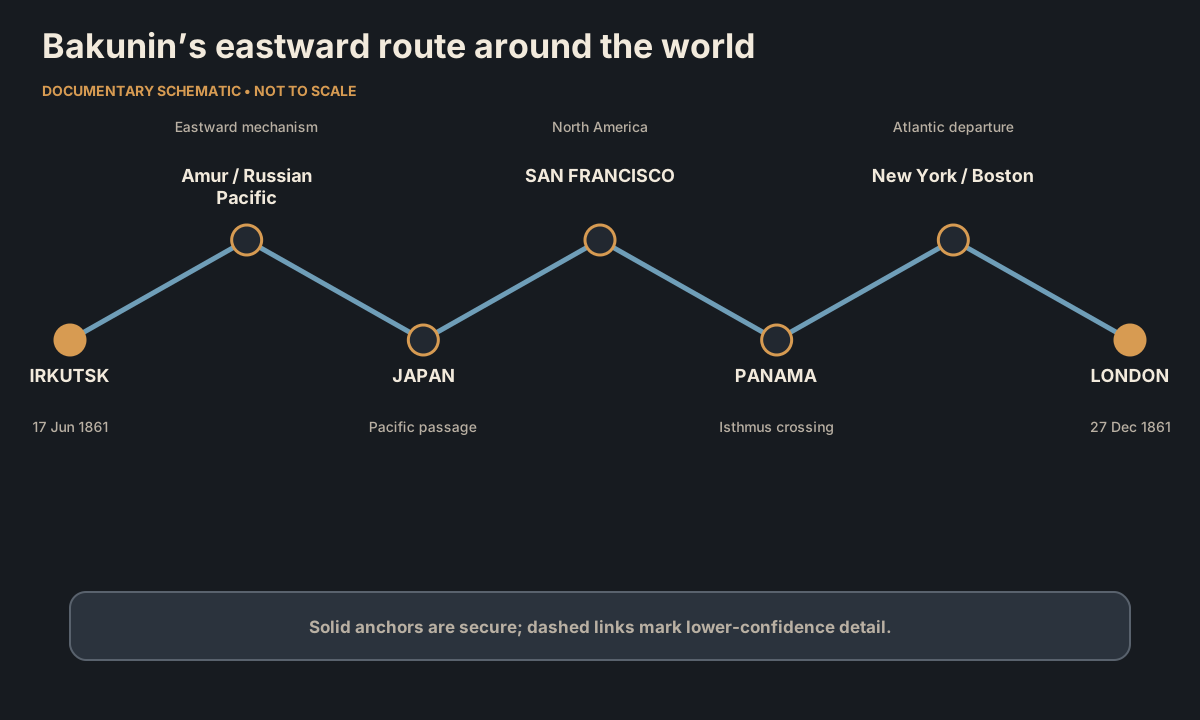
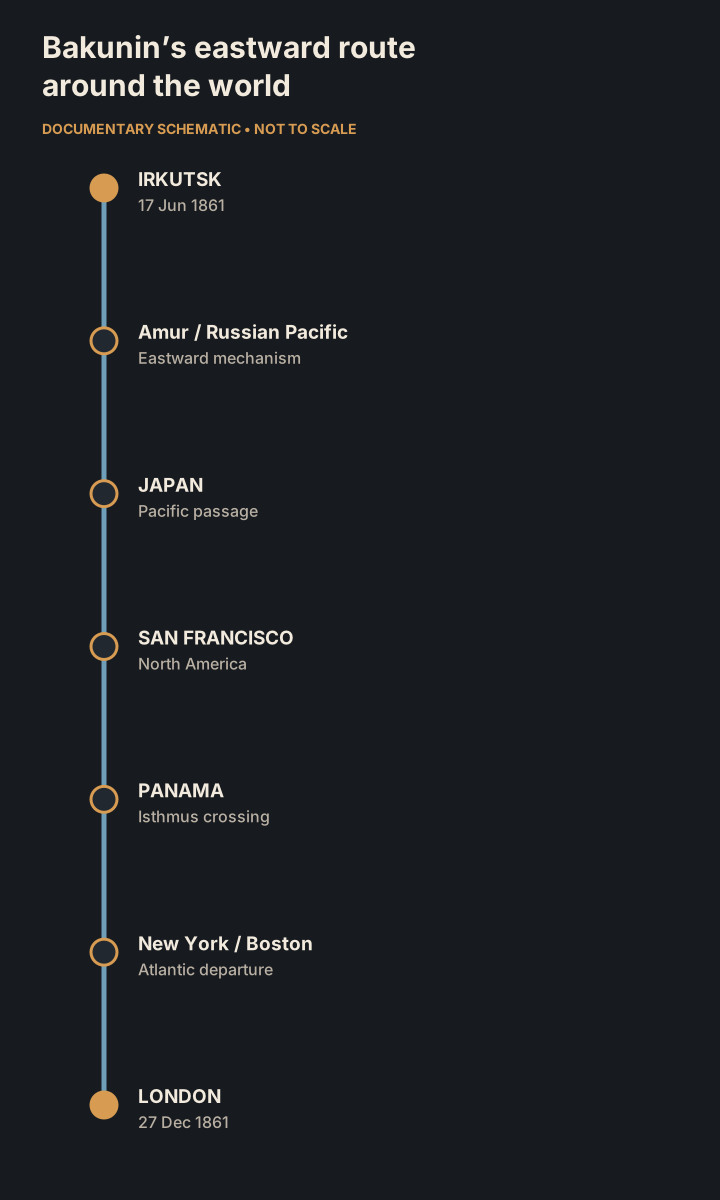
Simplified documentary reconstruction; not to scale. Evidence qualifications are written directly into the visual and explained in the adjacent text.
Evidence discipline
What the record supports
Status labels distinguish secure conclusions from uncertainty and rejected claims. Color is never the only signal.
DOCUMENTED
Bakunin escaped from Irkutsk on either 5 June or 17 June 1861.
The dates reflect calendar conventions rather than two competing events. 5 June is the Julian/Old Style date and 17 June is the Gregorian/New Style equivalent used by Avrich.
Sources: SRC-004, SRC-006, SRC-007DOCUMENTED
Bakunin's San Francisco letter is inconsistently dated 3 October and 15 October 1861.
The difference is again explained by Old Style and New Style dating. The public timeline uses 15 October New Style.
Sources: SRC-001, SRC-006UNKNOWN
Governor-General Korsakov knowingly helped Bakunin escape the Russian Empire.
Korsakov gave Bakunin unusually broad travel permission, but there is no hard evidence that he deliberately authorized flight abroad. Lower-level sympathy or noninterference is possible but cannot be precisely established.
Sources: SRC-004, SRC-005, SRC-007LATER CLAIM
Bakunin personally talked his way past the Russian consul at Hakodate.
The episode appears in specialist Japanese and biographical reconstruction, but it is not supported by the same direct primary documentation as the Carrington voyage and American leg.
Sources: SRC-004DISPUTED
Frederick Koe lent Bakunin exactly $250.
Bakunin's own letter reports $250. Koe's diary records an intention to lend $250 but indicates that the final loan was $300.
Sources: SRC-001, SRC-003, SRC-006MYTH
Bakunin crossed the United States by transcontinental railroad.
No transcontinental U.S. railroad existed in 1861. Bakunin sailed from San Francisco to Panama, crossed the isthmus by rail, and then sailed to New York.
Sources: SRC-006, SRC-011UNKNOWN
Bakunin's escape can be assigned one exact mileage, commonly around 25,000 miles.
Published estimates depend on which inland, coastal, and ocean routes are measured. The broad scale of the journey is secure, but an exact total would create false precision.
Sources: SRC-004, SRC-006MYTH
Bakunin escaped Siberia as the fully developed anarchist theorist known from his later career.
He was already a famous radical revolutionary and anti-autocratic political exile, but his mature anarchist doctrine developed more fully after his return to Europe.
Sources: SRC-005, SRC-009, SRC-010