
At a Glance
- Date: 21 August 1902
- Place: Verkholensk, Irkutsk Governorate, Russian Empire
- Escapee: Lev Davidovich Bronstein, later known as Leon Trotsky
- Captivity type: Police-supervised political exile
- Main method: Concealment, underground assistance, false identity papers, and rail travel
- Key obstacle: Distance from European Russia and continuing police surveillance
- Outcome: Reached western Europe and arrived in London by early October 1902
In August 1902, Lev Bronstein was living thousands of kilometers from the political centers that mattered to him. The twenty-two-year-old revolutionary had been sent into eastern Siberian exile after prison sentences connected to the South Russian Workers' Union. He was watched by the authorities and restricted in where he could live, but he was not behind prison walls. That distinction shaped both the problem and the solution.
Bronstein escaped from Verkholensk with the help of other exiles and an underground network. He left concealed in a cart, obtained new clothes and a false passport, took the railway west, and eventually crossed into Europe. Somewhere in that process he began traveling under a surname that would become far more famous than Bronstein: Trotsky.
Exile without prison walls
Tsarist political exile could be severe without looking like conventional imprisonment. Bronstein and his wife, the revolutionary Alexandra Sokolovskaya, were sent to Irkutsk Governorate in 1900. They lived first around Ust-Kut and later in Verkholensk, moving within the exile system rather than occupying a locked cell or fenced camp.
The conditions were isolating and often materially difficult. Trotsky later described primitive lodgings, Siberian cold, mud, insects, and the long distances separating exile settlements from the main centers of the empire. Archive-based research also shows that the family's finances could be strained despite a state allowance. At the same time, political exiles could live with family, seek work, read and write, request transfers, and sometimes receive official permission to travel.
Bronstein used that limited space. He wrote articles for the legal Irkutsk newspaper Vostochnoye Obozreniye, studied Marxist controversies, and took part in the intellectual life of the exile colony. The government intended distance and police supervision to separate political activists from the organizations they had helped build. Yet the exile settlements themselves created networks of educated, politically experienced prisoners and former prisoners who exchanged information and maintained contacts beyond Siberia.
Verkholensk therefore presented a different security problem from a fortress or penal colony. A fugitive did not need to scale a wall. He needed to get beyond local surveillance, reach long-distance transport, acquire papers that could survive inspection, and move faster than official warnings.

Why escape became possible
By 1902, Bronstein had become increasingly interested in the revolutionary newspaper Iskra and in the effort to organize Russian Social Democrats across the empire. Siberian activists were linked to broader clandestine networks, including people who helped political exiles leave their assigned settlements. Archive-based research on Trotsky's Irkutsk years shows that the regional underground was capable of helping fugitives move out of exile and reconnect with party organizations.
Trotsky's later memoir presents his departure as a calculated choice made before autumn worsened the roads. His wife remained behind with their young children. Later accounts emphasize that Sokolovskaya supported his decision, but the surviving evidence does not permit a detailed reconstruction of their private conversation. What can be established is that Bronstein left while still under police supervision and that other revolutionaries assisted him almost immediately.
Leaving Verkholensk
Archival research dates Bronstein's disappearance from Verkholensk to 21 August 1902. Police realized by the next day that he had gone and sent a telegram toward Irkutsk describing the missing exile. His name was subsequently entered into a wanted circular on 1 September.
The physical departure is known mainly from Trotsky's memoir. He recalled leaving in a peasant cart with another political exile whom he identified only as "E.G." Later research identifies her as Evgenia Gurvich, a translator and revolutionary. The two were covered with hay and matting while the driver carried them away from Verkholensk.
Trotsky also described a simple deception intended to buy time: someone remained in his bed and played the role of a sick man so that his absence would not immediately be obvious. The detail fits the larger documentary chronology, in which police did not begin pursuing him until after he had already left the settlement. It should nevertheless be understood as a memoir detail rather than a surviving police description of the decoy itself.
Bronstein and Gurvich did not remain together for the entire journey. His account says they separated before reaching the railway. From that point, the escape ceased to be primarily an exercise in physical concealment and became a problem of identity, documents, and movement.
A passport and a new surname
Contacts in Irkutsk provided Bronstein with clothes more suitable for long-distance travel and with a false passport. Such papers mattered because a fugitive crossing the Russian Empire by rail could not simply rely on anonymity. Police notices, registration requirements, and identity checks made a usable name and document part of the escape mechanism.
In My Life, Trotsky wrote that the passport was made out in the name Trotsky, which he entered "at random." He added that he had no idea the name would remain attached to him for the rest of his life. The passage securely establishes that he adopted the name during the 1902 flight, but it does not explain where he first heard it.
A longstanding account fills in that gap. Grigory Ziv, who had known Bronstein in the revolutionary movement, later wrote that the surname belonged to a senior warder at the Odessa prison where Bronstein had previously been held. Early biography and later scholarly reference works repeat the same connection. Because Trotsky's own escape chapter does not make that identification, the warder origin is best treated as well supported rather than as an uncontested detail recorded by the escapee himself.
That distinction also removes a more dramatic but weaker version of the story. There is no need to claim that Bronstein stole the jailer's own passport. The better-supported account is that the underground supplied a false or blank passport and Bronstein supplied the surname.
West by rail
Once he reached the railway, distance could work in Bronstein's favor. The same transportation system that allowed the imperial state to administer Siberia also gave a properly documented traveler a route back toward European Russia. Trotsky's memoir describes taking the westbound Siberian railway, while archival scholarship provides useful points against which that recollection can be checked.
Bronstein reached Samara on 8 September 1902, according to research drawing on party correspondence and Irkutsk records. There he entered the Russian organization connected with Iskra. He was given another underground name, Pero, meaning "Pen," a reference to his reputation as a writer and polemicist.
Samara did not mark the end of the journey. Instead of proceeding directly to the border, Bronstein carried out assignments in Kharkov, Poltava, and Kiev. This part of the chronology matters because later summaries can make the escape sound like a continuous sprint from a Siberian settlement to London. In reality, the initial escape had succeeded well enough that he could be redeployed within the revolutionary underground before leaving the empire.
The distinction also helps explain what "escape" meant in this case. Getting out of Verkholensk removed Bronstein from immediate local supervision. Remaining free required new papers, safe contacts, transportation, and people willing to move him through successive jurisdictions.
Across the frontier
By early October, Bronstein was moving toward the western frontier. His memoir places the clandestine crossing in the region of Kamenets-Podolsk and Brody, using smugglers or guides familiar with the border. The exact crossing point should not be reconstructed more precisely than the sources allow.
Once beyond the Russian Empire, the journey passed through a network of socialist contacts in central and western Europe. Trotsky described reaching Vienna, where he was directed onward with help from Victor Adler, then traveling through Zurich and Paris before arriving in London. The major stages are consistent with later biographical reconstruction.
Nadezhda Krupskaya, Lenin's wife and a central member of the Iskra circle, later remembered that Trotsky arrived in London at the beginning of October after escaping from Siberia. Trotsky himself was uncertain of the exact day but also placed his arrival in that period. The independent recollection gives the western endpoint a useful second witness.
In London, Bronstein was brought into close contact with Lenin, Krupskaya, Julius Martov, and other figures associated with Iskra. He was already using the name Trotsky. The alias chosen for a false passport had become a political identity.
What the escape changed
The 1902 escape did not send Trotsky directly into the Bolshevik Party, because no such faction yet existed in the later sense. The famous split between Bolsheviks and Mensheviks emerged at the Russian Social Democratic Labour Party's 1903 congress. Describing the 1902 journey as an escape "to join the Bolsheviks" projects a later political division backward onto an earlier moment.
What the flight did accomplish was to move a young provincial revolutionary into the international circle around Iskra. That placed Trotsky among many of the people who would shape the next two decades of Russian revolutionary politics, even though their alliances and divisions would change repeatedly.
The escape also transformed a temporary document identity into a permanent public name. "Trotsky" did not begin as an ideological title or a carefully constructed political brand. It appears to have been selected for practical use on false papers, with later testimony connecting it to a remembered prison warder. Its permanence was an unintended consequence of a successful escape.
Evidence and limits
The broad sequence is unusually well anchored for a clandestine event. Irkutsk archival research supplies the date of disappearance, the police response, and later movements; party correspondence supports the Samara stage; Krupskaya corroborates the arrival in London. Trotsky's memoir then provides the most detailed description of the cart, the concealment, the decoy, the passport, and the border journey.
Those sources are not interchangeable. Trotsky wrote My Life decades after the escape, when he was an internationally famous political figure explaining his own past. Its scene-level detail is valuable but should not automatically be treated as a contemporary record. Conversely, police and party documents can establish dates and movements without explaining every practical decision made along the way.
For that reason, a reconstruction can securely show Verkholensk, Irkutsk, Samara, the Ukrainian cities where Trotsky carried out party work, the border region, Vienna, Zurich, Paris, and London. It cannot responsibly draw an exact road out of Verkholensk, identify every railway segment he used, or mark an exact point where he crossed the frontier.
Why it worked
Trotsky escaped because the exile regime combined real coercion with practical vulnerabilities. Police supervision depended on knowing where an exile was supposed to be and on transmitting warnings after a disappearance. A concealed departure and a decoy could create a head start before that administrative machinery reacted.
The underground then supplied what distance alone could not: transportation, clothing, papers, contacts, and successive destinations. Rail travel converted Siberia's enormous geography from an almost insurmountable barrier into a route that could be crossed quickly enough to stay ahead of local pursuit. By the time official notices were circulating, Bronstein was already moving through a network that extended far beyond Irkutsk Governorate.
The false passport was therefore only one part of the mechanism. The escape succeeded because concealment, identity, transport, and organization reinforced one another.
Aftermath
Trotsky remained abroad until the revolutionary crisis of 1905 drew him back to Russia. His political career would later include another Siberian exile and another escape in 1907, a separate episode that should not be confused with the first flight.
The 1902 escape stands on its own because it marks a transition in both geography and identity. Lev Bronstein left a remote Siberian settlement under police supervision and reached the European revolutionary underground within weeks. The name placed on his false passport traveled with him—and outlasted the document for which it had been chosen.
Documentary reconstruction
A westbound escape organized around a new identity
A case-local visual focused on the historical question that the surviving evidence can answer.
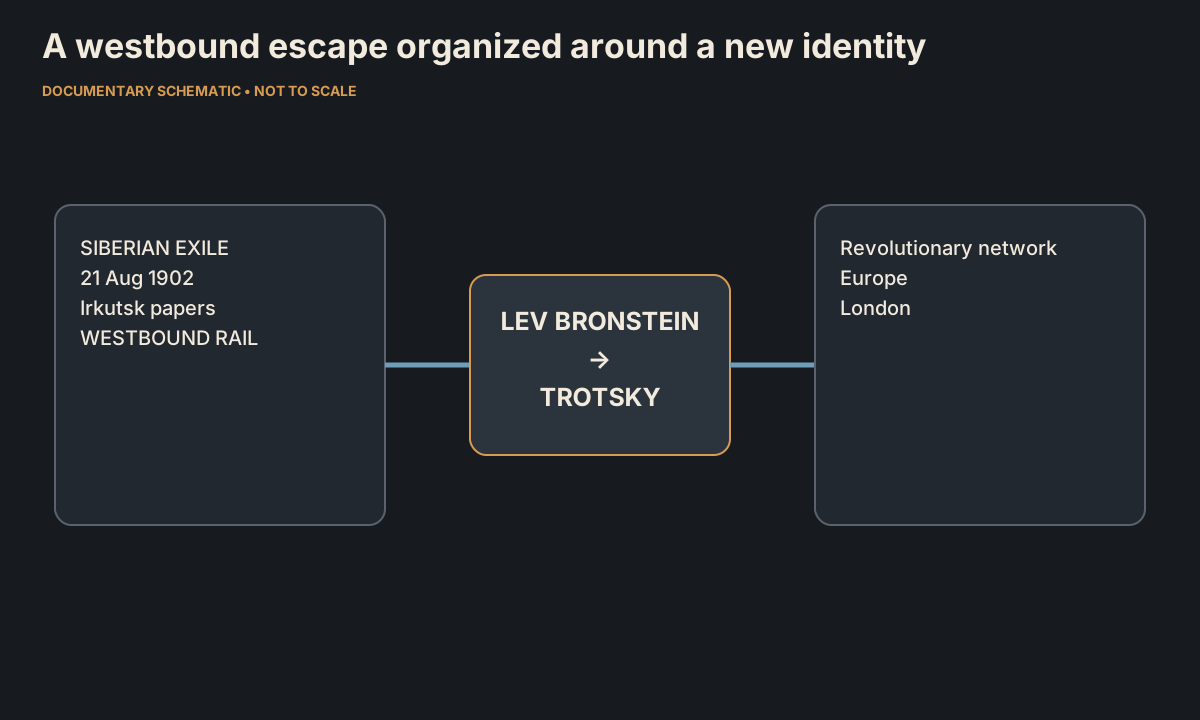
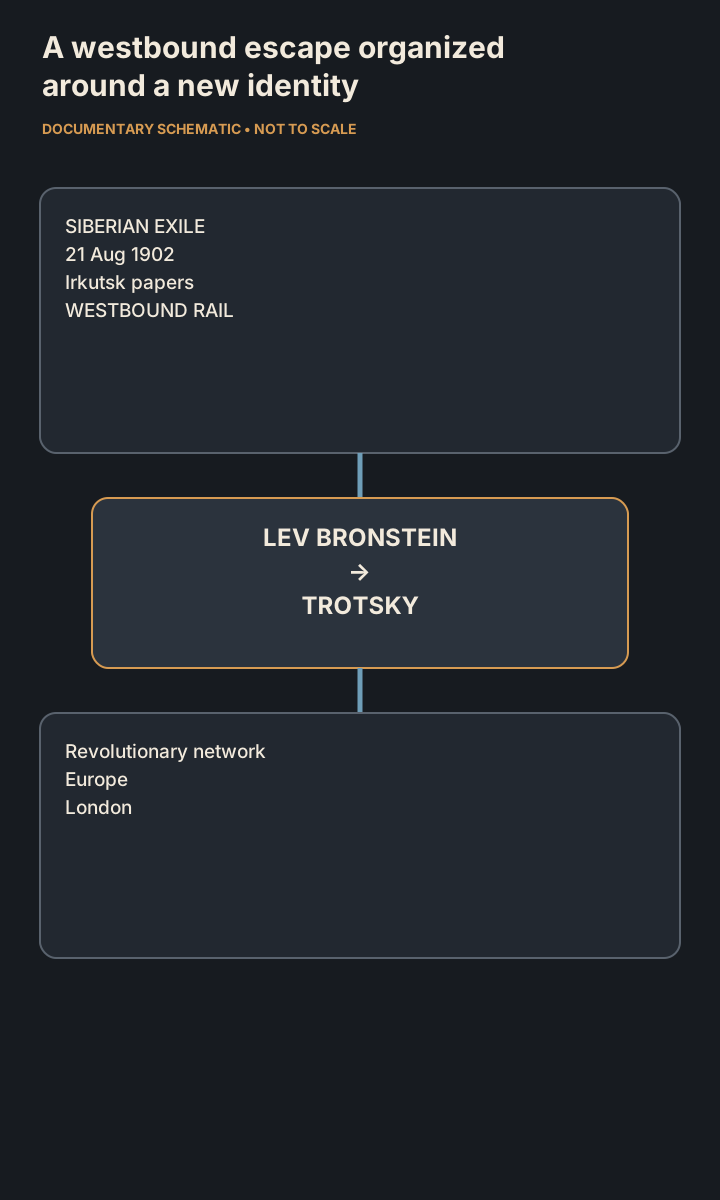
Simplified documentary reconstruction; not to scale. Evidence qualifications are written directly into the visual and explained in the adjacent text.
Evidence discipline
What the record supports
Status labels distinguish secure conclusions from uncertainty and rejected claims. Color is never the only signal.
DOCUMENTED
Bronstein left Verkholensk on 21 August 1902.
An archival study based on the State Archive of Irkutsk Region dates the escape to 21 August and records a police telegram after his absence was discovered.
Sources: SRC-005MYTH
The 1902 escape was a breakout from a Siberian prison camp.
Bronstein was in police-supervised administrative exile. He lived in civilian lodgings, could work and write, and could request transfers or official travel permission, although he remained under coercive state restriction and surveillance.
Sources: SRC-002, SRC-005MYTH
Bronstein stole an Odessa jailer's personal passport and escaped under it.
The better-supported account is that underground contacts supplied false or blank identity papers and Bronstein entered the surname Trotsky. Sources connecting the name to an Odessa warder do not establish that the document itself belonged to that warder.
Sources: SRC-003, SRC-005, SRC-007, SRC-008, SRC-009WELL-SUPPORTED
The surname 'Trotsky' came from an Odessa prison warder.
Early recollection and later biographical/reference works connect the surname with an Odessa prison warder. Trotsky's own escape chapter says only that he wrote 'Trotsky' into the passport at random and does not identify the surname's source.
Sources: SRC-003, SRC-007, SRC-008, SRC-009MYTH
Trotsky escaped directly from Siberia to London in order to join the Bolsheviks.
He stopped in Samara, worked through Kharkov, Poltava, and Kiev, crossed into central Europe, and only then reached London. The Bolshevik-Menshevik split did not occur until 1903; in 1902 he was joining the Iskra and Russian Social Democratic network.
Sources: SRC-003, SRC-004, SRC-005, SRC-006, SRC-009