
On the morning of 26 May 1986, a white Alouette II helicopter appeared over La Santé prison in Paris. Michel Vaujour, a repeat offender with a long history of escaping custody, reached the prison roof with another inmate. The aircraft was being flown by Vaujour’s wife, Nadine, who had learned to pilot helicopters before the attempt. Within minutes Vaujour was airborne, and the helicopter was heading away from the prison.
The spectacle has often been retold as a piece of criminal folklore: the “king of escapes,” a wife at the controls, and a helicopter over one of Paris’s best-known prisons. The documented story is more precise—and in places less cinematic. Nadine’s preparation stretched back years, the second prisoner did not leave with Vaujour, early reports misidentified at least one imitation weapon as real, and the escape ended exactly four months later in a failed bank robbery and a police shooting.
At a Glance
- Escape: 26 May 1986
- Prison: Maison d’arrêt de la Santé, Paris
- Escaped prisoner: Michel Vaujour
- Pilot: Nadine Vaujour
- Aircraft: Alouette II helicopter
- Immediate landing after the prison: football field at the Cité universitaire internationale in southern Paris
- Time at large: four months
- Recaptured: 26 September 1986, after a failed bank robbery in Paris
- Important source issue: contemporary and later accounts disagree over how to number Vaujour’s previous escapes and over exactly how the second prisoner came to remain behind
Vaujour at La Santé
By 1986, Michel Vaujour was already known to French police and prison officials for repeated robberies, convictions, and escapes. He had been imprisoned on and off since his youth and had previously broken custody several times. Contemporary reports described him as one of France’s most closely watched prisoners.
At La Santé he was serving an eighteen-year term, although newspapers did not always summarize the underlying convictions in exactly the same way. INA’s report on the day of the escape described the sentence as being for attempted homicide. UPI and other contemporary coverage linked the term to armed robbery and an attempted killing. A later Le Monde account noted that, because Vaujour had accumulated other sentences, his total remaining time in custody was substantially longer than eighteen years.
The variation matters because the same problem appears in accounts of his escape record. Some 1986 reports called the helicopter breakout his fourth escape. A 1988 court report called it his fifth, while later profiles counted his career differently again. The secure point is not the ordinal number: Vaujour had escaped repeatedly before 1986, and the La Santé breakout became the most famous of those episodes.
Nadine’s part was prepared outside the prison
The decisive preparation did not happen entirely inside La Santé. Nadine Vaujour acquired helicopter-flying skills before the escape, and the 1988 court report stated that she had obtained a helicopter pilot’s license in 1983 with the aim of helping her husband get out.
Contemporary police reporting also described a long preparation period. UPI reported the day after the escape that investigators believed the couple had been planning for years. Nadine had been renting helicopters regularly in the months before 26 May, giving her experience with the aircraft she would use and making her presence at an airfield less unusual.
Those preparations are historically important without needing to be converted into a modern security blueprint. The essential arrangement was a coordinated extraction: Vaujour would have to reach an exposed upper part of the prison while Nadine and an outside accomplice brought the helicopter into position above him.
26 May 1986
Shortly before 11 a.m., the Alouette II arrived over La Santé. First-day reporting and the later court account agree on the broad sequence: equipment was delivered into the prison area, Vaujour and another inmate used it to reach the roof, and the helicopter then hovered close enough for Vaujour to leave with it.
The details are less tidy. Le Monde’s first report identified the second prisoner as Pierre Hernandez. A later report from the 1988 trial printed the name as Pierre Fernandez. The earliest accounts said he tried unsuccessfully to get aboard; the later court version said a senior guard persuaded him not to continue. Because both descriptions come from serious reporting at different stages of the case, the sources support only the narrower conclusion that he reached the roof with Vaujour but remained at the prison.
There is a similar correction concerning the weapons. News reports on 26 and 27 May described an armed accomplice and, in some versions, a machine gun. By the 1988 prosecution for “escape by violence,” however, the court record described the weapon used to threaten guards as a plastic imitation resembling an assault rifle. Another imitation pistol was associated with the equipment sent into the prison. The early belief that a real automatic weapon had been used should therefore not be repeated as settled fact.
Vaujour’s final movement into the helicopter also appears differently in contemporary reports. One account described him being hoisted by a line; another said he got onto the aircraft’s skid. The court report favored the skid version. What is secure is the result: Vaujour alone left the roof with the helicopter, while the other prisoner remained behind.
A short flight across Paris
After leaving La Santé, the helicopter flew south and landed on the football field at the Cité universitaire internationale, near Porte d’Orléans. The aircraft was abandoned there. Vaujour, Nadine, and the unidentified outside accomplice then disappeared from the immediate scene.
The landing site was documented within hours. INA’s television report from 26 May showed the prison and covered the helicopter’s arrival at the Cité universitaire, while Le Monde and international wire reports gave the same destination. UPI reported that the helicopter reached the field about fifteen minutes after the escape.
That immediate flight is enough to establish the escape without reconstructing a tactical route over Paris. The historical importance lies in the coordination between a prisoner, a licensed pilot outside the prison, and an aircraft that could remove him from a rooftop faster than a conventional perimeter escape.
Four months at large
For the next four months, police searched for the couple. Contemporary authorities speculated about where they had gone, and later reporting repeated claims that they had traveled outside France. Those claims are not necessary to reconstruct the escape and are less securely documented than the beginning and end of the period at large.
The end came on 26 September 1986. Vaujour and accomplices attempted to rob a Crédit Lyonnais branch on rue Belgrand in Paris’s 20th arrondissement. Police encountered the group as they tried to leave. Gunfire followed.
Vaujour was struck in the head and seriously wounded. Police identified him through his fingerprints and tattoos. The bank’s money was recovered, and Vaujour was again in state custody—exactly four months after the helicopter escape.
Nadine was not captured with him at the bank. Le Monde reported that she was arrested early the following morning in Dordogne. Later summaries sometimes compress the recaptures into a single event, but the contemporary sequence is clearer: Michel was taken during the failed robbery in Paris on 26 September; Nadine was arrested separately on 27 September.
Vaujour survived the gunshot wound. He returned to prison and eventually spent many more years in custody before receiving conditional release in 2003.
What the later trial clarified
The helicopter escape returned to court in March 1988 because French law distinguished the simple act of escaping from violence or destruction used to accomplish it. The prosecution focused on threats made during the breakout.
That proceeding is especially valuable because it corrected some of the first-day reporting. The threatening rifle was described as plastic, not a genuine assault weapon, and the court account placed an unidentified accomplice aboard the helicopter with Nadine. It also confirmed that Nadine had trained as a pilot before the attempt and that she had been preparing an aviation-based escape well before May 1986.
The court report is not perfect. It uses “Fernandez” for the second inmate where 1986 reports used “Hernandez,” and it presents the episode with the benefit of hindsight. Still, for the nature of the imitation weapon and Nadine’s preparation, it is stronger than the confused descriptions published while the manhunt was beginning.
Not France’s first helicopter prison escape
Vaujour’s breakout is sometimes remembered as though it introduced helicopter escape to French prisons. It did not. Gérard Dupré and Daniel Beaumont had escaped from Fleury-Mérogis by helicopter in February 1981.
What made the Vaujour case distinctive was its setting and participants. La Santé sat inside Paris, Vaujour already carried a public reputation for repeated escape, and the pilot was his wife. The combination created an image that outlived the practical success of the operation, which lasted only four months.
French prisons subsequently adopted measures intended to make helicopter extractions harder, but those later security changes are not necessary to reproduce in operational detail. Historically, the case demonstrates how an outside aviation plan could briefly overcome a prison perimeter designed mainly around movement on the ground.
The escape in later memory
Vaujour’s life and repeated escapes later became the subject of Fabienne Godet’s documentary Ne me libérez pas, je m’en charge, released in France in 2009. The distributor’s synopsis states that he spent twenty-seven years in prison, seventeen of them in solitary confinement, and successfully escaped five times before his 2003 conditional release.
The film is useful for understanding how Vaujour later interpreted his own life, but it should not replace the contemporary record for the mechanics of 26 May 1986. Newspaper reporting from the day, the later criminal proceeding, and the September recapture reports establish a firmer chronology.
The La Santé escape succeeded in the narrowest sense: Michel Vaujour left a guarded Paris prison aboard a helicopter and stayed free for four months. Its lasting reputation came from the coordination behind it—especially Nadine Vaujour’s decision to become a pilot—and from the striking visual of an aircraft hovering over a prison roof. The documented ending is just as important as the famous departure: the escape did not end Vaujour’s imprisonment, and his freedom collapsed during another armed crime four months later.
Evidence discipline
What the record supports
Status labels distinguish secure conclusions from uncertainty and rejected claims. Color is never the only signal.
DOCUMENTED
Nadine Vaujour piloted the helicopter used to extract Michel Vaujour from La Santé.
Contemporary French and international reporting, INA footage metadata, and the later court account all identify Nadine as the pilot.
Sources: SRC-001, SRC-003, SRC-004, SRC-005MYTH
A genuine machine gun or assault rifle was used to threaten guards during the escape.
Initial reports described an armed accomplice and sometimes a machine gun, but the 1988 court account identified the threatening assault-rifle-like weapon as plastic. An imitation pistol was also described in the escape equipment.
Sources: SRC-003, SRC-005DISPUTED
The other prisoner on the roof tried and failed to board the helicopter.
First reports said he failed to get aboard; the later court report said a senior guard persuaded him to abandon the attempt. His presence on the roof and failure to escape are secure.
Sources: SRC-001, SRC-002, SRC-005MYTH
The 1986 La Santé breakout was France’s first successful helicopter prison escape.
Gérard Dupré and Daniel Beaumont had escaped Fleury-Mérogis by helicopter in February 1981.
Sources: SRC-008DISPUTED
The La Santé helicopter escape was definitively Vaujour’s fourth, fifth, sixth, or seventh escape.
Contemporary and later publications number his escapes differently. The event is better identified by place, method, and date than by an ordinal claim.
Sources: SRC-001, SRC-005, SRC-008, SRC-009DOCUMENTED
Vaujour remained free for four months after the helicopter escape.
He escaped on 26 May and was recaptured on 26 September 1986.
Sources: SRC-006, SRC-007Documentary reconstruction
A coordinated helicopter extraction
A case-local editorial visual separates the documented sequence from uncertainty without implying exact modern geography or operational detail.
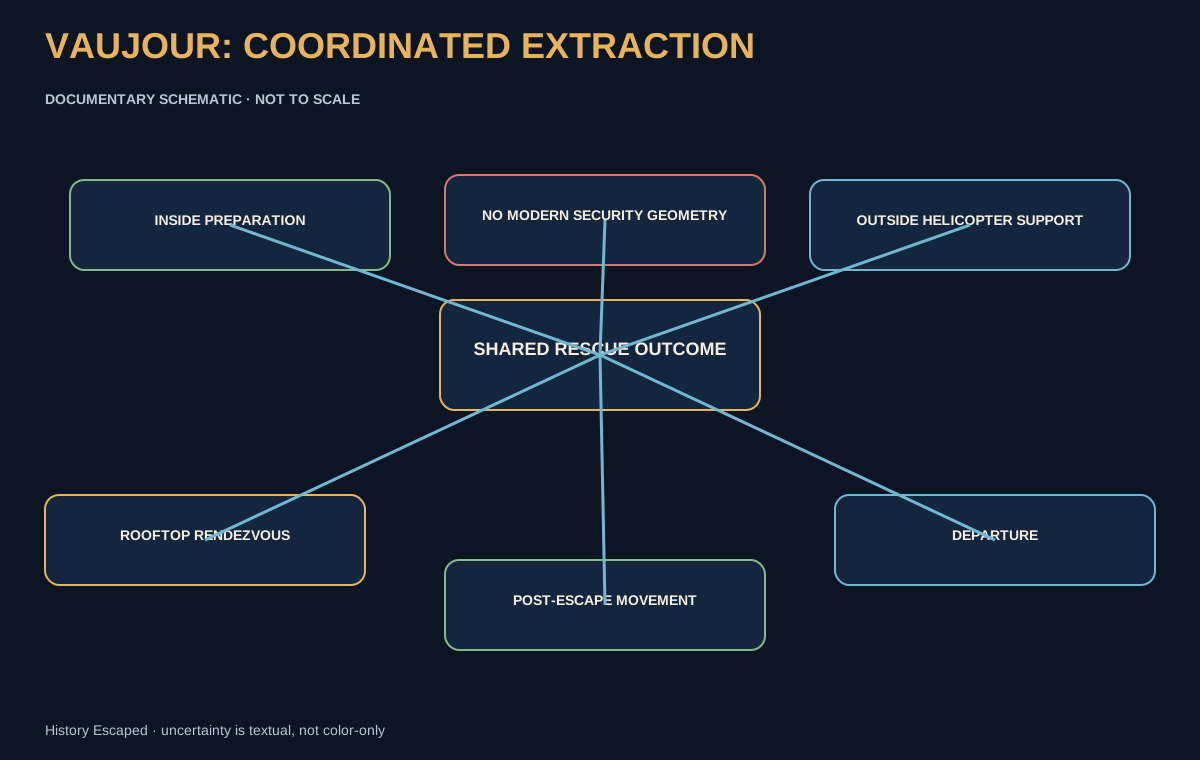
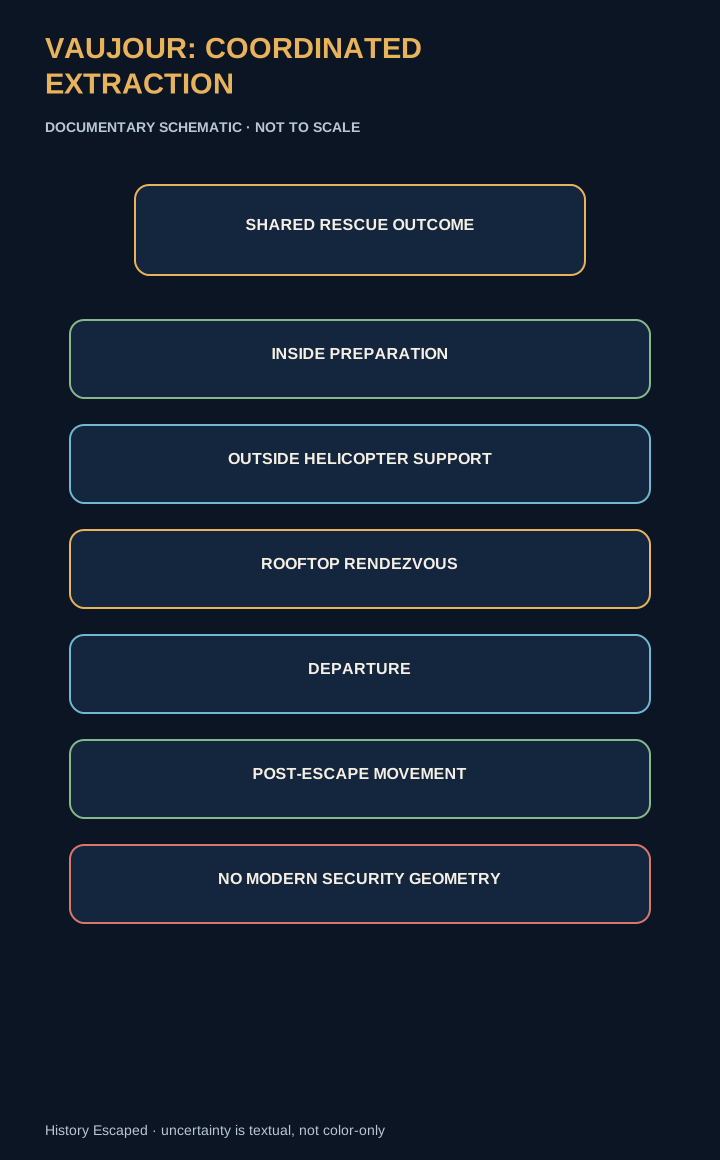
Simplified editorial reconstruction based on the cited historical record; not to scale. Uncertainty is stated directly in the visual and adjacent text.