
Vassilis Palaiokostas and Alket Rizai escaped from Greece’s Korydallos Prison by helicopter twice in less than three years. The first breakout, on 4 June 2006, involved a chartered helicopter whose pilot said armed accomplices forced him to fly to the prison. The aircraft entered the prison grounds, collected Palaiokostas and Rizai, and later landed near Schisto, where the escapees transferred to ground transport.
Both men were eventually recaptured. Then, on 22 February 2009, they escaped from the same prison by helicopter again.
The second breakout was not literally identical to the first. The aircraft did not need to settle inside the prison in the same way; contemporary reports instead describe a rope ladder lowered while the helicopter hovered over the prison area. Guards fired, the aircraft got away, and the pilot later said the charter had again been commandeered by passengers.
The repetition transformed the case from one remarkable jailbreak into a major institutional scandal. It also created a mythology around Palaiokostas that often overwhelms the basic facts. The two documented escapes, the coerced pilots, the criminal convictions surrounding the operations, and the unequal outcomes for the two fugitives are better established than the mythology that later grew around Palaiokostas.
At a Glance
- Prison: Korydallos Prison, Attica, Greece
- Escapees: Vassilis Palaiokostas and Alket Rizai
- First helicopter escape: 4 June 2006
- 2006 method: chartered helicopter commandeered by armed accomplices; aircraft entered the prison grounds and collected both prisoners
- 2006 immediate landing: near Schisto, close to the prison
- Rizai recaptured after first escape: 8 September 2006
- Palaiokostas recaptured after first escape: 20 August 2008
- Second helicopter escape: 22 February 2009
- 2009 method: chartered helicopter again commandeered; rope ladder used to lift the two men from the prison area
- Rizai recaptured after second escape: 16 November 2009
- Palaiokostas after second escape: not recaptured; Greek police later issued a €1 million reward and further arrest warrant
- Current public status: Greek reporting in 2026 still described him as an unresolved fugitive case
Korydallos and the two prisoners
Korydallos was Greece’s largest and most prominent high-security prison. By June 2006, Palaiokostas was serving a long sentence arising from kidnapping and robbery convictions. Rizai was serving a life sentence for homicide.
The pair were not historically important because they happened to share a prison. They became linked by the escape itself.
Palaiokostas already carried a public reputation as a bank robber and kidnapper. His elder brother Nikos was also a long-term fugitive and had himself escaped prison years earlier. That family history immediately shaped reporting about the 2006 operation, with early accounts strongly suspecting Nikos of organizing the helicopter pickup.
Later judicial proceedings complicated that simple story. A Piraeus appeals court eventually convicted Panayiot Papa of helping hijack the helicopter, while businessman Vassilis Stefanakos received a long sentence for complicity in the first breakout. Contemporary police reporting therefore supports an organized outside network, but not every early claim about exactly who occupied which seat or performed which task should be treated as settled.
4 June 2006
The first escape occurred on a Sunday evening. A private helicopter had been chartered from the Athens coastal area. According to the pilot’s account, two accomplices threatened him with firearms and a grenade and forced him to fly to Korydallos.
At about 6:25 p.m., the helicopter entered the prison grounds. Reports differ slightly over whether to describe the pickup point as the yard, grounds, or roof area. The strongest immediate Greek reporting says the helicopter landed on the prison grounds, while later international summaries often call it the exercise yard.
The distinction is not important enough to manufacture architectural precision. Palaiokostas and Rizai boarded. The aircraft then left Korydallos and landed near a cemetery at Schisto, a short distance away. The escapees and their outside accomplices departed by motorcycles.
The pilot was left behind. The entire event demonstrated that the prison’s high walls offered little protection against an attack from above.
What guards knew—and did not do
The government response began immediately. The prison governor and several guards were suspended, and Justice Minister Anastassis Papaligouras ordered an investigation. He publicly accused the prison administration of incompetence and lack of professionalism.
A second minister, Public Order Minister Vyron Polydoras, defended guards who had not fired at the helicopter. His argument was essentially a risk calculation: firing at an aircraft over a crowded prison created obvious danger.
That disagreement is historically useful because later retellings often reduce the first escape to guards simply “doing nothing.” The reality was more complicated. Authorities were surprised by an airborne extraction, and even after they understood what was happening, using firearms against a low-flying civilian helicopter carried risks to the pilot, prisoners and people on the ground.
What is clear is that the escape prompted promises that aerial security would be improved. Those promises made the events of 2009 much more damaging.
Recaptures after the first breakout
Rizai’s first period at large lasted about three months. On 8 September 2006, police arrested him at a house in Prodromos in Viotia. According to police, he surrendered after officers surrounded the property.
Palaiokostas remained outside custody much longer. He was arrested on the evening of 20 August 2008 at a property near Thessaloniki after police linked him to the kidnapping of industrialist Giorgos Mylonas. That arrest returned him to the prison system and ultimately to Korydallos.
By early 2009, Palaiokostas and Rizai were again in the same prison. They were also facing prosecution over the 2006 escape.
22 February 2009
The second escape took place on another Sunday afternoon. Contemporary Greek reporting places the helicopter over Korydallos shortly before 4 p.m. The aircraft circled the prison area and lowered a rope ladder.
Palaiokostas and Rizai climbed aboard. The exact pickup point varies in reporting. Some accounts say the roof; others describe the courtyard or exercise area. The prosecutor later conducted a helicopter reenactment specifically to examine the escape location.
Because the reports conflict, the evidence supports saying only that the men were lifted from the prison area by rope ladder; the exact architectural pickup point is not settled. This time, guards fired at the helicopter.
Early reports also said a female passenger in the aircraft fired back. Court testimony later confirmed that the pilot, Ilias Theofilopoulos, said a male-female pair who had chartered the aircraft threatened him with a knife and a grenade and forced him to fly to Korydallos.
The helicopter later landed at Polydendri in eastern Attica. The pilot testified that Palaiokostas indicated where to land before the fugitives left.
The woman in the helicopter
The identity of the female participant became one of the most publicized questions after the second escape. Police later alleged that Rizai’s girlfriend, Aspasia Mitropia, had rented the helicopter and played a role in the operation. Rizai denied that she had organized the escape or had been aboard.
The dispute did not end with that denial. In November 2010, a court convicted Rizai on charges linked to the breakout, including aircraft commandeering, hostage taking and escape. Mitropia was also convicted on related charges and received a substantial prison sentence.
The historical treatment should therefore separate two claims. A woman participated in the helicopter takeover and pickup; that is supported by the pilot’s testimony and contemporary reporting. Whether every early police description of Mitropia’s exact actions is correct should be attributed to the investigation and court case rather than narrated as omniscient fact.
A repeat that should have been impossible
The political damage came from repetition. The 2009 escape was not merely another failure at Korydallos. It followed the same broad concept as the 2006 breakout, involved the same two prisoners, and occurred while they were back in custody facing proceedings connected to the first escape.
Greek reporting said the pair had been held separately but were permitted to exercise in the same area. After the breakout, officials disclosed that the prison had received a warning suggesting another escape attempt was possible. The prison governor also testified that there was no developed operational plan for dealing with an approaching helicopter.
A court convicted the head guard responsible for the wing of negligence, although several other guards and the pilot were acquitted in the first proceedings concerning the security failure. The lesson was institutional rather than mechanical. Korydallos had already experienced an aerial escape by these same men and still failed to prevent a second one.
The first escape goes to trial
The timing of the second breakout added another layer of irony. Palaiokostas and Rizai were due to face trial over the 2006 operation when they escaped again.
In March 2009, while both men were fugitives, a Piraeus court sentenced each to 34 years on charges connected to the first helicopter escape. Vassilis Stefanakos was also convicted as an accomplice.
Panayiot Papa, another man connected to the 2006 helicopter hijacking, was arrested in the Netherlands shortly afterward on a European warrant. Greek reporting said his fingerprints had been found in the helicopter and that he had been convicted of helping force the pilot to fly to the prison.
These court outcomes are useful because they replace some of the immediate 2006 speculation with a firmer legal record. They also reinforce that the first escape was not simply two prisoners taking advantage of a passing aircraft. It depended on people outside the prison coercing an aviation crew and coordinating pickup and dispersal.
Nine months at large for Rizai
After the second escape, police launched a nationwide search. Rizai remained free until 16 November 2009.
That morning, Greek police and the EKAM special unit surrounded a house near Grammatiko in northeastern Attica. Rizai surrendered and was returned to custody.
His second period at large had lasted almost nine months. He was later convicted for the 2009 jailbreak. Unlike Palaiokostas, his fugitive period ended permanently. The two men’s stories therefore diverge sharply after the second helicopter flight.
Palaiokostas disappears
Palaiokostas was not recaptured after February 2009. Greek police continued linking him to later investigations and issued a €1 million reward in February 2011 for information leading to his arrest. In 2013, the Hellenic Police announced another arrest warrant in connection with a separate alleged attack on police officers.
The lack of an arrest created a parallel public mythology. Palaiokostas has often been described as a “Robin Hood” or folk hero, partly because of stories that he gave money to poor people and partly because his repeated escapes embarrassed institutions with little public affection.
That mythology should be kept separate from the criminal record. He had convictions for robbery and kidnapping. The helicopter operations involved coercion of civilian pilots. Later prosecutions arising from the jailbreaks included hostage-taking and aircraft-commandeering charges. A May 2026 Greek report still described the case as open for the Hellenic Police and Palaiokostas as unlocated.
What actually repeated
It is tempting to call the 2009 escape a carbon copy. Contemporary newspapers did exactly that.
At a broad level, the phrase works: same prison, same two prisoners, chartered helicopter, coerced pilot, airborne extraction and rapid dispersal. At the physical level, the escapes were not identical.
In 2006 the helicopter entered the prison grounds and collected the prisoners before setting down near Schisto. In 2009 it hovered and used a rope ladder, then landed elsewhere after leaving Korydallos.
The outside participants were also not the same proven group. Treating the two events as identical erases the one part of the story that is genuinely revealing: prison authorities had enough warning from the first event to understand the threat category, yet the second operation still succeeded.
What the evidence supports
Palaiokostas and Rizai escaped Korydallos together on 4 June 2006. The helicopter pilot said outside accomplices commandeered the chartered aircraft using weapons and forced him to fly to the prison. The two prisoners boarded and were flown to a landing point near Schisto, where the group dispersed by motorcycle.
Rizai was recaptured on 8 September 2006. Palaiokostas was recaptured on 20 August 2008.
Back in custody, the two escaped Korydallos again on 22 February 2009. The second helicopter had also been chartered and, according to its pilot, commandeered by passengers. A rope ladder was lowered to Palaiokostas and Rizai while the helicopter hovered over the prison area. Guards fired, but the aircraft got away.
Rizai was recaptured on 16 November 2009 and later convicted for the second escape. Palaiokostas remained a fugitive. The case is historically strongest not as a celebration of ingenuity, but as a study in repeated institutional failure, coerced civilian involvement, organized outside assistance, and the extraordinary fact that the same two prisoners escaped the same high-security jail twice by helicopter.
Evidence discipline
What the record supports
Status labels distinguish secure conclusions from uncertainty and rejected claims. Color is never the only signal.
MYTH
The 2006 and 2009 escapes were physically identical carbon copies.
They shared the same broad helicopter-extraction concept, but 2006 involved the aircraft entering/landing in the prison grounds while 2009 reporting describes a hovering rope-ladder extraction.
Sources: SRC-001, SRC-004, SRC-005DISPUTED
Nikos Palaiokostas is conclusively established as the sole mastermind and helicopter hijacker in the 2006 escape.
Early reports strongly suspected Nikos, but later prosecutions also identified and convicted other accomplices including Panayiot Papa and Vassilis Stefanakos. The exact division of outside roles should not be simplified beyond the court record.
Sources: SRC-001, SRC-009, SRC-011DISPUTED
The exact 2009 pickup point is securely known as either the roof or the courtyard.
Contemporary reports use both descriptions. The secure fact is a rope-ladder extraction from the prison area while the helicopter hovered.
Sources: SRC-004, SRC-005MYTH
The pilots willingly participated in the escape operations.
In both cases the pilots said outside participants coerced them. The 2009 pilot was acquitted in initial proceedings over the security failure.
Sources: SRC-001, SRC-005, SRC-008DISPUTED
Aspasia Mitropia’s exact role in the 2009 helicopter was uncontested.
Police alleged she rented and helped organize the helicopter operation and she was later convicted on related charges; Rizai denied she had organized or been aboard the escape flight.
Sources: SRC-007, SRC-010MYTH
Palaiokostas was recaptured after the 2009 escape.
Greek police later offered a €1 million reward and announced another arrest warrant. Greek reporting in 2026 still described him as unlocated and the case as open.
Sources: SRC-012, SRC-013, SRC-014Evidence diagram
Two Korydallos helicopter escapes
The 2006 and 2009 escapes involved the same two prisoners but different pickup methods and later outcomes.
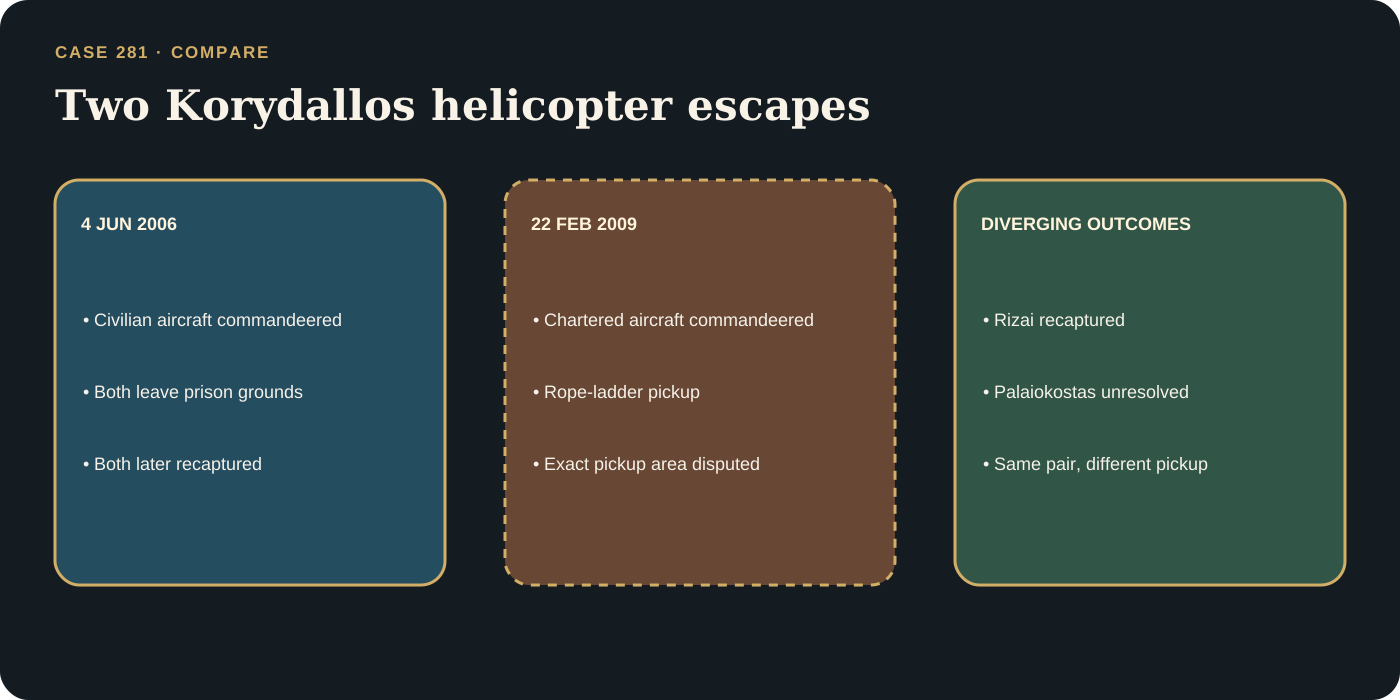
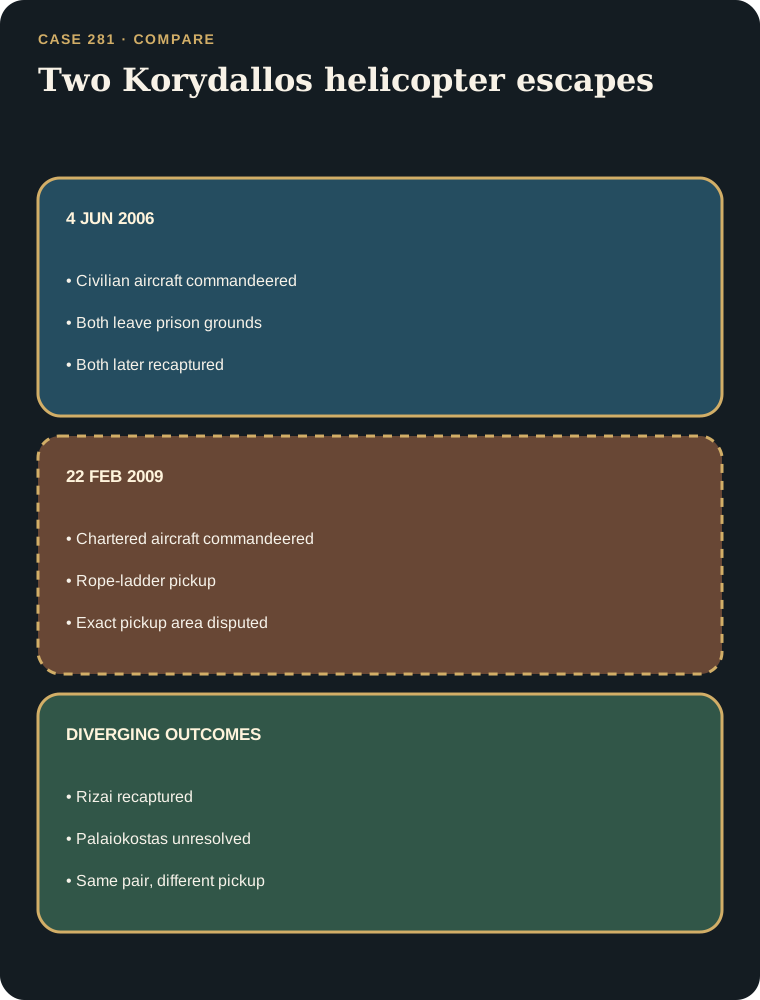
The 2006 and 2009 escapes involved the same two prisoners but different pickup methods and later outcomes.