
On Halloween afternoon in 1973, the security problem at Mountjoy Prison did not come through a gate, over a wall, or out of a tunnel. It came down from the sky.
A small civilian helicopter descended into an exercise yard inside the Dublin prison. Within moments, three Provisional IRA prisoners — Séamus Twomey, J.B. O'Hagan, and Kevin Mallon — were aboard. The aircraft lifted away from Mountjoy and carried them beyond the walls before prison staff could stop it.
The episode became one of the most famous jailbreaks of the Troubles. But the popular version can become so comic and compressed that it hides the essential facts. The pilot had been forced to participate at gunpoint. The escapees did not remain free forever. And the incident was not merely an embarrassing stunt: it exposed a serious weakness in prison security and helped reshape how the Irish state held prisoners associated with the IRA.
A prison built to stop people leaving on the ground
Mountjoy Prison stood in Dublin as one of the Irish state's best-known places of confinement. Its security, like that of almost any conventional prison, depended on controlling movement through doors, gates, yards, walls, and guarded routes.
That system assumed an escapee would somehow have to cross the perimeter. A helicopter changed the problem completely.
By 1973 the Republic of Ireland was itself under intense pressure from the conflict in Northern Ireland. The Provisional IRA was conducting an armed campaign, while the Irish government was using arrests, prosecutions, special courts, and imprisonment against people involved in illegal paramilitary activity.
Three important republican prisoners were being held at Mountjoy: Séamus Twomey, J.B. O'Hagan, and Kevin Mallon. Twomey had held senior positions in the Provisional IRA and had been arrested in Dublin only weeks before the escape. Their presence made Mountjoy a significant target for an outside rescue operation.
Later accounts identify IRA member Brendan Hughes as one of the principal planners. Those details come largely from retrospective testimony and are best treated cautiously. The basic operation, however, is securely documented by contemporary reporting.
The plan did not require the prisoners to break through Mountjoy's perimeter at all. It required the perimeter to be made irrelevant.
Escape sequence
A coerced flight into Mountjoy and out to Baldoyle
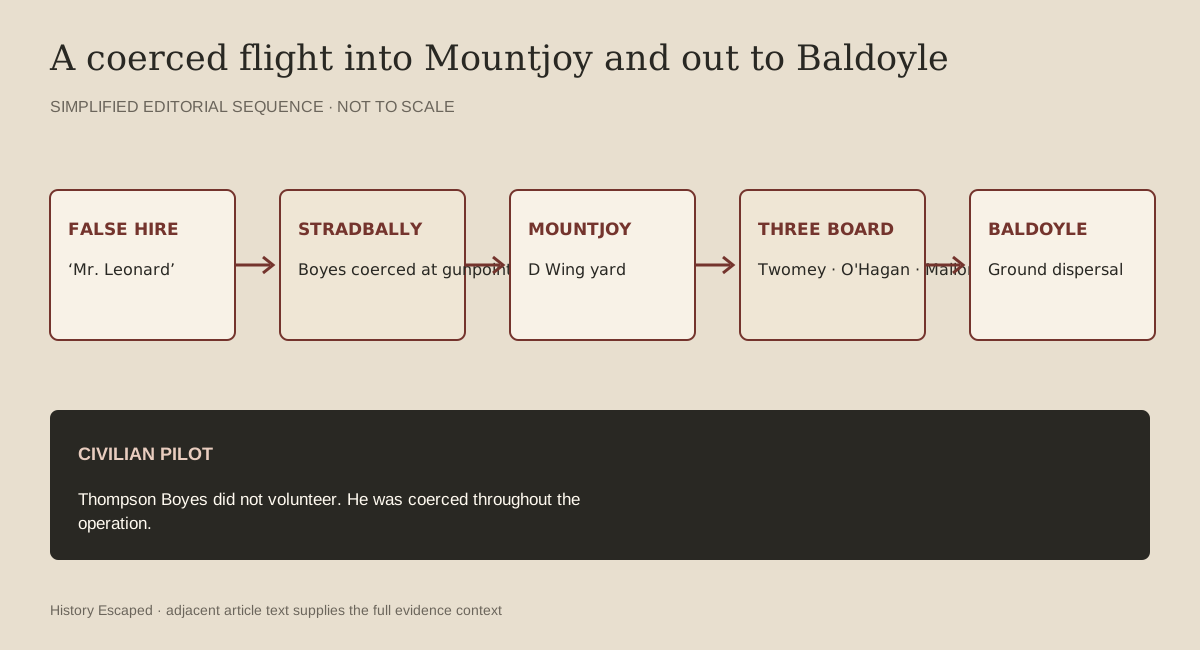
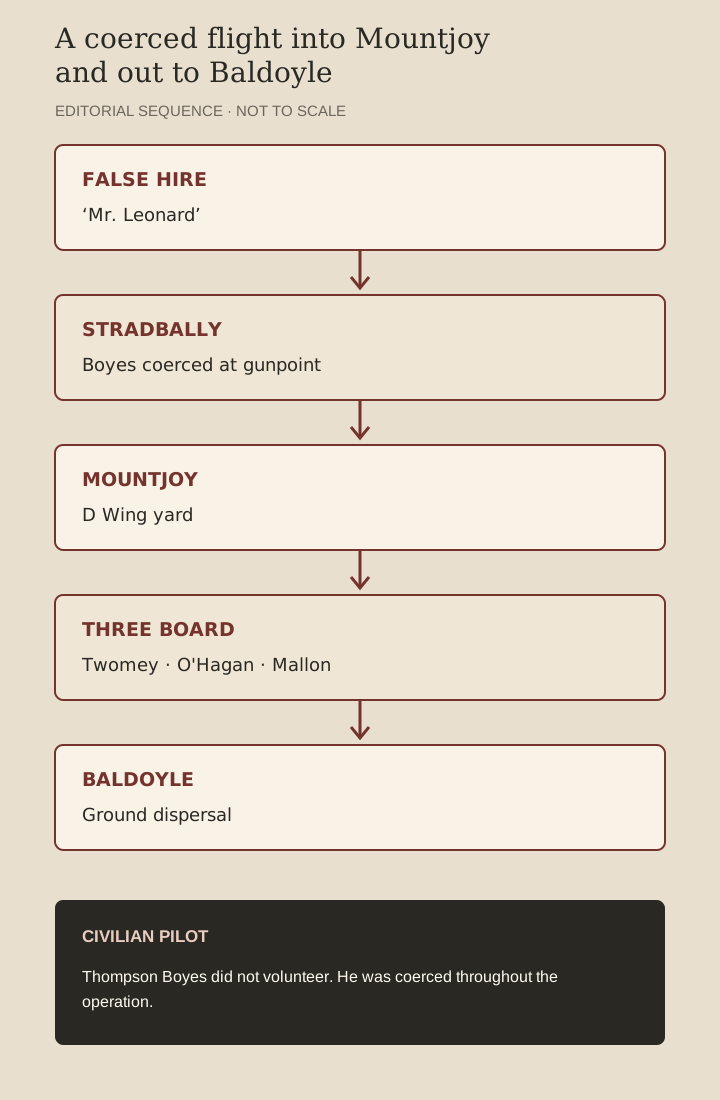
The operation joined a false hire, armed coercion, direct aerial extraction and a ground transfer.
- 01
False hire
A man calling himself Mr. Leonard arranged a commercial photography flight.
- 02
Stradbally
Civilian pilot Thompson Boyes was coerced at gunpoint.
- 03
Mountjoy
The helicopter landed in the D Wing exercise area.
- 04
Three board
Twomey, O'Hagan and Mallon boarded while Boyes remained under coercion.
- 05
Baldoyle
The helicopter landed at the racecourse and the escape shifted to ground transport.
Schematic sequence; not the helicopter's exact flight path or a measured 1973 prison plan.
The false photography flight
Two days before the escape, according to contemporary accounts, a man using the name Mr. Leonard arranged to hire an Alouette II helicopter from Irish Helicopters.
The stated purpose was innocent: aerial photography.
On 31 October, pilot Thompson Boyes flew with the supposed customer toward County Laois. Near Stradbally, the passenger asked to land.
That was when the flight changed.
Boyes later told reporters that armed, masked men approached after the helicopter touched down. The man who had hired the aircraft left. One of the armed men took his place, and Boyes was told that he was now flying to Mountjoy Prison.
This was a hijacking, not a willing collaboration.
Boyes's own account is particularly valuable because it strips away the later folklore. His immediate problem was not political. It was practical and personal: he was being held at gunpoint and ordered to fly an unplanned route toward central Dublin without the normal coordination he would have expected.
He later explained that he kept the helicopter low because air traffic control had not been informed of the flight path and he was concerned about other aircraft. The prison was the destination. The pilot did not yet know the identities of the men he was about to carry out of it.


The helicopter lands inside Mountjoy
In the mid-afternoon, the Alouette II approached Mountjoy. Then it descended into the prison's D Wing exercise area.
That single maneuver defeated the most important physical barriers around the prisoners. The helicopter did not have to open a gate. It did not have to clear a wall from the inside. It placed a temporary exit point directly inside the secure area.
The arrival was so unexpected that the first seconds were confused rather than decisive.
Later accounts famously claimed that at least one officer initially thought the helicopter might be carrying a government minister on an official visit. The anecdote is plausible and appears in contemporary reporting, although retellings disagree over exactly which minister the officer supposedly had in mind.
What is clearer is what happened next.
Other prisoners in the yard interfered with officers as the escape developed. Former IRA prisoner Gerry O'Hare was later specifically identified as one of those who restrained prison staff during the operation.
Twomey, O'Hagan, and Mallon moved to the helicopter and climbed aboard. The aircraft rose out of Mountjoy. The walls had never been breached. They had simply been bypassed.
From Mountjoy to Baldoyle
The helicopter did not attempt to carry the escapees far from Dublin.
Boyes was ordered to fly to Baldoyle Racecourse, north-east of the prison. There the three prisoners and the armed accomplice left the aircraft and transferred to ground transport.
Contemporary RTÉ reporting said they then headed in the direction of Howth. The pilot remained with the helicopter.
Boyes later admitted that he had feared he might be killed after landing at Baldoyle. He was not. The escape party departed, leaving him behind with the aircraft.
By then, the prison escape itself was over.
The next stage was no longer about Mountjoy's walls. It was about avoiding the Gardaí and Irish Defence Forces searching for the fugitives.
Problem → response
Escape was a sequence of problems
Each response solved a practical obstacle while often creating the next one.
- 01→
Obstacle
Mountjoy perimeter
Walls and gates that would normally have to be breached or crossed were bypassed from above.
Response
The operation bypassed the conventional walls and gates by placing the extraction aircraft directly inside the prison exercise area.
- 02→
Obstacle
Prison officers in the exercise area
Officers were present and some were impeded or restrained by other prisoners as the escapees boarded.
Response
Other prisoners impeded or restrained officers while Twomey, O'Hagan and Mallon boarded the helicopter.
- 03→
Obstacle
Post-escape manhunt
Irish security forces searched for the three men after the breakout; the fugitives nevertheless remained at large for different periods.
Response
The escapees transferred at Baldoyle to ground transport and dispersed, allowing each man to remain at large for a different period before recapture.
Why the escape worked
The operation succeeded because it exploited assumptions more than hardware.
Mountjoy was protected against ordinary escape routes. A helicopter made those routes irrelevant.
There was also no long period in which officers could observe a strange object approaching the perimeter on foot. The aircraft arrived quickly, directly, and in a form that was not automatically interpreted as hostile. Even a brief hesitation mattered because the extraction itself took very little time.
The plan also separated the operation into stages.
The person who arranged the helicopter hire did not simply fly the entire mission. The aircraft was brought to an isolated landing point, the pilot was taken under armed control, the helicopter was redirected to Mountjoy, and a different ground escape began at Baldoyle.
The participants therefore needed only a short window inside the prison. They got it.
The political shock
The escape was an acute embarrassment for the government of Taoiseach Liam Cosgrave, whose Fine Gael–Labour coalition had been in office for only months.
Opposition politicians attacked the government's security record. Parliamentary debate later returned to the question of how three high-profile IRA prisoners had been allowed to leave Mountjoy from the air.
State officials faced a harder problem than simply blaming a guard.
A Department of Justice memorandum prepared after the escape acknowledged the difficulty of preventing every imaginable method of rescue. Officials considered the obvious answer — denying vulnerable prisoners outdoor exercise — but recognized the consequences such a policy could create. Shooting at a helicopter over a populated prison complex also carried the risk of killing people on the ground.
The incident had exposed a genuine security dilemma: prisons could defend against many foreseeable threats, but not every threat could be eliminated without imposing new risks and restrictions. The state nevertheless made a major structural change.
On 9 November 1973, IRA prisoners held at Mountjoy and the Curragh were moved under heavy security to Portlaoise Prison. Government accounts explicitly connect that transfer to the Mountjoy escape. Portlaoise became the principal high-security location for prisoners associated with subversive activity.
In that sense, the helicopter escape changed more than the freedom of three men. It helped change the geography of political and paramilitary imprisonment in the Republic of Ireland.
Freedom was temporary
The phrase "successful escape" needs qualification.
The operation succeeded completely as a breakout from Mountjoy. All three target prisoners left the prison and escaped the immediate response.
But none remained permanently free.
Kevin Mallon was recaptured in December 1973 near Portlaoise. His prison history did not end there: he later escaped again during the mass Portlaoise breakout of August 1974 before being recaptured once more.
J.B. O'Hagan remained at large longer but was eventually recaptured and returned to custody.
Séamus Twomey remained free the longest. He was not recaptured until 1977, after a Garda operation in Dublin.
The Mountjoy flight therefore belongs in the category of successful prison escape, temporary freedom — not permanent evasion.
Evidence discipline
What the record supports
Status labels distinguish secure conclusions from uncertainty and rejected claims. Color is never the only signal.
DOCUMENTED
A hijacked Alouette II helicopter was forced to land inside Mountjoy Prison on 31 October 1973.
Contemporary RTÉ reporting and the pilot's own broadcast account independently establish the hijacking and prison landing.
Sources: SRC-001, SRC-002, SRC-003DOCUMENTED
The three prisoners who escaped were Séamus Twomey, J.B. O'Hagan and Kevin Mallon.
Their identities are consistent across contemporary broadcasting, official Irish government material and contemporary international reporting.
Sources: SRC-001, SRC-007, SRC-008MYTH
Pilot Thompson Boyes voluntarily cooperated with the escape.
Boyes said he was confronted by armed men and forced at gunpoint to fly to Mountjoy and then Baldoyle.
Sources: SRC-002, SRC-003WELL-SUPPORTED
Some prison staff initially mistook the helicopter for an official visit.
Contemporary and later reporting support the basic anecdote, although accounts disagree about which government minister was supposedly expected.
Sources: SRC-005, SRC-008LATER CLAIM
A prison officer shouted for the gates to be closed as the helicopter escaped.
The line is ubiquitous in republican memory and later retellings but is not necessary to the documented escape mechanism and should not be treated as verbatim fact without stronger contemporary sourcing.
Sources: SRC-009LATER CLAIM
Brendan Hughes masterminded the helicopter escape.
Hughes's later memoir presents him as a key planner, but the detailed attribution rests heavily on retrospective participant testimony.
Sources: SRC-009MYTH
The Mountjoy escape was the world's first helicopter prison escape.
A documented helicopter escape from Santa Martha Acatitla prison in Mexico City occurred in August 1971, two years before Mountjoy.
Sources: SRC-014UNKNOWN
The true identity of the helicopter hirer calling himself Mr. Leonard is established by the core evidence.
Contemporary sources document the alias and an American-sounding accent but do not securely establish the individual's real identity.
Sources: SRC-003, SRC-008What the famous retellings get wrong
The Mountjoy story accumulated folklore almost immediately.
A comic image of bewildered officers, an arriving minister, and a futile order to close prison gates became part of republican memory and popular retelling. The escape even inspired a chart-topping song in Ireland.
Those details are historically interesting because they show how quickly an event can become political legend. But they should not replace the evidence.
The pilot was a civilian forced to participate with weapons. The exact minute-by-minute sequence is less certain than many retellings suggest. Even the identity of the minister supposedly expected by a prison officer varies between accounts.
And despite occasional claims, Mountjoy was not the world's first helicopter prison escape. Two prisoners had already escaped from Santa Martha Acatitla prison in Mexico City by helicopter in 1971.
What made Mountjoy remarkable was not that nobody had ever imagined the method before. It was that a hijacked civilian helicopter could descend into a major prison in the capital of the Irish state, remove three high-profile IRA prisoners, and leave before the existing security system could respond effectively.
Why Mountjoy still matters
The physical mechanism of the Mountjoy escape was almost brutally simple. Walls stop people who must cross walls. A helicopter does not.
But the historical importance lies in what followed from that insight. The breakout embarrassed the government, triggered public and parliamentary scrutiny, and accelerated the concentration of IRA prisoners at Portlaoise. It also became a piece of republican folklore whose humorous retellings can obscure the coercion and political violence surrounding it.
The best reconstruction therefore does not need to make the event more dramatic. The documented facts are enough: a false hire, an armed hijacking, a forced flight, a landing inside a prison yard, three prisoners aboard, and a second landing beyond the walls. For a few minutes on 31 October 1973, Mountjoy's security system was designed to solve the wrong problem.
Selected chronology
Selected chronology
Twomey imprisoned at Mountjoy
Séamus Twomey was imprisoned at Mountjoy shortly before the escape.
Helicopter hire arranged
A man using the name Mr. Leonard arranged the helicopter hire under a photography pretext.
Pilot forced toward Mountjoy
The helicopter was seized near Stradbally and pilot Thompson Boyes was forced to fly to Mountjoy Prison.
Three prisoners escape by helicopter
Twomey, O'Hagan and Mallon boarded the helicopter inside Mountjoy and escaped to Baldoyle.
IRA prisoners transferred to Portlaoise
IRA prisoners from Mountjoy and the Curragh were transferred to Portlaoise Prison under heavy security.
Kevin Mallon recaptured
Kevin Mallon was recaptured near Portlaoise.
J.B. O'Hagan recaptured
J.B. O'Hagan was recaptured and returned to custody.
Séamus Twomey recaptured
Séamus Twomey was recaptured in Dublin.