
Mary Bryant’s 1791 Escape: 69 Days from Port Jackson to Timor
On the night of March 28, 1791, Mary Bryant climbed into a stolen open cutter with her husband, two young children and seven other convicts. The boat had six oars, sails, provisions and navigation equipment. Beyond the heads of Port Jackson lay a journey of more than 3,000 miles through coastal, reef and open-sea waters.
Sixty-nine days later, all eleven reached Dutch Timor alive. Their geographical escape had succeeded. Keeping it secret would prove harder.
At a Glance
Departure: March 28, 1791
Starting point: Port Jackson / Sydney Harbour
Escape party: 11 people — 9 adults and 2 children
Boat: Six-oared open cutter used by the colony
Navigation: Compass, quadrant, chart / route information; mixed maritime skill within the party
Voyage: 69 days
Distance: More than 3,000 miles / about 5,000 km
Timor arrival: June 5, 1791
Arrival point: Kupang, Dutch West Timor
Immediate outcome: All 11 arrived alive and posed as shipwreck survivors
Long-term outcome: Identified and recaptured after several months
Classification: Successful maritime escape followed by later recapture
Port Jackson, Not Botany Bay
Mary Bryant’s escape is often called an escape from Botany Bay. That label belongs more to British penal mythology than to geography.
The First Fleet had entered Botany Bay in January 1788, but the settlement was established at Sydney Cove in Port Jackson. Three years later, the Bryant party stole its boat from the Port Jackson colony and sailed through Sydney Harbour toward the Pacific.
“Botany Bay” remained a powerful shorthand for transportation. It should not replace the actual starting point.
Mary Broad
Mary had grown up in Cornwall and was baptized at Fowey in 1765. In 1786 she was convicted of robbery and sentenced to death. The sentence was commuted to seven years’ transportation, placing her among the convicts sent to New South Wales with the First Fleet. Her daughter Charlotte was born during the voyage.
At Sydney Cove, Mary married William Bryant in February 1788. Their son Emanuel followed in 1790. The family therefore entered the escape with two children too young to contribute to the rowing, sailing or gathering on which their survival would depend.
William Bryant and the Colony’s Boats
William was a Cornish fisherman. That experience made him valuable in a settlement repeatedly threatened by food shortage. He worked in the government fishing operation and became familiar with the small boats used around Port Jackson. He also got into trouble for privately selling fish that belonged to the government supply.
The episode matters less as character judgment than as access. William knew the harbor, knew the fishing operation and knew what a cutter could do. The escape plan grew from that practical environment.
A Group With Different Reasons to Run
Mary and William were not the only convicts willing to gamble on the sea. The full party was:
Mary Bryant
William Bryant
Charlotte Bryant
Emanuel Bryant
James Martin
William Allen
Samuel Bird / John Simms
Samuel Broom / John Butcher
James Cox / Rolt
Nathaniel Lillie
William Morton
Their legal positions were not identical. Some still had years left to serve. Some had life sentences. William Bryant’s formal term was essentially complete, yet completing a sentence in New South Wales did not magically supply a passage home to Britain.
For men transported for life, the difference was sharper. James Cox reportedly left a letter explaining that he saw no ordinary route out of the colony. The sea offered a possibility that the penal system did not.
Planning for North
A small boat could not simply be stolen and pointed toward Timor. The route required navigation.
A Dutch ship, the Waaksamheyd, had visited Port Jackson in 1790. Its master, Detmer Smit, became part of the escape preparations.
Colonial official David Collins later wrote that, once the Bryants were beyond pursuit, the settlement learned Smit had sold William a compass and quadrant and had provided a chart and information about travelling north. Other sources add weapons, ammunition and provisions to the material accumulated for the voyage. The compass and quadrant are the most important correction to the idea that the party navigated only by instinct.
Who Was the Navigator?
Mary Bryant is now the name most closely attached to the voyage. That does not make her the only navigator.
Modern scholarship identifies William Morton as an experienced navigator. William Bryant brought fishing and maritime experience. Other adults contributed rowing, sailing, landing and boat work.
Mary made the entire voyage while caring for two small children and participating in the survival of the group. Nothing in that achievement requires assigning her a technical role that the evidence does not securely prove. The strongest reconstruction is collective.
March 28
The party chose its moment. The cutter was ready. Supplies and equipment had been concealed or accumulated.
The harbor lacked an immediately effective pursuit vessel. The night offered darkness.
Then eleven people moved into the boat and left. A contemporary observer, John Easty, understood the scale of the decision almost immediately: a woman, two children and eight men had taken a six-oared government boat and gone beyond the harbor. The colony expected them to be heading for the north. It could not catch them.
Through the Heads
A period view by First Fleet officer William Bradley shows the entrance to Port Jackson from South Head. Bradley made the image several years before the escape. It is not a picture of the Bryant party.
It does, however, show the geographical threshold they crossed. Inside the heads lay a penal settlement with government boats, soldiers and legal authority. Outside lay a coastline along which the British colony had very little capacity to retrieve eleven fugitives in a small cutter. Once they cleared the harbor, the problem changed from pursuit to survival.
Selected chronology
Selected chronology
Mary Broad baptized at Fowey
The future Mary Bryant is baptized in Cornwall.
Convicted at Exeter
Mary is convicted of robbery, sentenced to death and later reprieved to seven years' transportation.
First Fleet voyage
Mary sails aboard Charlotte; her daughter Charlotte is born during the voyage.
Mary marries William Bryant
The couple marry at the new Port Jackson settlement.
Waaksamheyd visits Port Jackson
The Dutch vessel's captain Detmer Smit later becomes associated with navigation equipment and route information used by the escape party.
The cutter leaves Port Jackson
Mary and William Bryant, their two children and seven other convicts steal a six-oared cutter and pass out of Sydney Harbour.
Northward open-boat voyage
The party uses sails, oars, navigation instruments and repeated coastal replenishment while travelling through eastern and northern Australian waters.
Kupang reached
After 69 days, all eleven fugitives arrive alive in Dutch West Timor.
Shipwreck identity in Timor
The fugitives live under a false shipwreck-survivor story, receiving Dutch support and remaining outside British custody.
Edward Edwards arrives
The Pandora survivors reach Kupang and Edwards questions the fugitives after months of their residence in Timor.
Returned to British custody
Edwards takes charge of the escape party for the voyage toward Batavia.
Emanuel dies at Batavia
Mary and William's young son dies during the forced return.
William Bryant dies
William dies at Batavia approximately three weeks after Emanuel.
Charlotte dies at sea
Mary's daughter dies aboard the final return voyage; sources differ between May 5 and May 6.
Surviving escapees reach Portsmouth
Mary, Allen, Broom, Lillie and Martin reach Britain aboard HMS Gorgon and return to custody.
London court proceedings
The surviving fugitives are ordered to remain under their former sentences rather than receiving new death sentences. Modern sources generally place the proceeding in July; a June 7 date in one biography conflicts with the June 18 arrival.
Mary pardoned
Mary receives an unconditional pardon after Boswell's advocacy, approximately six weeks after her original sentence had expired.
Four surviving men released
Allen, Broom, Lillie and Martin leave Newgate by proclamation.
Last secure record of Mary
An acknowledgment of financial help from Boswell is the last known documentary trace identified by her Australian Dictionary of Biography entry.
The Boat
The cutter had six oars and sails. Eleven people shared its limited space with: - water; - provisions; - weapons; - navigation gear; - fishing equipment; - and whatever clothing or material they had managed to take. Exact dimensions and exact starting weights are often supplied in later retellings. They are not necessary to understand the event.
This was an open boat, not a decked ocean-going vessel. It offered mobility without much protection.
Staying Near Land
The party’s most important survival strategy was not to remain at sea whenever possible. They moved generally northward while using the coast. Landings provided opportunities to: - search for fresh water; - gather or catch food; - repair or tend the cutter; - rest; - and wait for conditions that made onward travel possible. This was not a perfectly safe choice.
Every approach to land introduced surf, reef, unknown shore conditions and possible encounters with people already living there. But a 69-day journey could not be sustained on whatever the party had loaded at Port Jackson alone.
The First Surviving Eyewitness
Much of what can still be said about the voyage depends on James Martin. His manuscript, now called Memorandoms, survived among Jeremy Bentham’s papers and was edited by historian Tim Causer. It is the only known participant narrative of the escape that survives. Martin records storms, hunger, landings, encounters and the gradual northward progression.
That makes him indispensable, but the surviving record does not preserve eleven voices equally. Mary’s full account is lost. William’s voyage journal is lost.
The surviving story is therefore rich but asymmetrical.
William Bryant’s Lost Journal
Evidence that William kept a journal does not come from modern speculation. Lieutenant George Tobin visited Timor in 1792 and recorded seeing a journal of Bryant’s voyage in the possession of the Dutch governor. Tobin remembered one especially interesting observation: Bryant had recorded coal north of Port Jackson. The journal later disappeared.
For historians, that creates a frustrating boundary. We know there was a second substantial participant record. We cannot use details no longer preserved within it.
Water
Fresh water repeatedly controlled the route. The group could carry some, but an open boat crowded with eleven people could not carry enough for a 69-day voyage without replenishment. Landings therefore served a practical function that modern adventure maps can obscure. A route line looks continuous.
The historical voyage was not. It was a sequence of movements interrupted by the recurring need to solve the same basic problem again:
Where can eleven people obtain enough water to continue?
Material evidence
Tools of Escape
The objects used in an escape reveal how a plan worked under constraint.
- 01Essential
Six-oared cutter
The colony's open cutter provided sail-and-oar mobility capable of coastal landings and the final offshore crossing.
- 02Essential
Compass and quadrant
David Collins records that Detmer Smit supplied William Bryant with a compass and quadrant before the escape.
- 03High
Chart and northward route information
Collins also records a chart and navigational information supplied by Smit.
- 04Essential
Fishing gear and provisions
Initial provisions and the ability to fish or gather helped sustain a voyage that could not carry sixty-nine days of supplies in full from departure.
- 05Essential
Maritime and navigation experience
William Bryant had fishing/boat experience and current scholarship identifies William Morton as an experienced navigator.
- 06Essential
False shipwreck identity
At Kupang the party used a shipwreck-survivor story to explain their arrival and live outside British custody for several months.
Food
Food worked the same way. The party began with provisions and had fishing equipment. They also gathered food along the coast and on islands.
Later narratives list precise weights of rice, flour, pork and other supplies. Some may derive from sound research, but the broad history does not depend on turning uncertain quantities into false precision.
The secure point is more important. The fugitives carried enough to begin and repeatedly used coastal resources to stay alive.
Storms
The cutter encountered severe weather. Martin’s surviving narrative makes clear that the voyage was not a calm progression along an accommodating shoreline. At times the party was pushed away from land, deprived of easy replenishment and forced to endure conditions for which an open cutter offered little shelter.
Later storytelling naturally concentrates on these episodes. The evidence does not justify turning every storm into an exact scripted sequence. The real boat was small enough and the voyage long enough that the underlying risk needs little embellishment.
Coal
Somewhere north of Port Jackson, the party encountered coal. George Tobin remembered the observation from William Bryant’s lost journal. Later historians have linked it to the Newcastle or Hunter region. This should be described carefully.
The voyage may have added to British knowledge of coal deposits north of Sydney. It did not constitute a human “discovery” of a resource in Country already known to Aboriginal communities.
Entering Other Peoples’ Country
The Bryant party repeatedly landed on coasts and islands inhabited by Aboriginal and Torres Strait Islander peoples. James Martin wrote from the perspective of fugitives who were frightened, armed and usually unable to communicate with the people they encountered. Some meetings involved caution or observation. Some became tense.
Later British retellings flattened these episodes into a simple progression through “hostile natives.” That framing makes Indigenous people obstacles in someone else’s adventure. A stronger reconstruction asks what the sources actually show: eleven outsiders repeatedly entered different communities’ Country while trying to survive, and Martin interpreted each encounter through the fear and assumptions of his own situation.
Poorly Charted to Whom?
The northeast coast, reef passages and Torres Strait presented serious navigational problems for eighteenth-century British mariners. European charts were incomplete. That does not make the route universally “uncharted.” Aboriginal and Torres Strait Islander peoples possessed deep geographic and maritime knowledge of these waters.
The distinction is especially important in a route graphic. The Bryant party was crossing gaps in British navigational knowledge, not entering a world without existing human geography.
Problem → response
Escape was a sequence of problems
Each response solved a practical obstacle while often creating the next one.
- 01→
Obstacle
Immediate pursuit risk
Stealing a government cutter from a small penal settlement could have failed before the party cleared Sydney Harbour.
Response
The fugitives chose a dark night and a moment when no effective pursuit vessel was immediately available.
- 02→
Obstacle
Limited open-boat capacity
Eleven people, including two children, had to share a small undecked cutter with water, food and equipment.
Response
The party relied on sail and oar work plus repeated coastal replenishment rather than carrying the entire voyage's needs at departure.
- 03→
Obstacle
Fresh water
The cutter could not carry a full 69-day water supply for eleven people.
Response
Repeated landings along the coast were used to obtain fresh water.
- 04→
Obstacle
Food
Initial provisions were finite and the voyage repeatedly outlasted what could be safely carried in an open boat.
Response
The fugitives fished and gathered food during coastal and island stops.
- 05→
Obstacle
Storm and reef danger
Severe weather, reefs and offshore displacement threatened the cutter throughout the northward voyage.
Response
The group combined sailing, rowing, landings and waiting for workable conditions.
- 06→
Obstacle
Incomplete British charts
Parts of the northeastern and northern route were poorly represented in British/European navigational knowledge.
Response
The party used its instruments, route information, navigation experience and repeated visual/coastal navigation.
- 07→
Obstacle
Need for a legal identity in Timor
Arrival in a Dutch colonial port in a stolen open boat could expose the group as fugitives.
Response
They adopted a shipwreck-survivor story that initially convinced Dutch authorities.
- 08→
Obstacle
British imperial recapture
Once their identities became known, the fugitives could be returned through British naval and colonial networks.
Response
The deception delayed recapture for months but ultimately failed after suspicion and Edward Edwards's arrival.
Reef and Island Waters
Progress through the Great Barrier Reef and adjacent island systems gave the party both danger and opportunity. Reefs threatened the cutter. Islands could offer: - food; - rest; - shelter; - and sometimes easier water access. Later accounts credit the fugitives with charting or identifying stretches of coast and islands poorly represented on British maps.
Those claims belong to the history of European charting. They should not be expressed as first discovery.

Torres Strait
The route eventually brought the cutter through the Torres Strait region. For British mariners, the strait was a difficult navigational space of: - reefs; - islands; - tides; - currents; - and incomplete chart information. For the Bryant party, passing through it meant that the east-coast phase was giving way to the northern and open-sea stage. Timor was closer.
So was the point at which the coast would no longer provide a continuous safety net.
Across the Arafura Sea
The Arafura Sea required a major offshore crossing. The party could no longer rely on repeated mainland stops in the same way.
The comparison often made with William Bligh’s 1789 open-boat voyage after the Bounty mutiny is understandable here. Both involved extraordinary survival in small boats and both ended at Timor.
The Bryant voyage was not simply a reproduction of Bligh’s. Its starting circumstances, route, passengers and pattern of coastal replenishment were different.
Five June
After 69 days, landfall at Kupang ended the escape voyage. The canonical date is:
June 5, 1791.
The scholarly UCL edition and Australian Dictionary of Biography agree. Some later UCL promotional text says June 8, but that date conflicts with the stronger publication record and the established 69-day chronology. All eleven people who had left Port Jackson were still alive, a central fact of the voyage.
Documentary reconstruction
Port Jackson to Kupang: a voyage system
A case-local visual focused on the spatial, mechanical or evidentiary relationship established by the surviving record.
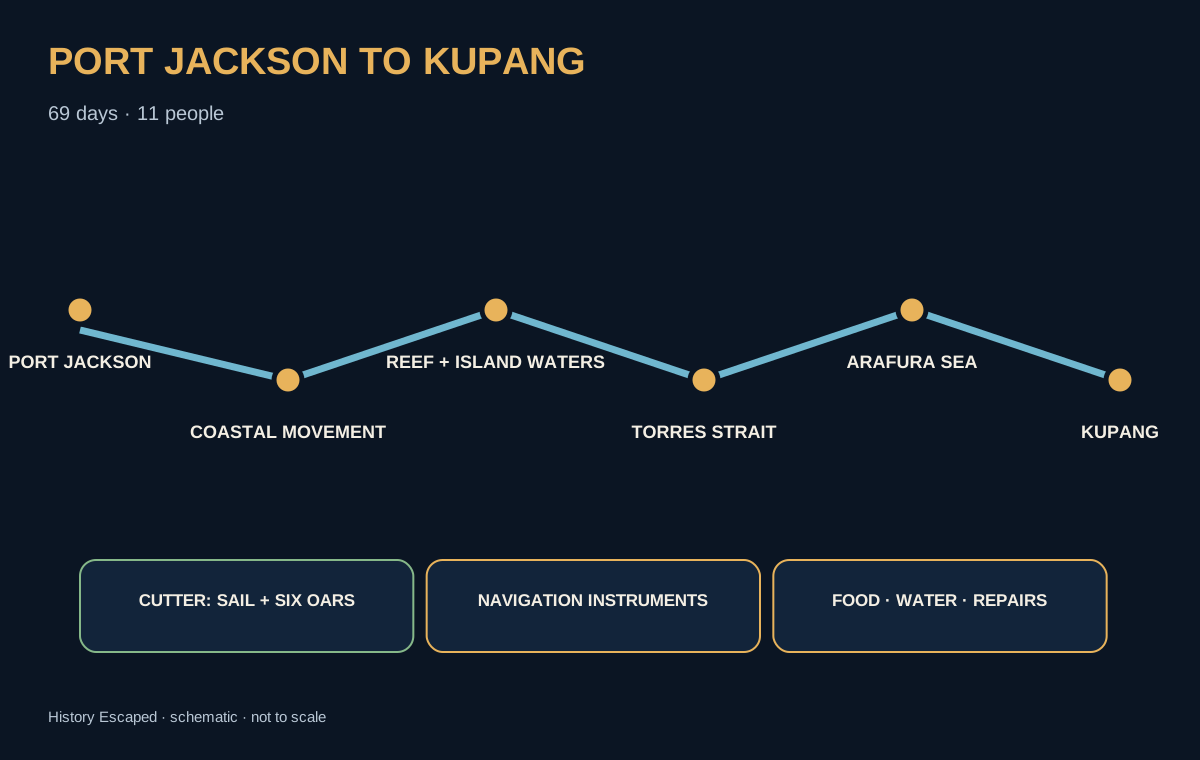
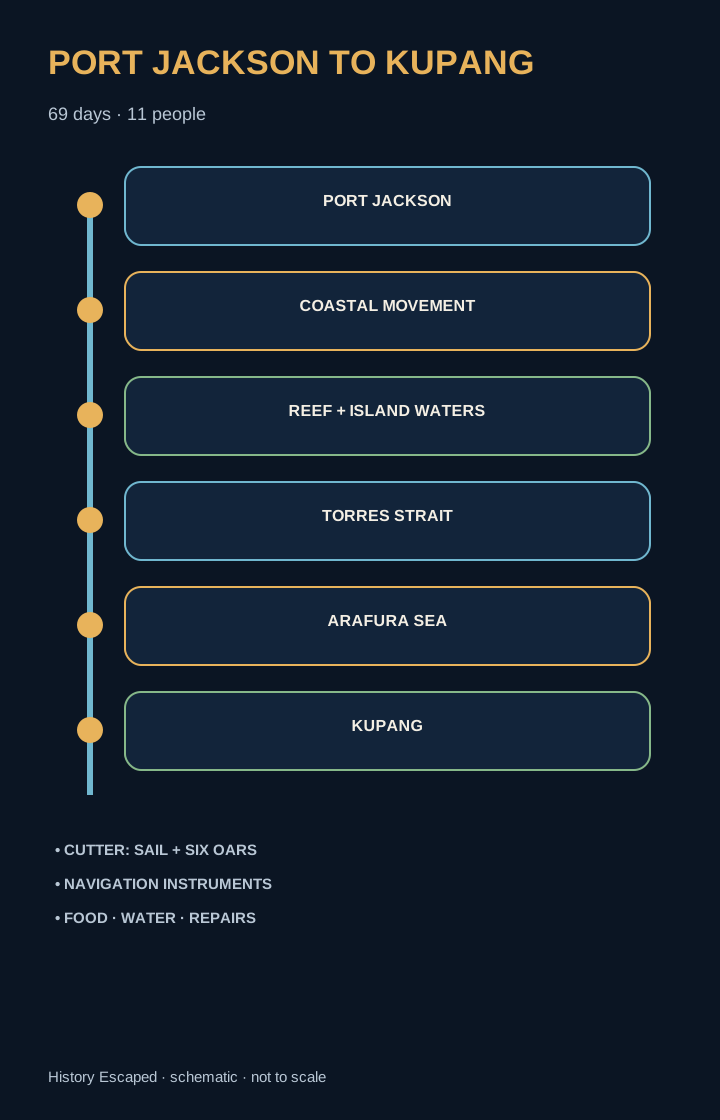
Simplified editorial reconstruction based on the cited historical record; not to scale. Uncertainty is stated directly in the visual and adjacent text.
How Far?
The Australian Dictionary of Biography gives:
3,254 miles — 5,237 kilometres.
The safer headline language is:
more than 3,000 miles / about 5,000 kilometres.
No exact daily track survives. A precise modern route total can suggest a level of cartographic certainty the sources do not possess. The achievement does not depend on the final mile.
The Second Escape Problem
Reaching Timor created freedom from Port Jackson. It did not create a legal identity. Eleven British people had appeared in a small open boat inside a Dutch colonial port. They needed a plausible reason to exist.
The group claimed to be survivors of a shipwreck. The story was believable enough to work. For months.
Life Under a False Story
Dutch governor Timotheus Wanjon initially accepted the fugitives. They received food, clothing and accommodation. Members of the group found work. For the first time since Port Jackson, the adults could live without presenting themselves as transported convicts.
The deception therefore became a second form of escape. The cutter had removed them from British physical control. The shipwreck identity protected them from legal recapture.
Did William Get Drunk and Confess?
Possibly—but the popular version is too certain. Later narratives often make the collapse of the ruse into one memorable scene: William drinks too much and boasts that the family escaped Botany Bay. Early official and modern scholarly accounts are less clean.
David Collins wrote that suspicion developed from the group’s language and behavior and that their true situation was eventually disclosed. UCL’s scholarly account simply notes that they were eventually recognized as escaped convicts.
The exact moment cannot be reconstructed confidently. The drunken-confession story remains a disputed later explanation, not a secure part of the historical sequence.
Pandora Arrives
In September, Captain Edward Edwards arrived at Kupang with survivors of HMS Pandora and captured Bounty mutineers. The timing is important. Edwards had not been waiting when the Bryants landed. The escapees had already spent months in Timor.
Edwards questioned them, and the British identity of the group was confirmed. The Dutch authorities now had a clear route for returning them to British custody.
The final accounting
Outcome
Port Jackson-to-Timor escape party
All eleven fugitives survived the 69-day voyage and reached Kupang alive.
Escapees ultimately reaching Britain alive
Mary Bryant, William Allen, Samuel Broom, Nathaniel Lillie and James Martin survived the forced return to Britain.
October 5
On October 5, the fugitives left Kupang under Edwards’s authority aboard the Dutch vessel Rembang. The open-boat escape was finished. A coerced return across the Indian Ocean and Atlantic began. The human cost of that return would be severe.
Emanuel and William
At Batavia, disease devastated the family. Emanuel died on December 1, 1791. William Bryant died roughly three weeks later, generally dated December 22. Mary had crossed more than 3,000 miles with her husband and both children alive.
Within months of recapture, her son and husband were dead.
James Cox
As the surviving fugitives continued westward, James Cox disappeared overboard in the Sunda Strait. Later narratives often interpret this as a deliberate leap rather than facing execution in Britain. That motive is plausible. It is not secure enough to present as fact.
What can be stated is that Cox went overboard and did not survive.
More Deaths
Samuel Bird and William Morton also died during the return journey. The party that had kept every member alive from Port Jackson to Timor was shrinking under captivity, disease and ocean travel. By the Cape of Good Hope, the survivors who would continue aboard HMS Gorgon were Mary, Charlotte, William Allen, Samuel Broom, Nathaniel Lillie and James Martin.
Charlotte
Charlotte died aboard Gorgon in early May 1792. Sources vary between May 5 and May 6. The difference is minor compared with the loss. Mary had now lost: - William; - Emanuel; - Charlotte.
She still had to arrive in Britain as a prisoner.
Evidence discipline
What the record supports
Status labels distinguish secure conclusions from uncertainty and rejected claims. Color is never the only signal.
MYTH
Mary Bryant escaped from Botany Bay in March 1791.
Botany Bay became shorthand for the penal colony, but the fugitives departed from Port Jackson / Sydney Harbour.
Sources: SRC-001, SRC-002, SRC-006DOCUMENTED
The escape party consisted of eleven people.
UCL's scholarly edition identifies Mary, William, their two children and seven additional adult male convicts.
Sources: SRC-001, SRC-002DOCUMENTED
All eleven survived the Port Jackson-to-Timor voyage.
Participant and scholarly records establish that the complete party reached Kupang alive after 69 days.
Sources: SRC-001, SRC-002, SRC-003UNKNOWN
Mary Bryant was the sole navigator of the cutter.
The evidence establishes Mary's central participation but current scholarship identifies William Morton as having navigation experience and William Bryant as an experienced fisherman/boatman.
Sources: SRC-002, SRC-003MYTH
The party had no navigational instruments.
David Collins reported that Detmer Smit supplied William Bryant with a compass, quadrant, chart and northward route information.
Sources: SRC-004MYTH
The waters through which the party travelled were completely uncharted and unknown.
Some stretches were poorly charted in British/European records, but Aboriginal and Torres Strait Islander peoples had extensive existing knowledge of Country and Sea Country.
Sources: SRC-001, SRC-002DOCUMENTED
The party arrived at Kupang on June 5, 1791.
The UCL scholarly publication record and Australian Dictionary of Biography agree on June 5 and this date is consistent with the 69-day chronology.
Sources: SRC-001, SRC-002, SRC-003DISPUTED
June 8 is an equally secure Timor arrival date.
Some UCL promotional pages reproduce June 8, but the scholarly edition metadata, UCL Discovery abstract and ADB support June 5.
Sources: SRC-001, SRC-009DOCUMENTED
William Bryant kept a written journal of the escape voyage.
Lieutenant George Tobin recorded seeing a Bryant voyage journal in Timor in 1792. The journal is now lost.
Sources: SRC-005UNKNOWN
A complete first-person Mary Bryant narrative of the voyage survives.
Boswell recorded an account from Mary after her return, but those pages are no longer known to survive. James Martin's Memorandoms is the only extant participant narrative.
Sources: SRC-001, SRC-002DISPUTED
William Bryant got drunk in Kupang and confessed, directly causing the group's recapture.
The story is prominent in later retellings, while Collins and modern scholarship describe a less precise development of suspicion and eventual disclosure.
Sources: SRC-001, SRC-004, SRC-010MYTH
Edward Edwards arrested the Bryant party as soon as they landed in Timor.
The escapees arrived June 5 and lived in Timor for months. Edwards arrived only in September and took formal British custody in October.
Sources: SRC-003MYTH
Mary's husband and children died during the 69-day open-boat escape.
All eleven reached Timor alive. William, Emanuel and Charlotte died only after recapture during the forced return.
Sources: SRC-001, SRC-003UNKNOWN
James Cox deliberately went overboard to make another escape or avoid execution.
Cox was lost overboard during the return; later narratives assign motive, but the exact intent is not securely established in the strongest accessible sources.
Sources: SRC-003, SRC-010MYTH
The surviving escapees were newly sentenced to death in London.
They were ordered to remain under their former sentences until lawfully discharged rather than receiving new death sentences.
Sources: SRC-002, SRC-003MYTH
Mary's May 1793 pardon released her years before her original transportation sentence expired.
ADB notes that the pardon came roughly six weeks after the original seven-year term had already expired, although the pardon formalized her legal release and Boswell's advocacy remained important.
Sources: SRC-003UNKNOWN
An authenticated contemporary portrait of Mary Bryant is available for publication.
No securely identified contemporary portrait of the convict Mary Bryant was located in this production pass. Modern illustrations and actress images must not be presented as her likeness.
Sources: SRC-006, SRC-010Back in Britain
HMS Gorgon reached Portsmouth on June 18. Mary and the surviving men were committed to Newgate. Escaping transportation and returning unlawfully could have exposed them to a capital prosecution. They were not hanged.
Instead, the surviving escapees were ordered to remain under their existing sentences until legally discharged.
A Date That Cannot Be Right
The Australian Dictionary of Biography places the Old Bailey proceeding on June 7. That cannot fit the same biography’s later arrival chronology: Gorgon did not reach Portsmouth until June 18. Other modern reconstructions place the court proceeding in July. The June 7 proceeding date therefore cannot be accepted simply because it appears in an authoritative biography.
Use:
July 1792
until the primary Old Bailey record is inserted into the source stack.
Boswell
James Boswell became fascinated by Mary’s case. He visited her, supported her financially and argued for clemency. He also recorded an account from Mary. Those pages are now lost.
Their disappearance is one of the great frustrations of the Bryant source record. The only surviving first-person narrative of the escape is Martin’s. Mary’s own fuller voice reached one of the most famous biographers in Britain—and then vanished from the archive.
The Pardon
Mary received an unconditional pardon on May 2, 1793. The date sounds like the final triumph of Boswell’s campaign. There is a complication. Her original seven-year sentence had already expired weeks earlier.
The pardon still mattered as formal legal protection and recognition, but it did not release her years ahead of the original term. The four surviving male escapees remained in custody until November.
Cornwall
Boswell continued to send Mary money. She returned to Cornwall. The final secure documentary trace identified by her Australian Dictionary of Biography entry is a November 1794 acknowledgment of one of Boswell’s gifts. Then the record stops.
The woman whose movements can be followed across: - Cornwall; - the Atlantic; - the Cape; - Port Jackson; - thousands of miles of Australian coast; - Timor; - Batavia; - the Cape again; - and Britain; disappears from surviving history at home.
Evidence, Myth and What the Sources Support
Did Mary Bryant escape from Botany Bay?
MYTH
The phrase became a British shorthand for transportation, but the 1791 escape began from Port Jackson / Sydney Harbour.
Were there eleven people in the cutter?
DOCUMENTED
Yes: Mary and William Bryant, Charlotte, Emanuel and seven additional male convicts.
Did all eleven survive the escape voyage to Timor?
DOCUMENTED
Yes. The deaths occurred only after the party had been recaptured and forced onto the return journey.
Was Mary Bryant the sole navigator?
UNKNOWN
Mary was a central participant, but current scholarship identifies William Morton as having navigation experience and William Bryant as an experienced fisherman and boatman. The surviving evidence does not establish Mary as sole navigator.
Did the party possess navigation instruments?
DOCUMENTED
David Collins wrote that Detmer Smit supplied William Bryant with a compass, quadrant, chart and northward route information.
Did the group travel through completely “uncharted” waters?
MYTH
British and European charts were incomplete in parts of the route. Aboriginal and Torres Strait Islander peoples already possessed extensive knowledge of their Country and Sea Country.
Did the party reach Timor on June 5 or June 8?
DISPUTED
The UCL scholarly publication record and Australian Dictionary of Biography support June 5, which also aligns with the 69-day chronology. Some UCL promotional text gives June 8.
Did William Bryant keep a journal of the voyage?
DOCUMENTED
Lieutenant George Tobin recorded seeing Bryant’s journal in Timor in 1792. The journal is now lost.
Does Mary Bryant’s own full account survive?
UNKNOWN
Boswell recorded an account from Mary, but the pages are no longer known to survive. James Martin’s manuscript is the only extant first-hand narrative by an escape participant.
Did William get drunk and confess the truth in Timor?
DISPUTED
It is a memorable later story, but contemporary and scholarly accounts do not securely establish one drunken confession as the sole cause of exposure.
Did Captain Edward Edwards arrest the fugitives as soon as they landed?
MYTH
The party reached Timor in June. Edwards arrived in September after the wreck of Pandora. The fugitives had maintained their shipwreck identity for months.
Did the open-boat journey kill Mary’s husband or children?
MYTH
All eleven reached Timor alive. William, Emanuel and Charlotte died during the coerced return after recapture.
Was Mary sentenced to death again in London?
MYTH
The surviving fugitives were kept under their existing sentences rather than receiving a new death sentence.
Did Boswell’s campaign free Mary years before her sentence expired?
MYTH
Boswell’s advocacy was important, but Mary’s May 1793 pardon came about six weeks after the original seven-year term had already expired.
Why the Escape Worked
The party prepared before it moved. It took a cutter capable of both sail and oar work. It had navigation instruments. It combined different forms of maritime experience.
It exploited a moment when Port Jackson lacked immediate pursuit. Then it avoided treating the journey as one uninterrupted ocean crossing. The fugitives repeatedly used the coast to solve: - water; - food; - repair; - shelter; - and rest. When they reached the reef and Torres Strait systems, their navigation problem became more complex.
When they crossed toward Timor, the land-based safety net disappeared. Then the problem changed again. At Kupang, survival depended not on sailing but on identity. For months, the false shipwreck story succeeded.
The Bryant escape therefore had two mechanisms:
an open-boat voyage that escaped British physical control
and:
a false identity that temporarily escaped British legal control.
Both worked. Neither lasted forever.