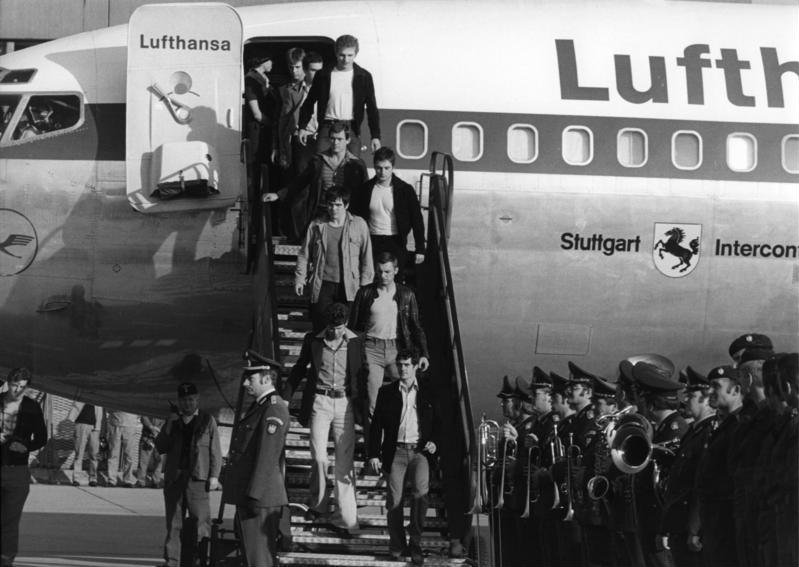
Lufthansa Flight 181 left Palma de Mallorca for Frankfurt on October 13, 1977 with a name painted on its fuselage: Landshut. Four Palestinian militants aboard the Boeing 737 seized control and turned a holiday flight into the moving front line of West Germany’s most severe domestic-security crisis of the decade.
For the next five days, the aircraft moved from airport to airport across the Mediterranean, Middle East and Horn of Africa. The hijackers demanded the release of imprisoned members of the Red Army Faction and two Palestinians held in Turkey, alongside a large cash payment. Captain Jürgen Schumann was murdered during the stop in Aden. By the time the Landshut reached Mogadishu, 86 living hostages remained aboard.
Shortly after midnight on October 18, members of the West German Federal Border Guard’s GSG 9 entered the aircraft in an assault codenamed Operation Feuerzauber. Three hijackers were killed and the fourth was wounded and captured. Every hostage who was alive when the assault began was brought out alive.
The result made Mogadishu a landmark in the history of hostage rescue. It also encouraged a simplified national story in which a German special unit appears almost alone at the end of a purely German crisis. The record is broader. The hijacking emerged from cooperation between West German and Palestinian militants; the aircraft crossed a chain of sovereign states; Somali permission made the final intervention possible; British advisers assisted the German force; and many of the passengers and crew carried the effects of those five days long after the public celebration ended.
At a Glance
- Hijacking began: October 13, 1977, after departure from Palma de Mallorca for Frankfurt.
- Aircraft: Lufthansa Boeing 737-230C, registration D-ABCE, named Landshut.
- Original hostages: 87 — 82 civilian passengers and five crew members.
- Hijackers: Four members of a Palestinian PFLP-linked commando associated with Wadi Haddad’s external-operations network.
- Demands: Release of eleven RAF prisoners in West Germany and two Palestinians imprisoned in Turkey, plus a cash demand widely reported as $15 million.
- Route: Rome → Larnaca → Bahrain → Dubai → Aden → Mogadishu.
- Hostage murdered: Captain Jürgen Schumann, shot in Aden on October 16.
- Surviving hostages rescued: 86 — 82 civilian passengers and four surviving crew members.
- Hijacker outcome: Three killed; Souhaila Andrawes wounded and captured.
- Rescue: GSG 9 stormed the aircraft in Mogadishu early on October 18 with Somali authorization.
The German Autumn reaches an airliner
The Landshut hijacking was not an isolated aviation crime. On September 5, 1977, members of the Red Army Faction kidnapped Hanns Martin Schleyer, president of the Confederation of German Employers’ Associations, after killing his driver and three police escorts. The kidnappers demanded the release of imprisoned RAF members. Chancellor Helmut Schmidt’s government refused to surrender the prisoners while a prolonged crisis-management effort tried to locate Schleyer and prevent further killings.
The Palestinian dimension of the crisis was also more than an improvised alliance. German historical research traces sustained contacts between the RAF and the Popular Front for the Liberation of Palestine and, more specifically, the international operations network associated with Wadi Haddad. Haddad had been involved in earlier transnational hijacking operations and in 1977 supported an operation intended to reinforce the pressure generated by Schleyer’s abduction.
Four hijackers boarded Flight 181. Later German historical and legal sources identify the leader as Zohair Youssef Akache, who used the name “Captain Mahmud,” together with Wabil Harb, Hind Alameh and Souhaila Andrawes Sayeh. Andrawes would be the only one of the four to survive Mogadishu.
Their demands enlarged the Schleyer crisis. They called for the release of eleven RAF prisoners in West Germany and two Palestinian prisoners in Turkey, and contemporary and parliamentary accounts also record a demand for roughly $15 million. The flight therefore tied the domestic struggle over imprisoned RAF members to a transnational militant network capable of taking civilians hostage far outside West Germany.
Eighty-seven hostages, not ninety-one
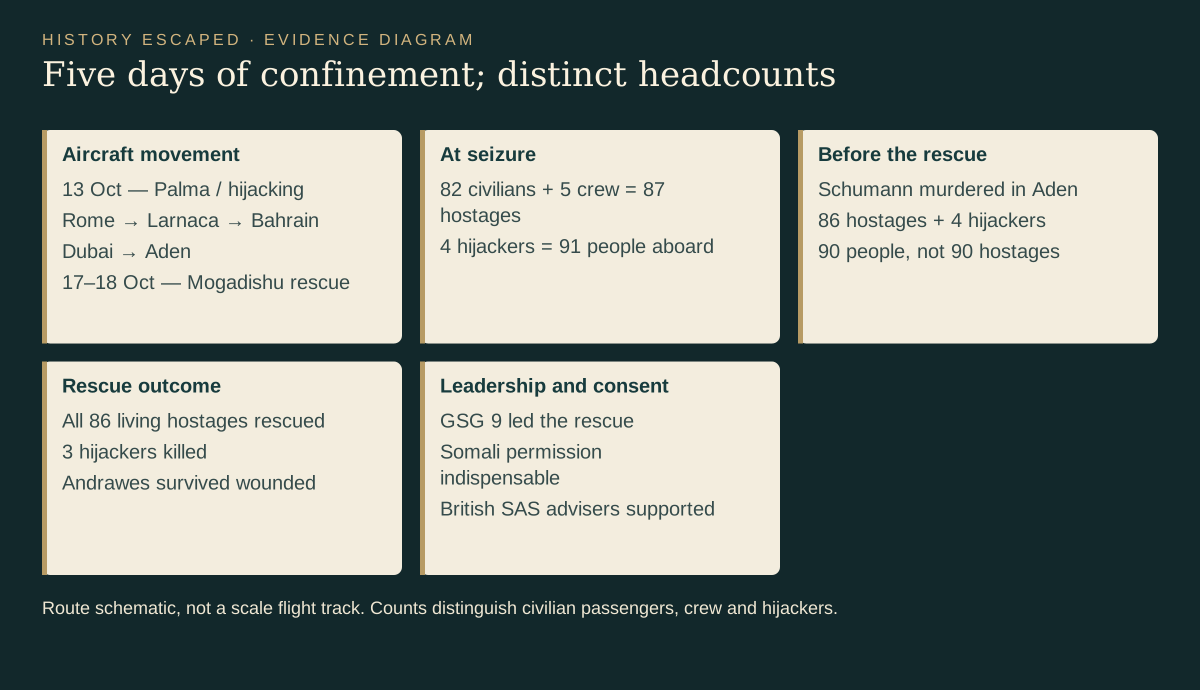
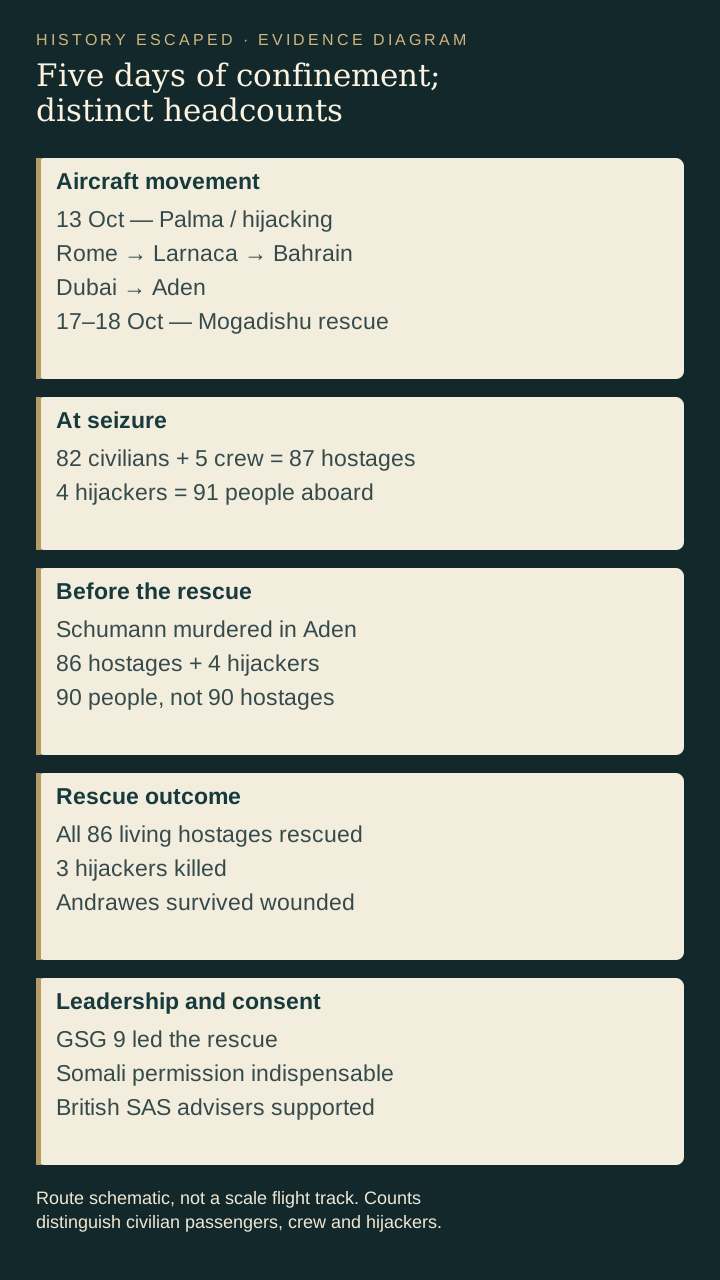
The numbers surrounding Flight 181 are confusing because different sources use “passenger” and “hostage” as if they were interchangeable. They were not.
The aircraft carried 86 people in the airline passenger category and five crew members. Four of those 86 passengers were the hijackers. That leaves 82 civilian passengers. The five crew members were Captain Jürgen Schumann, co-pilot Jürgen Vietor, chief flight attendant Hannelore Piegler, later Hannelore Brauchart, and flight attendants Gabriele Dillmann, later Gabriele von Lutzau, and Anna-Maria Starringer.
At the moment the hijacking began, the hostage population was therefore 87: 82 civilian passengers plus five crew. There were 91 people aboard altogether once the four hijackers are included.
Schumann’s murder in Aden reduced the number of living hostages to 86. Those 86 — the 82 civilian passengers and four surviving crew — were the people GSG 9 ultimately freed. Immediately before the assault there were 90 living people in the aircraft: 86 hostages and four hijackers.
That final distinction explains a later official error. A 2002 German presidential speech referred to “90 hostages” being liberated. Ninety is a real headcount for the living people aboard just before the rescue, but four of those people were the hostage-takers. The number of people rescued from captivity was 86.
A five-day journey without a safe destination
After taking control of the aircraft, the hijackers forced it to Rome, where it was refueled. From there the Landshut moved through Larnaca in Cyprus, Bahrain and Dubai. Each stop created a new political problem: the hijackers needed fuel and a government willing to tolerate the aircraft, while West German officials needed a host government willing to permit intervention.
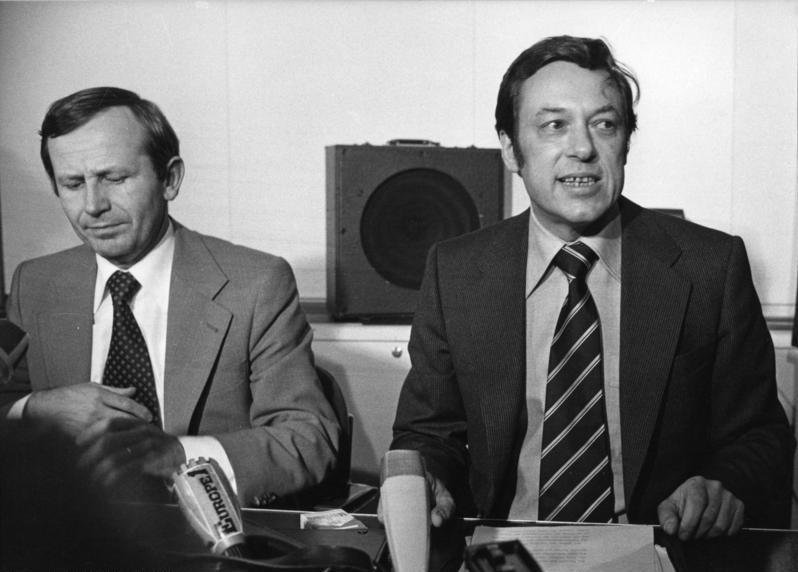
Hans-Jürgen Wischnewski, a state minister in the Federal Chancellery, followed the crisis as Schmidt’s special envoy. He negotiated with governments along the route and explored opportunities to end the hostage-taking. GSG 9 also deployed and repositioned, but it could not simply storm an aircraft in a foreign country without the consent of the government controlling the airport.
The crisis unfolded in front of an international television audience, yet reporters knew surprisingly little about what was happening inside the cabin. Later Federal Agency for Civic Education research emphasizes how often contemporary coverage had to speculate about conditions aboard. Media reporting also became part of the operational environment: disclosure of security movements could alert the hijackers to rescue preparations.
Dubai became one of the longest stops. Local authorities permitted the aircraft to remain and refuel but did not authorize the German force to take the aircraft. Wischnewski even explored exchanging himself for hostages. No such arrangement occurred, and the aircraft eventually departed again.
In Aden, South Yemen, the hijackers encountered a runway that had been obstructed in an effort to prevent their landing. With fuel becoming critical, the crew brought the aircraft down away from the normal landing surface. That stop became the point at which the hostage-taking turned fatal.
Jürgen Schumann in Aden
Schumann left the aircraft under the stated purpose of examining its condition after the difficult landing. German institutional accounts say he also made contact with Yemeni personnel and urged intervention. He remained away from the aircraft long enough to increase the hijackers’ suspicion.
The broad outline is secure, but the exact sequence outside the aircraft is not. A scholarly chronology of the RAF period explicitly notes unresolved circumstances surrounding Schumann’s movement away from the plane. Later narratives sometimes fill this gap with precise dialogue, motives or a fully scripted plan of self-sacrifice that the available record cannot establish.
When Schumann returned, Akache killed him inside the cabin. The murder took place on October 16. Survivor testimony recorded by the modern Landshut memorial project confirms the direct human impact: at least one former child hostage recalled witnessing the killing at close range and living for decades with its psychological consequences.
The death also changed the crew structure. Co-pilot Jürgen Vietor now had to fly the aircraft without the captain. He took the Landshut onward to its final destination: Mogadishu.
Why Mogadishu changed the balance
The aircraft arrived in the Somali capital on October 17. For the hijackers, Somalia offered another possible place to press their demands. For the West German government, it offered something the previous stops had not: a government willing to authorize a foreign rescue force on its territory.
That permission was not a technicality. Wischnewski negotiated directly with Somali President Mohamed Siad Barre, while Schmidt also communicated with the Somali leadership. German historical research drawing on diplomatic records shows that Bonn was careful to recognize Somalia’s sovereignty rather than treating the airport as an open field for German action.
Somalia had its own reasons for cooperating. The country was fighting the Ogaden War and its relationship with the Soviet Union was deteriorating. Contemporary American reporting described diplomatic appeals from the United States and Britain encouraging Barre to help West Germany. German accounts also refer to promises of financial or development support. The evidence does not require reducing Somali consent to one simple transaction; it does establish that without that consent Operation Feuerzauber could not have occurred as it did.
The British role belongs in the same category of necessary nuance. Contemporary reporting stated that two members of Britain’s Special Air Service traveled to Mogadishu and advised GSG 9, a point later repeated in a Canadian government aviation-security study. The assault nevertheless remained a West German operation under GSG 9 leadership. Describing the British role as advisory preserves both facts.
Buying time
The hijackers imposed another deadline and threatened to kill the hostages if their demands were not met. West German negotiators indicated that progress was being made toward satisfying them. The message was deceptive: its purpose was to gain time while the rescue force prepared and Somalia completed the arrangements that would allow it to act.
Inside the aircraft, five days of confinement had produced exhaustion, fear and severe physical discomfort. Later survivor accounts describe heat, sanitation failures, repeated threats and uncertainty about whether the next deadline would end in death. At Mogadishu the danger was immediate enough that the rescuers had to assume the aircraft could become the scene of mass killing if the hijackers concluded negotiations had failed.
The fame of the operation has produced many highly detailed retellings: precise officer positions, particular entry points, exact weapons, exact signals and second-by-second timings. Some details come from participants and may be accurate, but sources frequently measure different phases of the assault or disagree about particulars.
The historically important mechanism is secure without reproducing an assault manual. Somali authorities permitted the operation. GSG 9 approached the aircraft at night, entered at multiple points, engaged the hijackers and directed the hostages out. The decisive action was over within minutes.
Operation Feuerzauber
Shortly after midnight on October 18, GSG 9 began Operation Feuerzauber. The unit had been created after the disastrous failure of the 1972 Munich Olympic hostage rescue, in which all eleven Israeli hostages were killed. Mogadishu was therefore a major test of a specialized capability West Germany had built in direct response to Munich.
Three hijackers — Akache, Harb and Alameh — were killed during the assault. Souhaila Andrawes survived with serious wounds and was captured. A GSG 9 officer and flight attendant Gabriele Dillmann were injured; some later accounts also mention minor injuries among passengers. None of the surviving hostages was killed.
The 86 living captives were freed. Only minutes after the operation, the successful result was transmitted back to the West German government. The outcome — every hostage still alive at the start of the assault alive and out of captivity at its end — explains why Mogadishu immediately became a reference point for specialized hostage rescue.
The exact duration is less secure than the outcome. Some institutional summaries use seven minutes; other accounts divide the entry, gunfight and evacuation into separate intervals and generate different totals. “Within minutes” is more defensible than pretending that every source started and stopped the same clock.
The same night in Stammheim
The rescue did not end the German Autumn neatly. In Stuttgart-Stammheim prison, RAF leaders Andreas Baader, Gudrun Ensslin and Jan-Carl Raspe died by suicide after the failure of the hijacking destroyed the prospect that the hostages would force their release. Irmgard Möller survived serious injuries.
Schleyer’s captors then killed him. His body was found on October 19 in the trunk of a car in Mulhouse, France. The rescue of the Landshut hostages, the deaths in Stammheim and Schleyer’s murder therefore belong to the same political sequence without being equivalent events.
For Schmidt’s government, Mogadishu became proof that the state could refuse prisoner-release demands and still save hostages. That interpretation became powerful in West German public memory. It remains incomplete if it erases the people who bore the risk of that policy while confined aboard the aircraft or treats Schleyer’s death as an abstraction attached to a successful operation.
Former Landshut hostages have described very different long-term effects. Some returned comparatively quickly to ordinary life. Others struggled with trauma, employment problems, family strain and difficulty obtaining psychological or financial support. The modern Landshut77 project deliberately places those survivor voices beside the better-known stories of government leaders, militants and rescuers.
The survivor among the hijackers
Souhaila Andrawes was initially dealt with by Somali authorities and later lived in Norway. After she was located and extradited to Germany, prosecutors brought her before a Hamburg court. In 1996 she was sentenced to twelve years for crimes arising from the hijacking, including murder-related liability, hostage-taking and the attack on civil aviation.
The later prosecution matters for two reasons. It confirms that the political drama was also a sequence of crimes against identifiable victims. It also provides retrospective participant evidence that must still be weighed as such: testimony given almost two decades later cannot automatically settle every disputed detail of the five-day event.
Andrawes remained the only hijacker to survive the Mogadishu assault. That makes the common shorthand that GSG 9 “killed the hijackers” inaccurate. Three died; one was wounded, captured and later prosecuted.
What the rescue changed
Mogadishu transformed GSG 9 from a newly created specialist unit into an international model. Governments and police organizations elsewhere were already reassessing hostage rescue after the violence of the early 1970s, but the contrast with Munich gave the West German result particular weight. A state that had failed catastrophically in 1972 now possessed a force capable of mounting a successful overseas aircraft rescue five years later.
The episode also changed the imagery of the RAF conflict. Earlier RAF violence had often selected people because they represented government, policing, business or military power. Flight 181 exposed ordinary holiday travelers and airline employees to the same coercive strategy. German historical work has linked the escalation of 1977 to the erosion of residual sympathy for the RAF in parts of the radical left and broader society.
The international dimension is equally important. The hijacking grew from cooperation between German and Palestinian militants. The aircraft crossed jurisdictions across Europe, the Middle East and Africa. Governments denied landing access, allowed fuel, rejected intervention or negotiated over sovereignty. West Germany’s ability to act at the final stop rested not only on police skill but on diplomacy.
For that reason, “Mogadishu” should mean more than the few minutes in which GSG 9 entered a Boeing 737. It was the endpoint of five days in which pilots, cabin crew, passengers, diplomats, local governments and police units all affected whether the hostages would live.
The aircraft as evidence
The Boeing itself survived. D-ABCE returned to commercial service, later passed through other operators and eventually ended up out of service in Brazil. Germany acquired the aircraft in 2017 and brought it back for preservation. The Federal Agency for Civic Education and the House of the History of the Federal Republic of Germany have since developed it as a learning site rather than merely a trophy of the rescue.
That shift is historically useful. An aircraft displayed only as proof of GSG 9 success would tell a much narrower story than the object actually contains. The Landshut connects the globalization of political violence, the vulnerability of civilians, Schumann’s murder, the government’s refusal to exchange prisoners, the legacy of Munich, international diplomacy and the experience of people who lived inside a hostage crisis rather than watching it on television.
Operation Feuerzauber succeeded in the most important immediate sense: all 86 people still held hostage when the assault began were alive and free when it ended. The result deserves its reputation. It does not erase the hostage who had already been murdered, the parallel death of Schleyer or the decades of trauma some survivors carried afterward.
The achievement becomes more historically meaningful, not less, when those limits remain visible.
Evidence diagram
Five days of confinement; distinct headcounts
Route schematic, not a scale flight track. Counts distinguish civilian passengers, crew and hijackers.
- 01
Follow the aircraft and seek an intervention point
West German crisis officials and GSG 9 tracked the Landshut through successive international stops while negotiating with host governments. DOCUMENTED. Sources: SRC-005, SRC-011.
- 02
Secure Somali consent
Wischnewski and Schmidt obtained the Somali government's authorization for a German rescue operation at Mogadishu airport. DOCUMENTED. Sources: SRC-005, SRC-011, SRC-012.
- 03
Gain additional time
West German negotiators led the hijackers to believe that movement toward meeting their demands was underway, extending the deadline while the rescue force prepared. WELL-SUPPORTED. Sources: SRC-005, SRC-006.
- 04
Approach and enter the aircraft
GSG 9 moved on the Boeing at night and entered the aircraft at multiple access points. Fine tactical geometry is intentionally omitted. DOCUMENTED. Sources: SRC-001, SRC-010.
- 05
Neutralize the hijackers
Three hijackers were killed and Souhaila Andrawes was wounded and captured. DOCUMENTED. Sources: SRC-001, SRC-008, SRC-009.
- 06
Evacuate the surviving hostages
All 82 civilian passengers and four surviving crew members left hijacker control alive. DOCUMENTED. Sources: SRC-001, SRC-002, SRC-010.
Route schematic, not a scale flight track. Counts distinguish civilian passengers, crew and hijackers.
Problem → response
Escape was a sequence of problems
Each response solved a practical obstacle while often creating the next one.
- 01→
Obstacle
Moving hostage site
The aircraft repeatedly changed jurisdictions, preventing West German forces from acting without host-state permission.
Response
Wischnewski and other officials followed the crisis diplomatically while GSG 9 repositioned for a possible intervention.
- 02→
Obstacle
Host-state sovereignty
A German police unit could not conduct an armed operation in Somalia without authorization.
Response
Schmidt and Wischnewski negotiated with President Siad Barre and obtained Somali consent.
- 03→
Obstacle
Threat to kill the hostages
The hijackers imposed deadlines and threatened lethal escalation if their demands were not met.
Response
Negotiators created the appearance of movement toward compliance to gain preparation time.
- 04→
Obstacle
Information leakage
Media reports exposed aspects of West German movements and could increase hijacker suspicion during the crisis.
Response
Officials attempted to limit additional operational disclosure while continuing to seek an intervention opportunity.
The final accounting
Outcome
Original hostages
Eighty-two civilian passengers and five crew members became hostages when the aircraft was seized.
Hostages murdered before rescue
Captain Jürgen Schumann was killed in Aden.
Surviving hostages freed
All living hostages aboard at the start of the Mogadishu assault were freed.
Hijackers killed
Akache, Harb and Alameh were killed during the assault.
Hijackers captured alive
Souhaila Andrawes survived wounded and was taken into custody.
Selected chronology
Selected chronology
RAF kidnaps Hanns Martin Schleyer
The kidnapping creates the immediate prisoner-release crisis that the later Landshut hijacking is designed to reinforce.
Flight 181 is hijacked
Four Palestinian militants seize the Lufthansa Boeing after departure from Palma de Mallorca; the aircraft later lands at Rome and Larnaca.
The aircraft moves through Bahrain and Dubai
The hijacking becomes an international diplomatic crisis as governments negotiate over landing, refueling and possible intervention.
Captain Schumann is murdered in Aden
After leaving the aircraft during the Aden stop and attempting to obtain help, Schumann returns and is shot by the hijacker leader.
Landshut arrives in Mogadishu
West German officials negotiate with President Siad Barre's government for permission to conduct a rescue.
Operation Feuerzauber
GSG 9 storms the aircraft, kills three hijackers, captures the wounded fourth hijacker and frees all 86 surviving hostages.
Deaths in Stammheim
RAF prisoners Andreas Baader, Gudrun Ensslin and Jan-Carl Raspe die by suicide after the rescue; Irmgard Möller survives serious injuries.
Schleyer's body is found
After his captors kill him, Hanns Martin Schleyer's body is discovered in Mulhouse, France.
Evidence discipline
What the record supports
Status labels distinguish secure conclusions from uncertainty and rejected claims. Color is never the only signal.
MYTH
Ninety-one people aboard Flight 181 were hostages.
There were 91 people aboard when the hijacking began, but four were the hijackers. The hostage count was 82 civilian passengers plus five crew, or 87.
Sources: SRC-001, SRC-002DOCUMENTED
GSG 9 rescued 86 surviving hostages in Mogadishu.
After Schumann's murder, 82 civilian passengers and four crew members remained alive under hijacker control and were freed.
Sources: SRC-001, SRC-002, SRC-010MYTH
Ninety hostages were rescued.
The number 90 appears in later official language, but it corresponds to the 86 hostages plus four hijackers alive aboard before the assault. The hijackers were not hostages.
Sources: SRC-002, SRC-015MYTH
The Landshut hijacking was an independent Palestinian operation unrelated to the RAF's Schleyer campaign.
German historical research documents cooperation between the RAF and Wadi Haddad's PFLP-linked network and treats the hijacking as an effort to reinforce the Schleyer prisoner-release demands.
Sources: SRC-002, SRC-005DISPUTED
Schumann left the aircraft in Aden only to inspect its condition.
Inspection provided the reason for leaving, but institutional sources state that he also contacted Yemeni personnel and sought intervention. The complete circumstances of his movement away from the aircraft are not fully reconstructed.
Sources: SRC-006, SRC-007DISPUTED
GSG 9 carried out the rescue without meaningful foreign assistance.
GSG 9 led and executed the assault, but Somali authorization was indispensable, and contemporaneous reporting plus later government studies document British SAS advisory assistance.
Sources: SRC-011, SRC-012, SRC-016MYTH
All four hijackers were killed during the Mogadishu assault.
Three were killed. Souhaila Andrawes survived with serious wounds, was captured and was later prosecuted.
Sources: SRC-001, SRC-008, SRC-009MYTH
Operation Feuerzauber ended the RAF conflict.
The rescue was a major political and operational turning point, but the RAF continued violent activity for years and did not announce its dissolution until 1998.
Sources: SRC-002, SRC-013DISPUTED
The assault lasted exactly seven minutes.
Seven minutes appears in institutional summaries, while other accounts use different intervals for entry, firefight and evacuation. The secure conclusion is that the rescue unfolded within minutes rather than that one stopwatch figure covers every phase.
Sources: SRC-007, SRC-010