
Air France Flight 8969 was already a killing site before it ever left Algiers. On Christmas Eve 1994, four armed members of Algeria’s Groupe islamique armé entered the Airbus A300 as boarding was ending at Houari Boumediene Airport. They presented themselves as security personnel, checked passports and then seized the aircraft. A plainclothes Algerian police officer was singled out and shot. Vietnamese commercial attaché Bui Giang To was also killed. During the long standoff that followed, passengers were released in groups, but the hijackers continued to demand that the aircraft be allowed to depart.
On the evening of December 25, they murdered a third hostage, Yannick Beugnet, a cook employed by the French embassy, after using him to relay an ultimatum. The Airbus finally left Algeria in the early hours of December 26. Its stated destination remained Paris, but the crew persuaded the hijackers that fuel limitations required a stop at Marseille. GIGN personnel were already positioned in France after the Algerian government had refused a French intervention on its territory.
At Marseille-Provence Airport, negotiations continued for most of the day. French authorities had become convinced that the aircraft could not be allowed to leave again. The GIGN assaulted it at 17:12.
Seventeen minutes later, in the official Gendarmerie chronology, all four hijackers were dead and every hostage still alive when the assault began had been freed. The operation became one of the defining actions in GIGN history. It also acquired a powerful retrospective interpretation: that the hijackers intended to turn Flight 8969 itself into a weapon against Paris, possibly the Eiffel Tower or Montparnasse Tower. Evidence strongly supports French fears of an airborne mass-casualty attack. The exact target and the degree to which the final plan was known before the assault are less secure than many later retellings suggest.
At a Glance
- Hijacking began: December 24, 1994, at Houari Boumediene Airport, Algiers.
- Rescue: December 26, 1994, at Marseille-Provence Airport.
- Aircraft: Air France Airbus A300B2-1C, registration F-GBEC.
- Original hostage population: Best-supported contemporary Air France figure is 227 passengers plus 12 crew = 239 hostages.
- Passengers released in Algiers: 63.
- Hostages murdered before Marseille: 3.
- Hostages remaining for the final rescue: 173, the figure reported by TIME and later Radio France accounts and consistent with 239 − 63 − 3.
- Hijackers: 4, all killed during the GIGN assault.
- Assault injuries: 13 passengers, 3 crew members and 9 GIGN personnel were wounded; none of the remaining hostages or GIGN members was killed.
- Official assault window: Approximately 17:12–17:29 on December 26 in the Gendarmerie’s published chronology.
- Major count warning: Later sources sometimes give 220 passengers, 227 passengers, 229 “freed,” or other totals. These figures use different or mistaken denominators and should not be blended.
- Intent warning: An airborne attack on Paris is well supported as the threat French authorities came to believe they faced. A specific plan to strike the Eiffel Tower should not be stated as equally secure primary evidence.
A French flight inside Algeria’s civil war
The hijacking occurred during the Algerian civil war, when armed Islamist organizations were fighting the Algerian state and increasingly targeting foreign nationals. France occupied a particularly exposed position. Its colonial history in Algeria, support for the post-1992 Algerian political order and large bilateral community made French interests a recurring target. By late 1994, the GIA had already threatened foreigners and attacked French personnel.
Air France understood that the route was dangerous. Contemporary reporting described tightened security and operational precautions on Algeria services. Flight crews working the route were volunteers.
Flight 8969 was scheduled to leave Algiers for Paris-Orly at 11:15 on December 24. A contemporary Le Monde reconstruction contains an important manifest detail. Air France later told reporters that 227 passengers were actually aboard, while 271 people had been registered for the flight. Forty-four late passengers had not yet boarded when the hijacking began and were turned back.
Twelve crew members were also aboard. That makes the strongest contemporary starting denominator 239 hostages.
Four men enter the Airbus
The four hijackers approached the aircraft in uniforms or badges that made them appear to belong to airport or security personnel. The disguise mattered because their initial behavior resembled an official check. They inspected passenger documents before revealing weapons and taking control of the cabin and cockpit.
Later reporting identifies the group as a GIA commando led by Abdul Abdallah Yahia. Some details about the other men’s biographies come primarily from later security reporting and popular reconstruction, and they are not necessary to explain the hostage crisis.
What matters immediately is that the group had firearms, grenades and explosives and had gained access to an international flight despite heightened security. Algerian security forces surrounded the aircraft. The standoff had begun.
The first two murders
The hijackers used passenger identities to choose victims. A plainclothes Algerian police officer was identified through his documents. He was taken toward the aircraft door and shot.
The second victim was Bui Giang To, a 48-year-old commercial attaché at the Vietnamese embassy in Algiers. Contemporary witnesses remembered him being called forward from the rear of the cabin.
Their bodies were left outside the aircraft. The killings immediately changed the nature of the negotiations. The hijackers had demonstrated that deadlines were not merely rhetorical.
At the same time, they began releasing passengers, particularly women, children and Algerians. Le Monde reported 57 released by the evening of December 24 and later reported a cumulative figure of 63. That figure is important to the final count.
Paris and Algiers do not control the same crisis
The aircraft remained on Algerian territory, which constrained French options. Paris offered technical and operational assistance. The Algerian government did not permit a French armed intervention at the airport. France therefore positioned GIGN personnel at Palma de Mallorca, close enough to respond without entering Algeria uninvited.
The disagreement was not simply procedural. An armed French unit operating at Algiers airport would have raised sovereignty and political issues in the middle of Algeria’s civil war.
French officials nevertheless intensified pressure as the hostage situation worsened. The hijackers’ demands also shifted in contemporary reporting. Algerian officials at one point said they had demanded the release of imprisoned or restricted leaders of the Front islamique du salut, then abandoned that demand. The consistently reported operational demand was that the aircraft be allowed to leave. The destination was eventually presented as Paris.
Yannick Beugnet
By the evening of December 25, the standoff had lasted more than a day. The hijackers selected Yannick Beugnet, a French passenger who worked as a cook for the French embassy in Algiers, and forced him to communicate an ultimatum to the control tower.
If the aircraft was not permitted to leave, they would kill him. The deadline passed.
At approximately 21:31, Beugnet was shot and his body was thrown from the aircraft. His killing sharply increased French pressure on the Algerian government. Prime Minister Édouard Balladur warned that he would hold Algerian authorities responsible for the safety of French nationals aboard if the plane continued to be prevented from departing. Shortly after midnight, Algeria authorized the Airbus to leave.
The count problem
Flight 8969 has accumulated unusually confused passenger totals. One common modern figure is 220 passengers plus 12 crew. Other sources, including current Gendarmerie and INA pages, state 227 passengers plus 12 crew. Some summary pages then claim that 229 hostages were liberated.
Those numbers cannot all describe the same stage of the event. The best reconstruction starts with the contemporary Air France statement reported by Le Monde: 227 passengers were actually aboard when the aircraft was seized, with another 44 registered passengers still outside. Add the twelve crew members and there were 239 hostages.
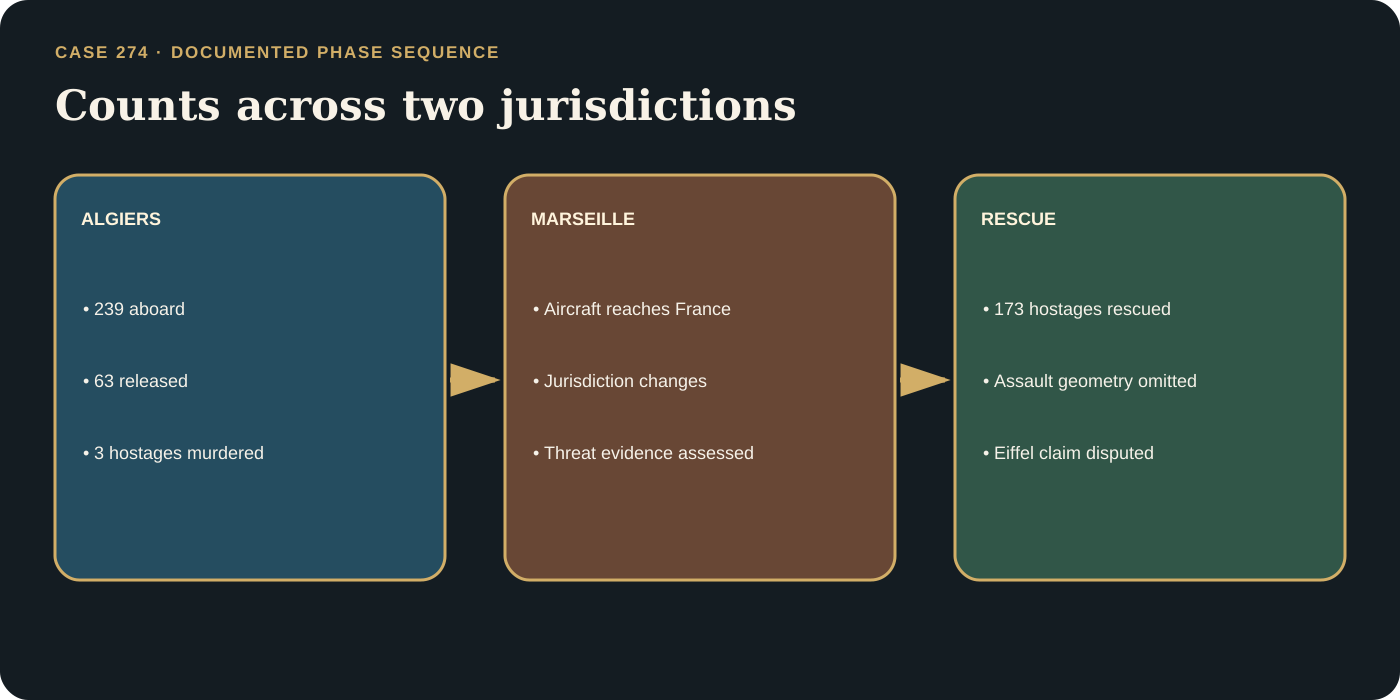
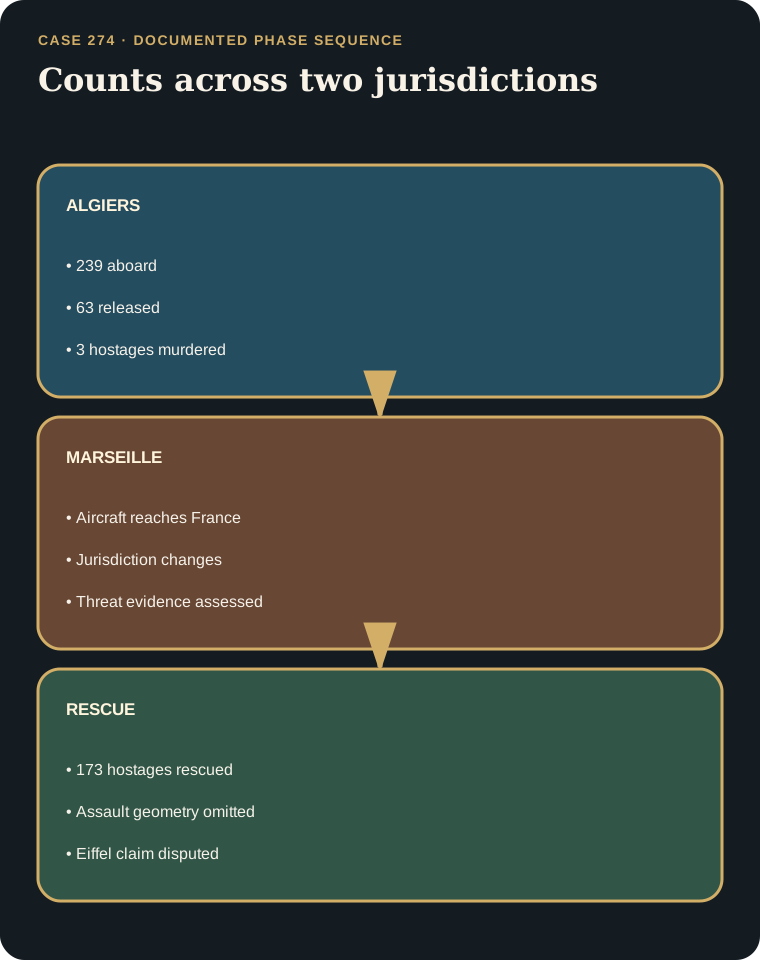
Contemporary reporting gives 63 passengers released in Algiers. Three hostages were murdered. The arithmetic is then:
239 original hostages − 63 released − 3 murdered = 173 remaining hostages.
That is also the number TIME reported freed at Marseille immediately after the event and the number preserved in later Radio France accounts. The contemporary Le Monde article itself contains an internal one-person inconsistency when it describes how many people remained at intermediate moments. That makes the stage-based arithmetic more reliable than copying any single “people aboard” sentence without checking its denominator. For this case, the locked publication counts are therefore 239 initially held, 63 released before departure, 3 murdered, 173 rescued at Marseille.
Leaving Algiers
The Airbus took off from Algiers around 2 a.m. on December 26. The hijackers wanted Paris.
The crew needed to get the aircraft onto French territory. Later crew accounts describe convincing the hijackers that the aircraft could not safely reach Paris with the fuel remaining after the long period on the ground and that Marseille was necessary for refueling. Whatever exact fuel margin existed, Marseille became the accepted intermediate destination.
The aircraft landed at Marseille-Provence in the early morning. GIGN personnel had already moved from Mallorca to the Marseille area and had access to another Airbus of the same general type for familiarization.
The crisis had entered a fundamentally different phase. French authorities now controlled the ground around the aircraft.
The “flying bomb” question
Later accounts of Flight 8969 often state as simple fact that the hijackers intended to crash the Airbus into the Eiffel Tower. The evidence deserves more careful wording.
TIME’s January 1995 reconstruction described French authorities as believing that the hijackers intended a suicidal attack over Paris using the aircraft’s fuel and explosives. Later security studies and French aviation sources repeated the assessment that the Airbus could have been detonated over Paris or deliberately crashed into a major landmark.
At Marseille, the hijackers’ demand for a very large fuel load reinforced French suspicion that Paris was not simply a destination for a press conference or onward negotiation. Yet no hijacker survived to testify, and no planning document found in the source base reviewed here fixes the Eiffel Tower as the single proven target. The strongest formulation is therefore:
French authorities came to believe that Flight 8969 was intended for an airborne mass-casualty attack on Paris.
The Eiffel Tower and Montparnasse Tower appear in later intelligence and media reconstructions and should be treated as possible or reported targets, not as equally documented facts. That distinction makes the case more historically significant, not less. The French government’s decision at Marseille was shaped by the belief that allowing the aircraft to leave could transform a hostage crisis into a mass-casualty attack.
Marseille becomes the final stop
At Marseille, French negotiators sought time. The hijackers wanted fuel and onward flight to Paris. French officials slowed the process with servicing, supplies and negotiation.
The GIGN used the delay to observe the aircraft, understand where passengers and hijackers were concentrated and prepare an intervention. The unit’s own later history emphasizes that the doors had been checked and that the team intended to enter without explosive breaching if possible.
This is where modern retellings often become tactical. For historical purposes, the secure sequence is enough: negotiators delayed departure; the aircraft was kept on the ground; the hijackers became increasingly impatient; the Airbus was eventually moved closer to the control tower; shots were fired toward the tower; and French authorities ended negotiation. At 17:12, Denis Favier ordered the assault.
Seventeen minutes
GIGN assault teams approached the aircraft using mobile boarding stairs and entered through multiple doors. The heaviest resistance came from the forward section and cockpit.
Passengers were evacuated from the rear while GIGN personnel engaged the hijackers. Co-pilot Jean-Paul Borderie eventually escaped from the cockpit through a window, sustaining injuries in the fall.
Captain Bernard Dhellemme and flight engineer Alain Bossuat remained exposed near the cockpit during part of the gunfight. All four hijackers were killed.
The Gendarmerie’s official retrospective places the end of the assault at approximately 17:29, about seventeen minutes after it began. Other retellings use fifteen, sixteen or twenty minutes depending on what portion of the action they count. Seventeen minutes is therefore best understood as the official Gendarmerie operational window, not as a universal stopwatch measurement for every evacuation and clearing action.
No hostage died in Marseille
The rescue succeeded in its central purpose. Every hostage alive when the GIGN entered survived the assault.
That does not mean no one was hurt. TIME reported 13 passengers, three crew members and nine GIGN personnel wounded. FENVAC also records sixteen civilian victims injured during the rescue phase.
The Gendarmerie’s own later article describes nine GIGN members wounded and says the hostages were evacuated without fatalities, though one sentence uses “unharmed” more broadly than the injury record supports. The injury total should therefore remain explicit:
- 16 hostages/crew wounded
- 9 GIGN personnel wounded
- 0 hostage deaths during the assault
- 0 GIGN deaths
- 4 hijackers killed
The three hostage deaths all occurred earlier in Algiers.
Why 173 matters
The number rescued at Marseille has often been swallowed by the larger headline numbers attached to the flight. It should not be.
The GIGN did not rescue every person originally held aboard because 63 had already been released in Algeria and three had been murdered. Its direct rescue population was 173.
That stage-specific count also explains TIME’s description of 177 people in the aircraft during the final phase: 173 hostages plus four hijackers. Keeping those groups separate prevents a recurring historical error in which hijackers, released passengers, murdered passengers and final hostages are mixed into one “survivor” total.
The aircraft did not return to service
F-GBEC survived the assault as an object but not as a viable airliner. Gunfire and explosions badly damaged the Airbus. It was written off and later scrapped.
That outcome is useful evidence in its own way. The intensity visible in television footage was not merely theatrical. The firefight occurred in a confined commercial aircraft filled with hostages.
The fact that all 173 remaining hostages survived was therefore not an automatic consequence of overwhelming force. It was an unusually favorable outcome from a dangerous intervention.
What the operation changed
Marignane became a central reference point in GIGN history. The rescue was broadcast to a mass television audience. Images of black-clad gendarmes moving up mobile stairs toward the Airbus became inseparable from the unit’s public identity.
For French security institutions, the event also reinforced the need to prepare for aircraft hijackings in which the aircraft itself might become part of the attack rather than merely a bargaining platform. It is tempting to describe Flight 8969 as a direct preview of September 11, 2001. That analogy can be useful but should not be stretched too far. The political organizations, operational contexts and available evidence were different.
What can be said is narrower: French authorities in December 1994 confronted the possibility that hijackers intended to use a fuel-laden commercial aircraft to produce mass casualties in a capital city. That possibility materially shaped the decision not to let the Airbus leave Marseille.
The Algeria-France relationship after the rescue
The crisis did not end the violence connected to Algeria’s civil war. Hours after the rescue, the GIA claimed retaliation in the killing of four Catholic priests in Tizi Ouzou. France then faced a series of attacks connected to Algerian Islamist networks in 1995.
Air France suspended regular service to Algeria for years before resuming flights in 2003. The 8969 crisis therefore belongs to more than the history of hostage rescue. It was part of the moment when Algeria’s internal conflict became an immediate French security problem.
The aircraft crossed the Mediterranean. The conflict had already done so.
What the evidence supports
The strongest record is unusually good for the final phase because the assault was filmed, surviving crew members later gave interviews, contemporary newspapers documented the negotiations, and the Gendarmerie preserved its own institutional chronology.
That does not eliminate source problems.
Passenger totals diverge. Intermediate headcounts in contemporary reporting do not always add up. Later official pages sometimes repeat totals that contradict the 1994 Air France statement. The exact Paris target remains less secure than the broader airborne-attack assessment.
The correct approach is to preserve denominators and certainty levels.
The case can be stated firmly without exaggeration:
Four GIA hijackers seized Flight 8969 in Algiers on December 24. They murdered three hostages and released dozens of others while demanding departure. The aircraft reached Marseille on December 26 with 173 hostages still alive. French authorities refused to let it continue to Paris. GIGN assaulted the Airbus, killed all four hijackers and freed every remaining hostage.
The rescue was real.
So were the three people who never reached Marseille.
Evidence discipline
What the record supports
Status labels distinguish secure conclusions from uncertainty and rejected claims. Color is never the only signal.
WELL-SUPPORTED
Flight 8969 initially held 227 passengers and 12 crew, for 239 hostages.
Contemporary Le Monde reporting attributes the 227-passenger figure to Air France, distinguishing it from 271 people registered for the flight; Gendarmerie and INA retrospectives also use 227 plus 12.
Sources: SRC-001, SRC-002, SRC-003DISPUTED
Only 220 passengers were aboard when the hijacking began.
A widely repeated alternative source tradition gives 220, but contemporary Air France reporting and French institutional retrospectives give 227. The controlling reconstruction uses 227 while preserving the conflict.
Sources: SRC-002, SRC-005WELL-SUPPORTED
GIGN rescued 173 hostages at Marseille.
TIME reported 173 immediately after the event and Radio France later repeated the figure. It also matches 239 original hostages minus 63 released and three murdered.
Sources: SRC-004, SRC-006MYTH
229 hostages were liberated in the GIGN assault.
Some modern summary pages repeat 229, but this conflicts with the staged contemporary record. 173 were still hostages for the Marseille rescue.
Sources: SRC-001, SRC-002, SRC-004, SRC-006WELL-SUPPORTED
The hijackers intended to use Flight 8969 for a mass-casualty airborne attack on Paris.
French authorities and early post-event reporting treated this as the likely plot, reinforced by explosives aboard and fuel demands at Marseille. No surviving hijacker or discovered planning document provides direct final confirmation.
Sources: SRC-004, SRC-010, SRC-011DISPUTED
The Eiffel Tower was definitively the hijackers’ chosen target.
Later accounts frequently identify the Eiffel Tower, sometimes alongside Tour Montparnasse, but the stronger evidence establishes a feared Paris airborne attack more securely than one exact target.
Sources: SRC-004, SRC-010MYTH
No hostages were injured during the Marseille assault.
Although no surviving hostage was killed, TIME and FENVAC record 13 passengers and three crew injured.
Sources: SRC-004, SRC-005WELL-SUPPORTED
The GIGN assault lasted exactly seventeen minutes.
The Gendarmerie’s official chronology gives 17:12 to 17:29. Other accounts use nearby durations because they define the start/end of fighting and clearing differently.
Sources: SRC-001, SRC-004Evidence diagram
Hostage counts across two jurisdictions
The count chain and the shift from Algiers to Marseille explain the outcome without reconstructing the armed assault.
The count chain and the shift from Algiers to Marseille explain the outcome without reconstructing the armed assault.