
On 8 November 1794, the Marquis de Lafayette got out of Austrian custody. For a short time, the escape worked. He broke free from an escort outside Olmütz, mounted a horse supplied by two would-be rescuers and rode away from the fortress. The failure came afterward, as a series of small disruptions separated Lafayette from the only men who knew the full route to safety. By the time the day ended, Lafayette was a prisoner again.
At a Glance
- Date: 8 November 1794
- Place: Olmütz, Moravia, Habsburg Monarchy
- Prisoner: Gilbert du Motier, Marquis de Lafayette
- Outside rescuers: Justus Erich Bollmann and Francis Kinloch Huger
- Classification: Failed political-prisoner escape attempt
- Temporary success: Lafayette broke from his escort and rode roughly thirty miles
- Planned destination: A waiting carriage at Hoff, then the Prussian/Silesian frontier
- Immediate result: Huger captured, Lafayette recaptured, Bollmann later arrested
- Final release: 19 September 1797
A Revolutionary Between Enemies
Lafayette had become vulnerable to both sides of the French Revolution. He had supported constitutional reform, helped draft the Declaration of the Rights of Man and commanded the Paris National Guard. Yet he opposed the radicalization of the Revolution and tried to preserve a constitutional monarchy.
After Louis XVI was suspended in August 1792, revolutionary authorities moved against Lafayette. He fled France on 19 August.
His hope was to pass through neutral territory and eventually find refuge outside the conflict, with America remaining one possible destination. Instead, Coalition forces captured him after he crossed into Austrian-controlled territory.
He was passed into Prussian custody and moved among prisons before Austria took him back in 1794. By May, he was at Olmütz.
The Prisoner at Olmütz
Olmütz was a fortified Moravian city, far from the political audiences that had once surrounded Lafayette. His imprisonment was intentionally isolating.
Lafayette College’s history of the captivity describes his remaining possessions being stripped away, correspondence restricted, and even his whereabouts concealed from many of his friends. The European monarchies holding him did not regard him as an ordinary traveler who had crossed the wrong frontier.
He represented revolution. That made efforts to free him politically dangerous.
Washington Could Ask, but America Would Not Intervene
Lafayette had another identity that complicated his captivity. He was one of the most celebrated foreign veterans of the American Revolution and had been granted citizenship by several American states. George Washington regarded him with deep personal affection.
Washington and other Americans explored diplomatic appeals. The problem was neutrality.
The United States did not want a private friendship with Lafayette to pull the young republic into the European war between revolutionary France and the Coalition powers. Official pressure therefore remained limited. Private friends were less cautious.
Justus Erich Bollmann
The man who turned sympathy into an escape plan was Justus Erich Bollmann, a German physician with experience moving politically endangered people across borders. He had already helped the Comte de Narbonne escape revolutionary France.
Friends of Lafayette in London enlisted Bollmann to locate the prisoner and explore a rescue. Finding Lafayette was the first problem.
He had been moved without public notice. Bollmann eventually traced him to Olmütz.
The Unwitting Doctor
At Olmütz, Bollmann made contact with the prison physician, usually identified as Dr. Haberlein.
The doctor became a messenger without understanding the real purpose of the correspondence. Books and apparently harmless notes passed between the prisoner and the outsider. Hidden writing in lemon juice carried the information that mattered.
Lafayette was being allowed escorted carriage rides for his health. That was the opening.
Lafayette Helps Design the Escape
The plan was not imposed on Lafayette from outside. Messages attributed to him discuss the carriage, the corporal accompanying him and the possibility of taking the guard’s sword once help arrived.
He wanted horses waiting. He also understood that ordinary prison-escape methods were effectively closed.
Getting him out of the cell was not the objective. The rescuers intended to intercept a routine movement that already took him outside the fortress.
Francis Kinloch Huger
Bollmann needed another man. In Vienna he approached Francis Kinloch Huger, a twenty-one-year-old South Carolinian completing medical studies in Europe.
Huger had a remarkable personal connection to Lafayette. When Lafayette first reached the American coast in 1777, he landed near property belonging to Huger’s family in South Carolina and was received by Major Benjamin Huger before continuing to Charleston.
Francis had been a small child then. Seventeen years later, he agreed to risk imprisonment for the man his family had once welcomed into America.
Two Horses, Not Three
Bollmann and Huger traveled toward Olmütz under the appearance of ordinary travelers. A detailed later reconstruction places them at the Golden Swan by 5 November.
Their equipment exposed one of the plan’s compromises. Lafayette had suggested that a third horse be brought for him. Bollmann and Huger feared that three saddle horses would look suspicious.
Instead, they brought two. Lafayette would ride one.
Bollmann and Huger would share the other. The arrangement worked on paper because one of the horses had been tested carrying two riders. Under pursuit, it became a serious weakness.
The Waiting Carriage at Hoff
The escape was supposed to have a second stage. Bollmann and Huger sent their traveling carriage ahead to a village called Hoff on the intended route toward the frontier.
Once the three men reached it, Lafayette and Bollmann could transfer into the carriage. Huger would help take control of the vehicle and the group would continue toward Prussian Silesia.
The carriage mattered because the horses were only the extraction from Olmütz. Hoff was the transition point. The frontier was the real objective.
November 8
Saturday, 8 November, was a market day. That meant traffic on the road and people in the surrounding fields.
Lafayette’s carriage appeared with his escort. Bollmann and Huger followed until the party was far enough from the fortress to act.
Lafayette and the corporal left the carriage and began walking. Then Lafayette reached for the corporal’s sword. The quick release everyone had imagined did not happen.
The Escort Fights Back
The corporal resisted. Instead of giving up the sword, he seized its blade and struggled with Lafayette. Bollmann and Huger rode forward to help.
The fight changed the pace of the entire operation. Bollmann dismounted.
His horse got loose. Another member of the escort began moving back toward Olmütz and raising the alarm. The quiet roadside transfer had become a visible struggle on open ground.
Lafayette Gets a Horse
Huger managed to keep control of his own mount. He and Bollmann subdued the corporal long enough for Lafayette to break away.
Huger gave Lafayette the horse and told him to ride to Hoff. Lafayette left, then briefly returned or hesitated, apparently reluctant to abandon the rescuers while they were still fighting.
Huger again urged him onward. Lafayette rode away alone. That was the closest the plan came to success.
The Most Famous Misunderstanding
A later Huger-family account supplies one of the story’s most memorable details. Huger had shouted in English for Lafayette to “go to Hoff.”
According to the family narrative, Lafayette either did not know the village name or understood the words as simply “go off.” The explanation fits what happened next.
It is also retrospective. The secure fact is that Lafayette did not reach the waiting carriage at Hoff, while Bollmann did. Whether one English phrase caused the separation cannot be proved with the same confidence.
The Horse That Could Not Carry Two
The first loose horse had been caught by a local boy. That seemed to restore the plan.
Bollmann and Huger mounted together and tried to follow Lafayette. The horse did not cooperate.
Under the double load and pressure to move quickly, it became difficult and repeatedly threw one or both riders. Every delay widened the distance between Lafayette and the men who knew where he was supposed to go.
Huger finally made a decision. Bollmann should take the horse alone.
Why Bollmann Went Ahead
Bollmann knew German. He knew the roads.
He had designed the route. If one of them had a chance of catching Lafayette and guiding him across the border, Bollmann was the better choice.
Huger continued on foot. He did not get far enough.
Local pursuers overtook him and returned him to Olmütz. The rescue now consisted of three separated men moving in different directions.
Lafayette Without a Guide
Lafayette had spent months inside a tightly controlled prison routine. His carriage rides had carried him only a few miles from the fortress.
Now he was on horseback in unfamiliar country with no guide beside him. The strongest near-contemporary description of what happened next comes from Huger himself.
On 5 January 1795, imprisoned at Olmütz, Huger managed to send out a short letter. He wrote that Lafayette had ridden hard and reached a small town roughly thirty miles away.
There he obtained a fresh horse. Then someone recognized him.
Recognition Before the Frontier
Huger said the person who recognized Lafayette was a clerk who had seen him while he was being transported from an earlier prison at Neisse. The fugitive was detained.
According to Huger, Lafayette was still about twenty miles from the frontier. Later histories assign a more precise town to the recapture, often identifying it with Sternberg.
That detail is not needed to understand the failure. Lafayette had traveled far enough to make the attempt serious, but not far enough to reach a jurisdiction where Austrian pursuit became much harder. He was sent back to Olmütz.
Bollmann Reaches Hoff
Bollmann did what Lafayette had failed to do. He reached Hoff.
The carriage was waiting, but Lafayette was not there. Bollmann delayed as long as he thought possible and then moved across toward Silesia, hoping Lafayette might have found another route.
For a time, Bollmann himself remained free. He was eventually arrested, handed back to Austrian authorities and returned to Olmütz. All three men were now prisoners.
The Failure Was a Chain
The escape was not defeated by one ingenious countermeasure. The corporal resisted more fiercely than Lafayette expected.
A horse bolted. The replacement horse could not efficiently carry both rescuers.
Huger and Bollmann separated. Lafayette did not know the route well enough to reach Hoff alone.
The alarm spread across open country. Then recognition ended the attempt.
Any one of those problems might have been survivable by itself. Together they destroyed the plan.
Huger and Bollmann in Prison
The rescuers paid heavily for the attempt. Huger and Bollmann were imprisoned, interrogated and held for months.
Huger’s later account describes irons, solitary confinement and fear that the offense could carry a death sentence. The investigation initially looked for a larger political conspiracy.
That fear was understandable. Austria was at war with revolutionary France, and two foreigners had just broken a high-profile political prisoner away from military custody.
Eventually the authorities concluded that the rescue was a private enterprise rather than a local revolutionary plot. Both men survived. They were later released and expelled from Austrian territory.
Lafayette Did Not Blame Them
Lafayette’s later correspondence leaves little doubt about how he regarded the two men. In a prison letter written in 1795 and transmitted through his friends, he expressed deep gratitude toward Bollmann and Huger and defended the attempt as an effort to escape a detention he considered unjust.
After his eventual liberation, he continued to praise them. In 1798 he wrote to George Washington about Bollmann and referred to the “heroic young Huger” with extraordinary warmth. Failure did not turn the rescuers into scapegoats.
The Attempt Tightens the Prison
Lafayette returned to confinement after coming much closer to freedom than Austrian officials had thought possible. The failed escape reinforced the logic of stricter security.
His situation nevertheless remained an international issue. Friends in Europe and America continued trying to secure his release, and Washington remained personally concerned even when formal American action was constrained.
In 1795, Lafayette’s wife Adrienne and two daughters obtained permission to join him in Olmütz. They chose imprisonment with him over separation.
Freedom Comes Through War and Diplomacy
Lafayette did not escape again. By 1797, French armies under Napoleon Bonaparte had transformed the military balance in Europe.
Austria entered peace negotiations. Lafayette’s release became part of the diplomatic settlement.
On 19 September 1797, nearly three years after the failed roadside escape, Lafayette finally left Olmütz. This time there was no horse running loose, no misunderstood rendezvous and no frontier race. His freedom came through political pressure.
Why the Failed Attempt Matters
The Olmütz story belongs in escape history precisely because it failed. Its planning was credible.
Its opening phase worked. Lafayette physically got away from his escort and covered substantial ground.
What destroyed the attempt was the gap between a plan and the sequence of accidents that followed contact with reality. The rescue needed three men to remain connected.
Within minutes, they were no longer together. The waiting carriage at Hoff never carried Lafayette anywhere.
Evidence discipline
What the record supports
Status labels distinguish secure conclusions from uncertainty and rejected claims. Color is never the only signal.
MYTH
Lafayette successfully escaped Olmütz in 1794 and reached freedom.
He temporarily broke free from his escort and traveled substantial distance but was recaptured before reaching the frontier.
Sources: SRC-001, SRC-002, SRC-003MYTH
The escape attempt took place on 8 November 1795.
The accepted date is 8 November 1794. A 1795 date in one Founders Online editorial annotation conflicts with Huger's January 1795 letter and the broader documentary chronology.
Sources: SRC-001, SRC-002, SRC-011MYTH
Francis Huger was the principal planner of the operation.
Bollmann was the principal organizer who located Lafayette and developed the extraction; Huger joined later and became an essential operational participant.
Sources: SRC-002, SRC-003MYTH
The United States government officially organized the Olmütz rescue.
American and American-connected supporters encouraged Lafayette's release, but the rescue itself was privately organized while U.S. officials remained constrained by neutrality.
Sources: SRC-005, SRC-007MYTH
Three riding horses were waiting for the escape.
Later detailed accounts say Bollmann and Huger deliberately brought only two horses to avoid suspicion, requiring them to share one mount.
Sources: SRC-002, SRC-003LATER CLAIM
Lafayette definitely misunderstood 'go to Hoff' as 'go off.'
This explanation comes from the later Huger-family narrative and is plausible, but it is not established by Huger's January 1795 prison letter.
Sources: SRC-002DISPUTED
The exact town of Lafayette's recapture is securely established as Sternberg.
Later accounts use specific place names, but Huger's strongest near-contemporary report describes only a small town about thirty miles from Olmütz.
Sources: SRC-002, SRC-003UNKNOWN
Austrian authorities knew about the escape in advance because someone betrayed the plan.
No secure evidence establishes advance betrayal. The documented failure sequence is better explained by escort resistance, horse problems, separation and recognition after the attempt had begun.
Sources: SRC-002, SRC-003MYTH
The 1794 attempt directly secured Lafayette's release.
Lafayette remained imprisoned until 19 September 1797, when diplomatic and military pressure produced his release.
Sources: SRC-001, SRC-009Documentary reconstruction
The plan and its failure cascade
A case-local editorial visual separates the documented sequence from uncertainty without implying exact modern geography or operational detail.
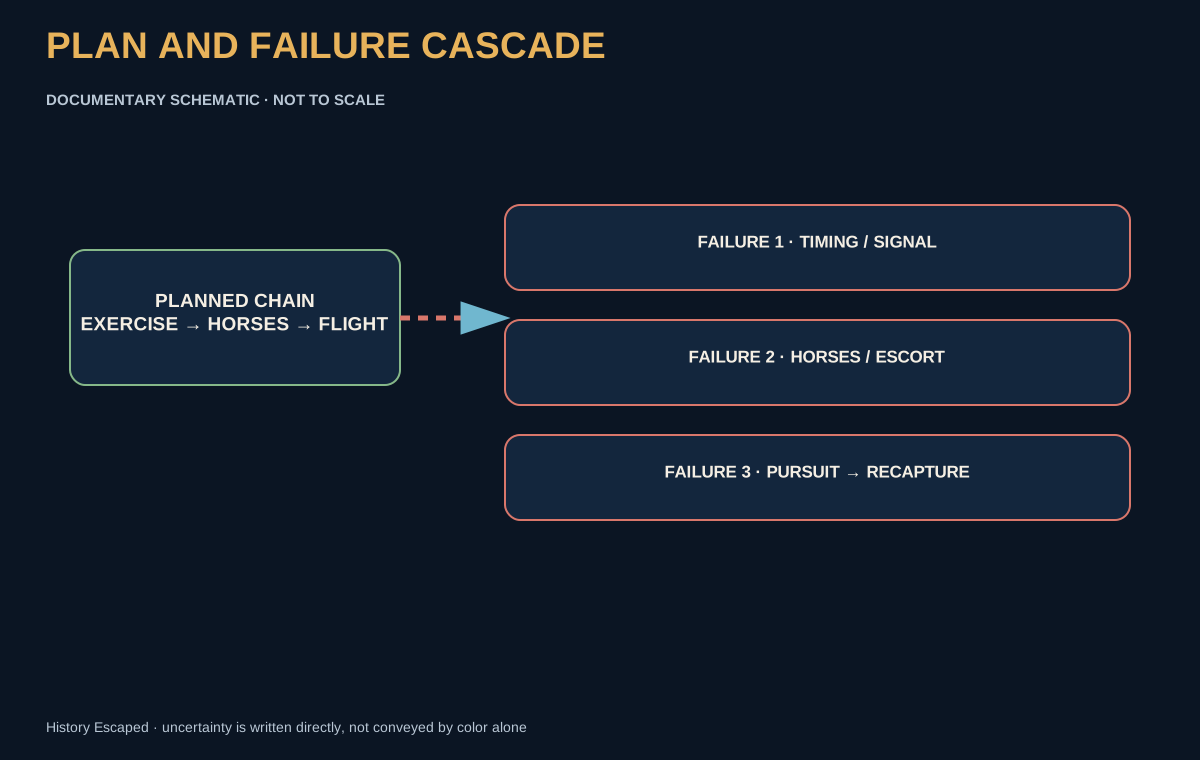
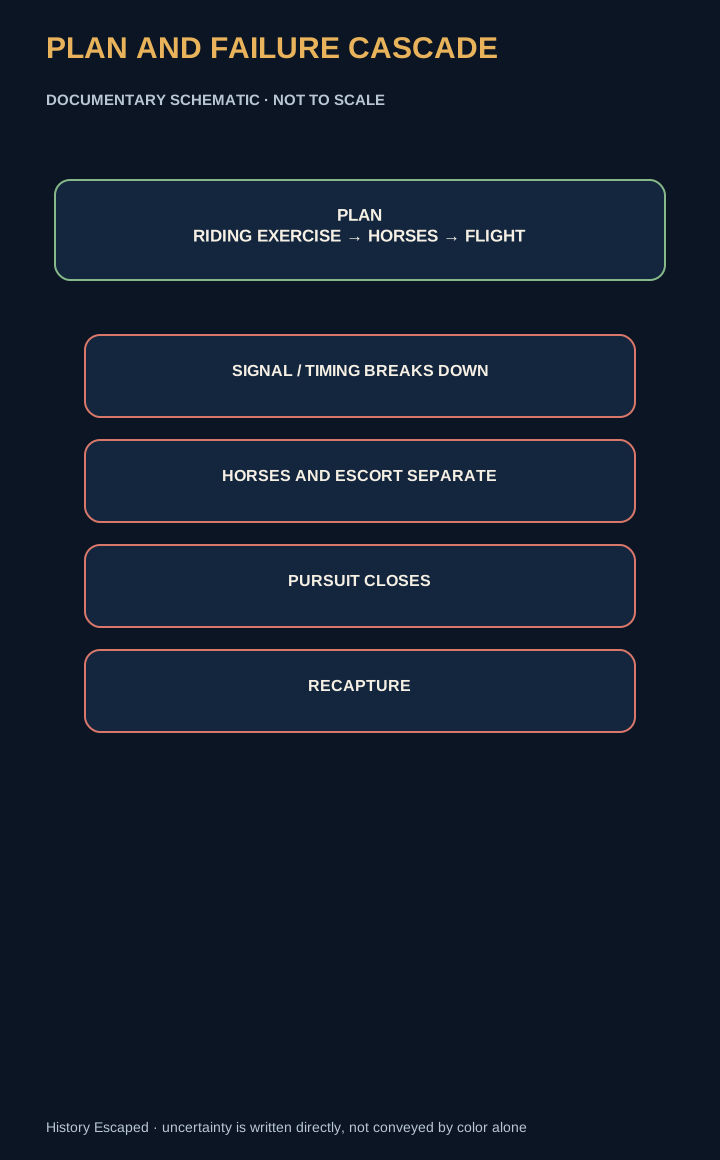
Simplified editorial reconstruction based on the cited historical record; not to scale. Uncertainty is stated directly in the visual and adjacent text.
