
Virginia Hall had spent more than a year helping other people get out of danger. In November 1942, she had to use an escape line herself.
The American agent had become one of Britain's most valuable operatives in France.
From Lyon, Hall worked for the Special Operations Executive, Britain's clandestine wartime organization for espionage, sabotage and support to resistance movements. She built contacts, helped agents and airmen move through France, and supported escape operations that sent other fugitives toward Spain.
Then the strategic situation changed.
On 8 November 1942, American and British forces landed in French North Africa. Three days later, German troops occupied the part of Vichy France that had previously remained outside direct German military occupation.
Hall's position in Lyon had already become dangerous. Now it was becoming untenable. She left. Her way out would take her south by train, into the Pyrenees on foot, and over the mountains into Spain.
She would do it with one natural leg and one prosthetic.
The agent in Lyon
Hall had not entered France as a soldier.
When SOE sent her into Vichy France in 1941, her cover was journalism. As an American citizen at a time when the United States had not yet entered the war, she could move with freedoms denied to many British agents.
She used those freedoms aggressively.
Lyon became the center of her work. Hall cultivated contacts, helped build resistance circuits, arranged money and supplies, aided agents moving through the region and assisted efforts to get Allied personnel out of France.
Her disability did not make her invisible.
Years earlier, a hunting accident had led to the amputation of her lower left leg. Hall used a prosthetic leg she nicknamed Cuthbert.
The limp made her distinctive.
Over time, the French and Germans became aware of a woman operative associated with a limp. Her usefulness depended on remaining one step ahead of the security services trying to identify the networks around her.
By the second half of 1942, that margin was narrowing.
Networks collapse around her
Hall had already seen how quickly clandestine organizations could disintegrate. Agents were arrested. Wireless operators disappeared. Resistance groups were infiltrated.
A man calling himself Robert Alesch approached Hall while posing as a priest and claiming links to the compromised GLORIA intelligence network. Hall had doubts about him. Later evidence established that Alesch was working for German intelligence.
At the same time, German security resources in southern France were increasing. Hall had survived partly because the southern zone, while controlled by the collaborationist Vichy regime, was not yet under the same direct German occupation as northern France. That distinction ended in November.

The occupation of southern France
The Allied landings in Morocco and Algeria began on 8 November 1942. The German response was rapid. On 11 November, German forces occupied Vichy's previously unoccupied southern zone. For Hall, this was not an abstract shift on a map.
The space in which she had operated was disappearing.
The CIA later described her as escaping only steps ahead of the expanding hunt associated with Klaus Barbie and the Lyon Gestapo. That captures the danger but can be misleading if read literally. The evidence does not require a cinematic chase with Barbie personally behind her.
The threat was broader. German forces were moving into the zone. German security services could operate more aggressively. Resistance networks had been compromised.
Hall's identity and limp made continued exposure increasingly dangerous. She needed to leave France before the exits closed.

She arranged the escape herself
Hall's own report is unusually clear on this point. Dated 18 January 1943 and preserved in her SOE personnel file, it says that she arranged her exit herself, particularly because she needed to move quickly. She went south to Perpignan. There she contacted a man identified in the report as GILBERT, whom she knew could be found in a particular square during a predictable hour in the afternoon.
Gilbert obtained guides. That is an important part of the story. Hall did not simply point herself toward the mountains and start walking. Crossing the France-Spain frontier clandestinely required local knowledge: paths, timing, checkpoints, villages, and an understanding of where an illegal crossing might still be possible.
The Pyrenees were the barrier. The guides were the way through it.
From Perpignan toward the mountains
The National Archives' reconstruction says Hall travelled from Lyon to Perpignan by train and then continued toward the Pyrenees on foot. Her own report names Villefranche in the route. It also names Lavelanet in the surviving transcription before describing the mountain crossing. Here historical discipline matters.
Those place names should not be turned automatically into a smooth modern hiking itinerary. The accessible transcript is short, and the geography is not neat enough to justify pretending that every turn has been reconstructed.
Hall herself was cautious about the pass. She reported that she crossed what she thought was the Col de Tivoli. That phrase should control any modern map. We know the broad corridor.
We do not know every step.
Cuthbert
For most people, a clandestine crossing of the Pyrenees would have been punishing. Hall faced another problem. Her left leg below the knee had been amputated years earlier, and her prosthesis was not designed for a wartime mountain escape. She called it Cuthbert.
Before the crossing, Hall communicated with SOE and expressed concern that Cuthbert might become troublesome. The reply from London has become one of the most famous anecdotes of her career: whoever received the message did not understand that Cuthbert was her artificial leg and responded that, if he caused trouble, Hall should get rid of him. The joke survived because the misunderstanding was absurd.
The underlying problem was not. Hall could not eliminate Cuthbert. She needed him to walk.
The climb
The National Archives describes the route as crossing a pass at roughly 7,500 feet. That figure gives a sense of the terrain without pretending the entire path is known. The crossing inflicted severe pain.
Hall's prosthesis rubbed and injured the stump of her amputated leg as she climbed and descended. Smithsonian's interview with biographer Sonia Purnell describes the special difficulty of steep descent for Hall because the prosthetic ankle could not function like a natural joint.
The ascent mattered. The descent mattered just as much. A mountain route that demanded constant changes in balance and footing magnified every limitation of the prosthesis. Later retellings sometimes turn this into a contest of superhuman endurance measured in exact miles, hours and snow depths.
The surviving evidence supports something more restrained and more impressive. Hall kept moving through difficult mountain terrain despite a prosthetic limb that was causing significant pain and injury. She crossed.
The route she remembered
Hall's January report provides the strongest outline of what came next. She believed she went over the Col de Tivoli. From there she descended toward the area of Camprodon, on the Spanish side of the Pyrenees. Her destination was San Juan de las Abadesas, now generally called Sant Joan de les Abadesses.
The plan was practical. She wanted the early train to Barcelona. Hall's report gives the departure time as 5:45 a.m. and notes that she believed the train was not controlled. If she could reach it, the most physically dangerous part of the escape would be over.
The mountains would be behind her. Barcelona could provide the next link.
4:30 in the morning
Hall and the others reached Sant Joan de les Abadesses at about 4:30 a.m. They were early. They never made the 5:45 train. Spanish authorities picked them up and put them in jail.
That outcome can make the escape sound like a failure. It was not. Hall had escaped France. She had crossed out of territory now under German occupation and into neutral Spain.
But she had entered Spain illegally, and Spanish neutrality did not mean that clandestine entrants could simply travel without interference. The escape from one security system had ended in detention by another.
Getting out of Spanish custody
Hall's imprisonment in Spain was an obstacle, but not the end of her Allied career. American diplomatic intervention eventually secured her release. The precise duration of that detention varies across later accounts, so it is safer not to build the story around one fixed number of weeks. Once free, Hall remained useful.
She worked for SOE in Spain for a time and later returned to Britain. There she wanted to go back into France.
SOE leadership considered that too dangerous. Hall's profile had become too recognizable, and the Germans had invested too much effort in identifying her.
So she found another organization willing to take the risk.
Back to France
Hall later joined the Office of Strategic Services, the American wartime intelligence organization that preceded the CIA. In 1944 she returned clandestinely to France. CIA accounts emphasize an important practical detail: her prosthetic leg made parachuting unsuitable, so she was inserted by boat. She then resumed work with resistance forces, radios, supply drops and sabotage networks.
The 1942 Pyrenees crossing therefore was not the end of Hall's field career. It was the bridge between two phases of it.
What later versions get wrong
Virginia Hall's mountain escape has attracted legend because so much about it sounds unbelievable even when stripped to the evidence. That makes precision more important. The exact mountain route is not fully known. Hall's own report contains uncertainty about the pass and should not be converted into a definitive modern trail.
The crossing should not be reduced to an exact mileage challenge. Popular versions use different totals and daily distances. The secure point is the difficult multi-stage mountain crossing, not a stopwatch or fitness statistic.
The Cuthbert story is not simply internet folklore. The National Archives links the anecdote to Hall's SOE personnel file. Klaus Barbie should not be depicted as personally chasing Hall through the mountains. German security pressure and the occupation of southern France were real; a literal one-man pursuit is a different claim. Reaching Spain did not mean immediate freedom. Hall was arrested after the illegal frontier crossing.
Her disability was neither irrelevant nor the whole story. The prosthetic made the crossing substantially more difficult, but the escape also depended on timing, contacts, guides, clandestine travel knowledge and Hall's judgment about when France had become too dangerous to remain.
Why the escape worked
The first reason was timing.
Hall left when the political geography of France changed dramatically. Waiting longer would have meant operating under a much denser German military and security presence.
The second was preparation.
She knew where to find a contact in Perpignan who could arrange guides. That small piece of clandestine infrastructure mattered more than bravado.
The third was adaptability.
Hall did not require the journey to go according to a clean plan. The route was difficult, the prosthesis hurt, the pass itself was not something she later identified with complete certainty, and Spain ended with arrest instead of a train to Barcelona.
She kept solving the next problem. Lyon to Perpignan. Perpignan to guides. Guides to the mountains.
Mountains to Catalonia. Spanish detention to diplomatic release. The escape was successful because no single failure ended the chain.
The route that should remain partly blank
Hall's story tempts a historian to draw a line. It would look satisfying on a map: Lyon, Perpignan, the pass, Camprodon, Sant Joan de les Abadesses, Barcelona. But a clean line would claim more than Hall herself did. Her own report contains uncertainty.
That is not a flaw in the evidence. It is part of the evidence.
Clandestine journeys were designed to leave incomplete records. Mountain routes changed. Guides made local decisions. Agents often knew only the stage immediately in front of them.
The responsible reconstruction is therefore not the most detailed map possible. It is the map that knows where to stop. Virginia Hall escaped France in November 1942. She crossed the Pyrenees on foot with a prosthetic leg.
She reached Spain. And the parts of the trail that remain uncertain should stay uncertain.
Escape reconstruction
How the escape unfolded
An evidence-aware sequence of the principal stages.
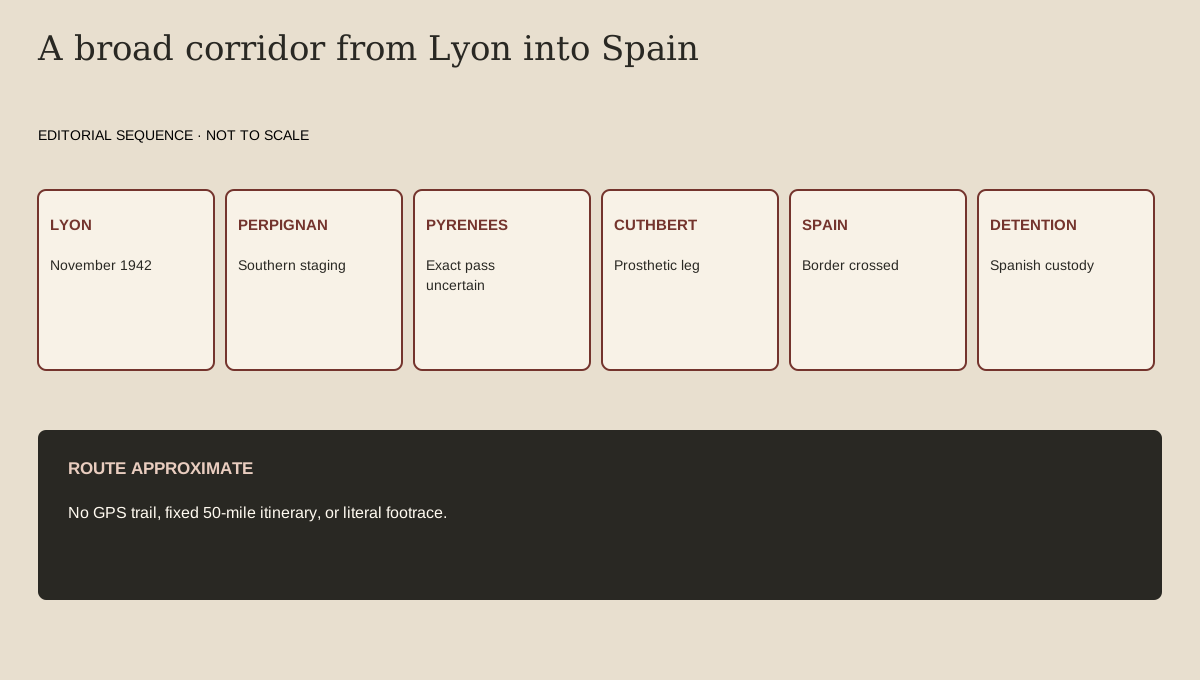
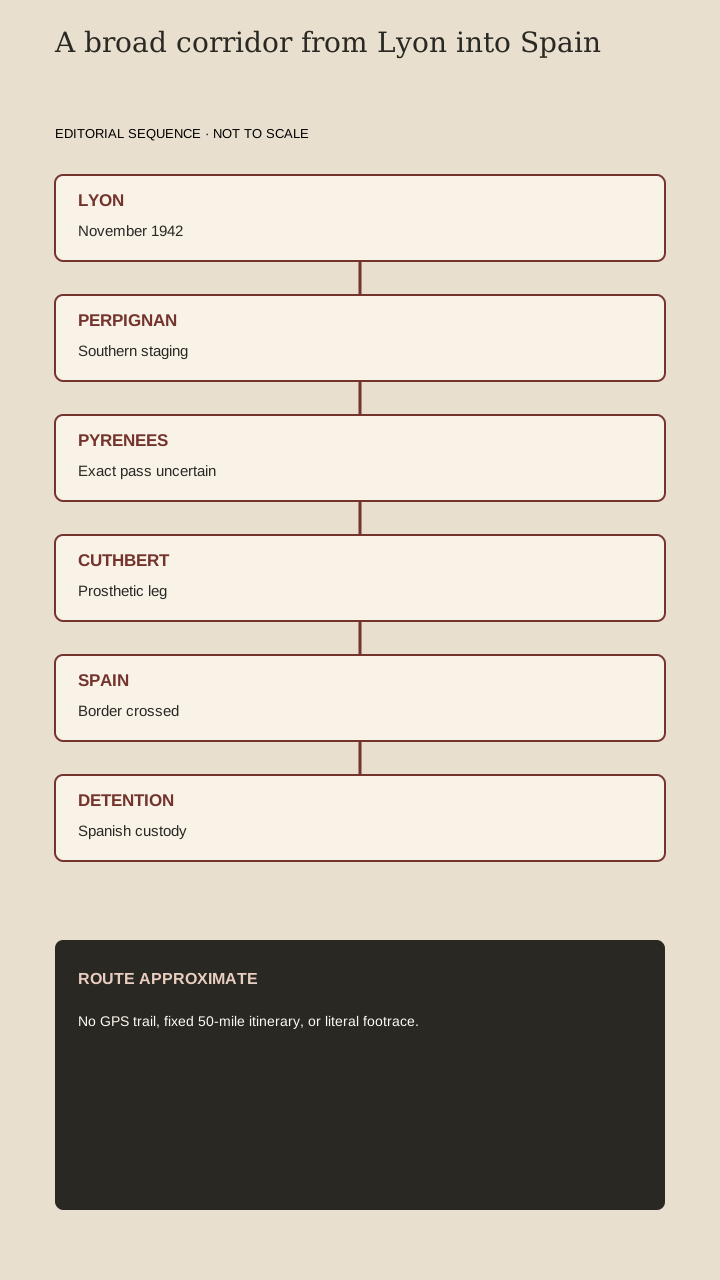
Simplified editorial reconstruction; not to scale. See adjacent text for evidence qualifications and unresolved details.
Material evidence
Tools of Escape
The objects used in an escape reveal how a plan worked under constraint.
- 01Mobility and physical constraint
Prosthetic leg 'Cuthbert'
Hall's artificial lower left leg was essential to her mobility but became a severe physical obstacle during the mountain crossing.
- 02Route knowledge
Local guides
Guides arranged through Hall's Perpignan contact enabled clandestine movement through the frontier mountains.
- 03Long-distance movement
Rail travel
Hall used train travel to reach southern France and intended to use an early train from Sant Joan de les Abadesses to continue toward Barcelona.
Problem → response
Escape was a sequence of problems
Each response solved a practical obstacle while often creating the next one.
- 01→
Obstacle
Rapid German expansion into southern France
The occupation of Vichy's formerly unoccupied zone sharply reduced Hall's ability to remain safely in Lyon.
Response
Hall abandoned the operating area and moved south before German security pressure could close her exit.
- 02→
Obstacle
Need for clandestine frontier knowledge
The France-Spain border could not be crossed safely by simply following ordinary controlled routes.
Response
Hall used her Perpignan contact Gilbert to obtain guides who knew how to move through the mountain frontier.
- 03→
Obstacle
Pyrenean terrain
The escape required a high, difficult mountain crossing on foot.
Response
Hall continued through the guided route despite the terrain and uncertainty over the exact pass.
- 04→
Obstacle
Prosthetic-leg pain and injury
Cuthbert rubbed and injured Hall's stump during the prolonged ascent and descent.
Response
Hall continued walking rather than abandoning the crossing; the prosthesis remained necessary despite the pain it caused.
- 05→
Obstacle
Spanish border enforcement
Reaching neutral Spain did not legalize Hall's clandestine entry or guarantee onward movement.
Response
After arrest, American diplomatic assistance eventually secured her release.
The final accounting
Outcome
Escape from France
Hall successfully crossed out of German-controlled France into Spain.
Immediate detention in Spain
Spanish authorities arrested Hall after the illegal frontier crossing before she could continue to Barcelona.
Return to Allied intelligence work
Hall was later released and ultimately returned to clandestine field work in France with the OSS.
Evidence discipline
What the record supports
Status labels distinguish secure conclusions from uncertainty and rejected claims. Color is never the only signal.
DOCUMENTED
Hall arranged her own rapid exit from France and used a Perpignan contact to obtain guides.
Her 18 January 1943 SOE report explicitly states that she arranged the exit herself and went to a contact called Gilbert who obtained guides.
Sources: SRC-001DOCUMENTED
Hall crossed the Pyrenees on foot with her prosthetic leg.
The National Archives, CIA and later institutional accounts consistently document the mountain crossing and the prosthetic leg she called Cuthbert.
Sources: SRC-001, SRC-002, SRC-003MYTH
The exact pass and trail used by Hall are known with certainty.
Hall's own report says she thought the pass was the Col de Tivoli, explicitly preserving uncertainty. The available transcript should not be converted into a definitive hiking route.
Sources: SRC-001DOCUMENTED
SOE told Hall to 'eliminate' Cuthbert because London did not realize Cuthbert was her prosthetic leg.
The National Archives presents the exchange from Hall's SOE file and identifies Cuthbert as Hall's nickname for her artificial leg.
Sources: SRC-001MYTH
Klaus Barbie personally chased Hall from Lyon across the Pyrenees.
Barbie and German security pressure were part of the danger surrounding Hall, but the primary escape account documents a planned withdrawal, not a literal continuous pursuit by Barbie.
Sources: SRC-001, SRC-002MYTH
Reaching Spain immediately ended Hall's captivity risk.
Hall was arrested by Spanish authorities after the illegal crossing and required later diplomatic assistance to regain freedom.
Sources: SRC-001, SRC-004UNKNOWN
Hall's crossing can be reduced to one universally agreed exact mileage.
Later accounts provide different distance formulations. The primary-derived record securely establishes the mountain crossing and route nodes but not a single audited mileage total.
Sources: SRC-001, SRC-003, SRC-004Selected chronology
Selected chronology
Hall enters Vichy France for SOE
Hall began an extended SOE field mission under journalistic cover and established her operational base around Lyon.
Mauzac prisoners escape
SOE and resistance prisoners escaped from Mauzac after an operation in which Hall helped provide outside support, increasing German interest in the networks around her.
Compromise deepens
The GLORIA/WOL network was infiltrated and Hall encountered Robert Alesch, increasing concern that German intelligence was penetrating the organizations around her.
Operation Torch begins
American and British forces landed in French North Africa, accelerating the strategic crisis for Vichy France.
Germany occupies southern France
German forces occupied Vichy's previously unoccupied zone, sharply increasing the danger to Hall and other clandestine operators.
Hall escapes across the Pyrenees
Hall travelled south, arranged guides in Perpignan and crossed the Pyrenees on foot into Spain.
Arrested in Spain
Spanish authorities detained Hall and her companions before they could board the early train from Sant Joan de les Abadesses to Barcelona.
Hall files an escape report
Her SOE report recorded how she arranged the exit, named route points and explicitly qualified her memory of the mountain pass.
Returns to France with OSS
After joining the American OSS, Hall returned clandestinely to occupied France and resumed field operations.