
On the evening of 20 December 1681, one of Scotland’s most conspicuous political prisoners faced a problem that could not be solved by force. Archibald Campbell, 9th Earl of Argyll, was inside Edinburgh Castle, the kingdom’s principal garrison, after a prosecution that had already ended in a treason verdict. His future depended on instructions from King Charles II. The widespread expectation was that the consequences would be ruinous and might include death.
Argyll did not tunnel beneath the fortress, scale Castle Rock, overpower a guard or force a gate. He escaped by changing what the guards thought they were looking at.
Lady Sophia Lindsay, his stepdaughter, entered the castle as an authorized visitor. When she left, the man accompanying her appeared to be a servant or page. That servant was Argyll.
The deception carried him through the guarded exit, into Edinburgh, and eventually out of Scotland. It also produced one of the great dramatic anecdotes of seventeenth-century escape history: a suspicious sentry, a lady’s train dropped in the mud, and an apparently furious aristocrat striking or scolding her clumsy servant. The basic disguise is well supported. The theatrical scene is not nearly as secure.
There is another important correction. Argyll is often said to have escaped after being sentenced to death. The detailed chronology says otherwise. He escaped on 20 December. The king’s instructions arrived two days later, and the formal sentence of death and forfeiture was pronounced against the absent Argyll on 23 December.
Why Argyll Was in the Castle
The escape grew out of the political and religious tensions of Restoration Scotland.
In 1681 the Scottish parliament passed the measure generally known as the Test Act. The oath was intended for people holding public trust and bound together declarations about Protestant religion, royal authority and the established order. For some Scots, its different requirements were difficult to reconcile.
Argyll was not a marginal dissident. He was one of Scotland’s leading nobles, a former privy councillor and the head of one of the country’s most powerful families. His father had been executed after the Restoration, but the son’s titles and estates had later been restored. That combination of political importance, family history and religious position made his conduct unusually consequential.
Argyll agreed to take the Test only with an explanation of how he understood it. In substance, he maintained that he was accepting the oath insofar as its provisions were consistent with one another and with Protestant religion, while reserving the possibility of pursuing lawful changes for the good of church or state.
The qualification became the basis of an extraordinary prosecution.
Contemporary printed material shows how closely the dispute turned on Argyll’s wording, the Test itself and older Scottish statutes concerning treason and “leasing-making”—the creation or spreading of statements said to cause discord between king and subjects. A surviving speech attributed to Argyll’s 12 December trial likewise confirms how quickly the controversy moved from oath-taking into criminal law.
The judges allowed the treason and leasing-making charges to proceed. A jury found against Argyll on those counts while acquitting him of perjury. But the court did not immediately pronounce the final sentence. The Scottish authorities sought the king’s direction.
Argyll therefore returned to Edinburgh Castle in a dangerous interval: convicted, still alive, and waiting.
A Fortress That Did Not Need to Be Broken
By the later seventeenth century Edinburgh Castle had become increasingly important as Scotland’s chief military garrison. Its defenses and controlled entrances made a conventional breakout a poor proposition.
That physical strength explains why Argyll’s escape is more interesting as a study in perception than engineering.
The plan did not need to defeat the walls. It needed to carry the prisoner through the ordinary human system operating inside them.
Lady Sophia Lindsay was the essential advantage. As Argyll’s stepdaughter, she could plausibly visit him. A visitor leaving a prisoner was normal. A lady being accompanied by a servant was normal. The escape depended on making the second scene appear to be nothing more than the continuation of the first.
Detailed later accounts say that Sophia entered with a male attendant dressed as a country servant or page. He wore a fair wig and had his head wrapped or bandaged, supposedly because he had recently been hurt in a fight. Inside, Argyll and the attendant exchanged clothing.
When the visit ended, Lady Sophia departed in visible distress, as one might expect from a relative leaving a condemned or endangered prisoner. Beside her was the “servant.”

Walking Through the Gate
The disguise inverted the guards’ expectations.
The prisoner they were supposed to keep was the Earl of Argyll: an aristocrat of exceptional prominence. The man leaving with Lady Sophia presented the outward markers of a household subordinate. Clothing, position and behavior did much of the work.
Later reconstructions describe Argyll bearing or managing Lady Sophia’s train as they moved toward the exit. At the gate, according to the famous version, a sentry looked at him too closely. Sophia reacted by snatching her train from him, letting or forcing it into the mud, berating the supposed servant for his incompetence and striking him or smearing his face in the process. The guard, seeing an angry noblewoman humiliating an inept attendant, supposedly ceased to suspect that the attendant was one of Scotland’s most important prisoners.
It is a superb escape story. It is also the part that requires the most caution.
The episode is preserved in later Lindsay family tradition and was repeated by nineteenth- and twentieth-century writers. It may retain a genuine memory of a tense encounter at the gate. But its dialogue, physical gestures and comic timing cannot be treated as securely contemporary evidence.
What can be said with considerably more confidence is simpler: Lady Sophia helped Argyll leave Edinburgh Castle in the role and clothing of a servant or page, and the deception succeeded. No broken gate was necessary.
The Coach and the Wynds
Once clear of the guarded exit, Argyll still had to separate himself from the person whose visit would immediately attract scrutiny when the deception was discovered.
A detailed biographical reconstruction describes him climbing onto the rear of Lady Sophia’s coach in the place of a lackey. Down in Edinburgh, near the custom-house or weigh-house area in later accounts, he slipped away from the coach and entered the narrow wynds of the Old Town.
The exact micro-route should not be overdrawn. Edinburgh’s streets have changed, later authors used different landmarks, and the surviving evidence does not justify a precise turn-by-turn reconstruction.
The strategic logic, however, is clear.
Lady Sophia’s coach had carried the disguise beyond the fortress. Argyll then broke contact with it. From that point forward, remaining free depended on a network rather than costume alone.
Later memoir-based accounts connect him first with George Pringle of Torwoodlee and then with the Presbyterian minister William Veitch. Veitch’s role belongs to the onward escape rather than the castle deception itself. The reconstruction has Argyll moving south under the name “Hope,” reaching London, receiving shelter there, and ultimately crossing to the Continent.
The fortress escape had become a clandestine flight.
The Sentence Came After the Escape
The order of events matters because it changes how the escape should be understood.
Many short biographies say that Argyll was sentenced to death and then escaped from Edinburgh Castle. That is an understandable compression: he had been convicted of offences carrying the gravest consequences, he believed execution was near, and formal death and forfeiture were indeed imposed.
But not in that order.
The detailed chronology places the escape on 20 December. Charles II’s response to the Scottish council reached Edinburgh on 22 December. On 23 December, with Argyll already gone, death and forfeiture were formally pronounced against him in absence.
This distinction does not make his danger imaginary. Far from it. The evidence indicates that Argyll and those around him had strong reason to expect the worst. It does mean that the most accurate description is escape while awaiting the crown’s decision after conviction, not escape from a sentence that had already formally been delivered.
The distinction also helps explain the timing. Argyll did not wait to discover whether the threat would become final.
He moved during the interval.
What Happened to Lady Sophia?
Lady Sophia’s assistance was not a decorative part of the story. It was the mechanism that made the escape possible.
Sources differ in how they describe her later family status, sometimes calling her Argyll’s stepdaughter and sometimes his daughter-in-law. “Stepdaughter” is the safest description for the escape itself: Sophia was the daughter of Argyll’s second wife, Anna Mackenzie, from her earlier marriage into the Lindsay family.
The later family tradition makes Sophia the brilliant improviser at the castle gate. Even if the most theatrical version cannot be verified in full, the core historical achievement remains substantial. She converted her legitimate access to the prisoner into a route through a heavily guarded institution.
Her role is also a reminder that disguise escapes are rarely about clothing alone. A costume works only when the surrounding behavior makes it believable. Sophia supplied the status, the context and the outward social relationship that allowed Argyll’s new identity to make sense.
Exile Was Not the End
Argyll’s 1681 escape saved him from immediate custody, but it did not end his conflict with the Stuart regime.
He eventually reached the Dutch Republic. There he became part of the world of British political exiles opposed to the direction of royal government. After Charles II died and James VII and II took the throne in 1685, Argyll returned to Scotland at the head of a rebellion intended to challenge the new king.
The rising failed.
Argyll was captured and brought back to Edinburgh. On 30 June 1685 he was executed. The successful escape of 1681 had bought him several years of freedom, not permanent safety.
After the Revolution of 1688–89 displaced James, Scotland’s political settlement changed dramatically. In 1690 the Scottish parliament revisited Argyll’s prosecution. Its records explicitly refer to the original libel, the judges’ ruling, the jury’s verdict, Argyll’s explanation of the Test and the resulting forfeiture. Parliament approved an act rescinding that forfeiture.
That later reversal does not simplify the politics of 1681 into a clean morality tale. It does show that the legal treatment of Argyll remained controversial enough to be formally undone under the new regime.
Why the Escape Worked
Argyll’s escape succeeded because the plan matched the institution it had to defeat.
Edinburgh Castle was strong against physical intrusion and breakout. The conspirators did not attack that strength.
Instead, they exploited three softer systems.
First was authorized access. Lady Sophia could enter where an outside rescuer could not.
Second was social expectation. Guards knew what an earl looked like in social terms: how he dressed, where he stood and how others behaved around him. A bandaged servant trailing an aristocratic woman occupied a different mental category.
Third was separation after the exit. The coach helped bridge the most dangerous ground, but Argyll did not remain attached to it. He disappeared into Edinburgh and then into a wider network of helpers.
The most memorable version of the story gives the victory to one perfect piece of acting at a muddy gate.
The evidence supports a broader conclusion. This was a layered social escape: access, disguise, performance, movement and then concealment.
The walls were never breached. For a few minutes, the guards simply failed to recognize the man walking through them.
Escape reconstruction
How the escape unfolded
An evidence-aware sequence of the principal stages.
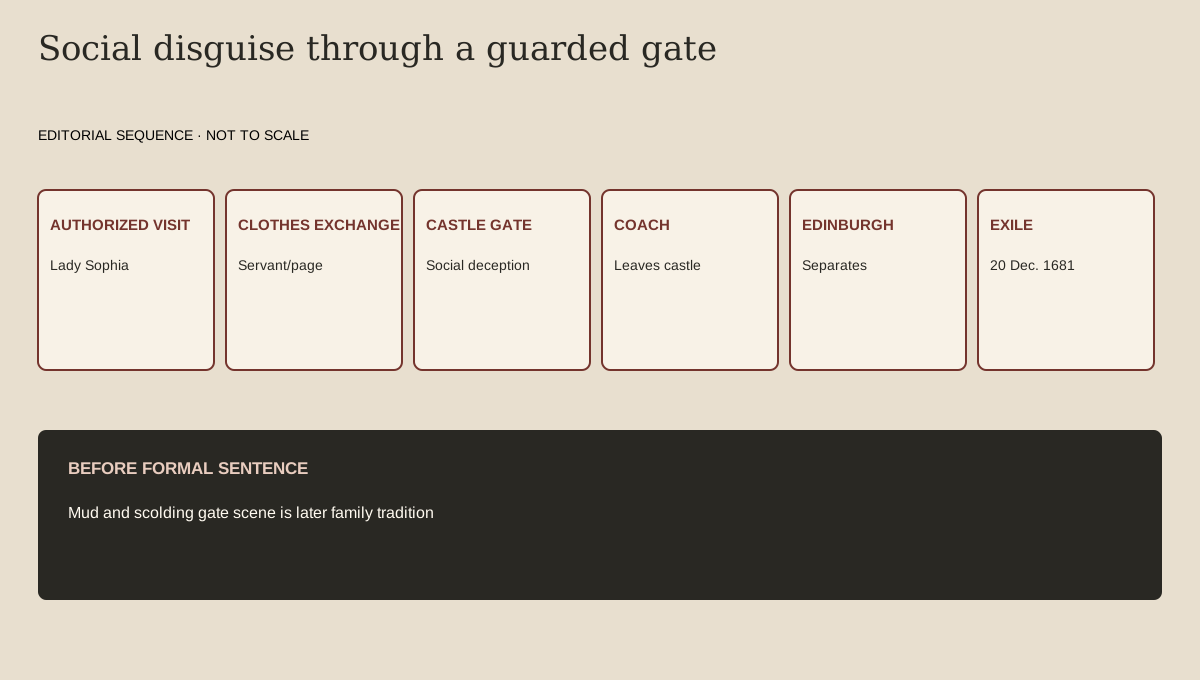
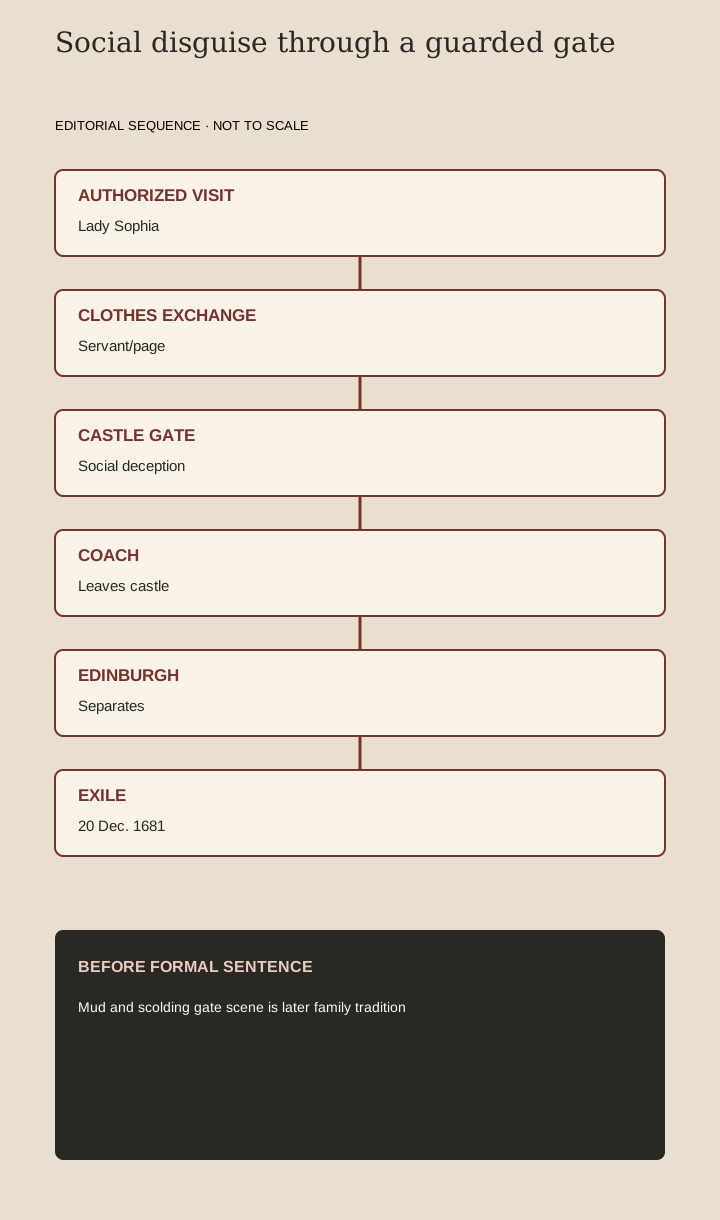
Simplified editorial reconstruction; not to scale. See adjacent text for evidence qualifications and unresolved details.
Material evidence
Tools of Escape
The objects used in an escape reveal how a plan worked under constraint.
- 01Decisive disguise
Servant’s clothing
The decisive disguise allowed Argyll to be read socially as Lady Sophia’s attendant rather than as the high-status prisoner the guards expected to see.
- 02Face and identity concealment
Wig and head covering
Later detailed accounts describe the servant arriving with a fair wig and a wrapped or bandaged head, features then transferred to Argyll as part of the disguise.
- 03Exit continuation
Lady Sophia’s coach
After leaving the guarded castle, Argyll could occupy the place expected of a household lackey rather than travel openly as himself.
Problem → response
Escape was a sequence of problems
Each response solved a practical obstacle while often creating the next one.
- 01→
Obstacle
Guarded fortress exit
Argyll could not simply walk out of Edinburgh Castle in his own identity.
Response
The plan used the normal departure of an authorized visitor and transformed Argyll into an apparently subordinate member of her household.
- 02→
Obstacle
Recognizable social status
As one of Scotland’s most prominent nobles, Argyll’s identity itself was an obstacle.
Response
Servant’s clothing, a wig and head covering inverted the social cues guards expected to see.
- 03→
Obstacle
Risk after clearing the gate
Passing the castle gate did not make Argyll safe; discovery could trigger a rapid search through Edinburgh.
Response
He separated from the coach and relied on helpers and concealed movement southward rather than remaining with Lady Sophia.
The final accounting
Outcome
Edinburgh Castle escape
Argyll successfully passed the castle’s guards in disguise on 20 December 1681.
Exile
He reached London and then continental exile, eventually establishing himself in the Dutch Republic.
Later capture and execution
Argyll returned during the failed rising of 1685, was captured, and was executed in Edinburgh on 30 June 1685.
Evidence discipline
What the record supports
Status labels distinguish secure conclusions from uncertainty and rejected claims. Color is never the only signal.
WELL-SUPPORTED
Argyll escaped Edinburgh Castle on 20 December 1681.
The date is consistently given by detailed biographical and family-history reconstructions and is accepted by modern institutional/genealogical summaries.
Sources: SRC-003, SRC-004, SRC-009WELL-SUPPORTED
Lady Sophia Lindsay enabled the escape by taking Argyll out disguised as a servant or page.
This is the stable core of the escape tradition across independent later reconstructions. The exact theatrical details at the gate are less secure.
Sources: SRC-003, SRC-004, SRC-009MYTH
Argyll had already been formally sentenced to death before he escaped.
Later summaries often compress conviction and sentence. The detailed chronology says the king’s instruction arrived on 22 December and death and forfeiture were formally pronounced on 23 December, three days after the escape.
Sources: SRC-003LATER CLAIM
Lady Sophia dropped her train in the mud and struck or loudly scolded the disguised Argyll to fool a suspicious sentry.
The vivid episode survives in later Lindsay family tradition and subsequent popular histories. It should not be presented with the same confidence as the basic disguise-and-departure mechanism.
Sources: SRC-004UNKNOWN
The precise chamber from which Argyll escaped in 1681 can be identified as today’s Argyle Tower room.
Historic Environment Scotland notes a tradition associating a chamber above the Portcullis Gate with Argyll, but the designation specifically describes a belief tied to his imprisonment before his 1685 execution. It does not securely locate his 1681 confinement.
Sources: SRC-006WELL-SUPPORTED
The escape depended more on social deception than on defeating the castle’s physical defenses.
The consistent mechanism is an authorized visit, role exchange, disguise, and passage through guarded exits. There is no reliable account of breaking locks, scaling walls or using a secret tunnel.
Sources: SRC-003, SRC-004, SRC-006Selected chronology
Selected chronology
Scottish parliament meets
The 1681 parliament enacted the measure known as the Act anent religion and the Test, establishing the oath that became central to Argyll’s prosecution.
Argyll is imprisoned
After qualifying the meaning under which he would take the Test, Argyll was committed and prosecuted for treason and related offences.
Trial begins
Proceedings against Argyll opened before the Scottish court of justiciary. A jury subsequently found against him on treason and leasing-making while acquitting him of perjury.
Escape from Edinburgh Castle
Lady Sophia Lindsay helped Argyll leave the castle disguised in a servant’s or page’s clothing. He separated from her coach in Edinburgh and began moving toward safety.
Death and forfeiture pronounced in his absence
After the king’s instructions reached the Scottish council, the court formally pronounced death and forfeiture against the already escaped Argyll.
Forfeiture rescinded
After the Revolution of 1688–89, the Scottish parliament reviewed the prosecution, including Argyll’s explanation of the Test, and approved rescission of the forfeiture.