
On the eve of his execution in 1716, William Maxwell walked out of the Tower disguised as a grieving female visitor. The deception worked because his wife, Winifred, had spent the evening controlling what the guards thought they saw.
A condemned Jacobite in the Tower
By February 1716, William Maxwell had almost run out of legal options.
Nithsdale was a Scottish peer and a supporter of the Stuart cause. He had joined the Jacobite rising of 1715, an attempt to overturn the Hanoverian succession and restore James Francis Edward Stuart. The English phase of the rising collapsed at Preston in November. Nithsdale was among the senior prisoners carried south.
He and other captured Jacobite peers were prosecuted for high treason before Parliament. Nithsdale pleaded guilty. Judgment followed in February, and his execution was fixed for 24 February 1716. Two of the condemned peers, the Earl of Derwentwater and Viscount Kenmure, would be beheaded on Tower Hill that day. Several others received reprieves.
Nithsdale's wife, Winifred Maxwell, had come to London and pursued mercy for him. Her later account describes petitions, appeals to influential figures, and a personal attempt to reach George I. None gave her confidence that her husband would be spared.
The remaining option was escape.
The Tower was not a single kind of prison
The Tower of London is easy to imagine as a collection of locked stone cells. Its actual use as a prison was more complicated. High-status prisoners could receive visitors, servants, food, and comparatively comfortable accommodation, even while facing severe sentences.
That distinction mattered.
Nithsdale was not free to walk out, but Winifred could reach him. Her escape plan therefore did not require breaking a wall or overpowering a guard. It required converting legitimate access into a false exit.
The surviving evidence is much better for the human sequence than for the architecture. Later writers have tried to identify the exact room in which Nithsdale was held, but the location is not secure enough to build a precise floor plan around it. The safe reconstruction begins with what Winifred herself described: controlled admissions, clothing changes, a guarded route, and a carefully managed departure.
Material evidence
Tools of Escape
The objects used in an escape reveal how a plan worked under constraint.
- 01Core disguise
Layered women's clothing and riding hood
Garments were carried into the Tower through legitimate visits and used to make Nithsdale resemble a woman who had already been seen entering.
- 02Facial disguise
Artificial head-dress and face coloring
Winifred's account describes an artificial head-dress, eyebrow coloring, white face coloring and rouge used to reduce obvious differences between Nithsdale and Mrs Mills.
- 03Concealment and cover story
Handkerchief
Held over the face, it was both a concealment device and a believable sign of grief for a visitor leaving a condemned prisoner.
- 04Delay mechanism
Latch string
Winifred manipulated the room's latch after returning so the closed door helped delay discovery once Nithsdale was gone.

The plan depended on more than a dress
The familiar shorthand says that Nithsdale escaped by dressing as a woman. That is true, but incomplete.
According to Winifred's narrative, she recruited women whose visits could help create both the disguise and the confusion required to carry it through. Mrs Morgan, also called Hilton in the account, brought clothing into the Tower beneath her own riding hood. Mrs Mills, Winifred's landlady, was close enough to Nithsdale in height and build to serve as the model for the identity he would imitate.
Only one additional visitor could be brought in at a time. Winifred turned that restriction into part of the deception. Women came and went while clothing was transferred and the story presented to people nearby kept changing in ways that sounded plausible on the eve of an execution.
Mrs Mills entered with a handkerchief held to her face like a woman overcome by grief. That detail was deliberate. Nithsdale would later leave in the same manner.
Inside, the transformation went beyond an outer cloak. Winifred's account says she had prepared paint to alter the appearance of his dark eyebrows, an artificial head-dress matching Mrs Mills's hair, white coloring and rouge for his face, and enough clothing to conceal his male dress and beard as far as possible. The beard could not simply be shaved away in the time available.
The disguise did not need to survive close inspection in daylight. It needed to fit a story the guards were already prepared to believe: a distressed female visitor leaving a condemned man's room.
Escape sequence
Winifred Maxwell’s staged visitor exchange
The mechanism was social and visual: clothing entered through legitimate visits, then a transformed prisoner followed the established pattern out.
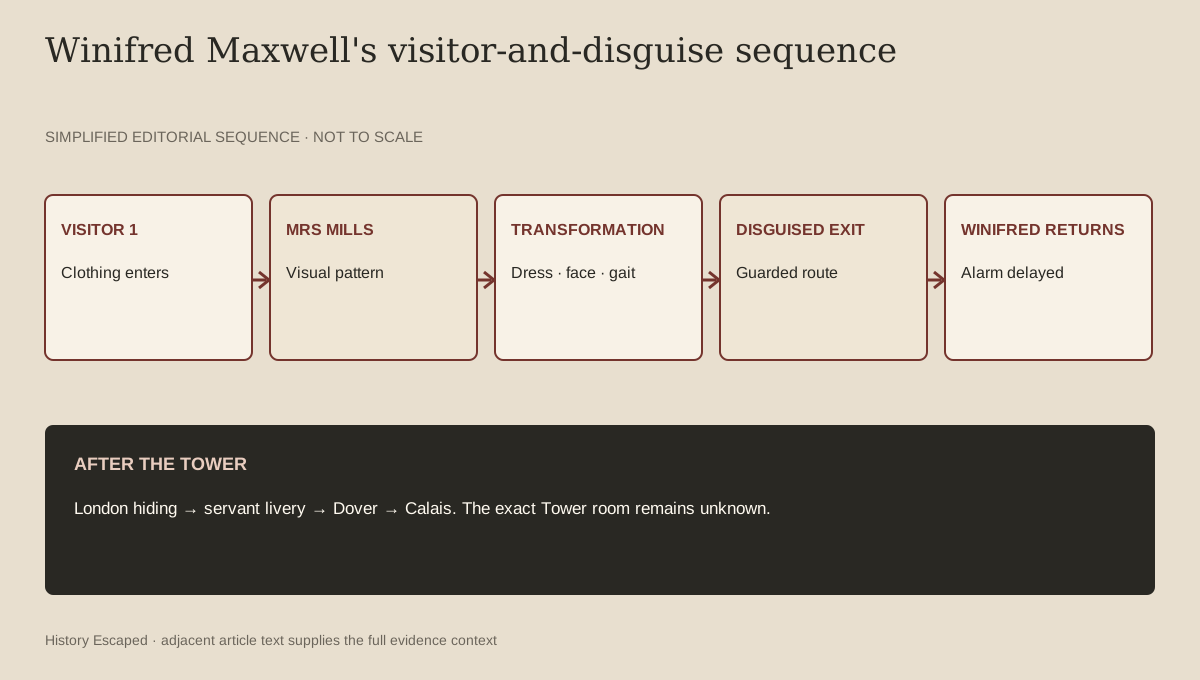
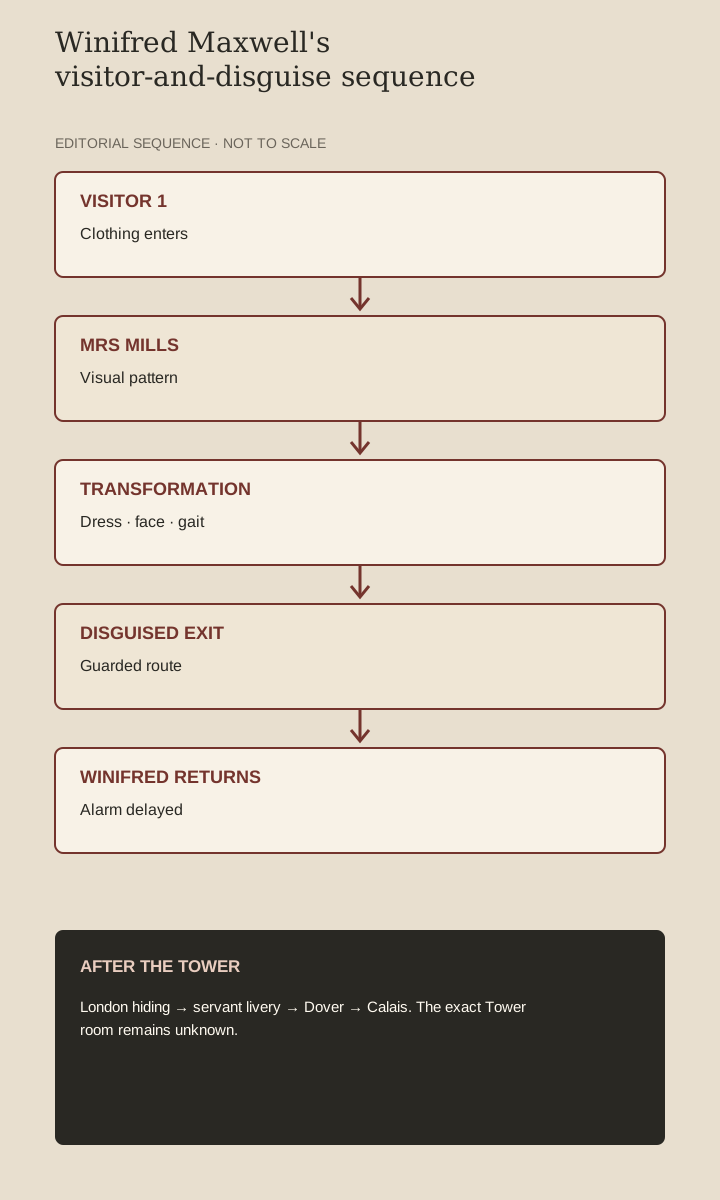
Simplified editorial sequence based principally on Winifred Maxwell’s account; exact Tower room and interior route are unknown.

Making the wrong woman leave
The visitor movements were staged so that the guards could see apparently ordinary departures without realizing that one of the women leaving would eventually be Nithsdale.
Winifred escorted Mrs Mills out first after altering what she wore. She performed urgency around another errand and spoke in front of people in the adjoining area. The point was not silence. It was normality. A wife desperately trying to make one last petition, sending women back and forth and lamenting delays, was easier to accept than an unnaturally quiet room on the night before an execution.
Then Winifred returned to Nithsdale and finished the disguise.
Her account says he wore her petticoats, the prepared head-dress and face coloring. He kept a handkerchief pressed to his eyes. Winifred led him by the hand while speaking to him as though he were a distraught woman being sent on an urgent errand.
The guards opened the way.
Once he had cleared the immediate doorway, Winifred made him walk ahead of her. She feared that the way he moved might give him away if a sentry watched too closely.
At the bottom of the stairs, the operation passed into another phase. Winifred's maid, Evans, took charge of Nithsdale. Mr Mills had also been placed outside the Tower as part of the contingency plan, although Winifred later wrote that the success of the escape initially left him astonished and ineffective. Evans instead moved Nithsdale to friends she trusted until a safer hiding place could be arranged.
Nithsdale was out. Winifred was not finished.
The prisoner who was no longer in the room
An immediate discovery could still have ruined the escape. The Tower could be sealed, nearby streets searched, and anyone waiting outside detained.
Winifred therefore went back upstairs.
Her description of what followed is one of the most striking parts of the surviving account. She acted as though Nithsdale were still in the room. She spoke aloud and answered herself in an imitation of his voice. She walked as though a conversation were continuing.
When enough time had passed, she staged a final farewell where people outside could hear her but could not see into the room. As she left, she manipulated the latch string so the closed door would appear to require opening from within. She also told a servant not to bring candles until his master requested them because he wished to pray.
The deception bought time.
This is why the escape should not be reduced to "Nithsdale put on women's clothes." The clothing defeated recognition. Winifred's performance defeated the immediate alarm.
He did not go straight from the Tower to France
Another compressed version of the story makes the escape look almost instantaneous: Tower, disguise, Dover, France. Winifred's account describes a more cautious sequence.
Nithsdale was first concealed in London. At one stage he was hidden in a small room in a house close to a guard-house. Winifred joined him there, and food was brought in discreetly. Her narrative says they remained concealed until Saturday night.
Only then did Mr Mills conduct Nithsdale to the Venetian ambassador's establishment. The diplomatic connection provided the next disguise and transport network. Nithsdale put on livery and travelled toward Dover as part of a servant's retinue. At Dover, a small vessel carried him across the Channel to Calais.
The disguise that got him out of the Tower was therefore only the first layer of the escape. Permanent freedom required concealment, a second identity, transport, and a sea crossing.
Evidence discipline
What the record supports
Status labels distinguish secure conclusions from uncertainty and rejected claims. Color is never the only signal.
WELL-SUPPORTED
Nithsdale escaped the Tower disguised in women's clothing.
Winifred Maxwell's retrospective first-person account gives detailed clothing, make-up and movement instructions, and later biographies agree on the core disguise.
Sources: SRC-001, SRC-006MYTH
Nithsdale's mother supplied the clothes used in the escape.
An older historical version assigned the disguise to his mother, but Winifred's detailed account makes herself, Mrs Morgan and Mrs Mills the people who organized and transferred the clothing.
Sources: SRC-001UNKNOWN
The exact Tower room and interior escape route can be reconstructed confidently.
The Tower is certain as the place of confinement and escape, but later Tower scholarship treated the exact locality as unresolved. No precise room geometry should be asserted.
Sources: SRC-012MYTH
Nithsdale went straight from the Tower to Dover and France on the night of the escape.
Winifred's account describes an intervening period of concealment in London before he was moved through a Venetian diplomatic connection, travelled to Dover in livery and crossed to Calais.
Sources: SRC-001DISPUTED
George I reacted calmly and approved of Nithsdale's decision to escape.
Later biography attributes a dry approving remark to George I, while Winifred's narrative says the king reacted with anger and suspected a confederacy. The memorable quotation should not be presented as settled fact.
Sources: SRC-001, SRC-006UNKNOWN
The guards knowingly collaborated in the escape.
Winifred says she had given the guards a small gratuity and encouraged the belief that pardons were coming, but her narrative presents them as deceived rather than conscious accomplices. No reliable source used here proves knowing collusion.
Sources: SRC-001What the famous retellings get wrong
The strongest evidence for the escape is also the reason to be skeptical of several later flourishes.
One older version claimed that Nithsdale's mother supplied the female clothing. Winifred's account makes clear that the scheme was hers and that Mrs Morgan, Mrs Mills, Evans, Mr Mills and others formed the support network around it.
The exact room from which Nithsdale escaped is also less certain than some reconstructions imply. The Tower is secure as the location; a precise chamber or architectural route is not.
There is also a conflict over George I's reaction. A later biographical tradition attributes to the king a dry comment approving Nithsdale's decision to flee. Winifred's narrative reports something very different: that George reacted angrily, believed the escape required a confederacy, and ordered attention to the security of the remaining prisoners. The conflict cannot be resolved simply by repeating the more memorable quotation.
Even Winifred's letter requires source criticism. It was written after the event and survives through later manuscript and printed transmission. She explicitly framed her account as a reconstruction from memory. That does not make it unreliable; it means its extraordinary detail should be presented for what it is—a first-person retrospective account, not a contemporary surveillance log.
Problem → response
Escape was a sequence of problems
Each response solved a practical obstacle while often creating the next one.
- 01→
Obstacle
Guarded departure from a state prison
Nithsdale could not simply leave the Tower under his own identity on the eve of execution.
Response
Winifred made the exit look like the departure of a legitimate female visitor already familiar to the guards.
- 02→
Obstacle
Nithsdale's recognizable male features
His dark eyebrows, beard, hair and gait could expose the disguise at close range.
Response
Face coloring, an artificial head-dress, layered clothing, a handkerchief over the face and careful walking reduced the chance of recognition.
- 03→
Obstacle
One additional visitor admitted at a time
Access limits prevented the accomplices from simply entering together with a complete disguise.
Response
The women entered and left sequentially, using each movement to transfer clothing and reinforce the false identities.
- 04→
Obstacle
Risk of immediate discovery after the exit
A rapid check of the room could have triggered a search while Nithsdale was still close to the Tower.
Response
Winifred returned, staged a conversation, imitated Nithsdale's voice, performed a farewell and manipulated the latch before leaving.
Why the escape worked
Three features made the plan effective.
First, the disguise matched an expected person. Nithsdale was not merely dressed generically as a woman. The plan tried to make him resemble a specific visitor whom guards had already seen.
Second, the deception exploited behavior as much as appearance. A covered face made sense for a grieving woman. Winifred's anxious speech made haste seem natural. Repeated visitor movements created noise instead of suspicious calm.
Third, the escape included a delay mechanism. Winifred went back after Nithsdale had left and created the impression that he remained in the room. Those additional minutes mattered because a man walking away from the Tower in disguise was still vulnerable to a rapid alarm.
The walls did their job. The guards remained in place. The failure occurred in identification.
Selected chronology
Selected chronology
Jacobite force defeated at Preston
The Jacobite force that had entered England was surrounded and defeated at Preston. Nithsdale was among the senior participants taken prisoner.
Nithsdale pleads guilty
Nithsdale and other captured Jacobite peers faced proceedings at Westminster; he pleaded guilty to the high-treason charge.
Judgment of death
The peers were brought to judgment in Westminster Hall. Nithsdale was condemned and later scheduled to be executed on 24 February.
Escape from the Tower of London
Winifred Maxwell used a staged series of female visitors, transferred clothing and a disguised identity to lead Nithsdale through the guarded route and out of the Tower.
Scheduled execution passes without Nithsdale
The Earl of Derwentwater and Viscount Kenmure were executed on Tower Hill. Nithsdale had escaped the previous day.
Nithsdale dies in Rome
After years in exile and association with the Stuart court abroad, William Maxwell died in Rome.
Exile instead of the scaffold
On 24 February 1716, Derwentwater and Kenmure were executed on Tower Hill. Nithsdale was no longer there.
He eventually joined the Stuart court in exile and lived on the Continent. The attainder cost him his honours, although later legal decisions limited what could permanently be taken from the family estates. He died in Rome in 1744. Winifred later joined him abroad and died in 1749.
Their escape story endured because it is dramatic, but its historical importance lies in something more precise. It shows how access rules can create their own vulnerabilities. The Tower's guards were watching for a condemned male peer. Winifred Maxwell gave them a grieving woman instead—and then kept the fiction alive after her husband had already passed them.