
In the last weeks of the Second World War in Europe, a convoy of buses painted white and marked with red crosses entered Nazi Germany from neutral Sweden through occupied Denmark. Their first purpose was limited: gather imprisoned Danes and Norwegians, concentrate them at Neuengamme, and bring them out before the collapsing Nazi camp system consumed them. By early May, however, the operation had widened into something much larger. Current Swedish institutional research places roughly 15,500 former prisoners within the White Buses rescue count, just over half of them Scandinavian, while thousands of women from Ravensbrück and other camps were among those carried toward safety.
That achievement is real, but the familiar image of an uncomplicated humanitarian triumph is incomplete. To make room for Scandinavians at an overcrowded Neuengamme, German authorities required Swedish vehicles to move about 2,000 non-Scandinavian prisoners to other camps in late March. Many were gravely ill; several died during the transports, and Swedish Holocaust Museum research records two prisoners beaten to death by SS guards on one bus. The rescue therefore belongs to two histories at once: a large and consequential extraction from Nazi captivity, and a morally compromised negotiation conducted under the control of the regime that had created the camps.
At a Glance
- What: A Swedish Red Cross rescue mission, increasingly supported by Danish personnel and vehicles, that evacuated prisoners from Nazi-controlled Europe.
- When: The main expedition departed on 8 March 1945 and formally concluded on 1 May; associated prisoner transports continued through 4 May.
- Where: Primarily northern Germany, Denmark, and Sweden, with major operations involving Neuengamme, Theresienstadt, Ravensbrück, Padborg, and Lübeck.
- Who negotiated: Count Folke Bernadotte for the Swedish Red Cross negotiated repeatedly with Heinrich Himmler. Norwegian diplomat Niels Christian Ditleff had been a major early advocate for a Swedish rescue effort, while World Jewish Congress representative Norbert Masur conducted a separate crucial negotiation with Himmler on 21 April.
- How many: A current Swedish Red Cross/Swedish Holocaust Museum reconstruction uses about 15,000–15,500 rescued; other serious estimates range upward, including more than 17,000 in scholarly and Danish museum accounts and about 19,700 in Bernadotte's own postwar estimate.
- Why it is disputed: The operation initially prioritized Scandinavians rather than prisoners in greatest danger, accepted the forced transfer of non-Scandinavian prisoners out of Neuengamme, and later became part of competing postwar narratives about Swedish humanitarianism and Folke Bernadotte.
A rescue conceived for Scandinavians
The White Buses did not begin as a plan to empty the concentration camps or rescue prisoners without distinction. During 1944, concern grew over Danes and Norwegians held across the Nazi camp system. Norwegian diplomat Niels Christian Ditleff, representing the government-in-exile in Stockholm, pressed for a Swedish-led mission and presented a rescue proposal to the Swedish Foreign Ministry in November. Danish authorities had also been pursuing their own relief and prisoner-retrieval efforts before the later combined operation.
Sweden's neutrality made it one of the few states capable of mounting such an expedition while the war was still being fought. In January 1945 the Swedish Foreign Ministry decided to send Folke Bernadotte, vice president of the Swedish Red Cross, to negotiate in Berlin. The Swedish government supplied military vehicles and resources; the mission was formally Red Cross but depended heavily on state and military logistics.
Bernadotte's central counterpart was Heinrich Himmler, Reichsführer-SS and one of the principal architects of Nazi persecution and mass murder. On 19 February, Himmler accepted a first major concession: Scandinavian prisoners could be collected from camps across Germany and concentrated at Neuengamme near Hamburg. He did not yet agree that all of them could leave Germany for Sweden. The arrangement therefore moved prisoners into a single assembly point while negotiations continued.
The Swedish expedition assembled in early March. The Holocaust Museum's current timeline records roughly 75 vehicles and 250 people in the initial formation, including three medical transport platoons with 36 buses. The buses were painted white and marked with large red crosses so that Allied aircraft would be less likely to mistake them for German military traffic. They departed Sweden in stages beginning on 8 March and established a German base at Friedrichsruh.
The markings were a precaution, not a guarantee of safety. The convoy operated in a landscape of air raids, advancing armies, damaged roads, fuel problems, and rapidly changing German authority. Later transports were attacked from the air despite the Red Cross markings, with both rescuers and former prisoners killed.
Neuengamme and the rescue's darkest compromise
Neuengamme became the logistical center of the Scandinavian phase. Danish and Norwegian prisoners were transferred there from other camps, given additional food and medical attention, and housed in a special Scandinavian section. Concentrating them increased the chance that the Red Cross could move them together if Himmler allowed their release.
It also created a severe moral problem. Neuengamme was overcrowded, and the SS demanded space for the incoming Scandinavians. According to the Swedish Holocaust Museum's current reconstruction, German authorities required the Red Cross expedition to transport around 2,000 French, Russian, Polish and other non-Scandinavian prisoners from Neuengamme to camps in the Hannover and Braunschweig areas between 27 and 29 March.
The Swedish drivers did not control the prisoners or the destinations. SS guards accompanied the transports, and Swedish accounts describe reluctance and objections before higher orders required compliance. Yet the buses and personnel of a humanitarian rescue operation were nevertheless used to move prisoners deeper into the Nazi camp system. Many of those prisoners were extremely weak. Several died during the journeys, and two were beaten to death by SS guards on one bus.
A separate Neuengamme memorial chronology states that more than 4,000 very weak prisoners were sent from the main camp to satellite camps around the end of March and beginning of April while the Scandinavian compound was being established. That larger figure should not be treated as the number physically transported by the White Buses. The most defensible reconciliation is that roughly 2,000 were moved by the Swedish expedition itself in the documented 27–29 March transports, while the broader clearing of Neuengamme affected more than 4,000 prisoners.
This distinction matters because later arguments about the White Buses have sometimes collapsed those denominators. The operation unquestionably participated in a forced redistribution that harmed non-Scandinavian prisoners. It does not follow that every prisoner displaced from Neuengamme during the wider clearing was carried by a White Bus.
From a Swedish mission to a Swedish-Danish operation
The first expedition had been organized as Swedish, even though Danish organizations had offered help. By early April, however, the scale of the work and the changing situation forced a practical expansion. Danish personnel and vehicles joined in strength, and the mission became Swedish-Danish in operation while remaining under Swedish Red Cross leadership.
On 2 April, Bernadotte obtained wider permissions from Himmler: Norwegian and Danish women, sick Scandinavians, Norwegian students, and imprisoned Danish police could be moved. A week later, about 1,200 sick prisoners were evacuated from Neuengamme under Swedish leadership using mainly Danish personnel and vehicles. At Padborg, near the Danish-German border, Red Cross teams deloused, fed, examined, and stabilized the evacuees before onward movement.
The Danish contribution was not an accessory to a purely Swedish rescue. Denmark had its own prehistory of prisoner relief and retrieval, and Danish transport capacity became indispensable during the final surge. The National Museum of Denmark describes a final phase involving roughly 200 Swedish and Danish vehicles and about 450 helpers. That broader Scandinavian cooperation is one reason the name "Bernadotte action," although historically common, can obscure as much as it clarifies.
Theresienstadt and a widening definition of who could be rescued
The Scandinavian priority did not mean that Jewish prisoners were categorically excluded. Some Danish Jews had been deported to Theresienstadt in 1943 and did not fit neatly into the Neuengamme concentration plan. In April 1945, Danish and Swedish vehicles traveled to Theresienstadt and brought out 423 Danish Jews. They reached the Danish border in mid-April and continued to Sweden.
The Theresienstadt transport is important because it complicates two opposite myths. The White Buses were not originally a universal rescue of Holocaust victims regardless of nationality, but neither is it accurate to describe the operation as one that simply refused to rescue Jews. Its eligibility rules changed over time, under pressure from diplomats, humanitarian actors, the collapsing military situation, and Himmler's own calculations.
By 19–20 April, the largest Scandinavian evacuation was underway. Himmler finally allowed the remaining imprisoned Scandinavians to leave for Denmark and Sweden. Danish reinforcements rushed south, and more than 4,000 prisoners were taken out of Neuengamme. The Neuengamme Memorial records more than 4,000 Danish and Norwegian prisoners rescued on 20 April; the Swedish Holocaust Museum timeline notes that more than 4,200 people were served at the Danish Red Cross feeding station in Kruså during the evacuation.
The rescue of those prisoners was especially consequential because Neuengamme was entering its final, murderous evacuation. Soon afterward, thousands of other prisoners were sent on death marches or placed aboard ships in the Bay of Lübeck. The White Buses did not end the danger surrounding Neuengamme, but for the Scandinavian prisoners it removed them from a camp system that was disintegrating into further mass death.
Norbert Masur, Ravensbrück, and the late expansion
The late-April rescue of women from Ravensbrück cannot be attributed to Bernadotte alone. A separate negotiation was conducted by Norbert Masur, a German-born Jewish businessman living in Sweden and a representative of the World Jewish Congress. Working through contacts developed by the World Jewish Congress, Masur traveled into Germany and met Himmler during the night of 20–21 April.
Himmler agreed to release 1,000 Jewish women to Masur's effort. A few hours later, in a separate meeting, Bernadotte obtained a broader permission allowing the Red Cross to take women without regard to nationality. The precise causal relationship among Himmler's concessions, Masur's negotiation, Bernadotte's continuing contacts, and the regime's collapse is difficult to reduce to a single act. What is clear is that the rescue widened dramatically at this point.
Ravensbrück, the largest concentration camp for women in the German camp system, held prisoners from across occupied Europe. Swedish and Danish buses and ambulances began taking out women of multiple nationalities. Because road transport alone could not evacuate enough people quickly, trains were also used. Current Swedish and archival reconstructions place more than 7,000 women within the rescue effort from Ravensbrück and associated transports, many of them Jewish.
That expansion is central to the debate over Bernadotte and Jewish prisoners. Historian Sune Persson has argued strongly against accusations that Bernadotte refused to rescue Jews and notes that Swedish Foreign Ministry instructions had already broadened his mandate in late March. Other historians have emphasized that Jews and Eastern Europeans were not the initial priority and that the operation's celebrated postwar image could conceal that hierarchy. Both points can be true: the mission began with a national priority that favored Scandinavians, and it later rescued thousands of non-Scandinavians, including thousands of Jewish women.
The roads remained lethal
The White Buses are often remembered through images of conspicuous vehicles moving in disciplined columns. Their markings did not remove them from the war. Germany in April 1945 was under intense Allied air attack, and military communications could not ensure that every pilot recognized or trusted a convoy.
On 25 April, one evacuation convoy carrying women from Ravensbrück was attacked by an Allied aircraft. Swedish driver Hilding Ringman was killed and Lieutenant Gösta Hallquist was seriously wounded; several former prisoners also died. Another convoy was fired upon and suffered additional prisoner deaths. The available institutional sources do not provide a single universally reconciled casualty total for all air attacks connected to the operation, so a precise aggregate should not be manufactured.
The episode also underlines why the white paint should not be narrated as a protective device that "worked" in any absolute sense. It was an identification measure intended to reduce risk. The expedition remained exposed to war from the air and to Nazi control on the ground.
What did Himmler want?
No account of the rescue is complete without the motives of the man whose permission made it possible. Himmler was not converted to humanitarianism in the spring of 1945. By then he understood that Nazi Germany was losing and had begun using prisoners and releases as possible instruments in efforts to open contacts with the Western Allies.
The United States Holocaust Memorial Museum describes Himmler during the winter of 1944–45 as considering concentration-camp prisoners as bargaining chips for separate peace approaches. Neuengamme's memorial interpretation similarly connects his concessions to hopes of using Bernadotte as a channel toward the British and other Western powers. In late April, Himmler asked Bernadotte to transmit a surrender proposal to General Dwight D. Eisenhower that would exclude the Soviet Union. The Western Allies rejected such a separate arrangement.
Himmler's self-interest does not negate the rescue. Humanitarian negotiators often have to secure concessions from perpetrators for reasons that are anything but humanitarian. It does change how the bargaining should be described. The prisoners were not released because the SS suddenly recognized their rights; they were released because a collapsing regime, and Himmler in particular, believed those releases might serve political purposes.
How many people did the White Buses rescue?
The most famous number is also one of the least stable. Bernadotte later estimated that about 19,700 people had been rescued. Sune Persson's scholarly reconstruction describes more than 17,000 prisoners transported via Denmark to Sweden through 4 May. The National Museum of Denmark likewise uses about 17,000. Current Swedish Red Cross and Swedish Holocaust Museum material has moved toward a lower figure of about 15,000, with the detailed museum timeline stating approximately 15,500 former prisoners from German camps by 4 May, just over half of them Scandinavian.
The disagreement is not simply a matter of one source being careful and another careless. Different tallies can include or exclude different categories and end dates. About 1,500 German-Swedes were evacuated by the expedition but are listed separately from former concentration-camp prisoners in the current Swedish timeline. On 2 May, a freight train carrying about 2,800 women arrived at Padborg and was cared for by Red Cross personnel, yet those women are explicitly excluded from the White Buses statistics used by the museum. The later White Boats and Lübeck Detachment brought thousands more former prisoners to Sweden after the core operation and should not be folded into the spring White Buses total.
For a case reconstruction, approximately 15,500 rescued from German camps by 4 May is the strongest current strict count, with the older 17,000 and 19,700 figures preserved as alternate definitions or estimates rather than silently discarded. "Around 15,000" is safer in general prose when the denominator is not being explained.
The Jewish total is even less secure. Persson cites a World Jewish Congress estimate of at least 5,000 Jews saved and argues that roughly half of the approximately 7,000 women rescued from Ravensbrück were Jewish. Current Swedish museum material explicitly says both the overall total and the number of Jewish survivors remain debated. It is therefore better to say that the operation ultimately rescued thousands of Jews, including the 423 Danish Jews from Theresienstadt and many women from Ravensbrück, rather than to present one exact Jewish total as settled.
What the rescue did — and what it did not do
By the beginning of May, the White Buses had carried a remarkable number of people out of Nazi captivity. They were fed, examined, deloused, quarantined, hospitalized, or housed in reception centers in Denmark and Sweden. Many were profoundly ill or malnourished. Some died even after reaching safety. Others eventually returned to their home countries or built new lives in Sweden and elsewhere.
The mission did not liberate the concentration-camp system. Tens of thousands of prisoners remained in danger, and the SS forced many onto death marches as Allied armies closed in. At Ravensbrück, thousands of women were rescued while many thousands more were marched away or remained behind until Soviet troops arrived. At Neuengamme, the Scandinavian evacuation occurred alongside a broader clearing that sent other prisoners into catastrophic conditions.
Nor should the White Buses be merged with every Swedish humanitarian transport of 1945. The White Boats and other post-liberation programs brought additional survivors to Sweden after Germany's defeat. Those efforts belong in the aftermath of the rescue, but including them in the White Buses denominator inflates the operation and makes comparisons between sources almost meaningless.
The postwar argument over "good Sweden"
The White Buses became one of Sweden's most powerful wartime humanitarian symbols. Photographs of the white vehicles, Red Cross markings, returning survivors, and Folke Bernadotte offered a compelling image of a neutral country acting when Nazi Germany was collapsing. Bernadotte himself quickly became the most recognizable individual associated with the mission.
Later scholarship challenged the simplicity of that memory. Historians examining Sweden's relationship with Nazi Germany and the Holocaust asked why Scandinavian prisoners had been prioritized, how the Neuengamme transfers should be judged, and whether the heroic postwar story gave too little space to Danish and Norwegian organizers, Jewish negotiators, or the survivors themselves. Ingrid Lomfors's critical work became especially influential in bringing the forced relocation of non-Scandinavian prisoners into the center of Swedish debate.
Other scholars, especially Sune Persson, have argued that criticism can itself become distorted if it minimizes the scale of the rescue or turns Bernadotte's early Scandinavian mandate into a claim that he opposed saving Jews. Ulf Zander's work on Swedish memory shows how the dispute is partly about the event and partly about what later generations wanted the event to mean.
The strongest reconstruction does not need to choose between commemoration and criticism. The White Buses rescued many thousands of people from a murderous camp system in the final weeks of the war. The operation also functioned through bargains set by SS leaders, initially privileged nationality over comparative vulnerability, and participated in transfers that exposed other prisoners to further suffering. Its history becomes more important, not less, when both sides of that record are kept in view.
The white buses themselves are an unusually apt historical symbol for that complexity. Their paint and red crosses announced a humanitarian purpose in a landscape created by persecution and war. What happened around them cannot be made equally clean.
Evidence discipline
What the record supports
Status labels distinguish secure conclusions from uncertainty and rejected claims. Color is never the only signal.
WELL-SUPPORTED
Approximately 15,500 former prisoners were rescued within the strict current White Buses count by 4 May 1945.
The Swedish Holocaust Museum's current detailed timeline gives approximately 15,500, while its overview rounds to about 15,000. Serious older or differently bounded reconstructions use more than 17,000 or about 19,700, so the figure should not be presented as mathematically uncontested.
Sources: SRC-001, SRC-002, SRC-007, SRC-008MYTH
The White Buses were originally a universal rescue based solely on which prisoners were in greatest danger.
The original mandate prioritized Danish and Norwegian prisoners. The mission later widened substantially, but the national preference was real and has been central to later criticism.
Sources: SRC-001, SRC-008, SRC-012DOCUMENTED
The Swedish expedition transported about 2,000 non-Scandinavian prisoners out of Neuengamme to make room for Scandinavians.
Current Swedish institutional research identifies transports on 27–29 March involving about 2,000 prisoners. Neuengamme Memorial records a larger group of more than 4,000 affected by the wider camp clearing, which is a different denominator.
Sources: SRC-001, SRC-002, SRC-004DISPUTED
More than 4,000 prisoners were physically moved out of Neuengamme by the White Buses in the late-March displacement transports.
The memorial's more-than-4,000 figure describes the wider movement of weakened prisoners during the establishment of the Scandinavian compound. The White Bus expedition's documented transport total for 27–29 March is about 2,000; the two counts should not be merged.
Sources: SRC-001, SRC-004MYTH
The operation refused to rescue Jews.
The mission did not initially prioritize Jews as a group, but it rescued 423 Danish Jews from Theresienstadt and later thousands of women from Ravensbrück, many of them Jewish. The exact Jewish total remains disputed.
Sources: SRC-001, SRC-002, SRC-008, SRC-009MYTH
Folke Bernadotte alone caused the Ravensbrück rescue expansion.
Norbert Masur of the World Jewish Congress negotiated separately with Himmler on 21 April and secured a promise for Jewish women before Bernadotte received a broader concession hours later. The expansion was the product of multiple negotiating channels and Germany's collapse.
Sources: SRC-001, SRC-009MYTH
Himmler released prisoners primarily from humanitarian motives.
Institutional and scholarly interpretations link Himmler's concessions to his late-war attempts to use prisoners and neutral intermediaries in contacts with the Western Allies.
Sources: SRC-005, SRC-010MYTH
The white paint and Red Cross markings protected the convoys from Allied attack.
The markings were intended to reduce the risk of misidentification, but convoys were attacked from the air and people were killed and wounded.
Sources: SRC-001, SRC-002LATER CLAIM
At least 5,000 Jews were saved by the Swedish Red Cross before the end of the war.
Sune Persson cites a World Jewish Congress estimate by Hillel Storch of at least 5,000. Current Swedish museum material still treats the exact Jewish total as disputed, so this should remain an attributed estimate rather than a settled count.
Sources: SRC-008Documentary reconstruction
White Buses rescue totals and changing scope
A case-local editorial visual clarifies the evidence structure without adding false precision or reusable operational detail.
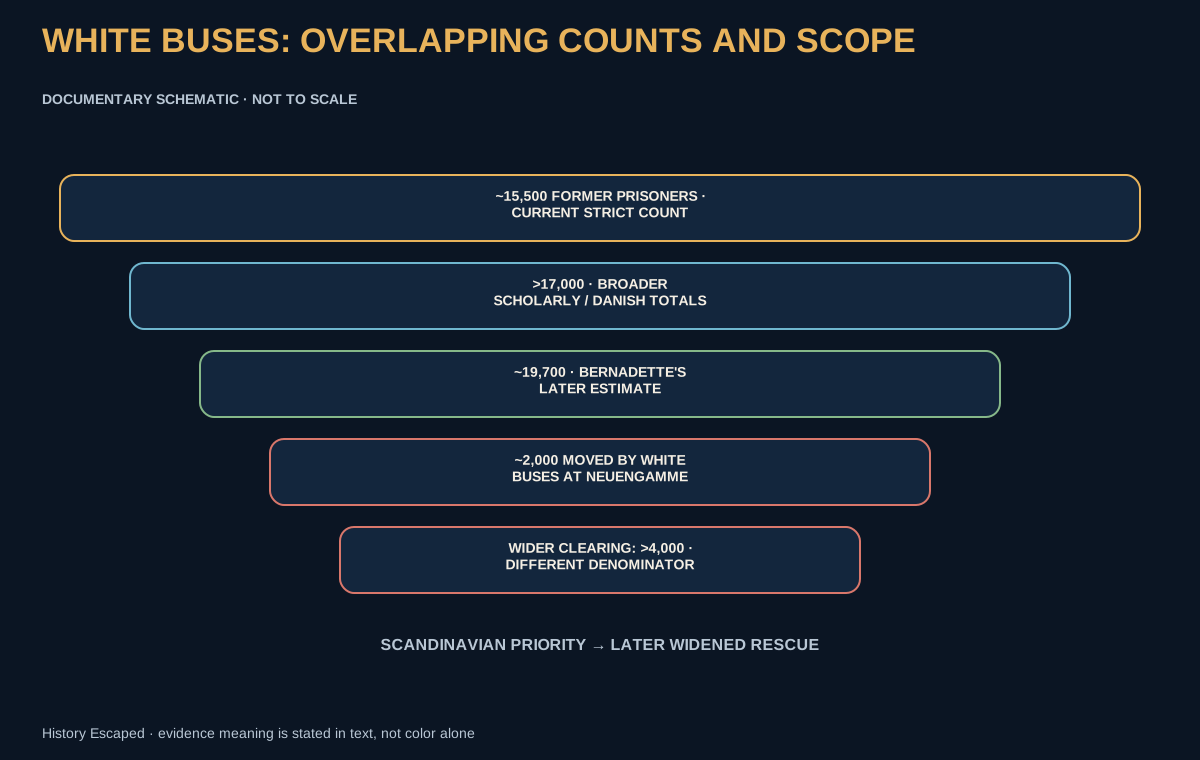
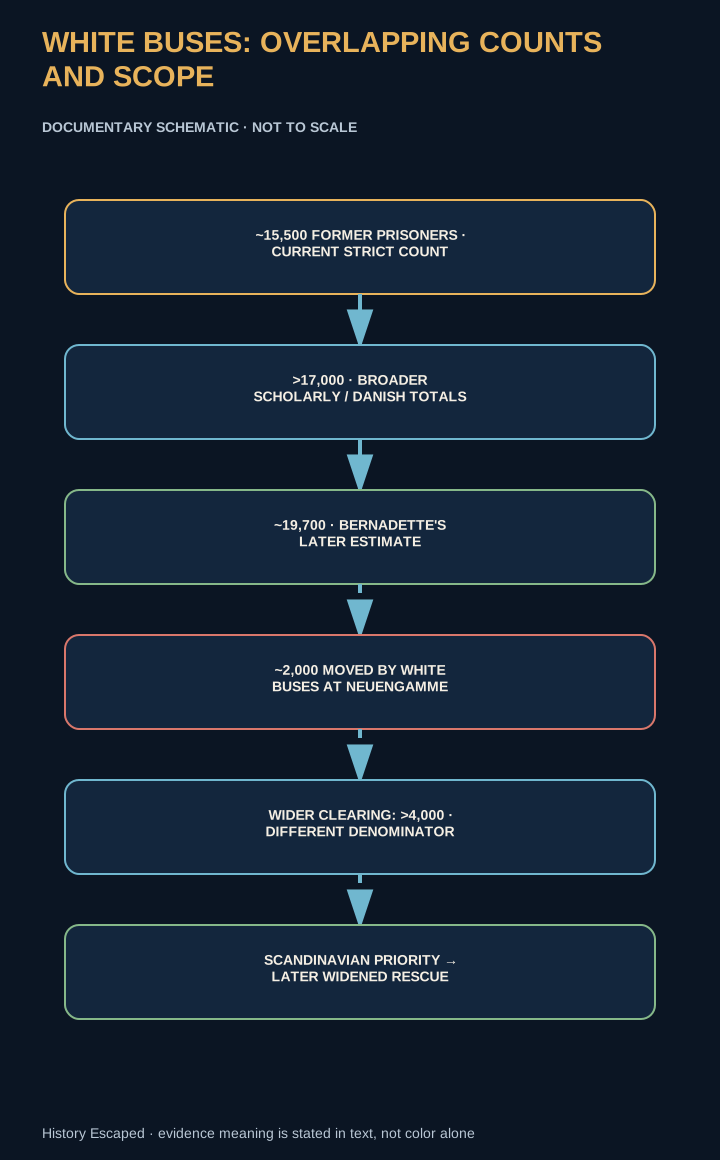
Simplified evidence-led editorial reconstruction based on the cited record; not to scale. Uncertainty is stated directly in the visual and adjacent text.

