
At a Glance
- Date: 11 September 1951
- Route: Cheb → Hazlov → Aš → West Germany → Selb
- Train: Czechoslovak State Railways passenger train no. 3717
- Escape type: Closed-border escape by diversion and seizure of a scheduled passenger train
- Best-supported total aboard: 111
- Returned to Czechoslovakia: 77
- Remained in the West: 34
- Outcome: The planned escape succeeded, but most passengers had not agreed to cross the border
Shortly after three o’clock on the afternoon of 11 September 1951, passenger train 3717 entered Aš, the final scheduled stop before Czechoslovakia’s western border. It slowed as if it were arriving normally, then continued past the station and accelerated onto the railway leading toward Bavaria.
For the small group that had planned the operation, this was the decisive stage of an escape from communist Czechoslovakia. For most people in the three passenger coaches, it was something very different. They had boarded an ordinary domestic train expecting to get off in Aš and learned only when the train failed to stop that they were being carried across the Iron Curtain.
That distinction is essential to understanding the “Freedom Train.” It was both a successful political escape and a train seizure involving unwilling passengers.
A border becoming harder to cross
The Communist Party’s seizure of power in February 1948 transformed Czechoslovakia’s western frontier. Political opponents were arrested, removed from employment or education, or pushed into clandestine resistance. Leaving the country without state permission became increasingly difficult as border enforcement tightened.
The railway around Aš offered an unusual vulnerability. A physical line still connected the Czechoslovak network to Selb in Bavaria even though ordinary passenger traffic did not simply continue through the frontier. Freight operations meant that track beyond Aš remained usable.
Among those who understood the system were locomotive driver Jaroslav Konvalinka and railway dispatcher Karel Truksa, whose surname also appears as Truxa in security records. Their circle included Aš physician Jaroslav Švec and Cheb official Václav Trobl. Archive-based research identifies these four as the operational core.
The operation was connected to a broader resistance network. František Šilhart Sr. helped with preparations and contacts but remained behind. Karel Ruml, who later published a prominent memoir of the event, became an armed participant aboard the train but appears not to have belonged to the small group that designed the plan from the beginning.
Train 3717
On the morning of 11 September, a longer-distance train traveled from Prague to Cheb. At Cheb, three passenger coaches continued toward Aš as local passenger train no. 3717, leaving at about 2:12 p.m. Konvalinka drove the steam locomotive; Josef Kalabza was the fireman in the cab.
The ordinary timetable was useful precisely because the train did not look like an escape vehicle. Students, spa visitors and other travelers boarded expecting a domestic journey. Some family members and associates of the organizers were aboard with prior knowledge, but most passengers were not.
The planners’ central problem was control. Even if the locomotive continued past Aš, a passenger train could be slowed by its braking system, by coach handbrakes, or through the intervention of railway staff. The escape therefore depended on preventing those safeguards from defeating the plan once people realized what was happening.
At Hazlov, the last scheduled stop before Aš, Konvalinka and Truksa worked on the train under the appearance of dealing with a brake problem. The archive-based reconstruction says the air-brake arrangement was altered so that the passenger coaches could no longer stop the train in the normal way. Handbrakes remained available, so armed participants positioned themselves near them.
This was the moment when a clandestine escape plan became coercive control of a scheduled train.
Selected chronology
Selected chronology
Communist takeover in Czechoslovakia
The Communist Party consolidated power, followed by expanding political repression and tighter control of movement across the western border.
Train 3717 leaves Cheb
The three-coach passenger train departed for Aš with Konvalinka driving and both informed escapees and unsuspecting passengers aboard.
Brake manipulation at Hazlov
Konvalinka and Truksa altered the braking arrangement while participants positioned themselves to prevent use of coach handbrakes.
The train passes through Aš
Instead of stopping at its terminus, train 3717 accelerated west and crossed the Czechoslovak border into Bavaria.
Returnees are handed back
Seventy-seven passengers who requested repatriation were returned to Czechoslovak authorities; thirty-four remained in the West in the archive-based count.
Akce Selb investigations and trials
The StB investigation expanded to 171 people and produced 70 convictions across the wider network.
Cross-border rail service returns
Regular rail service between Aš and Selb was restored decades after Cold War restrictions severed the connection.
The signal at Aš
Švec had another important task. He needed to determine whether the railway points at Aš were aligned toward the line leading to Germany. That route was not automatically available to an ordinary passenger service whose scheduled journey ended in Aš.
As train 3717 approached the station, Truksa used a pistol to force fireman Kalabza down in the locomotive cab. Kalabza had not joined the plan. In the coaches, participants guarded the handbrakes against anyone who might try to stop the train.
The train slowed on its approach to Aš and then accelerated rather than stopping. Passengers expecting to disembark watched the station pass by.
Later accounts frequently describe the train racing through Aš at about seventy kilometers per hour and striking or breaking a border barrier. The exact speed is less important than the secure sequence: the scheduled stop was deliberately missed, the route toward Germany was used, and train 3717 crossed the state frontier shortly after 3 p.m.
Several hundred metres into the West
Sources differ slightly over the exact minute and stopping distance. Slavomír Michálek’s reconstruction from security files gives a crossing time of about 15:10 and places the first stop roughly 500 metres inside West Germany. Later Czech Television reporting gives 15:04 and sometimes a somewhat longer distance.
The disagreement does not change the outcome. The train had crossed into Bavaria before Czechoslovak authorities could stop it.
At the first halt, people who had planned to escape began leaving the coaches. Some Czechoslovak security personnel headed back toward the border. German border police and American occupation authorities became involved, and the train was eventually moved onward to Selb.
The scene immediately attracted international attention. A Czechoslovak steam locomotive and three passenger coaches had crossed the Iron Curtain carrying more than a hundred people, even though only a minority had boarded with the intention of defecting.
Were there 110 people—or 111?
Even one of the most repeated facts about the Freedom Train is uncertain.
A 2021 Czech Television account says 110 passengers were aboard and 36 remained in the West. Other popular histories use similar numbers. Michálek’s archival study notes that contemporary and later records reported totals ranging from 96 to 164.
The strongest internal accounting in the Akce Selb records gives 111 aboard. It records 77 people returned to Czechoslovakia and 34 who remained in Germany, figures that reconcile exactly. On balance, 111/77/34 is the best-supported accounting, while the disagreement remains part of the evidence.
The count problem is not merely bookkeeping. Train crew, organizers, family members, ordinary passengers and security personnel could be counted differently in rapidly produced reports on both sides of the border.
Problem → response
Escape was a sequence of problems
Each response solved a practical obstacle while often creating the next one.
- 01→
Obstacle
A scheduled terminus at Aš
Train 3717 was supposed to stop at Aš rather than continue across the border.
Response
The planners used insider railway knowledge and the available cross-border track alignment to continue west instead of stopping.
- 02→
Obstacle
Multiple ways to stop a passenger train
The coach braking system, handbrakes and train crew could have stopped the diversion once it became apparent.
Response
The air-brake arrangement was manipulated, handbrakes were guarded, and the fireman was coerced in the locomotive cab.
- 03→
Obstacle
Militarized western border
The route led into a heavily controlled frontier where an ordinary unauthorized crossing risked interception.
Response
The train used intact railway infrastructure and crossed before border forces could physically halt the consist.
Not everyone was escaping
The name “Freedom Train” came from Western celebration of the event and remains useful shorthand. It can also obscure what happened if every person aboard is treated as a willing defector.
Most were not.
Many passengers were students or travelers from the spa region around Františkovy Lázně. They had bought tickets for an ordinary trip. Returned passengers later told the Czechoslovak State Security that they had been carried across without advance knowledge; at least one explicitly described the event as an abduction.
Those statements were taken inside a coercive security system and later served communist propaganda, so they require source criticism. The underlying absence of consent, however, does not depend on accepting the StB’s political interpretation. The organizers had deliberately prevented passengers and railway personnel from stopping the train and transported them across an international border without asking them first.
The most accurate description is therefore two-sided: the train carried a planned group escape to success while also carrying many unwilling passengers across the frontier.
Documentary reconstruction
Train 3717 and the Aš–Selb border corridor
A case-local visual focused on the spatial, mechanical or evidentiary relationship established by the surviving record.
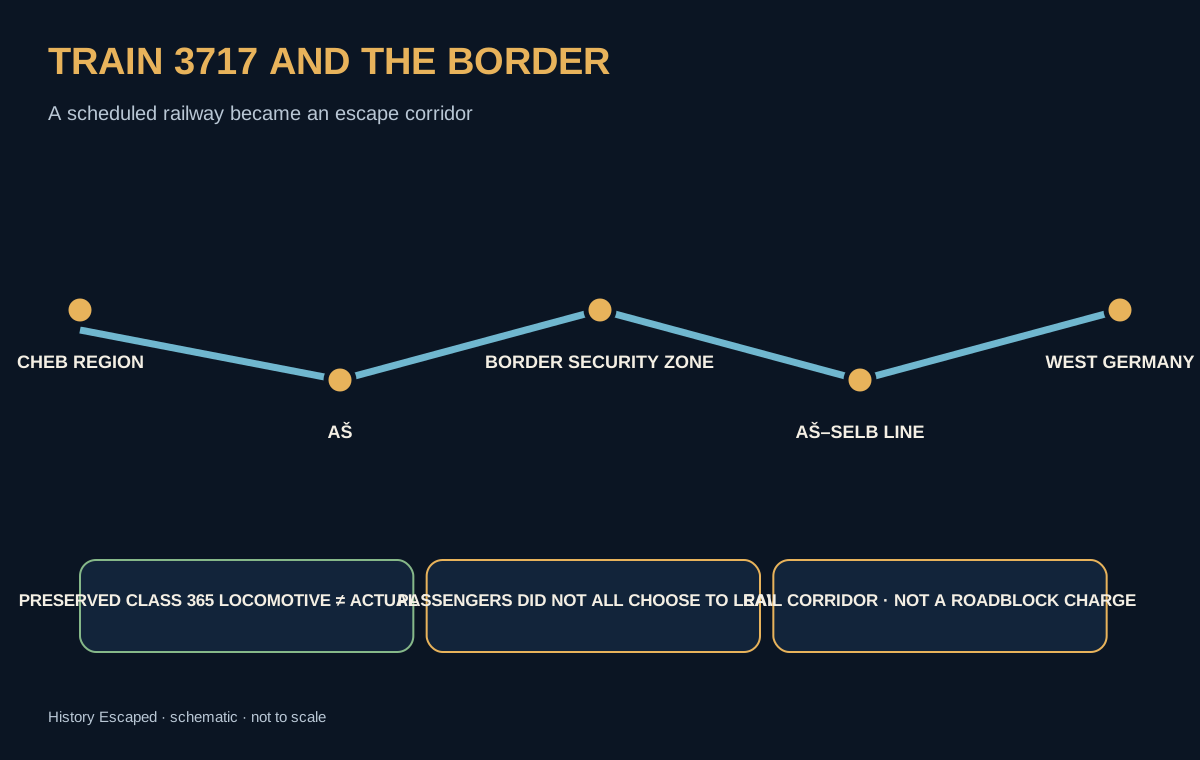

Simplified editorial reconstruction based on the cited historical record; not to scale. Uncertainty is stated directly in the visual and adjacent text.
Choosing whether to stay
Once the train was in West Germany, the situation changed. German and American authorities had to determine who wished to seek asylum and who wanted to return.
The archive-based reconstruction records that 77 requested repatriation. They were processed in the American zone and handed back to Czechoslovak authorities on 13 September. Thirty-four remained in the West.
Those 34 should not all be described as original conspirators. The group included planners and family members who had intended to leave, but some passengers decided only after the unexpected crossing that they preferred not to return. The train therefore created a new opportunity to defect for people who had never boarded with that plan.
The returnees faced questioning after re-entry. Later accounts describe educational or employment consequences for some of them, while the regime used selected testimony to support its claim that innocent citizens had been kidnapped by anti-state terrorists and pressured by Americans.
Two propaganda stories
The train became a Cold War symbol almost immediately.
Western reporting called it the “Freedom Train,” emphasizing the ingenuity and courage of people escaping communist repression. American information services publicized the episode, and refugee organizations helped people who remained in the West resettle elsewhere.
The Czechoslovak government presented almost the opposite story. State propaganda described an armed terrorist kidnapping and alleged foreign direction. That narrative exploited a genuine feature of the event—many passengers really had crossed unwillingly—but used it to portray the entire operation as an externally organized attack.
The organizers rejected the American-planning allegation. TIME later reported a balloon-leaflet campaign carrying a statement from Konvalinka denying that Americans had planned the escape. U.S. diplomatic records show rapid American interest in the train after it reached Bavaria and in the propaganda opportunities surrounding it, but that is not the same thing as evidence of operational control before departure.
A locally organized escape thus became an international information weapon almost as soon as it crossed the border.
Akce “Selb”
For people who remained in Czechoslovakia, the consequences extended far beyond train 3717.
The State Security opened Akce “Selb,” a wide investigation into the organizers’ families, contacts and resistance associates. Michálek’s study records 171 people investigated and 70 convictions connected with the wider network between 1951 and 1954.
Sentences were severe. Some defendants received decades in prison or life terms, and two death sentences were later commuted to life imprisonment. The escape had revealed relationships and suspicions that the security police then used to dismantle a much larger circle.
That aftermath complicates any uncomplicated victory story. The people who crossed the border escaped the reach of the Czechoslovak security apparatus; people connected to them who remained behind could become targets precisely because the operation had succeeded so publicly.
Evidence discipline
What the record supports
Status labels distinguish secure conclusions from uncertainty and rejected claims. Color is never the only signal.
DISPUTED
Exactly 110 people were aboard the Freedom Train and 36 stayed in the West.
Those figures appear in later Czech Television reporting, but the archive-based Akce Selb reconstruction notes multiple competing totals and uses 111 aboard, with 77 returned and 34 remaining.
Sources: SRC-001, SRC-002MYTH
All passengers on the Freedom Train were willing defectors.
Most passengers had not been told of the plan. Many returned to Czechoslovakia, and returnee testimony explicitly described the crossing as involuntary.
Sources: SRC-001, SRC-002, SRC-008DISPUTED
Karel Ruml was one of the small group that originally planned the operation.
Ruml became an armed participant aboard the train and later a prominent memoirist, but the archive-based study says he did not take part in the initial organization and learned the final operation shortly before departure.
Sources: SRC-001DISPUTED
The United States planned the Freedom Train operation.
Czechoslovak propaganda alleged American direction, while Konvalinka publicly denied U.S. involvement. The sources document rapid American political exploitation and handling after the crossing but do not establish U.S. operational control beforehand.
Sources: SRC-006, SRC-009, SRC-010MYTH
The Freedom Train was simply a nonviolent border escape.
The organizers manipulated the braking system, guarded handbrakes with weapons and coerced the locomotive fireman. The escape succeeded through control of a scheduled train carrying many uninformed passengers.
Sources: SRC-001, SRC-002, SRC-003The railway closes
The Freedom Train exposed a structural weakness in the emerging Iron Curtain. A railway line that still physically crossed the frontier could become an escape route if the state could not guarantee control of the train using it.
Czechoslovak authorities responded by tightening border-rail security. Later accounts describe rails being removed at some disused crossings and stronger physical measures being introduced to prevent another train from simply continuing west.
The Aš–Selb connection became part of the transport geography severed by the Cold War. Decades later, the symbolism reversed: regular cross-border rail service between Aš and Selb was restored in 2015.
Why the escape worked
The operation succeeded because the organizers understood several systems at once.
They knew the timetable and the locomotive. They understood the braking arrangements and the remaining handbrakes. They knew that the cross-border rail line beyond Aš still existed, and they recognized that the point alignment at the terminus mattered. They also understood that once passengers realized the train was not stopping, railway staff and coach brakes could defeat the plan unless controlled.
That knowledge created a brief window in which an ordinary domestic service could become a border-crossing vehicle.
The same mechanism created the event’s most serious ethical problem. The organizers could not ensure that only willing escapees crossed the frontier. Success required control of the whole train, not merely the ability of a small group to leave aboard it.
What the Freedom Train was
The Czechoslovak Freedom Train was one of the most dramatic vehicle-assisted escapes of the early Cold War. It turned ordinary railway infrastructure into a route across a border that was becoming one of Europe’s hardest to cross.
It was not a clean mass defection in which every passenger chose freedom together. A small network planned the operation. A larger group knowingly escaped with them. Some people decided to remain only after reaching West Germany. Most returned because they had never intended to leave.
That mixture is not an inconvenient footnote. It is the central fact that makes the case historically revealing. The same train could be, at the same moment, an escape vehicle for some people and an involuntary journey for others.
The name “Freedom Train” survived because it captured the political symbolism of 1951. The evidence is more complicated than the name—and more useful for understanding what actually happened.