
On 19 December 1992, Orestes Lorenzo Pérez returned to the country he had defected from twenty-one months earlier. He was no longer flying a Cuban military jet. Instead, he used a privately supplied Cessna 310, landed on a public road in Matanzas Province, took aboard his wife and two sons, and returned with them to Florida.
The rescue became famous because of the flight, but its origins lay in a political and family dispute that had lasted since March 1991. Lorenzo had reached the United States alone. María Victoria, known as Vicky, and their sons Reyniel and Alejandro remained in Cuba even after the United States issued them visas. By late 1992, public appeals had failed to reunite the family, and Lorenzo chose to return for them himself.
At a Glance
- Initial defection: 20 March 1991
- Family rescue: 19 December 1992
- Departure point: Florida Keys
- Pickup area: Matanzas Province, Cuba, near the Varadero area
- Rescued: María Victoria Lorenzo and sons Reyniel and Alejandro
- Aircraft: Cessna 310
- Method: Privately organized clandestine return flight and roadside pickup
- Outcome: All four reached Florida safely
- Political issue: The family had U.S. visas but Cuban authorities had not permitted them to leave
- Operational note: Exact evasion profiles, radar assumptions and route details are intentionally omitted
The First Flight: A MiG to Key West
Lorenzo was a major in the Cuban Air Force when he defected on 20 March 1991. Contemporary reporting records that he flew a Soviet-built MiG-23 to Naval Air Station Key West at Boca Chica and requested political asylum. Florida’s state archives preserve photographs of the aircraft on the ground at the naval station and of Cuban military personnel examining and escorting it before its return later that month.
The defection was politically embarrassing on both sides of the Florida Straits. Cuba had lost a military officer and aircraft to defection, while the arrival of a Cuban combat aircraft in Florida prompted questions about U.S. air-defense awareness. The MiG itself was eventually returned to Cuba, but Lorenzo remained in the United States. His wife and children did not accompany him.
That separation changed the meaning of the defection. What had begun as an individual political flight soon became a prolonged dispute over whether the rest of the family would be allowed to join him.
Visas Without Permission to Leave
The documentary record is unusually strong on the family’s legal predicament. By 1992, Vicky and the two boys had U.S. visas. That did not guarantee that Cuban authorities would issue the permissions necessary for them to depart the island.
The U.S. State Department’s annual human-rights report later identified Lorenzo’s wife and children among people denied exit permission because a husband had defected from the Cuban Air Force. President George H. W. Bush made the case public on 23 October 1992 while signing the Cuban Democracy Act in Miami. Lorenzo was present, and Bush said that the United States had issued visas for the family more than a year earlier.
The speech was part of a broader and highly political U.S. confrontation with Fidel Castro’s government, so its rhetoric should not be mistaken for neutral documentation. On the narrow point that matters here, however, it corroborates the State Department record: the visas existed, and the family remained in Cuba because Cuban authorities had not authorized their departure.
Contemporary reporting also described surveillance and pressure on Vicky after her husband’s defection. Some of the most dramatic claims about what senior Cuban officials told her come from Lorenzo, Vicky and exile-group supporters. They help explain how the family remembered the period, but the simpler documented fact is sufficient: they could not leave legally.
Diplomacy Before the Rescue
Lorenzo did not immediately decide to fly back. For much of 1991 and 1992 he pursued family reunification publicly through political leaders, human-rights organizations and international channels. The Valladares Foundation became an important supporter, and the family’s case gained visibility in the United States and abroad.
His campaign attracted prominent attention. Bush’s October 1992 statement placed the separation inside U.S. policy toward Cuba, while international reporting described other appeals and public protests. None produced an exit authorization for Vicky and the boys.
By the second half of 1992, Lorenzo was also preparing a private alternative. The Valladares Foundation and individual supporters helped make a civilian aircraft available. Contemporary reporting describes months of planning and a small circle of people who knew enough to assist.
Two women traveling to Cuba delivered written information to Vicky shortly before the rescue, while the couple used coded communications to confirm arrangements. The existence of that coordination is well documented; the code itself and the precise rendezvous procedure are not necessary to understand the history and are omitted here.
The Family’s Side of the Plan
The rescue depended as much on Vicky as on the pilot. She had to receive the plan without exposing it, move two children toward the designated area without attracting attention, and be ready when the aircraft appeared.
Contemporary accounts emphasize that the boys were not fully told what was happening beforehand. The family spent part of the day near the coast before moving toward the pickup area. Exact timing and recognition signals have often been retold in detail, but the important historical point is synchronization rather than technique.
Lorenzo could not remain on the ground waiting for a late arrival, and Vicky could not wait openly beside a road for an unauthorized aircraft. Private couriers and limited communications allowed both sides to arrive at roughly the same place at the same time without a large network knowing the full plan.
December 19, 1992

Lorenzo departed from the Florida Keys on 19 December in the Cessna 310. Contemporary U.S. reporting agrees that he entered Cuban territory without the Cuban government’s authorization and reached a road in Matanzas Province near the Varadero region.
The landing occurred in ordinary public space rather than at a clandestine airstrip. Accounts published immediately afterward describe traffic nearby as the aircraft came down and stopped. Vicky and the boys ran to the plane, climbed aboard, and Lorenzo departed again after a very brief stop.
The flight returned to Florida, first reaching Marathon. The family was later flown to the Miami area, where reporters, supporters and members of the Cuban exile community were waiting.
No one had been injured, and the twenty-one-month separation was over.
What U.S. Authorities Knew
Lorenzo insisted after the rescue that the U.S. government had not helped organize it. Contemporary reporting supports a distinction between private assistance and government sponsorship: the Valladares Foundation and individual supporters helped with the aircraft and communications, while Lorenzo said he deliberately kept U.S. authorities out of the operational plan.
That does not mean the aircraft was invisible to the United States. NORAD said afterward that the flight had been tracked and classified as friendly rather than as a military threat. U.S. Customs also said it was reviewing the incident to determine whether officials had done what they were supposed to do.
Those statements produced an awkward political contrast. A privately planned flight had crossed into Cuba and returned with three additional passengers, yet within days the family was being publicly celebrated in Washington. On 22 December, President Bush received Lorenzo, Vicky, Reyniel and Alejandro at the White House.
The reception made the administration’s political view unmistakable, but approval after the fact does not establish that the government planned the flight.
Cuba, Sovereignty and Exit Control
From the Cuban state’s perspective, Lorenzo was an Air Force defector who had returned without authorization, landed a foreign-registered civilian aircraft on Cuban territory, and departed with three Cuban residents whom the government had not authorized to emigrate.
From Lorenzo’s perspective, the operation reunited a family that already possessed permission to enter the United States and had been prevented from leaving Cuba for political reasons connected to his defection. These descriptions reflect two different legal and political frames around the same event.
The U.S. State Department’s 1992 human-rights report placed the case inside a wider discussion of Cuban exit controls. It specifically said the wives and children of Lorenzo and another defecting pilot had been denied exit permission because of their husbands’ defections. The report is itself a U.S. government document produced during a period of intense U.S.-Cuban hostility, but on this specific administrative fact it reinforces the contemporary record.
The rescue therefore sits at the intersection of family reunification, asylum, aviation law and state sovereignty. Its appeal in the United States came from the first of those themes; its diplomatic risk came from the others.
The Legal Afterlife
The immediate American legal aftermath was less dramatic than the rescue itself but still important. Customs officials publicly reviewed their handling of the flight, while NORAD defended its classification of the aircraft as non-hostile. Contemporary accounts do not present the event as a U.S. military operation, and Lorenzo repeatedly denied receiving operational help from American authorities.
The flight later became part of a broader argument about enforcement against civilian aircraft entering Cuban airspace. In 1996, after the Federal Aviation Administration revoked the pilot certificate of José Basulto over repeated unauthorized flights connected with Brothers to the Rescue, Basulto publicly pointed to Lorenzo’s 1992 White House reception and accused the U.S. government of applying its rules inconsistently.
The comparison was political rather than a judicial determination that the cases were legally identical. By 1996, U.S.-Cuban aviation tensions had also changed dramatically following the Cuban shootdown of two Brothers to the Rescue aircraft. Still, the reference shows how Lorenzo’s flight survived as more than a family story: it became an example invoked in later disputes over U.S. policy, Cuban airspace and civilian aviation enforcement.
What the Famous Retelling Leaves Out
The most familiar version of the story begins with a Cessna appearing over Cuba and ends with a family landing safely in Florida. That version misses why the return flight happened.
Lorenzo had already completed one escape in March 1991. The second operation existed because the first had left his family behind. For more than a year, Vicky and the boys had valid U.S. visas but no Cuban permission to use them, and Lorenzo pursued public pressure and international appeals before turning to a private rescue.
Supporters supplied money, an aircraft and limited courier help. Vicky managed the family’s side of the plan inside Cuba. The pickup worked, and the four reached Florida together.
The tactical details are the least durable part of the history. Air-defense systems change, aviation procedures change, and reproducing old evasion techniques adds little to an account of a family and a political dispute. The lasting structure is simpler: a military defection separated a husband from his wife and children, state exit controls kept the separation in place, diplomacy failed to resolve it, and Lorenzo returned to retrieve the three people he had left behind.
Documentary reconstruction
Two separated family tracks converge in December 1992
A case-local visual focused on the historical question that the surviving evidence can answer.
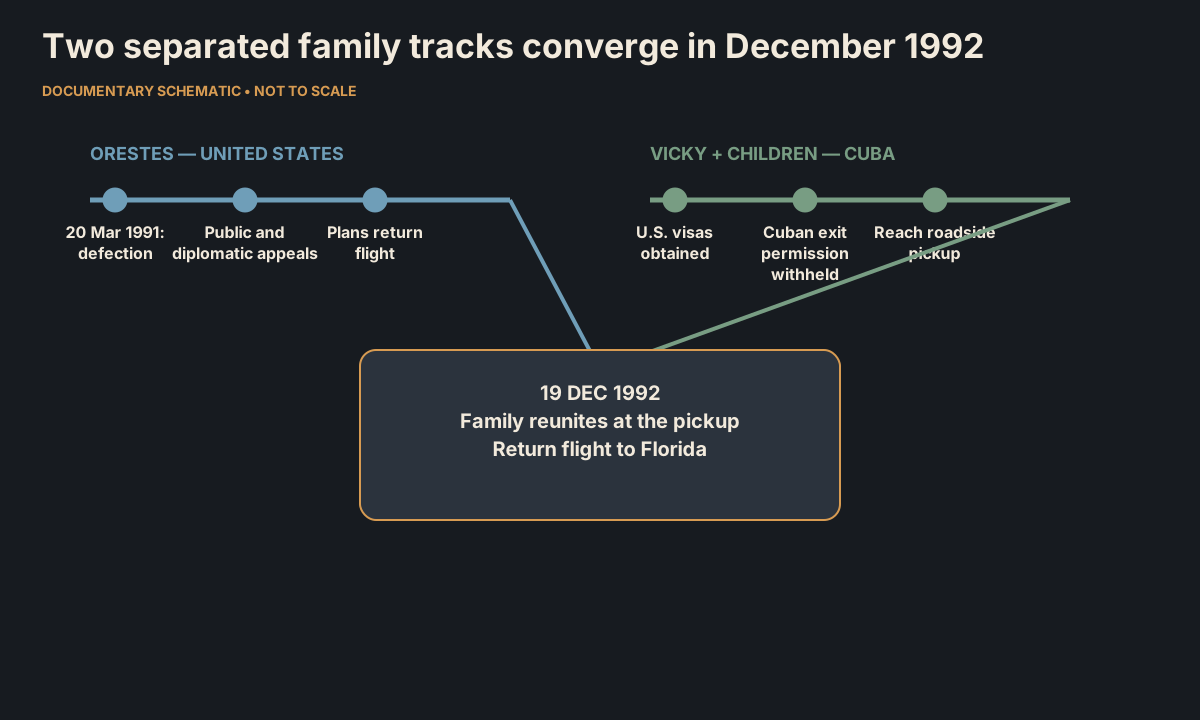
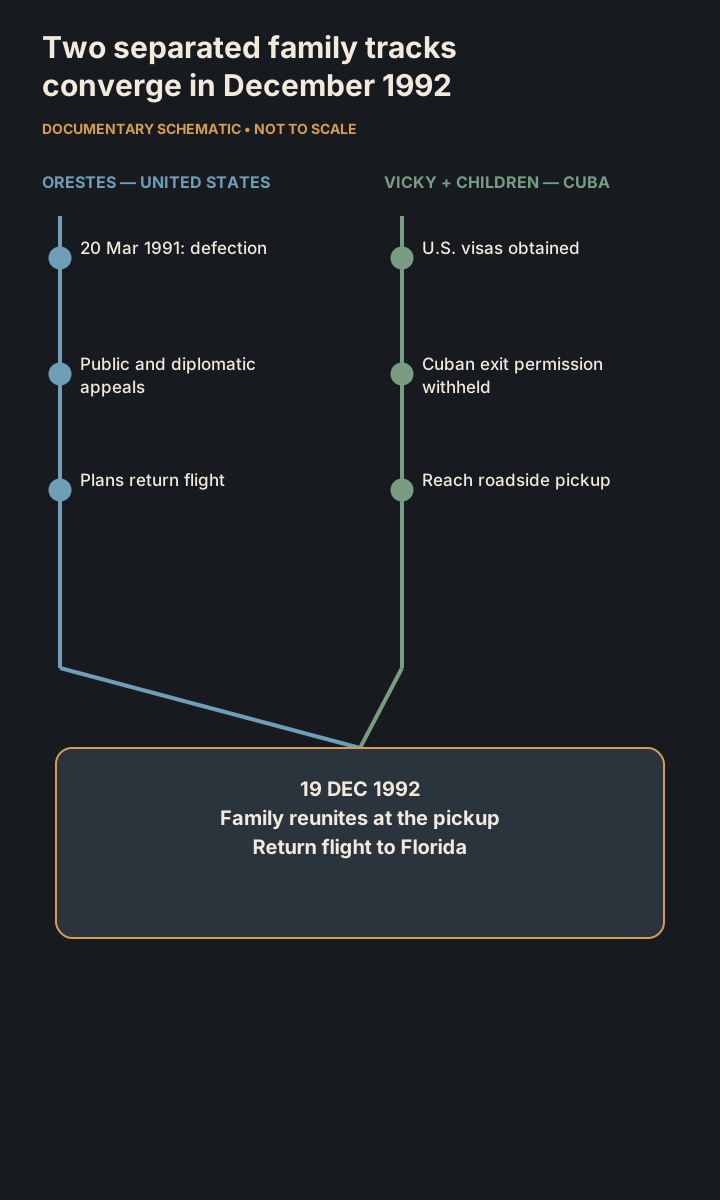
Simplified documentary reconstruction; not to scale. Evidence qualifications are written directly into the visual and explained in the adjacent text.
Evidence discipline
What the record supports
Status labels distinguish secure conclusions from uncertainty and rejected claims. Color is never the only signal.
DOCUMENTED
Orestes Lorenzo defected to the United States on 20 March 1991 in a Cuban MiG-23.
Contemporary UPI reporting gives the date and aircraft type, while Florida Memory preserves photographs of the actual MiG-23 at Naval Air Station Key West.
Sources: SRC-001, SRC-007DOCUMENTED
Lorenzo’s wife and children already had U.S. visas but were prevented by Cuban authorities from leaving.
President Bush publicly stated that visas had been issued more than a year earlier, and the State Department’s 1992 country report says the family was denied exit permission because Lorenzo had defected.
Sources: SRC-005, SRC-006UNKNOWN
The U.S. government secretly planned or directed Lorenzo’s 1992 rescue flight.
Lorenzo explicitly denied U.S. government operational assistance, and contemporary reports instead identify private supporters and the Valladares Foundation as the direct helpers. NORAD tracking of the flight does not establish sponsorship.
Sources: SRC-002, SRC-003, SRC-009DOCUMENTED
The family-rescue flight took place on 19 December 1992 using a Cessna 310.
Multiple independent contemporary news reports agree on the date, aircraft family, roadside pickup and safe return to Florida.
Sources: SRC-001, SRC-002, SRC-003MYTH
The exact radar-avoidance profile, altitude, airspeed and timing are necessary to explain the historical escape.
Those operational details appeared in contemporary participant accounts but are unnecessary to establish the historical mechanism. The publication intentionally omits them because they are modernizable evasion details.
Sources: SRC-002, SRC-003MYTH
The U.S. response after the rescue was purely celebratory and involved no procedural concern.
President Bush did receive the family at the White House, but U.S. Customs also announced a review of its handling, and NORAD issued a public explanation of how the flight had been classified.
Sources: SRC-004, SRC-008UNKNOWN
The 1992 rescue and later unauthorized Cuban-airspace cases were legally identical.
In 1996 José Basulto cited Lorenzo while alleging inconsistent U.S. enforcement, but that political comparison does not establish that the underlying aviation facts or legal violations were identical.
Sources: SRC-011