
On the night of 25–26 February 1756, two prisoners climbed upward through a chimney in the Bastille and emerged onto the upper works of one of the most famous prisons in Europe. One was Antoine Allègre. The other was Jean Henri, then commonly known as Danry and later celebrated under the name Masers de Latude.
Their problem was larger than getting out of a cell. The Bastille was a fortified royal prison enclosed by towers, walls and a defensive ditch. Ordinary exits were controlled. A successful escape meant finding a route that bypassed doors, descending from the fortress itself, and then defeating the outer barrier before guards could intervene.
Latude and Allègre did it.
The exploit later became wrapped in Revolutionary legend. Latude turned into a symbol of arbitrary royal imprisonment, his improvised ladder was preserved as a relic, and artists pictured him beside the instrument of his escape. But the historical record is more interesting than the simplified legend. Latude had not been imprisoned merely for holding dangerous political ideas, he did not escape the Bastille repeatedly, and his own later recollections cannot be accepted uncritically.
What can be reconstructed with confidence is a remarkable technical escape — and a story about how one prison break was transformed into political mythology.
A Prisoner Who Helped Create His Own Disaster
Latude's later image as a victim of despotism can obscure how his imprisonment began.
Jean Henri came to Paris from Languedoc in 1748. In 1749 he devised a scheme intended to make himself useful to Madame de Pompadour, the influential favorite of Louis XV. He prepared a suspicious package or device and then attempted to present himself as the person who could warn her about an imagined plot. The deception was uncovered. On 1 May 1749 he entered the Bastille under royal authority.
That does not make everything that followed proportionate or ordinary. Eighteenth-century French state detention could operate through administrative orders rather than a modern criminal trial, and Latude's confinement became extraordinarily prolonged. His later fame depended in part on that fact. But beginning the story with an innocent dissident suddenly punished for his beliefs would replace one legend with another.
The archival chronology also shows that the Bastille was only one part of his captivity. In July 1749 Latude was transferred to Vincennes. There, on 25 June 1750, he made his first successful escape. He was recaptured and returned to the Bastille the following month.
That matters because it corrects one of the most persistent misunderstandings surrounding him: the famous 1756 break was not one of several successful escapes from the Bastille. It was his second successful escape overall, but his only successful escape from that fortress.
Two Prisoners, One Technical Problem
By 1756 Latude was not alone in planning his way out. Antoine Allègre, another state prisoner, became his companion in the escape.
The pair faced a prison designed to make the controlled exits irrelevant to anyone without permission. A route through a door would lead into guarded circulation spaces. Their answer was to attack the problem vertically.
The material tradition surrounding the escape is unusually strong. The Musée Carnavalet preserves an elaborate ladder associated with Latude and dated to 1756. Its catalog records 135 wooden rungs joined by cords. An anonymous print produced around the time of the escape depicts the event, and later portraits made the ladder one of the central symbols of Latude's identity.
Latude's memoir tradition supplies more detail about how cords, wooden pieces and improvised implements were gathered and prepared. Those accounts cannot be treated as exact engineering records. Later versions of his story were revised and embellished, and the surviving accounts sometimes disagree. Still, the broad fact that an improvised ladder system was central to the 1756 escape is supported beyond Latude's late self-presentation.
Preparation therefore mattered as much as audacity. A ladder capable of helping two men descend a fortress could not simply appear on the night of escape. Materials had to be accumulated, concealed and assembled inside confinement without alerting those responsible for the prisoners.

Up the Chimney
The decisive move began upward.
On the night of 25–26 February, Latude and Allègre climbed through a chimney and reached the upper part of the Bastille. This was the first major reversal in the prison's logic. Instead of trying to force their way toward a guarded exit at ground level, they used a route intended for smoke and ventilation to reach a place from which the exterior defenses could be attacked from above.
The chimney ascent is one of the best-supported elements of the escape sequence. What should not be added are invented dimensions: the exact internal width of the passage, the number of minutes required, where every guard was standing, or precisely what each man could see when he emerged. The sources allow the movement to be reconstructed. They do not allow a cinematic floor plan.
Once on the upper works, the two prisoners had to descend. Their improvised ladder was the key. Historical accounts describe them fastening the ladder above and lowering themselves down the exterior. The surviving ladder associated with Latude became so famous that it eventually functioned almost as a material signature of the escape.
Getting down the fortress was not the same as getting free.
The Ditch and the Last Wall
Below the upper defenses lay another obstacle: the Bastille's ditch or moat area and the masonry separating the prison complex from the outside world.
Accounts of the escape describe the men making their way through the lower defensive zone and then opening a passage through the final wall with improvised tools. Later narratives supply vivid measurements and physical details, but those are exactly the sort of claims that deserve restraint. The defensible version is simpler: the prisoners descended into the outer defensive area, crossed it, and breached masonry that still stood between them and freedom.
This final stage explains why the escape required more than a rope. Latude and Allègre had planned for different kinds of obstacles: vertical descent and a hard physical barrier. The tools associated with the story were therefore not decorative props. They represented separate answers to separate parts of the fortress.
Once through the barrier, the two men were outside the Bastille.
For a prison whose later reputation would become synonymous with royal confinement, the achievement was extraordinary. But the next phase of Latude's story is a reminder that an escape can be operationally successful without producing permanent freedom.
Escape Did Not Mean Permanent Freedom
Latude fled France and reached the Dutch Republic. That gave him distance, but not safety.
He was arrested in Amsterdam in June 1756. French records and modern scholarship agree on the broad sequence even though sources differ over the exact June date on which he was returned to the Bastille. For the history of the escape, the important point is secure: the February break succeeded, but Latude was back in French custody within months.
His reputation for escaping was not finished. After later transfers, including another period at Vincennes, he escaped that fortress again in 1765. The exact day is disputed in the surviving and later traditions, so it is safer to state the year rather than force a false precision.
Recapture followed again. Latude would pass through several institutions over the course of his long confinement, including Charenton and Bicêtre. He was not definitively released until 1784.
That chronology makes another popular phrase misleading. Latude is sometimes described as having spent 35 years in the Bastille. His imprisonment did stretch across roughly thirty-five years, from 1749 to 1784, but it was neither uninterrupted nor confined to the Bastille. Transfers, escapes, recaptures and periods at liberty were part of the story.
The Ladder Became a Political Relic
Latude's most important transformation came after the escape itself.
By the 1780s, criticism of arbitrary detention and the machinery of royal authority had become politically potent. Latude's history could now be read not simply as the adventures of an ingenious prisoner but as evidence against the system that had held him for so long.
The fall of the Bastille in July 1789 gave that image extraordinary power. In the same revolutionary year, Antoine Vestier portrayed Latude in a composition that linked the living former prisoner, the demolition of the Bastille and the ladder associated with his escape. The ladder was no longer just equipment. It had become a relic of resistance to imprisonment.
Latude encouraged that interpretation. He donated escape-related objects to the Hôtel de Ville, and his memoirs circulated widely. Yet the same fame that preserved the story also distorted it. The Bibliothèque nationale de France characterizes his later memoirs as full of exaggerations, and scholars have shown that the textual tradition around Latude includes rewriting, collaboration and apocryphal material.
That does not mean the 1756 escape was invented. On the contrary, the archival chronology, contemporary documentation, surviving object tradition and visual evidence establish the event securely. The problem lies in treating every dramatic detail added around the secure core as equally trustworthy.
What the Legend Gets Wrong
“Latude escaped from the Bastille several times.”
He did not. The archival dossier records three successful escapes from state confinement: Vincennes in 1750, the Bastille in 1756, and Vincennes again in 1765. The famous Bastille escape happened once.
A c.1756 print titled the episode Latude's “second escape from the Bastille” in wording that can mislead modern readers. In context, the chronology shows why “second escape” should be understood as his second successful escape overall: his first had been from Vincennes.
“He was an innocent political prisoner.”
That is too simple. His initial detention followed his own fraudulent scheme involving Madame de Pompadour. At the same time, the length and administrative character of his subsequent imprisonment became a legitimate example for contemporaries who attacked arbitrary royal detention. Both facts belong in the story.
“He spent 35 uninterrupted years inside the Bastille.”
No. His repeated confinement extended across about thirty-five years, but he was moved among multiple institutions and escaped more than once. The Bastille was the most famous prison in his biography, not the only one.
“His memoirs tell us exactly how everything happened.”
They do not. Latude was a participant and an important witness, but he also became an architect of his public legend. Details from his later accounts should be accepted only when they fit the stronger archival, material and independent evidence.
Why the Escape Worked
Latude and Allègre's escape succeeded because they solved the prison in stages.
They did not depend on one miraculous opening. They accumulated materials, created a way to descend, chose a vertical route that bypassed controlled doors, and prepared to confront an outer masonry obstacle after reaching the lower defenses. Most importantly, the plan recognized that leaving a cell and leaving a fortress were different problems.
The plan also exploited a basic weakness shared by many secure sites: architecture is designed around expected movement. Guards watch doors, corridors and ordinary access routes. Latude and Allègre used a chimney and the exterior of the building — spaces never meant to carry prisoners at all.
Their freedom was temporary, but the prison break itself was real and technically successful.
Jean Henri Latude did not repeatedly humiliate the Bastille. He escaped it once. That one escape was enough to make an improvised ladder famous, to turn a complicated prisoner into an icon of the old regime's abuses, and to leave historians with a case in which the documented feat and the legend built around it must be carefully separated.
Escape reconstruction
How the escape unfolded
An evidence-aware sequence of the principal stages.
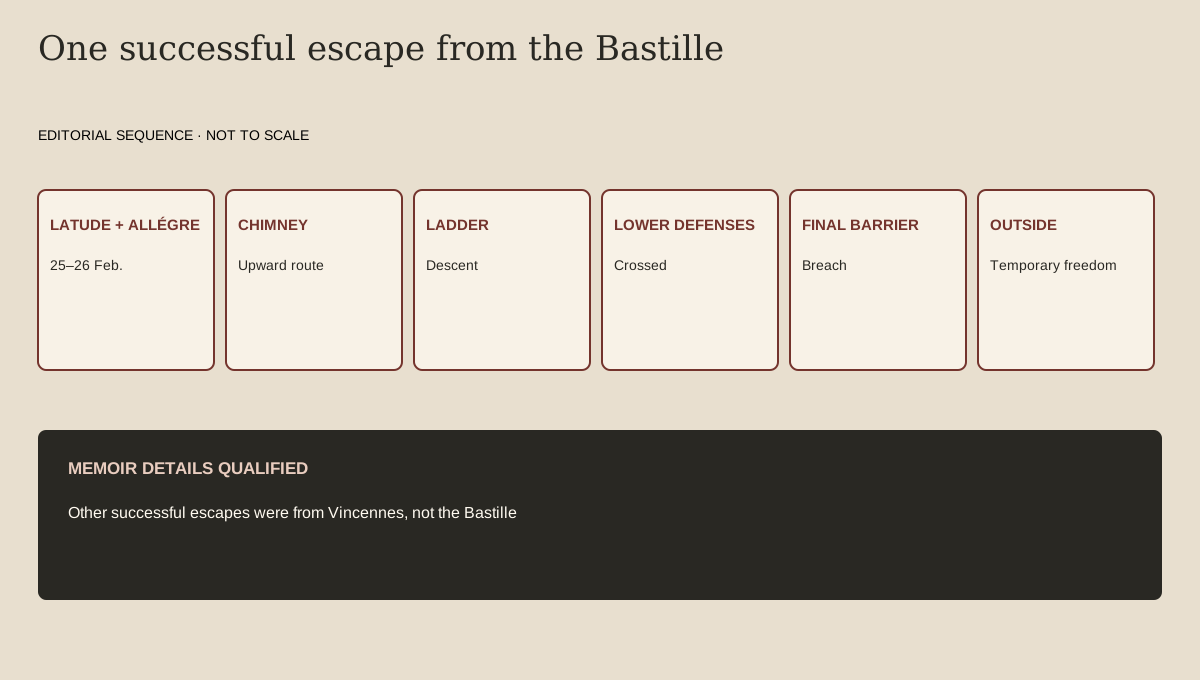
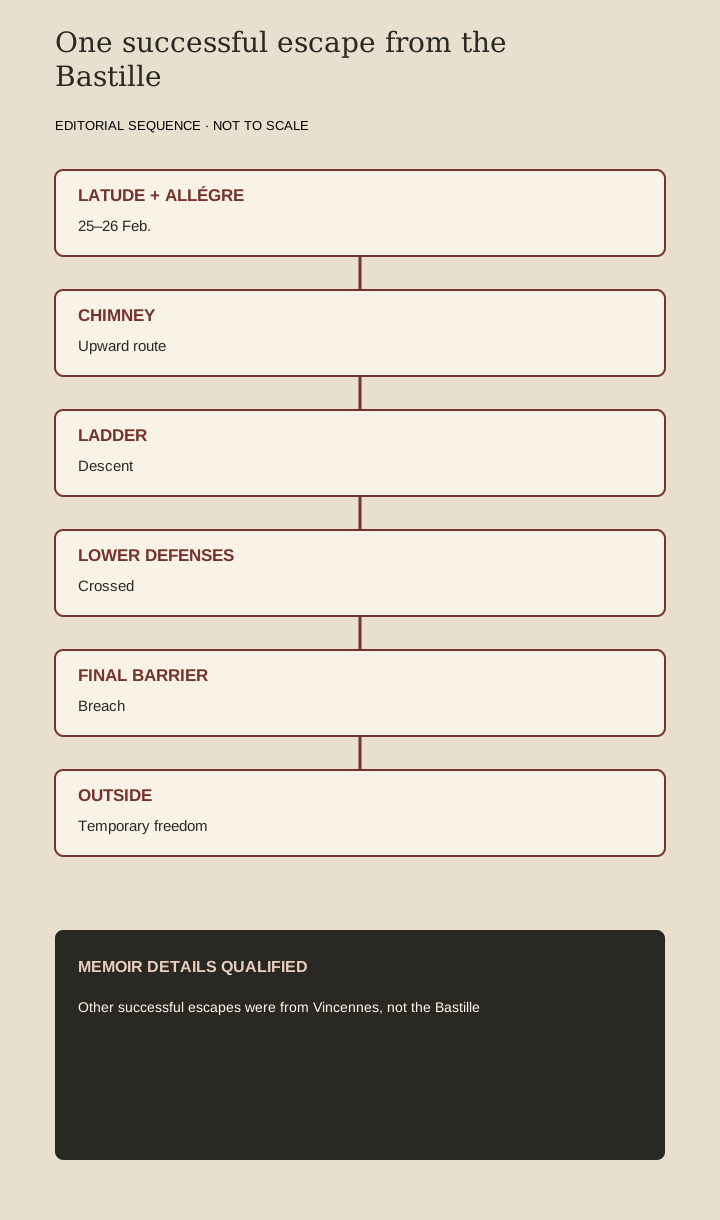
Simplified editorial reconstruction; not to scale. See adjacent text for evidence qualifications and unresolved details.
Material evidence
Tools of Escape
The objects used in an escape reveal how a plan worked under constraint.
- 01Decisive descent equipment
Improvised ladder system
A ladder system assembled from materials available in confinement allowed the prisoners to descend from the Bastille's upper works. A ladder associated with Latude is preserved by the Musée Carnavalet.
- 02Outer-barrier breach
Improvised hand tools
Tools were used in the final phase to open a passage through masonry after the prisoners had descended into the defensive area.
Problem → response
Escape was a sequence of problems
Each response solved a practical obstacle while often creating the next one.
- 01→
Obstacle
Controlled prison exits
Ordinary doors and circulation routes exposed prisoners to guards and locked barriers.
Response
Latude and Allègre used a chimney to reach the upper part of the fortress instead of relying on a normal exit.
- 02→
Obstacle
Vertical separation from the ground
Reaching the upper works still left the prisoners high above the lower defenses.
Response
They used an improvised ladder system to descend the exterior.
- 03→
Obstacle
Outer defensive barrier
The ditch or moat area did not itself place the prisoners outside the fortress complex.
Response
They crossed the lower defensive area and used tools to breach the remaining masonry barrier.
The final accounting
Outcome
Escaped the Bastille
Latude and Allègre successfully got out of the Bastille on the night of 25–26 February 1756.
Permanent freedom from the 1756 break
The escape did not produce lasting freedom; Latude was arrested in Amsterdam and returned to French custody within months, and Allègre was also recaptured.
Evidence discipline
What the record supports
Status labels distinguish secure conclusions from uncertainty and rejected claims. Color is never the only signal.
MYTH
Latude successfully escaped from the Bastille multiple times.
The archival chronology records three successful escapes from state confinement, but only the 1756 escape was from the Bastille. The other successful breaks were from Vincennes.
Sources: SRC-002, SRC-006DOCUMENTED
Latude and Antoine Allègre escaped the Bastille on the night of 25–26 February 1756.
The Bastille prisoner dossier and independent scholarly and museum sources converge on the date, the two escapees and the reality of the break.
Sources: SRC-002, SRC-005, SRC-006WELL-SUPPORTED
An improvised ladder was central to the escape.
A ladder associated with Latude is preserved by the Musée Carnavalet, appears in the visual tradition of the escape and matches the broad narrative of descent from the fortress.
Sources: SRC-003, SRC-004, SRC-005, SRC-007MYTH
Every technical detail in Latude's memoir tradition can be treated as exact eyewitness fact.
The BnF warns that his later memoirs contain exaggerations, and scholarship identifies rewriting, collaboration and apocryphal material in the Latude textual tradition. Scene-level detail therefore requires corroboration.
Sources: SRC-001, SRC-006, SRC-007MYTH
Latude was imprisoned simply because he was an innocent political dissident.
His initial 1749 arrest followed a fraudulent scheme involving Madame de Pompadour. His later prolonged administrative detention nevertheless became a powerful example in criticism of arbitrary royal imprisonment.
Sources: SRC-001, SRC-002, SRC-008MYTH
Latude spent 35 uninterrupted years inside the Bastille.
His repeated imprisonment spanned approximately 1749–1784 but involved multiple institutions and was interrupted by escapes and periods at liberty.
Sources: SRC-001, SRC-002, SRC-008DISPUTED
The exact date of Latude's 1765 escape from Vincennes is settled across the source tradition.
The Arsenal catalog and later narrative traditions give conflicting dates. The year 1765 is supported, but the precise day remains disputed.
Sources: SRC-002, SRC-007Selected chronology
Selected chronology
Latude enters the Bastille
After his fraudulent scheme involving Madame de Pompadour was uncovered, Jean Henri Danry was confined in the Bastille.
Transferred to Vincennes
The Bastille dossier records his transfer from the Bastille to Vincennes.
First successful escape
Latude escaped from Vincennes, his first documented successful break from state confinement.
Returned to the Bastille
After recapture, he re-entered the Bastille.
Escape from the Bastille
Latude and Antoine Allègre escaped by a route involving a chimney, improvised ladders, the lower defensive zone and a final masonry barrier.
Recaptured after reaching Amsterdam
Latude was arrested in Amsterdam and returned to French custody. Reliable sources differ on the exact June date of his return to the Bastille.
Another escape from Vincennes
Latude escaped from Vincennes again. The exact date is disputed between archival cataloging and later narrative traditions.
Definitive release
After decades of repeated confinement, transfers, escapes and recaptures, Latude was finally released.