
On the evening of September 3, 1651, Charles Stuart had lost an army. By the next morning, the problem was smaller and more dangerous. He had to disappear.
The 21-year-old had entered England at the head of a predominantly Scottish Royalist force and reached Worcester with hopes of overturning the Commonwealth. Oliver Cromwell's much larger Parliamentarian army destroyed that plan in a single day. Royalist resistance collapsed. Thousands were killed or captured. Charles escaped the city with mounted supporters while the victors began trying to close the roads around him.
For the next six weeks, the man claimed as King Charles II by his supporters would become a country laborer, a servant called William Jackson, an inconvenient guest hidden inside recusant houses, a participant in failed maritime plots, and finally a secret passenger aboard a small coal vessel. The oak tree at Boscobel became the symbol. It was only one day of the escape.
The real mechanism was a network that kept replacing one failed plan with another before Parliamentarian pursuit could catch up.
Worcester turned a king into a fugitive
Charles's status in 1651 was politically complicated.
His father, Charles I, had been executed in 1649. Royalists treated the son as the legitimate king. The Scottish authorities eventually recognized him on conditions of their own, and Charles was crowned King of Scots at Scone on January 1, 1651.
England's Commonwealth did not recognize that claim. When Charles marched south with a Scottish-Royalist army, the campaign ended at Worcester.
Historic England's battlefield assessment gives the Royalist army at roughly 12,000 and the Parliamentarian force at nearly 30,000. Whatever variation exists in other estimates, the imbalance and the result are clear. Cromwell's forces won decisively on September 3.
Charles escaped north from the city with several hundred survivors. That was not yet an escape plan. It was the remains of a defeated army.
A large mounted body could move quickly, but it was almost impossible to hide. It was too weak to win another battle and too conspicuous to pass unnoticed through a country controlled by the enemy.
So the problem changed. Charles had to stop looking like a commander.
White Ladies: the military column disappears
At about three in the morning on September 4, around sixty Royalists reached White Ladies, an estate on the Shropshire-Staffordshire border. The refuge had been chosen for a reason.
The Giffards were Catholic Royalists. The estate was managed by members of the Penderel family, also Catholics and loyal to the Stuart cause. Decades of religious pressure against recusants had taught households like these how to keep secrets, shelter priests, and survive official scrutiny.
A fugitive king could use the same infrastructure. At White Ladies, Charles dismissed most of the remaining mounted party. Then he changed his appearance.
English Heritage describes green breeches, a leather doublet, a coarse hemp shirt, and an old grey hat. His long dark hair was cut short.
This was not a theatrical disguise designed for a portrait. It was meant to make a 21-year-old king look ordinary enough to cross fields and lanes beside a local man. Richard Penderel took responsibility for him.

The first hiding place was not the oak
The Royal Oak dominates the memory of the escape so completely that it can make the previous two days disappear. On September 4, Charles hid in woodland around Spring Coppice while the network worked out what to do next. The first real plan was westward. Charles and Richard Penderel would cross the River Severn, enter Wales, and try to arrange a ship to France.
It was logical. Wales offered Royalist connections and a coastline from which the fugitive might leave the Commonwealth altogether. That night they started walking.

The Severn closes the first exit
The plan failed before Charles reached Wales. The crossings were guarded. At Madeley and along the approaches to the river, the pair learned that Parliamentarian security made a safe crossing too dangerous. This is the first important pattern in the escape.
A plan would be made. A barrier would close it. The network would not spend days trying to force the same solution. It would change direction.
Charles and Richard turned back east. They reached Boscobel exhausted, wet, and short of sleep in the early hours of September 6.
Why Boscobel was unusually useful
Boscobel House was not simply a friendly manor. Its Catholic history mattered.
Recusant families had lived with the possibility of searches for priests for generations. Houses associated with them could contain hidden spaces. Boscobel had priest holes. Nearby woodland offered another kind of concealment.
But a house that was known to shelter Royalists could also become a trap. Parliamentarian soldiers had already searched around White Ladies. Charles's presence could not be solved merely by closing a bedroom door. At Boscobel, he met another Royalist fugitive, William Careless.
Careless suggested a different solution. Go up.
The Royal Oak was real
On September 6, Charles and Careless climbed into a thick pollarded oak in the wood south of Boscobel House. This is not an episode that first appears in Victorian legend.
Nearly thirty years later, Charles dictated his account of the escape to Samuel Pepys. The manuscript tradition survives in the Pepys collection now catalogued by the British Library.
Charles described the oak as having been lopped several years earlier and grown thick and bushy. He also remembered soldiers moving through the woods below. The account is retrospective. It was told by a restored monarch who had repeated the story before.
That means the exact wording and remembered detail should be treated as memory, not as a stenographic transcript from 1651. But the basic event is strongly grounded. Charles and Careless spent the day in the oak. Parliamentarian soldiers searched the area.
They were not found.
The tree bought time, not freedom
The Royal Oak solved one day. It did not solve the escape. At dusk Charles came down.
He could not remain at Boscobel until the search ended. Every additional day put the household and the Penderels at greater risk.
There was also a £1,000 reward for his capture. National Portrait Gallery research notes that people caught assisting him faced execution. That changes how the helper network should be understood. These were not picturesque hosts in a royal travel story.
Discovery could destroy them. The network had to keep Charles moving without allowing his identity to spread farther than necessary.
A descendant stands where the symbol survives
Visitors to Boscobel today can still see a tree celebrated as the Royal Oak. It should not be presented as the literal trunk Charles climbed in 1651. The present tree is identified as a descendant of the original. That distinction is useful because the escape accumulated physical relics and traditions almost immediately after the Restoration.
The landscape is authentic. The tradition is old. The living tree is genealogical memory, not biological continuity from the exact hiding place.
Moseley: the safe-house system takes over
After Boscobel, the Penderel network moved Charles toward Moseley Old Hall. Here the character of the escape becomes even clearer.
Moseley belonged to Thomas Whitgreave, another Catholic Royalist. Father John Huddleston, a Benedictine priest, was also there.
The house had concealed space suitable for hiding someone during a search. The National Trust still interprets the priest hole used in the escape story and preserves the door associated with Charles's arrival. A priest hole was not created for kings. It existed because Catholic clergy had needed somewhere to vanish when authorities arrived.
In 1651, an infrastructure built under religious persecution became an escape technology for a political fugitive.
Charles could not stay hidden forever
Concealment kept him alive. It did not get him out of England. That was the next problem. The search around Shropshire and Staffordshire would only become more dangerous if the fugitive remained nearby.
Charles needed a socially plausible way to travel a long distance on public roads. Walking in country clothes had worked for short rural movement. It would be much harder across counties, inns, towns, bridges, and households. Then the network found one of its best opportunities.
Jane Lane already had a reason to travel.
Jane Lane had something better than a disguise
Jane Lane came from a Royalist family at Bentley Hall. She had obtained permission to travel toward the Bristol area to visit a pregnant kinswoman or family connection. The important part was not simply the destination. It was the pass.
A legitimate traveler could bring a servant. Charles could become that servant. On September 10, he left Bentley with Jane Lane. His name was now William Jackson.
This was a better identity than a pile of borrowed clothes because it answered several questions at once. Why was he on the road? Because his mistress was traveling. Why was he riding with her?
Because he was her servant. Why did the group have permission to move? Because Jane had a pass. The disguise had become administrative.
The servant role created a new kind of danger
A king pretending to be a servant had to do more than look poor. He had to behave plausibly. Later escape literature filled this stage with comic near-disasters: awkward household work, horses, kitchens, people who thought they recognized him. Some of those details may preserve genuine memories.
They were also exactly the sort of scenes Restoration audiences loved. The secure historical point is more useful. Charles had moved from hiding in isolated houses to passing through ordinary social spaces. Every servant, innkeeper, stable hand, soldier, and host could become a risk.
The Lane identity worked because it made those encounters explainable.
Bristol looked like the obvious exit
The journey carried the party toward the Bristol area. A major western port seemed like the answer to the problem that had defeated them at the Severn. Find a ship. Cross the Channel.
End the pursuit. But ports are useful to fugitives for the same reason they attract surveillance: people and vessels move through them. The Bristol-area search produced no practical passage to France. The plan failed.
Again, the network changed direction rather than forcing the exit. Charles moved toward Trent Manor, the Dorset home of Francis Wyndham.
Trent became the waiting room of the escape
Charles reached Trent on September 17. By then he had been on the run for two weeks. The fugitive no longer needed only a bedroom and a meal. He needed a base from which other people could search for a ship without repeatedly exposing him.
Trent became that base. Wyndham's contacts opened a route toward the Dorset coast. A merchant connection led to a boatman named Stephen Limbry near Charmouth. A departure was arranged for September 22.
For the first time since Bristol, Charles had something resembling a scheduled exit from England.
The Charmouth cover story
The coastal party needed a reason to arrive near a boat without announcing that a hunted king wanted passage to France. The cover story turned Wilmot and Juliana Coningsby into a private romantic party, often described in later sources as eloping lovers, with Charles acting as a servant. The details of who knew Charles's true identity changed as the network expanded.
That was deliberate. A helper who knew only that a person of quality needed to leave England posed less risk than a helper told that the passenger was Charles Stuart. The party reached Charmouth. The boat did not.
Stephen Limbry never appeared
The failure of the Charmouth plan produced one of the escape's most famous disputed anecdotes. A popular version says Limbry's wife learned enough to fear what he was doing and locked him in a room. Other surviving accounts point toward disagreements over payment or arrangement. The Pepys collection preserves the kind of contradictory testimony historians should expect from a clandestine operation reconstructed years later.
The safe conclusion is straightforward. Limbry failed to appear. The planned boat did not sail. The precise reason is disputed.
That failure mattered far more than the later comic explanation. Charles was now exposed on the coast with a cover story built around a voyage that was not going to happen.
Bridport: the failed exit becomes a pursuit problem
The next day, the party moved through Bridport. The town was crowded with Parliamentarian troops. This is the sort of moment that made the escape irresistible to later storytellers: the hunted king moving through a place full of soldiers who could earn £1,000 by identifying him. Again, the disguise did not make Charles invisible.
It made him interpretable. He belonged to a small traveling party. He had a servant identity. He did not behave like a man fleeing a national manhunt.
The party passed through. Later they encountered another dangerous concentration of soldiers around Broadwindsor. The correct response was no longer to hunt for another boat immediately. It was to disappear inland again.
Back to Trent
By September 24 Charles was back at Trent. The second major maritime plan had failed. This is where the escape becomes less cinematic and more impressive. There was no magical straight line to France.
For more than a week, the fugitive remained concealed while helpers worked at a distance. The network absorbed failure. That was its greatest strength. No single guide knew or controlled the entire route from Worcester to France.
Instead, each region handed the problem to someone with the right local knowledge. The Penderels understood the Shropshire countryside. Jane Lane supplied a lawful road identity. The Wyndhams supplied Dorset shelter and contacts.
The final stage would require people who understood the Sussex coast.
Heale moved the problem east
On October 6, Charles left Trent for Heale House near Salisbury. The move served two purposes. It removed him from a refuge that had already been used for weeks. And it brought him closer to the part of southern England where a final vessel might be found.
Later accounts include a remarkable interlude in which Charles went out to see Stonehenge while his presence at Heale was supposed to be concealed. The story is well established in later route narratives, but it is not the mechanism that made the escape work. The important development happened elsewhere. Wilmot, Robert Phelips, George Gunter, and other Royalists were trying to build a final chain to the coast.
George Gunter's account matters
The last stage is better documented than many fugitive journeys because George Gunter left a report of his role. Pepys gathered it with the other narratives. Gunter's job was not to hide Charles in an oak. It was to solve logistics.
Who had a vessel? Who could approach the owner or master? What cover story could justify two men needing to leave? Where could they meet without creating suspicion?
This was the final evolution of the escape. The problem had become maritime procurement.
Francis Mansell finds the vessel
Gunter's network reached Francis Mansell. Mansell helped identify a small coal vessel associated with Nicholas Tettersell. The ship is remembered as the Surprise. A coal carrier was almost ideal precisely because it was not romantic.
It had an ordinary commercial purpose. Its movement along the coast could be explained. The passengers did not have to announce a direct foreign voyage before departure. The final escape would hide inside normal trade.
Recognition did not always mean betrayal
Later accounts indicate that Tettersell recognized Charles before the vessel sailed. This is another recurring feature of the six-week flight. The disguise repeatedly failed at the level of perfect anonymity. People recognized him.
Or suspected him. Or realized that the ordinary servant in front of them did not quite fit. Yet recognition did not automatically produce capture. The reward was enormous.
So was the risk of helping him. Nevertheless, the network repeatedly found people who chose silence or active assistance. The escape was therefore not a triumph of costume alone. It was a triumph of loyalty and selective trust.
Brighton and Shoreham
By October 14, Charles had reached the Brighton area, then Brighthelmstone. The final arrangements were made. The coast was still dangerous. A ship openly declaring a voyage to France could attract attention.
The solution was to preserve the appearance of a domestic coastal movement. On October 15, Charles and Wilmot reached the vessel near Shoreham. They boarded. The Surprise sailed.
England was finally behind them.
The ship did not need to announce the escape
The cover voyage pointed along the English coast. Once safely underway, the vessel turned south. This was the third serious maritime solution after Bristol and Charmouth. Unlike the others, it worked.
Charles had spent six weeks changing forms of concealment. Army survivor. Countryman. Woodland fugitive.
Hidden guest. William Jackson. Servant in a false romantic party. Unknown gentleman of quality.
Now he was simply a passenger on a small commercial ship moving away from England.
Fécamp: the end of the six weeks
On October 16, Charles landed at Fécamp. From there he moved toward Rouen and Paris. The escape was over. The political problem was not.
He would remain in exile for nearly nine more years. Only in 1660, after the collapse of the Protectorate system that followed Cromwell's death, would Charles return to England and take the throne in the Restoration. Then the six-week flight acquired a new life.
Restoration turned memory into monarchy
The story of 1651 was perfect Restoration material. It showed the king as resilient. It showed ordinary and gentry supporters risking themselves for him. It offered providential escapes, disguises, hidden rooms, loyal women, secret priests, dangerous roads, and a miraculous tree.
Isaac Fuller painted a series of large scenes after the Restoration. Printed narratives circulated. Objects depicting Charles in the oak appeared. The Royal Oak became more than one hiding place in Shropshire.
It became a political symbol. That is why the episode has to be read twice. First as an escape. Then as a story the restored monarchy wanted people to remember.
Pepys gives the escape an unusual documentary afterlife
Samuel Pepys became one of the most important collectors of the story. His surviving papers include Charles's own dictated account from 1680. They also preserve or refer to accounts connected with Father Huddleston, Thomas Whitgreave, Colonel Robert Phillips, Captain Gregory Alford, and George Gunter, alongside an earlier relation from 1651. That documentary cluster is exceptionally valuable.
It also explains why contradictions survive. The participants remembered different things. They knew different parts of the route. They had reasons to emphasize their own roles.
Some were writing after the monarchy had been restored and the escape had become politically useful. A good reconstruction should not flatten those differences. It should use them.
The Royal Oak is the best-known part—and not the best explanation
Why does the oak dominate? Because it is one image. A king in a tree while soldiers pass beneath him can be painted, engraved, named, and retold in seconds. A distributed network is harder to turn into a symbol.
But the network explains the success better. The oak did not provide a ship. It did not create Jane Lane's pass. It did not find Trent Manor.
It did not replace the failed Charmouth boat. It did not arrange Tettersell and the Surprise. The tree preserved Charles for a day. The network kept repairing the escape for six weeks.
Why Charles was not betrayed
There is no single answer. Some helpers were committed Royalists. Some were connected by family. Some were Catholics accustomed to mistrusting state searches.
Some may have known only part of the truth. Others recognized Charles and chose to help anyway. The operation also compartmentalized knowledge naturally. A Penderel brother did not need to know which Sussex captain would sail six weeks later.
A boatman did not need to know every house Charles had used. Each local solution carried the fugitive only far enough to reach the next one. That reduced the number of people who could betray the entire route.
Why the escape worked
The six-week flight did not succeed because every plan was clever. Several plans failed. That is the point. The Severn route failed.
The Bristol ship search failed. The Charmouth boat failed. Charles was recognized more than once. Soldiers came dangerously close.
Houses were searched. The network survived because failure did not end the operation. Every stage had alternatives. Country clothing replaced military identity.
Boscobel replaced the Welsh route. Moseley replaced Boscobel. Jane Lane's pass replaced short-distance hiding. Trent replaced Bristol.
Heale and Sussex replaced Charmouth. The Surprise replaced every ship that had not materialized before it. The Royal Oak bought a day. The network bought six weeks.
And on October 16, 1651, six weeks were enough.
Escape reconstruction
How the escape unfolded
An evidence-aware sequence of the principal stages.
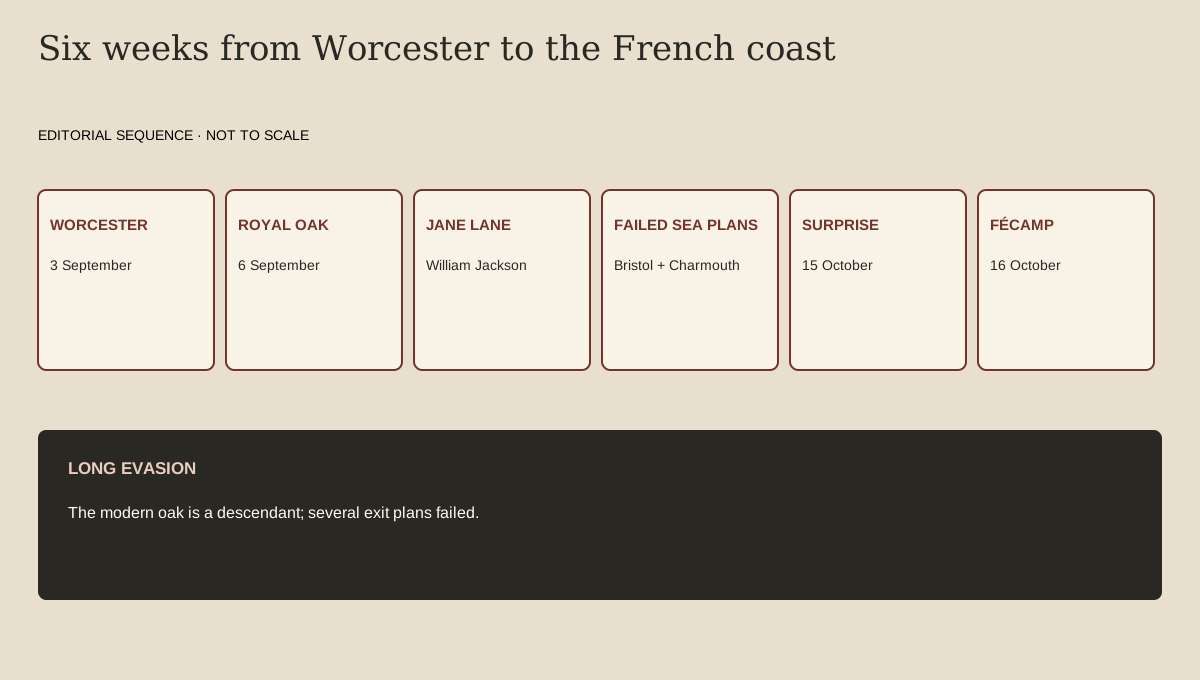
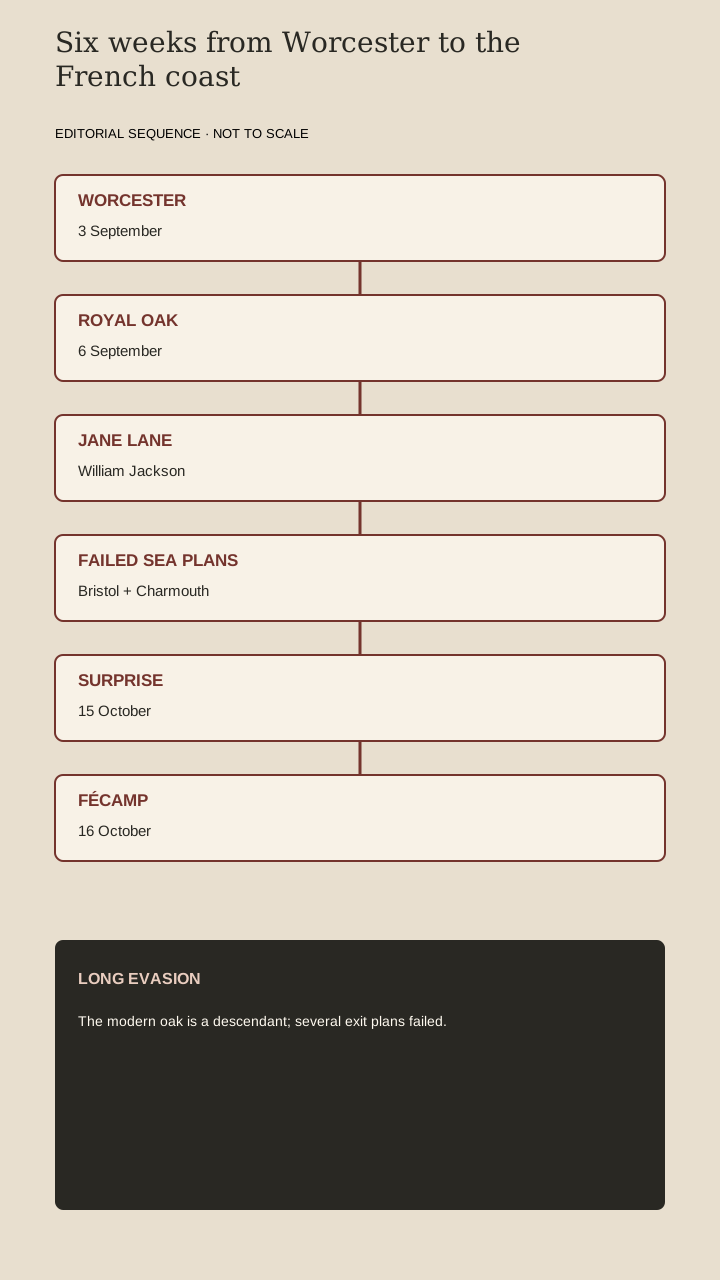
Simplified editorial reconstruction; not to scale. See adjacent text for evidence qualifications and unresolved details.
Material evidence
Tools of Escape
The objects used in an escape reveal how a plan worked under constraint.
- 01The disguise reduced the visual gap between a nationally hunted king and the rural people among whom he needed to move.
Country disguise
At White Ladies Charles exchanged conspicuous royal clothing for rough green breeches, leather doublet, coarse shirt, old grey hat, and a shortened hairstyle.
- 02The same culture that had produced priest holes and discreet movement of clergy could conceal a fugitive whose discovery endangered every helper.
Recusant safe-house network
Catholic households around White Ladies, Boscobel, and Moseley had trusted family and servant networks shaped by years of religious surveillance.
- 03They provided emergency concealment when houses themselves came under suspicion or search.
Priest holes
Boscobel and Moseley contained concealed spaces originally associated with protecting Catholic clergy.
- 04The pass converted Charles from an unauthorized fugitive into an apparently ordinary member of a legitimate traveling household.
Jane Lane's travel pass
Jane Lane already held permission to travel toward the Bristol area with a servant and companions.
- 05The alias made the servant role administratively and socially coherent instead of relying only on clothing.
Alias 'William Jackson'
Charles traveled as Jane Lane's manservant under an assumed name.
- 06The network did not force one disguise to survive six weeks; it repeatedly rebuilt Charles's apparent identity to fit the next route.
Rotating cover stories
Later stages used different stories suitable to different journeys, including the Charmouth party's supposed private romantic journey and a final coastal voyage arranged for men of quality.
- 07Its ordinary commercial appearance made it a more plausible final escape platform than an obviously Royalist or foreign ship.
Surprise
A small coal vessel mastered by Nicholas Tettersell and employed in coastal trade.
Problem → response
Escape was a sequence of problems
Each response solved a practical obstacle while often creating the next one.
- 01→
Obstacle
A defeated army too large to hide
Charles initially fled Worcester amid hundreds of Royalist survivors, a body that could be tracked and could not defeat the pursuing Parliamentarian forces.
Response
The party reduced itself until Charles could enter a covert civilian network rather than continue as a military column.
- 02→
Obstacle
Guarded Severn crossings
The first plan depended on entering Wales, but the river crossings near Madeley were watched.
Response
Charles and Richard Penderel abandoned the westward plan and returned toward Boscobel.
- 03→
Obstacle
Parliamentarian searches around Boscobel
Soldiers were actively searching the woods and nearby refuges after Worcester.
Response
Charles and William Careless chose the elevated concealment of a thick pollarded oak rather than remain visibly inside the house or on the woodland floor.
- 04→
Obstacle
Need to travel long distance on public roads
Remaining in Shropshire indefinitely increased the chance that the network would be compromised, but open travel exposed Charles to inns, servants, soldiers, and checkpoints.
Response
Jane Lane's pass, the William Jackson alias, and a servant's social role created a plausible reason for movement.
- 05→
Obstacle
No usable Bristol passage
The first major maritime search after the Lane journey did not produce a ship capable of taking Charles safely to France.
Response
The network moved him to Trent Manor and opened a second coastal search in Dorset.
- 06→
Obstacle
Charmouth boatman fails to appear
Stephen Limbry did not arrive for the planned September 22 departure, for reasons that differ across surviving accounts.
Response
The party abandoned the immediate sea attempt and moved inland rather than wait at a compromised coastal location.
- 07→
Obstacle
Parliamentarian soldiers at Bridport
The escape party entered a town crowded with troops when its maritime cover had already failed.
Response
They maintained their cover long enough to pass through and then continued away from the coast.
- 08→
Obstacle
Final vessel master can recognize Charles
Later accounts indicate that Nicholas Tettersell recognized the supposedly anonymous passenger before the Channel crossing.
Response
Rather than betray him, Tettersell accepted the risk and completed the covert voyage after financial and logistical terms were settled.
The final accounting
Outcome
Principal fugitive reached France
Charles landed at Fécamp on October 16 and continued into exile.
Successful final maritime departure
The Shoreham departure aboard Surprise succeeded after earlier Bristol and Charmouth plans failed.
Major failed sea-exit plans before Shoreham
A Bristol-area ship search produced no workable passage, and the Charmouth rendezvous failed when Limbry did not appear.
Capture of Charles during the six-week flight
Despite a £1,000 reward and repeated searches, the fugitive network carried Charles to the Channel without his arrest.
Evidence discipline
What the record supports
Status labels distinguish secure conclusions from uncertainty and rejected claims. Color is never the only signal.
MYTH
The Royal Oak episode was invented after the Restoration.
Charles himself dictated to Samuel Pepys in 1680 that he and William Careless spent the day in a thick pollarded oak and saw soldiers searching the surrounding woods. The account is retrospective, but the tree concealment is not merely a later Victorian invention.
Sources: SRC-001, SRC-004, SRC-005MYTH
The tree standing at Boscobel today is the exact oak Charles climbed in 1651.
The current celebrated Royal Oak is identified as a descendant of the original tree. The historical landscape preserves the tradition, not the same living trunk.
Sources: SRC-002, SRC-018MYTH
Charles escaped after Worcester largely by himself.
The flight depended on a large and changing network: the Penderels, William Careless, Thomas Whitgreave, John Huddleston, Henry Wilmot, the Lane family, the Wyndhams, Juliana Coningsby, Robert Phelips, George Gunter, Francis Mansell, Nicholas Tettersell, and others.
Sources: SRC-004, SRC-005, SRC-007, SRC-013MYTH
Charles used one disguise and one false identity for the entire six weeks.
His appearance and cover changed repeatedly. He first became a rough countryman near White Ladies, later traveled as Jane Lane's servant William Jackson, and used different social cover stories during the Dorset and Sussex stages.
Sources: SRC-001, SRC-007, SRC-006MYTH
Charles sailed directly from Bristol after traveling there with Jane Lane.
The Bristol-area plan failed. Charles moved to Trent, tried and failed to leave near Charmouth, returned inland, and only escaped weeks later from Shoreham.
Sources: SRC-007, SRC-020, SRC-019MYTH
Jane Lane personally accompanied Charles through the entire six-week flight and onto the ship to France.
Lane's travel pass and servant cover were crucial for the movement toward Bristol and onward toward Trent, but later stages depended on a different network and she was not part of the final Shoreham crossing.
Sources: SRC-007, SRC-008, SRC-005DISPUTED
Stephen Limbry failed to appear at Charmouth because his wife definitely locked him in a bedroom.
The locked-room story became popular, but Pepys's collected source tradition and later comparisons preserve conflicting explanations, including problems over payment or agreement. The secure fact is that Limbry did not appear; the exact reason is unresolved.
Sources: SRC-005, SRC-006, SRC-019MYTH
The final vessel Surprise sailed openly from Shoreham on a declared voyage to France.
The final arrangement used the cover of an ordinary coastal coal voyage. The vessel's course was then changed toward France, reducing the chance that the departure itself would advertise an escape.
Sources: SRC-006, SRC-012, SRC-019LATER CLAIM
Every famous close-call conversation in the escape can be treated as verbatim dialogue.
The documentary base is unusually rich, but many accounts were dictated or written years later and Restoration storytelling rewarded memorable dialogue. Exact quotations should be used only when their source and retrospective status are explicit.
Sources: SRC-004, SRC-005, SRC-010MYTH
The entire six-week route can be plotted as one exact modern GPS trail.
The major stops are well established, but road alignments, local tracks, nighttime detours, and some intermediate staging points remain uncertain. Modern Monarch's Way and commemorative routes are interpretive descendants, not exact seventeenth-century tracks.
Sources: SRC-014, SRC-019Selected chronology
Selected chronology
Battle of Worcester
Charles's army is decisively defeated and he leaves Worcester with a mounted Royalist party.
White Ladies
Roughly sixty Royalists reach White Ladies; Charles dismisses most companions, changes into country clothes, cuts his hair, and begins hiding with the Penderel network.
Spring Coppice
Charles spends the day concealed while he and Richard Penderel consider the plan to cross the Severn into Wales.
Madeley plan fails
Charles and Richard discover that Severn crossings are guarded and abandon the Welsh route.
The Royal Oak
Charles and William Careless hide for the day in a pollarded oak near Boscobel while soldiers search the woods.
Boscobel to Moseley
After further concealment at Boscobel, Charles leaves under Penderel guidance for Moseley Old Hall.
Moseley Old Hall
Thomas Whitgreave and Father John Huddleston shelter Charles; the house's concealed spaces provide a fallback during searches.
Jane Lane and William Jackson
Charles leaves Bentley Hall disguised as Jane Lane's servant, using the alias William Jackson and traveling under the protection of her legitimate pass.
Bristol-area plan fails
The party stays near Bristol while supporters search for a ship, but no practical passage to France can be secured.
Trent Manor
Charles reaches Francis Wyndham's house near Sherborne, which becomes the base for a new maritime plan.
Charmouth
Charles travels toward Charmouth under a cover story involving Wilmot and Juliana Coningsby, but the expected boatman Stephen Limbry does not appear.
Bridport and Broadwindsor
The failed sea party moves through an area crowded with Parliamentarian soldiers and then retreats inland rather than attempt another immediate coastal departure.
Back to Trent
Charles returns to Trent and remains concealed while the network searches for a safer exit.
Heale House
Charles moves to Heale near Salisbury, bringing the fugitive closer to a possible southern-coast departure.
Concealment at Heale
Later accounts place Charles briefly outside the house, including a visit to Stonehenge, before he returns secretly while the Sussex plan develops.
Brighthelmstone
Charles reaches the Brighton area, where George Gunter's network finalizes arrangements with the master of a small coal vessel.
Shoreham
Charles and Wilmot board the Surprise near Shoreham. The vessel sails under a coastal cover and then turns south for France.
Fécamp
Charles lands in France and proceeds toward Rouen and Paris, ending the six-week flight from Worcester.