
How Billy the Kid Escaped the Lincoln County Courthouse in 1881
On April 28, 1881, Billy the Kid was a condemned prisoner inside the Lincoln County Courthouse in New Mexico Territory. His execution had been set for May. He was guarded under heavy restraint in an upstairs portion of a building that was not designed as a modern jail. Sheriff Pat Garrett, the man who had captured him months earlier, was away from Lincoln.
By the end of the day, two guards—James W. Bell and Robert Olinger—were dead, Billy was free of the courthouse, and one of the most famous manhunts in Western history had begun again.
The broad sequence of the escape is well established. The most famous detail is not.
Historians still cannot say with certainty how Billy obtained the first revolver.
That uncertainty matters because it changes the mechanics of the escape. Did he exploit the courthouse layout to reach an inadequately secured weapon? Did he overpower Bell and take the deputy’s gun? Had someone hidden a weapon for him outside? Each version has appeared in the story. The earliest detailed published account itself admitted that evidence for those first moments was limited.
What can be reconstructed is a sudden failure of security built from routine, divided supervision, accessible weapons, and a prisoner with almost nothing left to lose.
A Death Sentence in a Courthouse That Had Become a Jail
Billy the Kid reached the Lincoln courthouse after a long cycle of violence, arrests, escapes, and fugitive life in the New Mexico Territory.
His most important legal problem came from the Lincoln County War, the violent struggle that had erupted in 1878 among rival economic and political factions. Billy had ridden with the Regulators, a group originally organized under color of local authority after the killing of English rancher John Tunstall. As the conflict escalated, distinctions among lawmen, posses, gunmen, and outlaws became increasingly tangled.
On April 1, 1878, Sheriff William Brady and Deputy George Hindman were ambushed and killed in Lincoln. Billy was among the Regulators involved. Years later, that killing produced the conviction that put him on the path to the gallows.
Sheriff Pat Garrett captured Billy and several companions in December 1880 after pursuing them through eastern New Mexico. Billy was eventually taken south for trial. In April 1881 he was convicted of first-degree murder for Brady’s death and sentenced to hang on May 13.
He was then returned to Lincoln.
The building used to hold him was itself part of the history of the Lincoln County War. Before becoming the county courthouse, it had been associated with the Murphy-Dolan commercial interests at the heart of one side of the conflict. New Mexico Historic Sites describes the surviving structure as having served at different times as store, residence, Masonic lodge, courthouse, and jail.
That last function is the important one for the escape.
This was not a purpose-built high-security prison with isolated cells, layered locked corridors, and a dedicated armory removed from prisoner movement. Billy was held upstairs and physically restrained, while guards controlled his movements inside a mixed-use public building.
The system depended heavily on the men watching him.

Material evidence
Weapons, restraints and escape means
The objects used in an escape reveal how a plan worked under constraint.
- 01Critical; obtaining the first firearm broke the guard system.
Revolver
The first firearm used in the escape. Its exact source is disputed among an upstairs armory, Bell’s possession, and a later hidden-gun tradition.
- 02Allowed Billy to stop Olinger’s return and control the immediate approach to the courthouse.
Robert Olinger’s double-barreled shotgun
A shotgun kept inside the courthouse and taken by Billy after Bell was shot.
- 03Converted armed control of the courthouse into physical mobility.
Pickax / miner’s pick
Tool used in later institutional reconstructions to describe how Billy removed or broke his leg restraints.
- 04Provided the mobility needed to turn the jailbreak into a successful flight from town.
Horse
Billy left Lincoln on horseback after his restraints were removed.
The Guard Routine Creates an Opening
Billy’s immediate guards were James W. Bell and Robert Olinger.
Bell was a Lincoln County deputy sheriff. Olinger is listed by the U.S. Marshals Service among its fallen personnel in the District of New Mexico and is generally described as a deputy U.S. marshal; local histories also connect him closely with Lincoln County law enforcement.
Later retellings often turn Olinger into a theatrical tormentor who repeatedly taunted Billy with a shotgun. Some version of hostility between the two men may well have existed, but the most colorful dialogue belongs to the tradition that grew around the case and should not be treated as verified transcript.
What is secure is the guard arrangement on April 28.
Pat Garrett was away from Lincoln on county business. At some point while the other prisoners were being taken across the street for a meal, Olinger left the courthouse with them. Bell remained behind with Billy.
For a prisoner awaiting execution, the significance was obvious: two guards had become one. Billy asked Bell to accompany him downstairs and outside, usually described as a request to use the privy behind the courthouse. Bell agreed. That ordinary movement—from upstairs confinement to an outdoor necessity and back—became the opening around which the entire escape turned.
Escape sequence
A documented escape with one disputed hinge
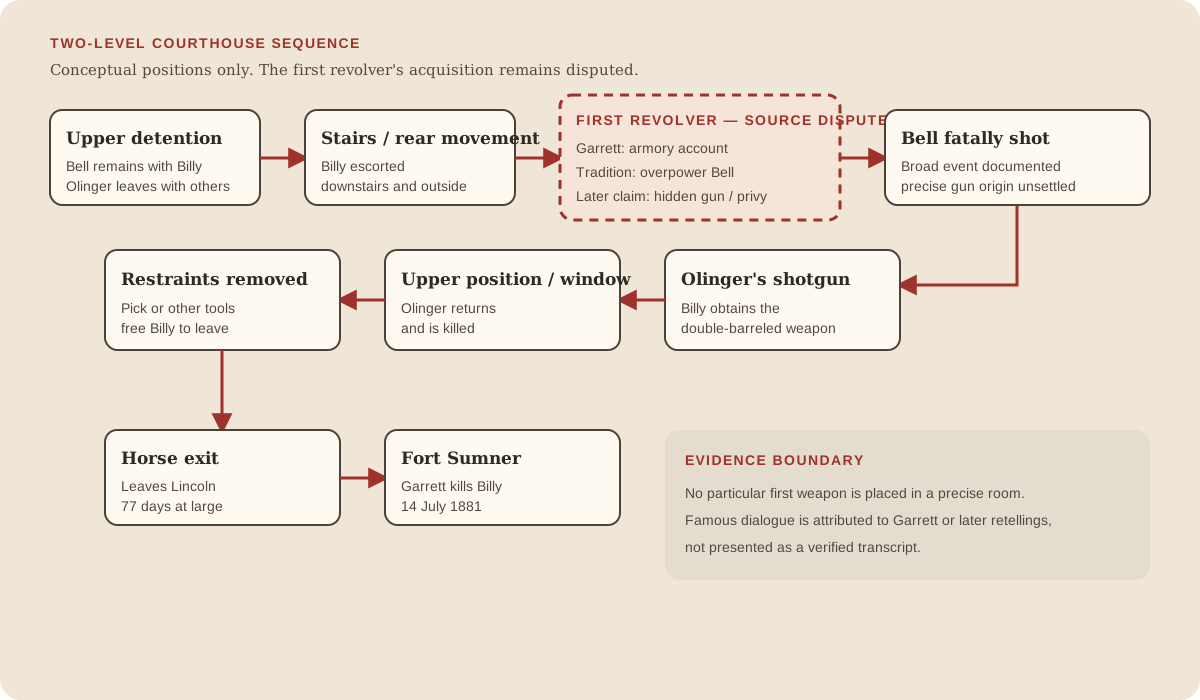
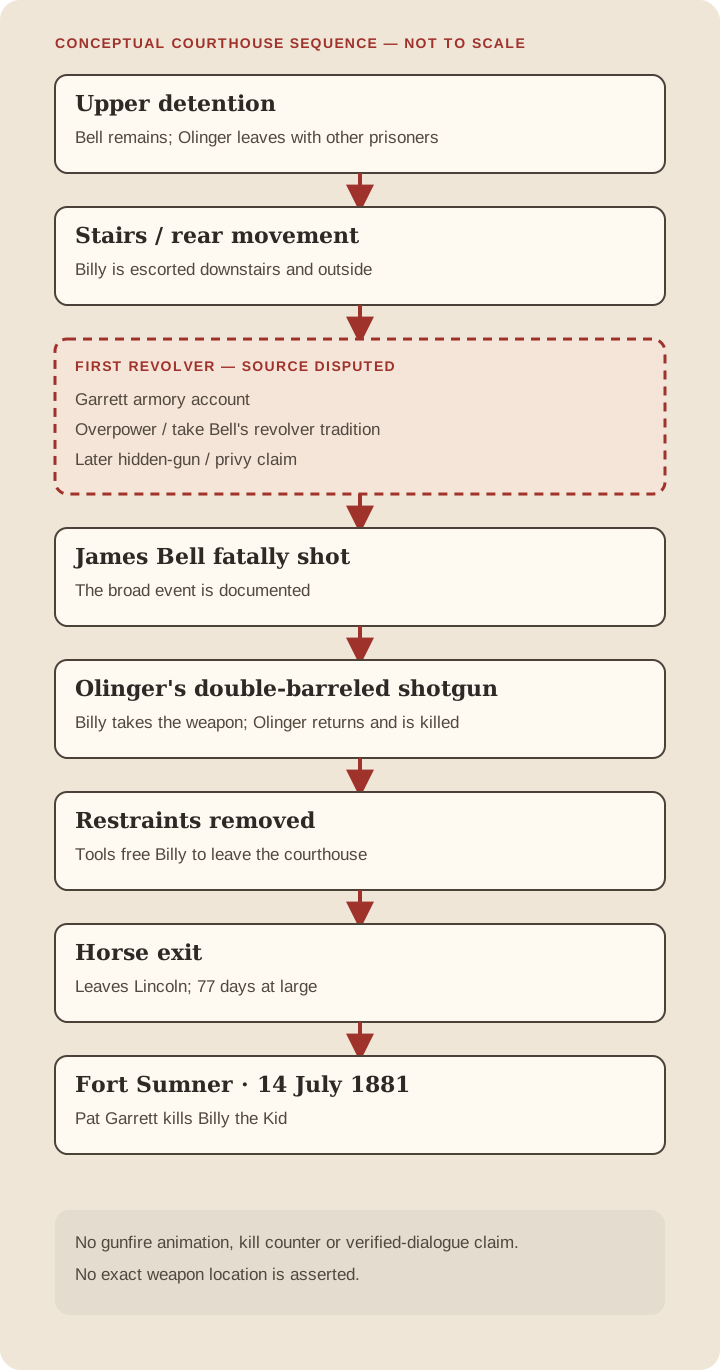
The broad sequence is secure. How Billy obtained the first revolver is not, so the diagram keeps three source traditions visible instead of choosing one.
- 01
Guard routine
Olinger left with other prisoners while Bell remained with Billy.
- 02
Movement
Bell escorted Billy downstairs and outside.
- 03
First revolver
Armory, overpowering and hidden-gun accounts remain in conflict.
- 04
Firearms
Bell was fatally shot; Billy then obtained Olinger's shotgun and killed him on return.
- 05
Exit
After removing restraints, Billy left on horseback and remained free for 77 days.
Simplified editorial schematic; not to scale. No specific first weapon is placed in a precise room, and reported dialogue is not treated as a verified transcript.
The Most Important Question Has No Certain Answer
The next few minutes are where evidence and legend separate.
Pat Garrett published a detailed account of Billy’s life in 1882. Garrett was not in Lincoln during the escape, and the book was ghostwritten with journalist Ash Upson. It is therefore neither an eyewitness transcript nor a neutral court record. Yet it remains unusually important because it was published only a year after the event and because Garrett said his reconstruction drew on what could be learned from people present and from Billy’s own statements.
Garrett also did something valuable: he admitted the limits of the evidence.
In his version, Bell escorted Billy downstairs and into the rear area. On the return, Bell allowed Billy to move ahead. Billy reached the top of the stairs, forced his way into a room used as an armory, seized a revolver, returned to the stairhead, and fired as Bell came into view.
That is one plausible reconstruction. It is not the only one.
Other accounts say Billy slipped one of his small hands from the cuffs, struck Bell with the irons, grappled with him, and took the deputy’s revolver. A different tradition says someone friendly to Billy had hidden a gun in or near the privy, allowing him to retrieve it while outside.
Modern institutional summaries often avoid deciding among these versions. PBS, for example, describes Billy as gaining possession of Bell’s gun or simply gaining a gun during the trip without resolving every mechanical detail.
The safest conclusion is therefore narrower:
Billy returned from the downstairs/outdoor trip with Bell and, before Bell could regain full control, obtained a revolver. Exactly how he obtained it is disputed.
That distinction is not pedantic. It is the difference between an escape built around an unsecured armory, one built around physically overpowering a guard, and one built around outside assistance.
The surviving evidence does not justify pretending that historians know which happened.
James Bell Runs for the Door
Whatever the precise origin of the revolver, Bell was soon trying to escape the confrontation.
The early Garrett account places Billy near the top of the stairway and Bell below him. Billy fired. Bell was wounded, made it toward the yard, and died.
Later accounts add a struggle before the shot, sometimes describing blows from handcuffs and sometimes saying Billy took Bell’s revolver. Those details should remain qualified. The essential fact does not depend on them: Bell was fatally shot during Billy’s attempt to break custody.
Bell’s death changed the problem immediately.
The escape was no longer an attempt to quietly slip away from one guard before the other returned. A gunshot could summon Olinger, townspeople, or both. Billy was still inside the courthouse, and at least his leg restraints were still a serious obstacle.
He needed control of the building for long enough to finish the escape. Inside the courthouse was the weapon that gave him that control.
Billy Takes Olinger’s Shotgun
Billy obtained Robert Olinger’s double-barreled shotgun from inside the courthouse.
The weapon appears consistently across the major accounts. PBS identifies it as a 10-gauge shotgun. Garrett described it as a fine breech-loading double-barreled gun that belonged to Olinger and had been loaded in Billy’s presence.
The exact loading details became part of the story’s later gruesome mythology, and Garrett’s own chapter is not perfectly consistent about the number of buckshot. There is no need to repeat those numbers to understand what happened.
The important point is simpler: the second guard’s powerful firearm had been left inside the building that contained the prisoner. Billy now had it. From an upper-floor position he could watch the approach from across the street. Olinger, learning that something had happened at the courthouse, came back.
Olinger Returns
Garrett’s account preserves a short exchange between Billy and Olinger before the shooting. Later books and films have expanded that moment into some of the most famous dialogue in the Billy the Kid legend.
The safest way to treat it is as an early reported tradition rather than a recording. What is not in serious dispute is the physical outcome.
Olinger returned toward the courthouse. Billy was above him with Olinger’s own shotgun. Billy fired and killed him.
The second guard was now dead. The same courthouse that had functioned as Billy’s jail had supplied the means to dominate the immediate area long enough for him to work on the final barrier: his restraints.
The Shackles Still Had to Come Off
Even after Bell and Olinger had been killed, Billy was not yet free to ride away.
He had been heavily restrained. Institutional summaries and local historical interpretation describe him using a pickax or miner’s pick to break or knock apart the leg irons.
The exact handling of the restraints differs in retellings, but the larger point is well supported. Billy had to convert an armed break in custody into physical mobility.
That took time.
Later accounts say he remained around the courthouse for a substantial interval while the irons were removed and a horse was prepared. This is another reason the event should not be reduced to a thirty-second gunfight. The shootings were rapid. The complete escape was a sequence.
He still had to get out of Lincoln.
A Horse and the Road Out of Town
Billy eventually mounted a horse and left Lincoln.
Garrett’s account says the horse later returned dragging a rope and that Billy was subsequently heard of elsewhere in the region. Other retellings embellish his departure with singing, cheering, balcony performances, or triumphant speeches.
Those flourishes are part of the legend, not the secure core of the escape. What matters is that no organized force in Lincoln stopped him before he could ride away.
The guard routine had split. Bell had been killed. Olinger had been killed with his own weapon. The prisoner’s restraints had been removed. The courthouse and nearby street were no longer functioning as a controlled detention space.
Billy the Kid was once again a fugitive.
Problem → response
Escape was a sequence of problems
Each response solved a practical obstacle while often creating the next one.
- 01→
Obstacle
Death-row restraints
Billy was kept in hand and leg restraints while awaiting execution.
Response
He exploited permitted movement and later removed or broke his remaining leg irons.
- 02→
Obstacle
Two dedicated guards
Bell and Olinger were assigned to watch the condemned prisoner.
Response
Billy acted when Olinger was across the street and Bell was the only guard immediately present.
- 03→
Obstacle
Second guard returning
Gunfire risked bringing Olinger back before Billy could escape.
Response
Billy obtained Olinger’s shotgun and used the upper-floor position to stop his return.
- 04→
Obstacle
Need to leave town quickly
Even after gaining control of the courthouse, Billy needed transport before a larger response formed.
Response
He acquired a horse and rode out of Lincoln.
Why the Escape Worked
The Lincoln courthouse escape was not an engineering feat. Billy did not tunnel through masonry, forge papers, construct a ladder, or spend months building a secret exit.
It worked because several weaknesses aligned at once.
The guards separated
The strongest immediate security advantage was two armed guards. When Olinger left with the other prisoners, Billy briefly faced only Bell.
Prisoner movement was unavoidable
Billy could not remain chained in one upstairs position every minute of every day. Bell had to escort him downstairs and outside for basic needs. That movement opened a route through the building.
Weapons were accessible inside the detention environment
Whatever the truth about the first revolver, the second weapon is much less uncertain. Olinger’s shotgun was inside the courthouse and available to Billy once Bell was out of the fight.
The building was not designed as a modern high-security jail
The courthouse had earlier commercial and residential uses. Its mixed interior spaces, stairs, windows, offices, and weapon storage created vulnerabilities very different from those of a purpose-built prison.
Billy acted during a brief routine opportunity
The escape did not require every part of the system to fail all day. It required a narrow window in which Garrett was away, Olinger was across the street, Bell was alone with the prisoner, and Billy could move through the building.
The result was devastatingly effective.

Evidence discipline
What the record supports
Status labels distinguish secure conclusions from uncertainty and rejected claims. Color is never the only signal.
DISPUTED
Billy obtained the first revolver by breaking into an upstairs armory.
Pat Garrett’s 1882 account gives this reconstruction but admits that evidence for the opening moments was sparse. Later accounts instead say Billy took Bell’s revolver or recovered a hidden weapon.
Sources: SRC-004, SRC-005, SRC-006, SRC-017LATER CLAIM
A confederate hid a gun for Billy in or near the privy.
The hidden-gun version is prominent in later retellings but is not established by the strongest institutional or near-contemporary sources.
Sources: SRC-017LATER CLAIM
Billy and Olinger exchanged the exact famous lines commonly quoted in popular histories.
Garrett’s 1882 book reports a short exchange, but exact wording cannot be independently verified and later retellings expanded the dialogue.
Sources: SRC-004, SRC-003LATER CLAIM
Billy theatrically sang, danced, or delivered a triumphant performance before leaving Lincoln.
These details belong primarily to later storytelling and should not be presented as secure historical fact.
Sources: SRC-003, SRC-017MYTH
Billy the Kid killed 21 men by age 21.
The famous number was amplified by newspapers and legend; the Library of Congress notes that the actual number directly attributable to him was considerably lower.
Sources: SRC-002, SRC-003What We Know—and What the Legend Added
Billy the Kid became a legend so quickly that even accounts written close to his lifetime have to be read carefully.
Documented: the date and place
The Library of Congress, New Mexico archival resources, and New Mexico Historic Sites all place the courthouse escape in Lincoln on April 28, 1881.
Documented: Bell and Olinger were killed
Both men are independently recorded as having died on April 28, 1881. Olinger appears in the U.S. Marshals Service roll call. Bell is recorded by law-enforcement memorial sources as a Lincoln County deputy sheriff.
Documented: Billy escaped
The New Mexico State Records Center and Archives specifically identifies a sheriff’s certificate of Billy’s escape among the surviving Lincoln County records.
Disputed: the first revolver
This is the central unresolved mechanism. Garrett’s armory version, the Bell’s-revolver version, and the hidden-gun tradition cannot all be literally correct in their full detail.
Later claim: the exact dialogue
Garrett’s book preserves a short exchange. Later tellings elaborated it. The event is credible at the level of “words were reportedly exchanged”; exact dramatic wording should be treated cautiously.
Later claim: Billy’s theatrical departure
Stories of singing, dancing, speeches, cheers, or deliberate showmanship as Billy departed are difficult to secure and should not be used as narrative fact without qualification.
Myth: 21 killings by age 21
The famous number became part of Billy’s legend, but it is not supported by careful historical accounting. Even the Library of Congress notes that the real number directly attributable to him was considerably lower.
Garrett Comes Back to an Empty Jail
Garrett was not present for the escape.
In his later account he wrote that he had left Lincoln on county business and received news of the escape afterward. He returned and resumed efforts to find Billy.
The jailbreak therefore became a personal and professional reversal for the sheriff. He had captured Billy in December 1880, delivered him into the legal process, and seen him sentenced to death. Now the prisoner was back at large after killing two law officers.
The escape also made Billy more famous.
Newspapers had already been turning him into a recognizable outlaw figure. The courthouse killings and escape supplied exactly the kind of story that traveled quickly: condemned prisoner, two dead guards, stolen weapons, dramatic flight, renewed manhunt.
The distinction between report and legend began narrowing almost immediately.
Seventy-Seven More Days
The courthouse escape bought Billy time, not a permanent disappearance. He remained free for 77 days.
On July 14, 1881, Pat Garrett found him at Fort Sumner. Garrett shot and killed Billy in the Maxwell house shortly before midnight. Billy’s death became almost as mythologized as the courthouse escape, producing later survival claims that have never displaced the established historical conclusion that he died in 1881.
The important endpoint is not the later mythology but what the 77-day interval reveals about April 28.
The escape succeeded in its immediate objective. Billy avoided the scheduled hanging, got out of Lincoln, and remained beyond custody for more than two months.
But it also left two men dead and made peaceful resolution almost impossible.
The Courthouse Still Makes the Escape Legible
Lincoln is unusual among famous escape sites because much of the historic environment survives.
The Old Lincoln County Courthouse remains part of Lincoln Historic Site. The New Mexico Department of Cultural Affairs describes the structure as a surviving building associated with the Lincoln County War and as the location of Billy the Kid’s violent final escape.
That physical survival is important. Visitors can understand why the case is spatial rather than merely biographical: an upstairs holding area; a stair route; a rear outdoor movement; weapons kept in the same general building; an upper-floor view toward the street; a second guard returning from across the way.
The story does not need invented suspense. The architecture supplies the logic.
Billy needed one guard separated from the other. He needed access to a weapon. He needed to stop the second guard from re-establishing control. He needed to remove his restraints. He needed a horse.
On April 28, 1881, every one of those problems was solved in sequence. The only major part historians still cannot reconstruct with confidence is the moment that made the rest possible: where the first gun came from. That uncertainty is not a weakness in the history. It is the most honest way to tell it.
Selected chronology
Capture, courthouse escape and final pursuit
Billy is captured
Pat Garrett’s posse captures Billy and surviving companions after the Stinking Springs confrontation.
Convicted and sentenced
Billy is convicted for Sheriff William Brady’s killing and sentenced to hang on May 13.
Lincoln courthouse escape
Billy escapes after James Bell and Robert Olinger are killed.
Billy is killed at Fort Sumner
Pat Garrett shoots and kills Billy at the Maxwell house, 77 days after the courthouse escape.