
In the last week of 1912, Francisco “Pancho” Villa was not yet the commander whose cavalry armies would make him one of the most famous figures of the Mexican Revolution. He was a prisoner in Mexico City, caught between a military prosecution that seemed to be going nowhere and powerful enemies who had already come close to killing him.
His way out did not begin with dynamite, a mass breakout or a gun battle at the gates. It began with access.
Carlos Jáuregui, a young clerk working in the military judicial offices at Santiago Tlatelolco, could move through administrative space that Villa could not. The barred division between prisoner and court employee was therefore not simply a barrier. It was also the point where an insider could prepare an opening.
Later accounts describe Villa entering the court area in late December 1912, probably on the 26 December date used by INEHRM’s dedicated chronology, forcing apart a weakened iron bar, changing into civilian clothes and walking out with Jáuregui before the prison understood what had happened. Once outside Mexico City, the problem changed completely. The fugitive no longer had to defeat a prison. He had to stay ahead of the search long enough to cross an international border.
He did.
Within days Villa was in the United States. Within months he was back in Mexico at war with Victoriano Huerta—the same general whose order had nearly ended Villa’s life before the prison sentence ever began.
From battlefield ally to condemned prisoner
Villa’s imprisonment grew out of one of the Mexican Revolution’s shifting alliances.
Francisco I. Madero had helped bring down the long rule of Porfirio Díaz in 1911, but his new government quickly faced rebellions from former revolutionary allies. In 1912, Pascual Orozco rose against Madero in northern Mexico. Villa remained loyal to the president and returned to military service against the Orozquistas.
That put him under the broader federal command of General Victoriano Huerta.
The relationship was combustible. Villa was an irregular revolutionary commander with his own following and habits; Huerta was a professional officer of the old federal army. Mexican archival and institutional accounts describe a confrontation that grew out of disputes within the campaign, including an argument connected to a confiscated horse and accusations of insubordination.
On 4 June 1912, Villa was arrested. The episode nearly became an execution rather than an imprisonment. Mexico’s National Institute of Historical Studies of the Revolutions of Mexico records that Huerta ordered Villa shot without a completed judicial process. Officers intervened, as did Raúl Madero, the president’s brother. President Madero ultimately ordered that the execution not proceed.
A U.S. consular telegram the following day independently reported the essential fact: Huerta had arrested Villa and was sending him to Mexico City for trial.
Villa had survived the firing squad. He had not regained his freedom.
Months inside Lecumberri
Villa reached Mexico City on 7 June. He was confined in the Penitenciaría de México, better known as Lecumberri, the imposing prison later remembered as the “Black Palace.”
The charges were broader than a single act of insubordination. The archival record summarized by Mexico’s Archivo General de la Nación includes accusations of insubordination and disobedience, along with theft and alleged unlawful seizures connected to Villa’s wartime conduct in Chihuahua.
Villa protested that his actions had been part of military and revolutionary service. He also continued to believe that Madero might intervene.
His months in confinement mattered in ways that later legend sometimes distorts. Villa did work on his writing and spelling while imprisoned, corresponded with the president and encountered other political prisoners. But the popular line that prison simply “taught Pancho Villa to read” is too neat. The evidence supports improvement in his written communication and sustained study, not a clean transformation from complete illiteracy to literacy inside a single cell.
More important for the escape was a change of prison.
Villa and his defenders pushed for a transfer. On 7 November 1912, he was moved from Lecumberri to the military prison at Santiago Tlatelolco.
That distinction is essential. Villa’s famous 1912 breakout was not an escape from Lecumberri. Lecumberri was where he spent much of his confinement. Santiago Tlatelolco was where he got out.

Carlos Jáuregui and the weak point in the prison
At Santiago Tlatelolco, Villa came into contact with Carlos Jáuregui.
Jáuregui is sometimes described in English-language retellings as Villa’s lawyer. Mexican accounts are more specific: he was an escribiente, a clerk attached to the military court. That role explains why he mattered.
Martín Luis Guzmán later published an account based on what he said Jáuregui had told him. In it, the young clerk worked beside a barred partition through which prisoners appeared before court personnel. Villa could approach the grille from the prisoner side; Jáuregui occupied the office side.
Villa’s later memoir tradition describes the escape plan developing around that physical relationship. A bar was weakened in advance. Jáuregui prepared clothing on the administrative side. Villa would cross at the point where the prison and the court met, then try to become, visually, someone who belonged outside the cells.
The broad mechanism is well supported by intersecting later accounts. The exact conversations are not.
That distinction matters because Villa became a legendary figure during his own lifetime. Stories attached themselves to him easily, and later memoirs often turn complicated events into clean scenes with perfect dialogue. The surviving evidence supports a simple reconstruction: Jáuregui had insider access; a bar at the court grille was prepared; clothing was waiting; and Villa used the administrative side of the prison as his exit path.
The escape
INEHRM’s dedicated Villa chronology dates the breakout to 26 December 1912. A separate INEHRM institutional article says 25 December, so even the official institutional record is not perfectly uniform.
In Villa’s later account, he entered the courtroom area and found Jáuregui ready. He forced the prepared bar far enough aside to squeeze through the grille. On the other side, Jáuregui had an overcoat, a dark bowler-style hat and dark glasses.
Those details transformed Villa’s appearance, but the disguise worked for another reason: the two men were now moving through a space associated with clerks, officials and visitors rather than prisoners.
Later retellings add that Villa had shaved his moustache, held a handkerchief to his face or was passed off as a doctor. Those details are possible, but they are less securely anchored than the core disguise and are not required to explain the mechanism.
The central achievement was quieter. Villa crossed the internal barrier, adopted civilian appearance and passed out before an alarm closed the route.
There is also a third date. A 1966 speech preserved in the records of Mexico’s Chamber of Deputies says the escape occurred on 24 December. Because that recollection came more than fifty years after the event, it carries less weight than INEHRM’s dedicated chronology. But the separate INEHRM article’s 25 December date means the conflict cannot be reduced to “official 26 versus later 24.” The evidence places the escape in late December 1912, with 26 December preferred when a single operational date is required, while the 25 and 24 December alternatives remain part of the source record.
Getting out of Mexico City was only the first escape
Leaving the prison did not mean Villa was safe.
An automobile was arranged to move the fugitives away from the capital. Later accounts place their first major destination at Toluca, west of Mexico City. From there, Villa and Jáuregui moved through a chain of rail and overland connections across central and western Mexico rather than heading directly north from the capital.
The most detailed route survives in later recollection and should be treated accordingly. It traces movement through places including Toluca, Acámbaro, Irapuato and Guadalajara, then toward the Pacific, with onward travel through the northwest and into the United States. Villa’s own memoir tradition places him in Mazatlán during the flight.
The route mattered because it bought time. A direct run from Mexico City toward Chihuahua or the nearest northern crossing would have been predictable. Moving west before turning north created distance from the capital and allowed the escapees to use Mexico’s transportation network before orders and descriptions could catch up with them.
There were risks at every stage: stations, checkpoints, tickets, hotels, public streets and the possibility that somebody would recognize one of the most famous revolutionaries in the country. But the alarm never closed the net in time. INEHRM records Villa in El Paso, Texas, on 4 January 1913—only nine days after the official escape date.
Why it worked
Villa’s breakout succeeded because several modest advantages combined at exactly the right point.
An insider changed the geometry of the prison. Jáuregui did not have to defeat the entire security system. He only had to make one judicial-administrative boundary penetrable.
The escape targeted identity as much as confinement. Once Villa crossed the grille, the overcoat, hat and glasses helped turn a conspicuous prisoner into a civilian figure moving through office space.
The alarm lagged behind the fugitives. They left by vehicle and continued moving. Every hour before authorities understood the route widened the search area.
The flight was not a straight line. Later accounts describe a long western arc before the fugitives reached the U.S. border. Whether every remembered stop is exact or not, the strategic principle is clear: Villa did not remain near the capital waiting for pursuit.
The escape was therefore less a feat of brute force than a chain of access, disguise, timing and movement.
The prison escape that changed the Revolution
Villa reached the United States at a moment when Mexican politics were about to collapse again.
In February 1913, a military uprising in Mexico City became the Decena Trágica. Madero was overthrown, and Huerta emerged at the head of the government. Madero and Vice President José María Pino Suárez were murdered.
For Villa, the political meaning of exile changed immediately. He no longer had to decide how to reconcile himself with Madero’s government. The president to whom he had remained loyal was dead, and Huerta—his old military enemy—was now the ruler of Mexico.
Villa returned across the border in March 1913 with only a small group. Over the following months he built a military force that became the División del Norte, one of the most powerful armies produced by the Revolution.
That later transformation can make the prison episode look inevitable in retrospect. It was not.
In June 1912 Villa had almost been executed. In December he was still a military prisoner with an unresolved case against him. Had the Santiago Tlatelolco escape failed, he could have remained imprisoned during the coup that destroyed the Madero government—or fallen into the hands of a Huerta regime with even less reason to spare him.
Instead, one prepared bar and one well-placed clerk returned Pancho Villa to the Revolution.
What the legend gets wrong
The escape has accumulated details that are memorable precisely because Villa’s life became so famous. The first correction is geographic: he did not break out of Lecumberri. He escaped from Santiago Tlatelolco after a documented transfer from Lecumberri seven weeks earlier.
The second concerns Carlos Jáuregui. He was not simply an outside attorney arriving with a clever disguise. The strongest Mexican accounts place him inside the military judicial system as a clerk. His access was the mechanism.
The third is about certainty. The prepared grille, civilian clothing and escape through court-administrative space are strongly supported by Villa’s memoir tradition and Jáuregui-related recollection. The exact dialogue, every costume detail and every claimed checkpoint encounter belong to later narrative layers and should not be presented with the same confidence as the transfer date or the fact of the escape.
The documented story is already remarkable without improving it.
In late December 1912, on the date most strongly represented by INEHRM’s dedicated chronology as 26 December, Pancho Villa walked out of military custody. Nine days later, the Mexican government’s prisoner was in El Paso. Three months after that, he was back in Mexico preparing for a war that would make his name inseparable from the Revolution.
Escape reconstruction
How the escape unfolded
An evidence-aware sequence of the principal stages.
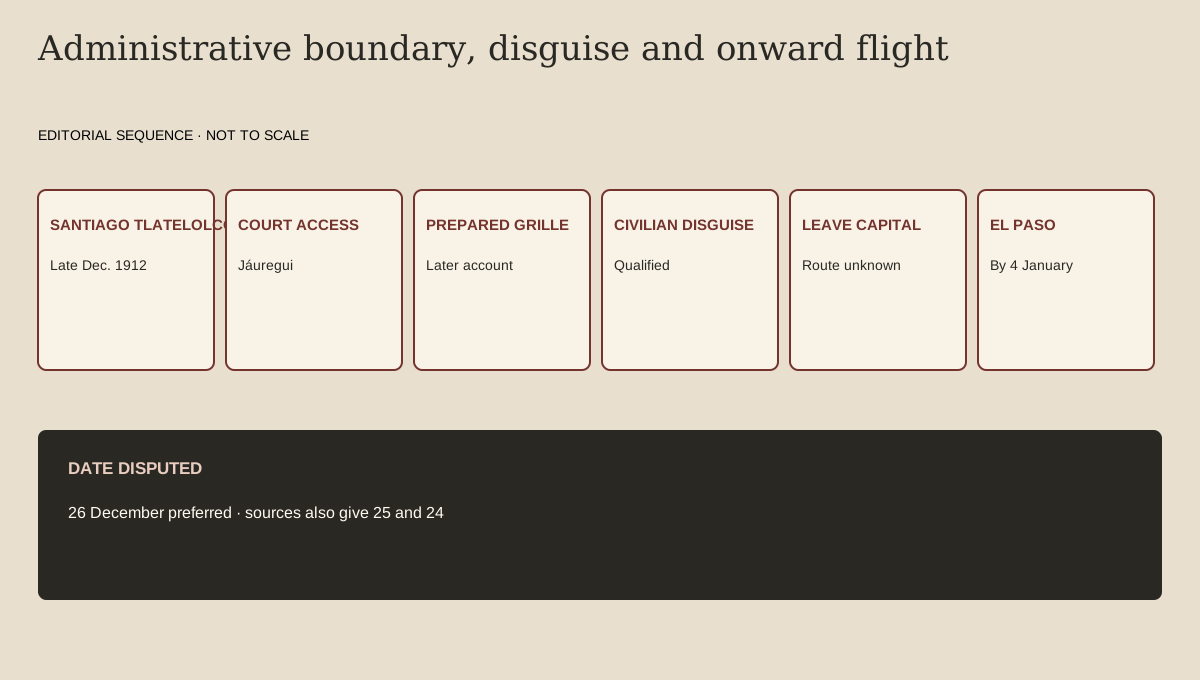
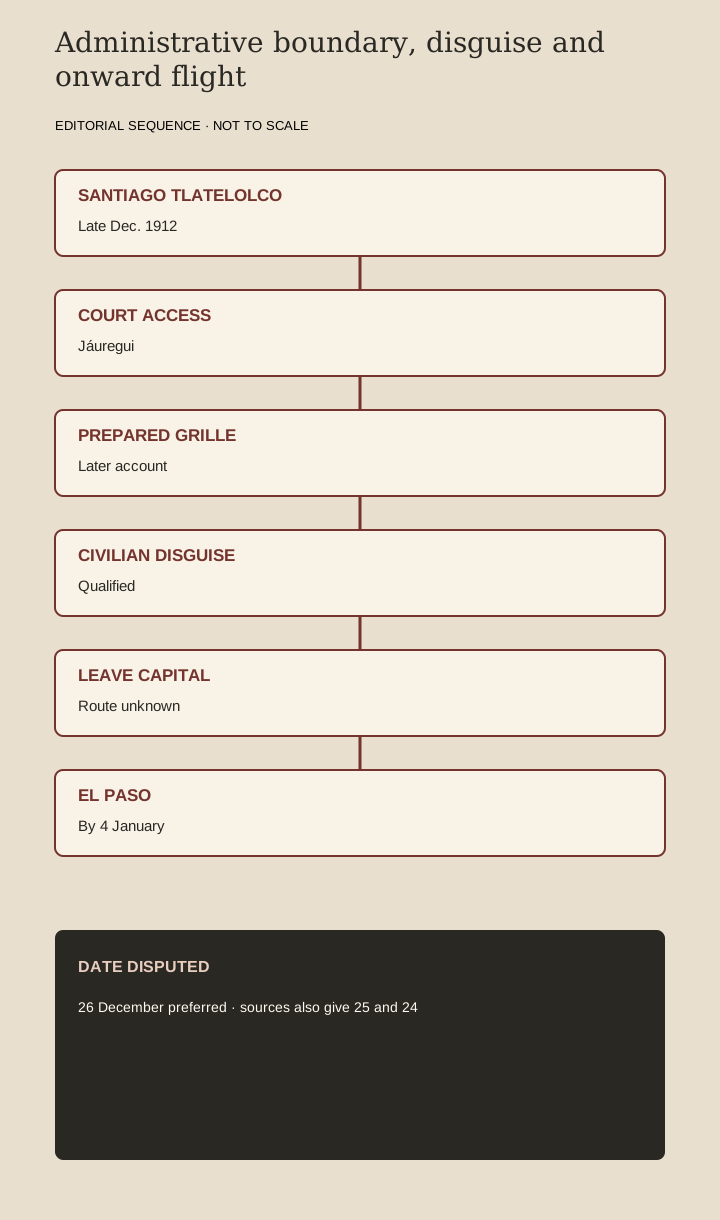
Simplified editorial reconstruction; not to scale. See adjacent text for evidence qualifications and unresolved details.
Material evidence
Tools of Escape
The objects used in an escape reveal how a plan worked under constraint.
- 01Decisive access point
Prepared iron bar / grille
The prisoner-court barrier was reportedly weakened before the escape, allowing Villa to force an opening rather than defeat an intact prison barrier on the spot.
- 02Identity concealment
Civilian disguise
Villa's later account describes an overcoat, dark bowler-style hat and dark glasses supplied by Jáuregui after he crossed the grille.
- 03Immediate separation from the capital
Getaway vehicle
Later accounts describe an automobile carrying Villa and Jáuregui away from Mexico City before the pursuit could close around the prison.
Problem → response
Escape was a sequence of problems
Each response solved a practical obstacle while often creating the next one.
- 01→
Obstacle
Barred prisoner-court boundary
Villa was physically separated from the judicial office by a metal grille.
Response
Jáuregui's insider access allowed a bar to be prepared so Villa could force an opening at the chosen moment.
- 02→
Obstacle
Recognition inside the prison complex
Villa was a conspicuous and nationally known prisoner moving through space used by military judicial personnel.
Response
He adopted civilian clothing immediately after crossing into the administrative side and left with Jáuregui before the escape was detected.
- 03→
Obstacle
Pursuit across Mexico
Leaving the building still left Villa hundreds of kilometres from a secure foreign refuge.
Response
The fugitives moved rapidly away from Mexico City and used a multi-stage route through Mexico before crossing into the United States.
The final accounting
Outcome
Escape from military custody
Villa successfully left the Santiago Tlatelolco prison complex and avoided immediate recapture.
International flight
Villa reached the United States and was in El Paso by 4 January 1913.
Return to revolution
After Madero's fall, Villa returned to Chihuahua in March 1913 and re-entered the armed struggle against Huerta.
Evidence discipline
What the record supports
Status labels distinguish secure conclusions from uncertainty and rejected claims. Color is never the only signal.
MYTH
Pancho Villa escaped from Lecumberri in December 1912.
Villa spent months in Lecumberri, but AGN and INEHRM document his transfer on 7 November 1912 to the military prison at Santiago Tlatelolco, from which he escaped in December.
Sources: SRC-001, SRC-002DISPUTED
The exact calendar day of Villa’s late-December 1912 escape is settled.
INEHRM’s dedicated Villa chronology uses 26 December, but another INEHRM institutional article uses 25 December, while a 1966 congressional recollection gives 24 December. Use 26 December as the preferred operational date while preserving the three-way conflict.
Sources: SRC-002, SRC-003, SRC-008MYTH
Carlos Jáuregui was Villa's lawyer.
Some English-language retellings call Jáuregui a lawyer, but Mexican sources and Guzmán's account identify him as an escribiente or military-court clerk. His clerical access is central to the escape mechanism.
Sources: SRC-006, SRC-008, SRC-009WELL-SUPPORTED
A prepared bar in the court grille enabled Villa to cross into administrative space.
Villa's later memoir tradition explicitly describes the weakened bar and his forcing it aside; Guzmán's Jáuregui-based account independently supports the barred prisoner-court layout. The mechanism is later recollection rather than a contemporaneous escape report.
Sources: SRC-004, SRC-006LATER CLAIM
Villa escaped disguised as a doctor.
The better-supported costume is an overcoat, dark hat and dark glasses. Later versions add a doctor cover story, shaved moustache or handkerchief. Those embellishments should remain qualified.
Sources: SRC-004, SRC-006DISPUTED
Villa learned to read and write from nothing while in prison.
AGN supports that Villa improved his orthography and writing while confined, but the cleaner legend that prison transformed a wholly illiterate Villa into a literate man overstates what the evidence establishes.
Sources: SRC-001, SRC-006Selected chronology
Selected chronology
Huerta has Villa arrested
During the campaign against Pascual Orozco, Villa is arrested after a breakdown in relations with Victoriano Huerta and narrowly avoids immediate execution.
U.S. consul reports the arrest
A U.S. consular telegram reports that Huerta has arrested Villa and sent him to Mexico City for trial.
Villa reaches Mexico City
Villa arrives at Buenavista station and enters confinement in Mexico City, with Lecumberri becoming his principal prison for the following months.
Transfer to Santiago Tlatelolco
Villa is transferred from Lecumberri to the military prison at Santiago Tlatelolco.
Escape from Santiago Tlatelolco
With Carlos Jáuregui's assistance, Villa crosses the barred court boundary, changes appearance and leaves military custody. INEHRM sources use both 25 and 26 December; a later 1966 recollection gives 24 December.
Villa reaches El Paso
INEHRM records Villa in El Paso, Texas, after his flight from Mexico.
Villa returns to Mexico
After Madero's overthrow and murder, Villa crosses back into Chihuahua to join the fight against the Huerta regime.