
On the evening of 17 April 1963, an armored personnel carrier came down Elsenstraße in East Berlin at high speed, its horn sounding as it approached the sector border. The East German post leader watching the road initially interpreted the vehicle as friendly. In a city where the border had been fortified for nearly two years, a military vehicle racing toward the Wall could plausibly look like reinforcement.
It was not.
At the controls was 19-year-old Wolfgang Engels, a civilian driver employed by the National People's Army. He had taken the vehicle from a military site at Friedrichsfelde and was heading for West Berlin. The carrier smashed through a preliminary roadblock, wire obstacles and a visual barrier before striking the Wall itself.
The impact did not carry Engels cleanly into the West. The armored vehicle stopped in the breach, still trapped in the border system. Engels had turned a military machine into an escape vehicle, but the last part of the escape would have to be made outside it—and under gunfire.
A wall that had changed the problem of escape
When the East German leadership sealed the border around West Berlin in August 1961, it transformed a political boundary into a guarded physical system. Streets were blocked, transport links cut and wire obstacles rapidly replaced or supplemented by more permanent construction. Over time, the border became increasingly layered and increasingly dangerous to cross.
That mattered because escape methods had to evolve with it. A person could no longer assume that reaching a single fence or wall meant reaching the West. Border troops, patrols, obstacles and the authorized use of firearms made a direct crossing potentially lethal. The same pressure produced tunnels, hidden compartments, forged documents and vehicle breaches.
Engels' case belongs to that early period of adaptation, when the Berlin Wall was already deadly but had not yet reached the heavily engineered form associated with its later decades. His escape exploited an unusual opportunity: he worked close enough to the East German military apparatus to encounter a vehicle powerful enough to challenge the physical barriers.
Why Engels wanted out
The motive is clearer in outline than in a single neat sentence.
A contemporary Ministry for State Security report noted that Engels had lived in West Germany as a child and moved to the GDR with his mother and stepfather in 1953. His mother worked for the state security apparatus, and his stepfather held an Interior Ministry position. The same report recorded family conflict in the days before the escape and stated that, during an argument on 13 April, Engels said he wanted to go to his biological father in West Germany.
Later recollection adds another element. In an oral-history account broadcast by WDR, Engels described being stopped and searched with friends near the border around Easter 1963. He said the episode helped crystallize his determination to leave the GDR.
Those accounts do not have to be forced into one cause. The safest reading is that Engels' decision formed quickly amid family tension, personal ties to the West and a growing sense that the border regime was constraining his future. What the evidence does not support is the image of a carefully rehearsed armored assault developed over many months.

Six vehicles, one opportunity
The opening appeared because of the calendar.
According to the Stasi's internal report written the next day, an advance detachment of an NVA motorized rifle division had moved into the Magerviehhof/Friedrichsfelde site on 16 April as part of preparations for the May Day parade. Six armored personnel carriers were parked there.
Engels was a civilian driver at the site. During the afternoon of 17 April, he had one of the armored-vehicle drivers explain the machine to him: technical details, how to start it and how to drive it. The significance of that exchange only became obvious later.
At about 7 p.m., Engels was back near the parked vehicles. The Stasi report says he tried to get another soldier away from the area by asking him to move Engels' car into a garage. The soldier refused. Engels then climbed into an armored carrier and announced that he intended to flee to the West.
The warning was immediate, but so was Engels' departure. A soldier alerted an officer. They tried to block the vehicle's exit. Engels drove toward the gate, broke through the barrier chain and entered the city.
The authorities began a search, but the response had almost no time to work. The stolen military vehicle was already moving toward the border.
The armored vehicle was camouflage as well as force
The machine's value was not simply that it was heavy.
As Engels approached Elsenstraße, the vehicle itself temporarily disguised his purpose. The border post leader later reported seeing an armored personnel carrier coming from the East German rear area at roughly 60 to 70 kilometers per hour while sounding its horn. His first assumption was that the carrier had been sent to reinforce the border.
That mistaken interpretation bought Engels crucial seconds.
An ordinary car charging the closed sector border would have announced its intent much earlier. An NVA armored carrier belonged to the security environment. Until its trajectory became unmistakable, the vehicle looked like part of the system Engels was trying to escape.
Escape sequence
The vehicle opened the route but did not complete the crossing
The armored vehicle lodged in the layered barrier. Engels then had to leave it and cross the remaining obstacles on foot.
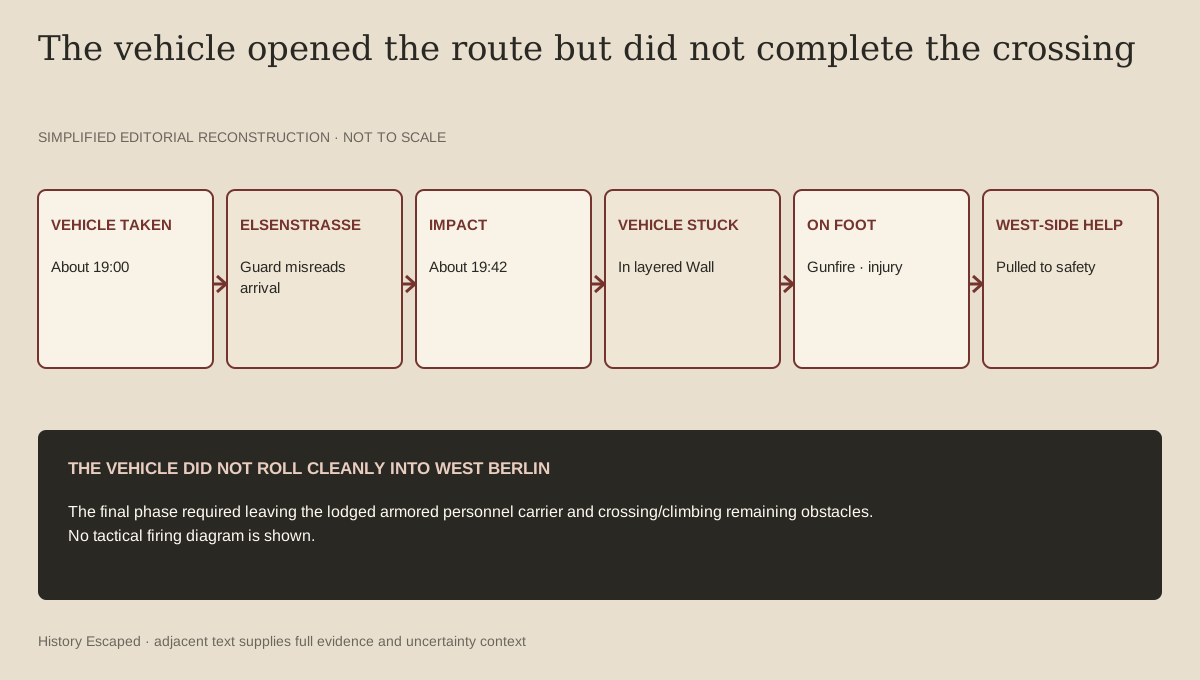
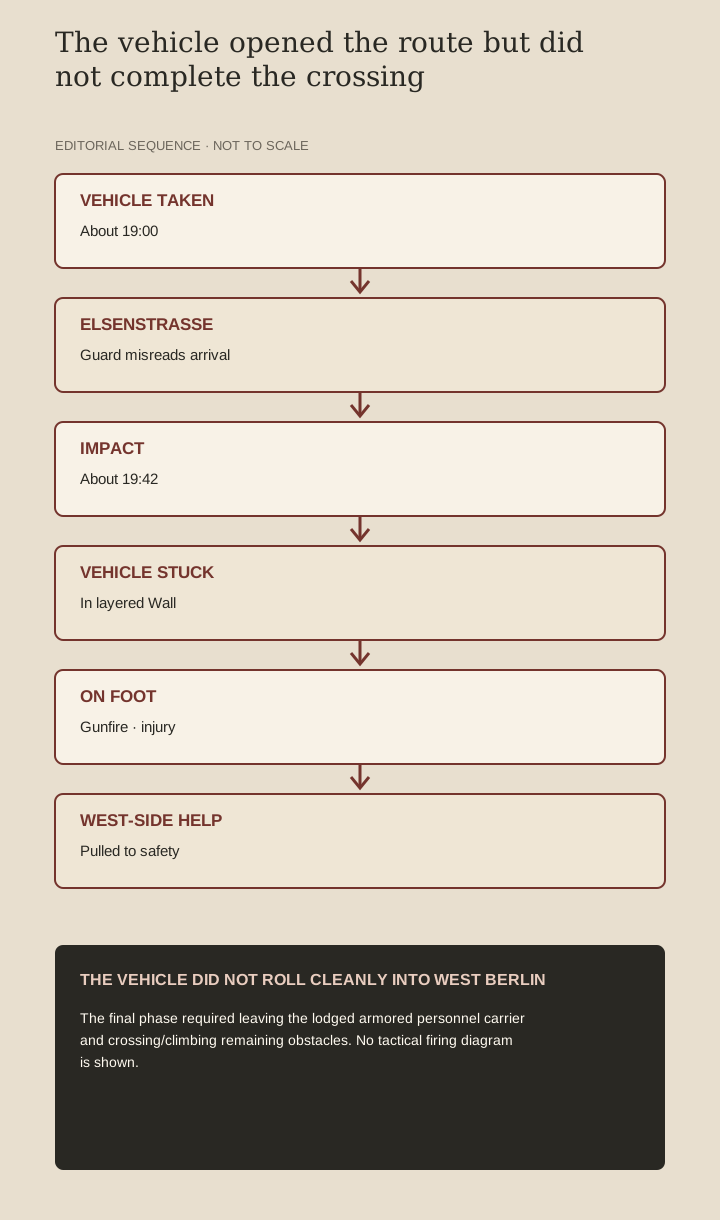
Simplified editorial sequence; not to scale. It does not reconstruct tactical gun positions, bullet paths, or exact barrier geometry.
The impact
At approximately 7:42 p.m. by the Stasi report's timing, the deception ended.
The carrier did not slow. It broke through a preliminary barrier made from stacked road-construction slabs, then through wire and a screen before striking the border wall. The internal East German report described the vehicle as continuing through these obstacles without reducing speed.
Then it stopped.
This is the central detail often flattened in retellings. Engels did not simply drive a tank through the Berlin Wall and emerge in West Berlin. The armored carrier punched into the Wall but became lodged in it. The Stasi report stated that it projected only about half a meter through the wall toward West Berlin.
The machine had done enough to make an opening, but not enough to complete the escape. Engels now had to leave the protection of the armored body.
Out of the vehicle and into the wire
Later, Engels recalled that the crash had dragged wire into the breach and that he became caught in it after climbing out. Other accounts describe him using the vehicle and damaged wall as the final route toward the western side.
The East German post leader ordered the escaping man to stop. When Engels continued, the guard fired.
The contemporary internal report records eight single shots. It also says West Berlin police fired several shots from the opposite side. Engels was wounded. The precise description of his injuries varies across later accounts and contemporary press reporting, but the sources agree on the essential point: he was seriously hit while exposed at the Wall.
He kept moving.
The Chronicle of the Berlin Wall describes Engels climbing toward the western side under covering fire from a West Berlin police officer. People on the West Berlin side then helped get him clear of the barrier. The vehicle that had seemed to be the whole escape plan had become, at the last moment, only a platform and a breach in the wall.
The Heidelberger Krug
Immediately beyond the crossing point stood the West Berlin neighborhood of Neukölln. Later reporting places Engels' first shelter in the nearby Heidelberger Krug, a local pub at the corner. West Berliners helped pull the badly wounded 19-year-old away from the exposed border and into cover.
The gunfire created a dangerous standoff. East German forces remained on their side of the damaged barrier while West Berlin police responded from the West. The Stasi report noted that a crowd quickly gathered, along with police vehicles and press photographers. East German forces deployed a water cannon as the confrontation continued.
Engels was eventually taken to a West Berlin hospital. By then the essential fact was beyond dispute: despite the stalled vehicle and the gunfire, he had crossed from East to West.
What the East German report reveals
One reason this escape can be reconstructed unusually well is that the East German security apparatus documented its own failure almost immediately.
The Stasi information report of 18 April was not written to celebrate Engels. It was an internal account distributed at senior levels, including Walter Ulbricht and Erich Honecker. That makes its details especially valuable, while also requiring normal source criticism: it reflects the priorities and vocabulary of the institution responsible for enforcing the border.
Still, several operational facts in that report are concrete enough to anchor the reconstruction. It records the approximate time of the breach, the speed at which the armored carrier approached, the sequence of barriers struck, the number of shots the post leader said he fired, the presence of blood in and on the vehicle, and the hurried search that failed to intercept Engels before he reached the Wall.
It also reveals how narrow the margin was. The border guard initially misread the approaching armored carrier as reinforcement. The search launched from the military compound was too slow. The barriers damaged the vehicle but did not completely stop Engels. And the gunfire wounded him without preventing him from reaching the West.
No single one of those failures explains the escape. Together, they do.
Evidence discipline
What the record supports
Status labels distinguish secure conclusions from uncertainty and rejected claims. Color is never the only signal.
WELL-SUPPORTED
The escape vehicle was a Soviet BTR-152 armored personnel carrier.
The contemporary Stasi report identifies the vehicle generically as an NVA Schützenpanzerwagen (SPW). The Federal Agency for Civic Education's Berlin Wall location history identifies it more specifically as a Soviet BTR-152.
Sources: SRC-001, SRC-003MYTH
Engels simply drove all the way through the Berlin Wall inside the vehicle.
The armored carrier broke the Wall but stopped in the breach. The Stasi report says it projected only about 50 centimeters through the wall toward West Berlin; Engels still had to leave the vehicle and cross the remaining barrier under fire.
Sources: SRC-001, SRC-002, SRC-003MYTH
The armored-vehicle escape was a long, meticulously prepared operation.
The surviving record points to rapid preparation. Engels learned the controls on the afternoon of 17 April and took the vehicle that evening. His broader desire to leave the GDR may have formed earlier, but the armored-vehicle operation itself was not a months-long plan.
Sources: SRC-001, SRC-004DOCUMENTED
The East German post leader fired eight single shots at Engels.
The Ministry for State Security's internal information report states that the post leader fired eight single shots after Engels did not obey an order to stop.
Sources: SRC-001DISPUTED
The exact number and pattern of bullets that struck Engels can be stated with complete certainty.
Sources agree that Engels was shot and seriously wounded, but descriptions vary between several hits and specific chest and hand wounds. The exact hit count remains uncertain.
Sources: SRC-001, SRC-002, SRC-007DISPUTED
Engels escaped for one single, fully documented motive.
A contemporary Stasi report records a family argument and his wish to go to his biological father in West Germany. In later oral history, Engels emphasized detention and suspicion near the border as helping crystallize his decision. A single-cause explanation is therefore too neat.
Sources: SRC-001, SRC-004The myths that make the story too simple
The most persistent shorthand is that Wolfgang Engels "drove a tank through the Berlin Wall." It is memorable, but it compresses several distinct facts.
First, the vehicle was an armored personnel carrier rather than a main battle tank. Later institutional histories identify it as a Soviet BTR-152 in East German service.
Second, it did not carry Engels cleanly through the Wall. The vehicle became stuck in the breach. His survival depended on getting out of the carrier, negotiating the damaged barrier and wire, enduring gunfire and receiving help from the western side.
Third, the episode was not a perfectly engineered operation. Engels had enough mechanical familiarity and nerve to exploit an opportunity, but the surviving evidence points to hurried preparation. The vehicle's presence for parade preparations created a short-lived chance, and he seized it.
The real escape is more revealing than the legend because it shows both improvisation and failure. Engels' first solution—the armored vehicle—was only partly successful. When it stopped, he had to continue without the protection on which the plan depended.
Why it worked
Engels' escape succeeded because several advantages aligned before the border system could react.
He had legitimate access to a military facility and enough driving experience to understand vehicles. He obtained a quick lesson on the unfamiliar armored carrier. The vehicle itself could defeat physical obstacles that would have stopped a civilian car. Its military appearance caused a border guard to misunderstand the threat for a few decisive moments. The search began, but not fast enough to intercept him.
Even then, success was not assured. The Wall stopped the vehicle. The wire impeded him. A border guard fired. In the final seconds, the western side mattered: police fire and civilian assistance helped turn a breach into an actual escape.
That sequence is why the case belongs in the history of the Berlin Wall rather than merely in a catalogue of spectacular stunts. It exposes the Wall as a system made of architecture, armed personnel, procedures and assumptions. Engels defeated some parts of that system with force, another part with surprise, and the last part only by surviving it.
Selected chronology
Selected chronology
Berlin sector border sealed
The East German regime closes the border around West Berlin and begins constructing the barrier system that becomes the Berlin Wall.
Armored vehicles arrive at Friedrichsfelde
An advance detachment brings six armored personnel carriers to the Magerviehhof/Friedrichsfelde site as part of preparations for the May Day parade.
Engels takes an armored personnel carrier
After learning the controls earlier that day, Engels starts one of the parked vehicles, breaks out of the compound, and heads into East Berlin.
Breach at Elsenstraße
The armored carrier breaks through several obstacles and strikes the Berlin Wall, where it becomes lodged. Engels exits, is fired on, and reaches West Berlin despite being wounded.
The breach is repaired
East German forces repair and reinforce the damaged border area while Engels is recovering in a West Berlin hospital.
Aftermath
The damaged border section was rapidly secured and repaired. Photographs taken the next day show work at the breach, documenting how quickly the East German authorities moved to restore the barrier.
Engels recovered in West Berlin. Later accounts describe him eventually settling in West Germany and working as a teacher. His relationship with his family in the East was deeply disrupted, and reunification would be required before some of those divisions could be revisited.
For the East German authorities, the escape was an embarrassment with practical consequences. It demonstrated that even a military vehicle inside the security apparatus could be turned against the border it was supposed to defend. For historians, the value of the episode lies in the unusually close match between institutional documentation, later testimony and physical photographic evidence.
The most accurate version of the story ends not with an armored vehicle triumphantly rolling into West Berlin, but with it immobilized in the Wall. Wolfgang Engels still had to climb out.
That was the moment the escape truly began.