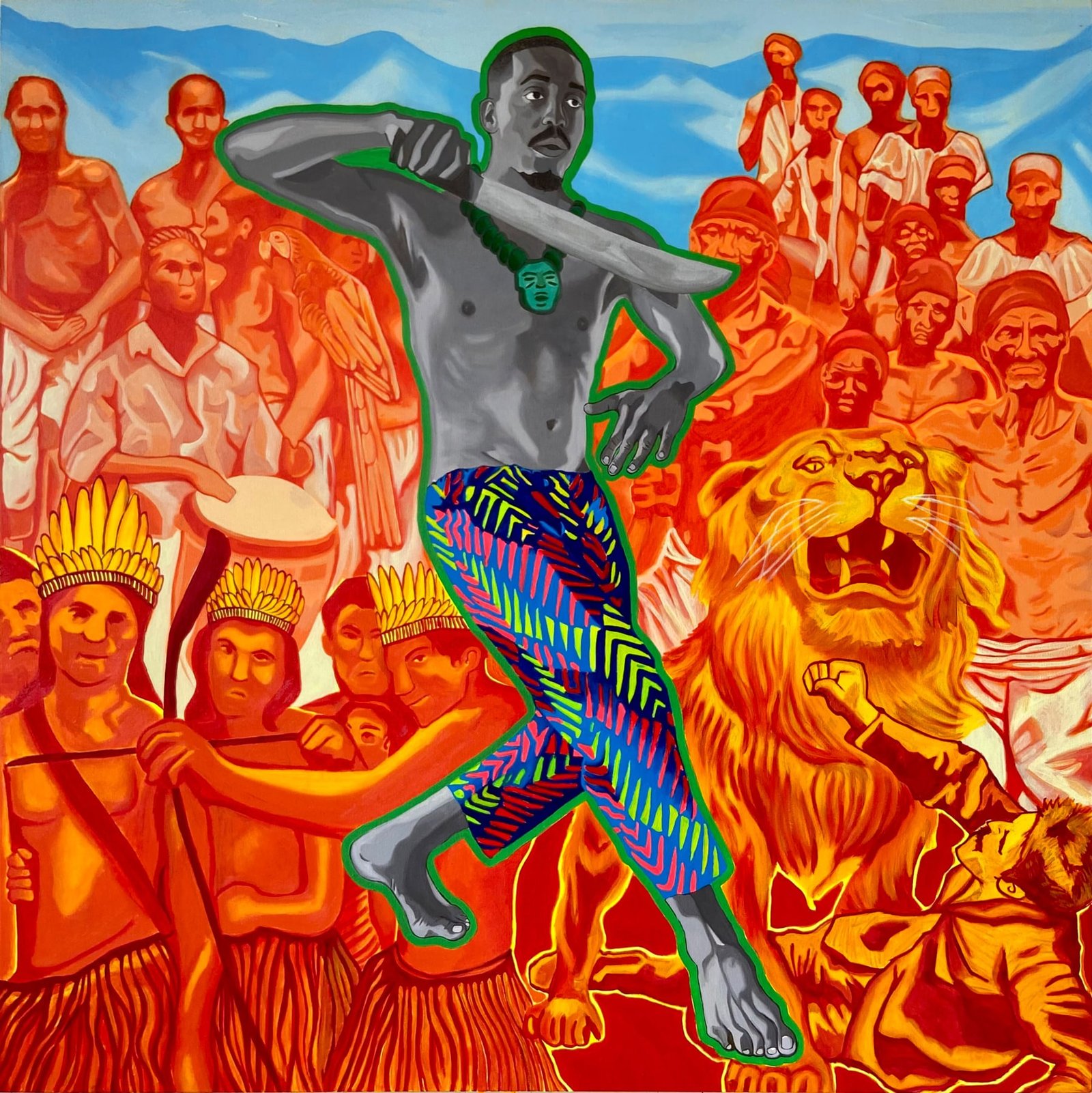
Benkos Biohó’s escape from enslavement around 1599 did more than remove one man from an enslaver’s control. The flight became the beginning of a durable maroon challenge to colonial Cartagena: a group of fugitives withdrew into the wetlands and woodland of La Matuna, enlarged their community, resisted repeated attempts to recapture them, and eventually forced colonial authorities into negotiation.
Even the first step of that story is disputed. A seventeenth-century chronicler said Biohó fled an enslaver’s house with his wife and seven other people. A colonial governor’s letter, preserved through later historical research, instead described him as having escaped forced service in the galleys. Both traditions point toward the end of the sixteenth century. Neither allows the escape to be reconstructed as a precise sequence of doors, guards, roads, and hours.
What can be reconstructed is the transformation that followed: from enslaved status in the Cartagena system to collective flight, from flight to La Matuna, and from La Matuna to an autonomous maroon power that colonial officials could not simply destroy.
At a Glance
Who: Domingo Biohó, remembered today primarily as Benkos Biohó.
When: Late 1599 or early 1600.
From where: Disputed—Fray Pedro Simón says an enslaver’s household; a 1603 gubernatorial letter says galley forced labor.
Initial party: Simón’s account gives Biohó, his wife, four other men, and three other women—nine people.
Expanded group: Later fugitives joined, producing a group of roughly thirty in early accounts and modern reconstructions.
Destination: La Matuna, a marshy and wooded area south of Cartagena and near Tolú.
Outcome: A maroon palenque that resisted colonial expeditions and acquired substantial autonomy.
Later fate: Biohó was arrested in 1619 and executed in Cartagena on 16 March 1621.
Cartagena and Enslavement
At the end of the sixteenth century, Cartagena de Indias was one of the principal ports through which enslaved Africans entered Spain’s American territories. People arriving through the port could be sold into urban households, estates, transport labor, military-support work, or other forms of forced labor.
Biohó’s life before Cartagena is much harder to establish than later biographies sometimes suggest. Modern institutional narratives often associate him with the Bijagós archipelago off present-day Guinea-Bissau. His name has also been used as evidence for an Upper Guinean connection.
That association is plausible, but it is not the same as a complete documented biography. Henry Arenas Valencia has emphasized the difficulty of determining Biohó’s precise origin. The widespread story that he had already been a king in Africa is still more uncertain. Later literature and national memory have amplified the royal image, but the evidence is much stronger for Biohó’s later authority as a maroon leader in New Granada than for a pre-capture African throne.
Colonial sources knew him as Domingo Biohó or Domingo Bioo.
Two Versions of the Escape
The most important source conflict concerns the place from which Biohó actually fled. Fray Pedro Simón, writing later, described an enslaver in Cartagena who treated enslaved people harshly.
In Simón’s account, Domingo Biohó fled the man’s house and took with him four other Black men, his wife, and three other women. That produces an initial party of nine.
A different version appears in a letter from Cartagena governor Jerónimo de Suazo y Casasola dated 16 May 1603. As summarized in María Cristina Navarrete’s research and more recent historiography, the governor said Biohó had escaped the punishment of rowing in the galleys four years earlier.
The difference is substantial. One version begins in household slavery; the other in forced galley labor.
Later writers have sometimes connected the two by imagining that Biohó escaped an owner, was recaptured and sentenced to the galleys, then escaped again. That sequence is possible, but possibility is not documentation. Without stronger evidence for the recapture and two distinct breakouts, the two accounts are better preserved as competing traditions.
They agree on the larger result: by around 1599–1600, Biohó was outside colonial custody and part of a growing group of fugitives moving toward La Matuna.
From Nine to About Thirty
The escape also suffers from a denominator problem. Simón’s detailed narrative begins with nine people.
Biohó was not alone, and his wife and three other women were part of the flight from its earliest remembered stage. Other fugitives then joined the group.
Modern historian Alen Castaño places the movement in late 1599 or early 1600 and describes an expanded group totaling around thirty people as it withdrew from the Cartagena jurisdiction toward La Matuna. Some later summaries compress the entire event and simply say that Biohó “escaped with thirty slaves.”
That wording erases the growth of the group and makes a developing maroon movement look like one organized departure. The stronger reconstruction is sequential. A smaller party escaped; more people joined; roughly thirty fugitives then moved into a landscape where they could defend a community beyond ordinary colonial control.
La Matuna
La Matuna was central to the success of the escape. Colonial descriptions place the palenque among wetlands, wooded islands, mud, and difficult approaches south of Cartagena, toward the Tolú region. The landscape did not make the community invulnerable, but it imposed serious costs on forces trying to penetrate it.
A palenque was more than a temporary hiding place. In the Caribbean regions of New Granada, the term came to describe communities organized by people who had escaped enslavement and created settlements outside routine colonial authority.
Biohó became the most famous leader associated with La Matuna. Colonial officials referred to him as a king of the woodland or of the palenque, language that reflected both his authority and Spanish anxiety about an alternative political order existing near a major slave-trading port.
The community attracted more fugitives. Its members defended themselves, obtained resources, and created relationships with the surrounding colonial countryside that included both conflict and negotiation.
The escape had become a territorial problem for Cartagena.
The Attempts to Destroy the Palenque
Colonial authorities tried repeatedly to reverse the flight. One early pursuit associated with the man identified as Biohó’s enslaver ended disastrously for the pursuers.
Later governors sent larger armed expeditions into La Matuna.
A 1604 gubernatorial report described an attack through deep water and mud, fighting against maroon defenders, and the difficulty of operating inside the wetland. The attackers could enter and inflict losses, but they did not permanently eliminate the community.
This is where later heroic narratives can become too simple. La Matuna’s survival was not the achievement of Biohó alone. Women and men sustained the settlement, rebuilt after attacks, gathered food and weapons, defended approaches, brought in new fugitives, and maintained the relationships that allowed the palenque to persist.
Biohó mattered because he became a leader of that collective power. By 1605 the repeated failure to suppress La Matuna had pushed colonial authorities toward accommodation.
From War to Negotiation
The peace chronology is not completely uniform across later histories. Some sources identify 1605 as the point when Governor Suazo recognized that military repression had failed and entered or offered terms. A more durable settlement is often placed under a succeeding governor around 1612 or 1613.
It is safer to describe a process than a single magical treaty day. The emerging arrangement recognized a degree of autonomy for La Matuna and allowed Biohó and other maroons greater freedom to enter Cartagena. In return, colonial authorities expected the palenque to stop encouraging or receiving additional fugitives and to reduce conflict with surrounding settlements.
Those terms reveal both the achievement and limits of maroon autonomy. Biohó and his community had forced a slave society to tolerate a population that had removed itself from enslavement. At the same time, colonial authorities tried to contain that freedom by separating the recognized maroons from people who remained enslaved and might seek the same route out.
The result was uneasy coexistence rather than abolition.
Arrest and Execution
Biohó’s negotiated position made his later arrest especially significant. Sources place his capture in Cartagena in 1619.
By then he was accustomed to entering the city under the arrangement that had followed the maroon wars.
Colonial authorities imprisoned him. On 16 March 1621 he was hanged in Cartagena.
A letter written by Governor García Girón later that month described Domingo Bioo as a dangerous leader whose influence among Africans in the city and province made him threatening to colonial order. The wording is hostile, but it also demonstrates the scale of the authority Spanish officials believed he possessed.
His execution did not erase maroon resistance in the region. Other palenques appeared, disappeared, regrouped, negotiated, and fought through the seventeenth and early eighteenth centuries.
La Matuna Is Not Simply San Basilio
Modern memory often draws a straight line from Biohó’s escape to today’s San Basilio de Palenque. The relationship is real, but the line is not that simple.
In San Basilio itself, Biohó is a foundational figure. His monument and community memory identify him as a father of Palenquero freedom. Colombian public culture has often repeated the claim that he founded the surviving town in 1603.
Archival scholarship complicates that date and identity. Biohó securely led La Matuna around the turn of the seventeenth century. Later in the century, new palenques formed or re-formed in the Montes de María. Research cited by the Archivo de Bogotá and by scholars of maroon geography connects San Basilio more directly with later communities, especially San Miguel, whose negotiations produced a recognized settlement around 1713–1714.
That does not make the Palenquero memory of Biohó meaningless. It shows two kinds of historical continuity operating at once: documentary continuity between particular settlements and leaders, and community memory that makes Biohó an ancestral symbol of the longer struggle that eventually produced San Basilio.
Both matter. They should not be mistaken for the same claim.
What the Escape Established
The exact doorway from which Biohó escaped may remain uncertain. The scale of what followed does not.
Around 1599 or 1600, Domingo Biohó and other enslaved people removed themselves from colonial control. A small remembered party became a larger group. They established themselves in La Matuna, survived armed attempts to destroy them, and created enough political and military leverage to force negotiation with Cartagena.
That was not freedom granted by an enslaver or governor. It was freedom first taken through flight and then defended collectively.
The distinction also explains why Biohó became larger than the narrow archival record of his life. He came to represent not only one escape but a model of marronage: enslaved people moving beyond individual flight to build communities capable of defending autonomy.
The living cultural space of San Basilio de Palenque, recognized by UNESCO, belongs to that longer history. Its direct institutional genealogy should not be collapsed into La Matuna, but its remembrance of Biohó preserves something the colonial record itself makes clear.
His escape became a political fact that Cartagena could not ignore.
Evidence discipline
What the record supports
Status labels distinguish secure conclusions from uncertainty and rejected claims. Color is never the only signal.
UNKNOWN
Biohó’s escape occurred at an exactly known point in 1599.
The strongest scholarly chronology gives late 1599 or early 1600; no secure exact day or month is established.
Sources: SRC-002, SRC-003DISPUTED
Biohó escaped directly from his enslaver’s house.
Fray Pedro Simón gives a household-escape tradition, while a 1603 gubernatorial letter summarized in later scholarship says Biohó escaped forced galley service four years earlier.
Sources: SRC-001, SRC-003, SRC-004DISPUTED
Biohó escaped directly from galley service.
The 1603 gubernatorial tradition supports galley escape, but Simón’s later chronicle gives a different immediate point of departure.
Sources: SRC-003, SRC-004, SRC-008UNKNOWN
The sources securely document two separate escapes—first from an owner, then after recapture from a galley.
Later authors use the conflicting accounts to propose a recapture-and-second-escape sequence, but the sources assembled here do not securely establish that chain.
Sources: SRC-003, SRC-004DISPUTED
The original escape party consisted of exactly thirty people.
Simón’s detailed tradition begins with nine people; later fugitives joined and the broader group is commonly described as roughly thirty.
Sources: SRC-001, SRC-002, SRC-004UNKNOWN
Biohó was securely documented as an African king before enslavement.
Later heroic and literary traditions emphasize African kingship, but the evidence used here securely establishes his later maroon kingship and authority rather than a pre-capture throne.
Sources: SRC-004, SRC-005DISPUTED
Biohó’s exact African birthplace is securely known.
Institutional histories often associate him with the Bijagós/Bissagos region, but scholarship notes that his precise origin cannot be established confidently.
Sources: SRC-005, SRC-008DISPUTED
Biohó directly founded the present-day town of San Basilio de Palenque in 1603.
Living Palenquero and Colombian commemorative traditions treat Biohó as a founding father, while archival scholarship distinguishes his La Matuna palenque from later San Miguel and the 1713–1714 formation of San Basilio.
Sources: SRC-006, SRC-007, SRC-010WELL-SUPPORTED
Biohó was executed on 16 March 1621.
Colombian institutional histories and the governor’s post-execution correspondence support the 1621 execution chronology.
Sources: SRC-001, SRC-008Evidence diagram
Conflicting escape traditions and the growth of La Matuna
Archival and community-memory traditions differ on the first flight, while La Matuna and collective marronage remain secure.
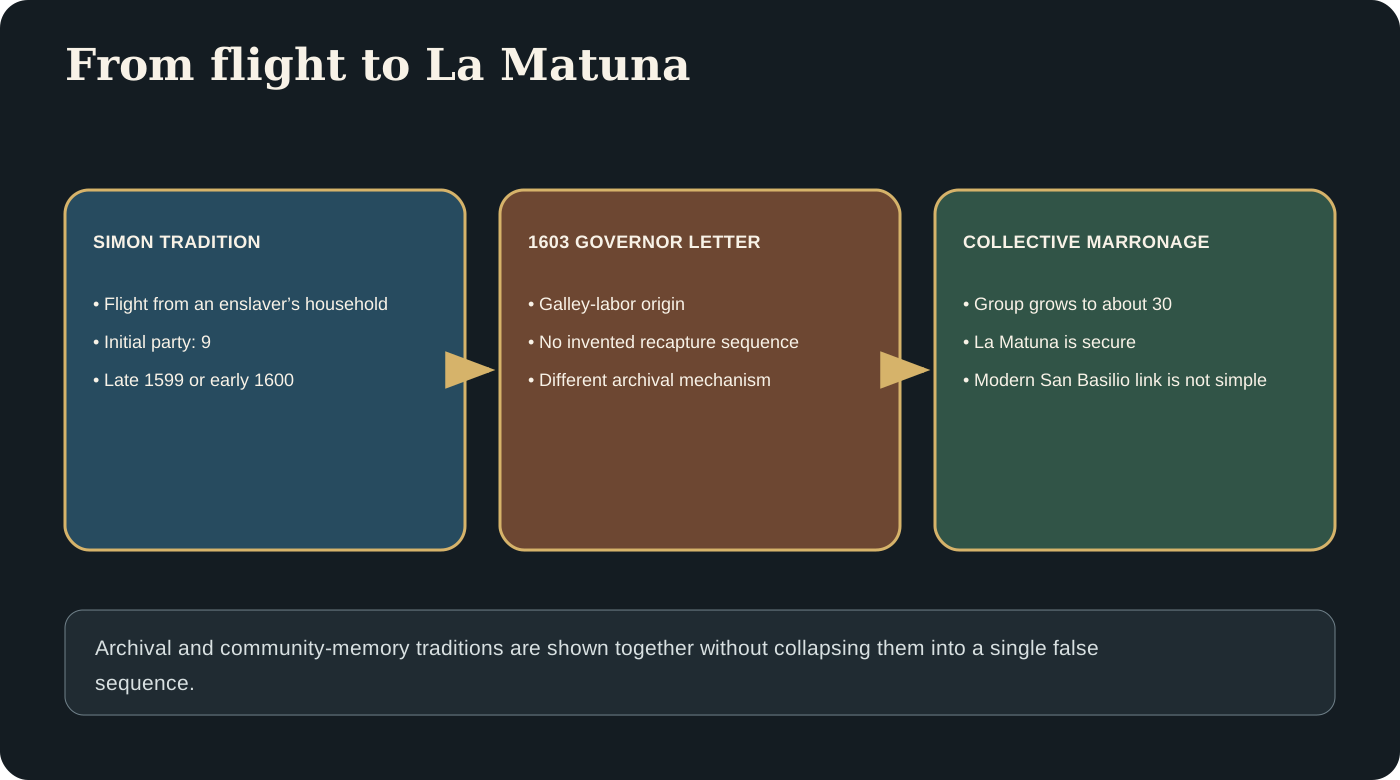
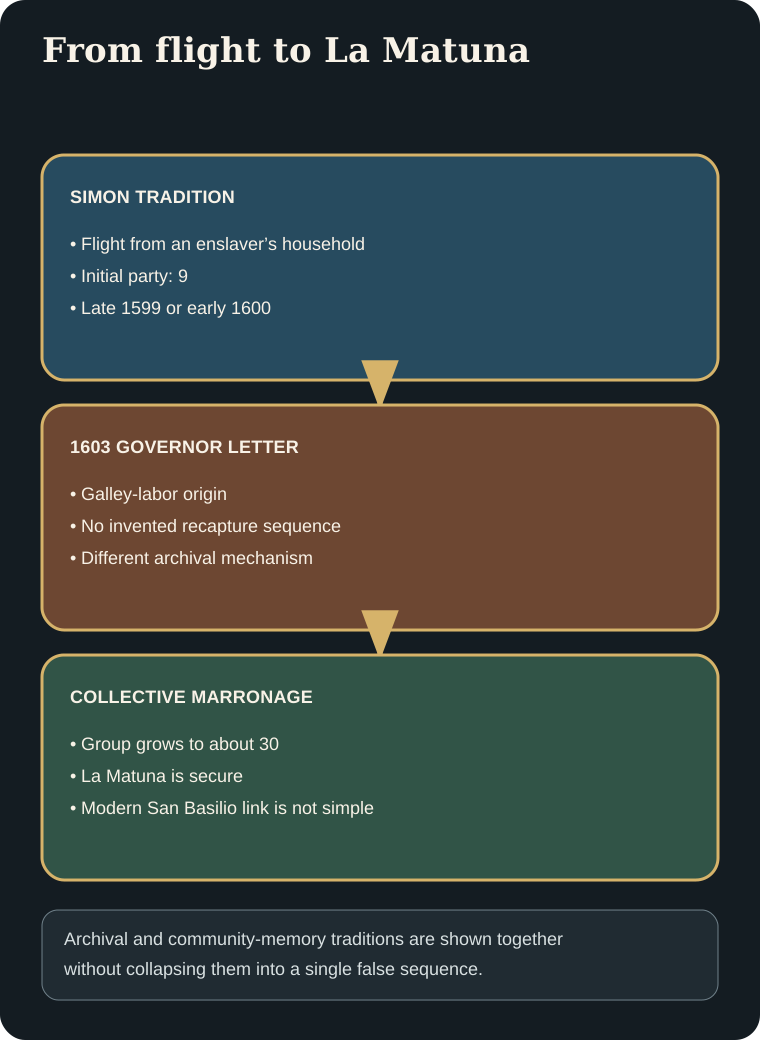
Archival and community-memory traditions differ on the first flight, while La Matuna and collective marronage remain secure.