
Mahommah Gardo Baquaqua reached New York in 1847 aboard a Brazilian ship on which he was still enslaved.
He had already survived forced captivity in West Africa, a march to the slave-trading coast, the Middle Passage and enslavement in Brazil. New York offered something he had not possessed for years: a chance to get away.
But when Baquaqua ran from the ship, freedom did not simply begin. American authorities arrested him.
At a Glance
- Escape process: Summer 1847
- Final jail escape: Night of 9 August 1847
- Escapee: Mahommah Gardo Baquaqua
- Companion: José da Rocha
- Ship: Lembrança
- Arrival in New York: 27 June 1847
- Immediate legal struggle: Habeas corpus and court orders over return to the ship
- Escape route after jail: Through abolitionist networks toward Massachusetts and Boston
- International refuge: Haiti
- Later record: Baquaqua’s 1854 life narrative
- Major correction: His self-emancipation was a multi-stage escape, not an automatic grant of freedom when he reached New York
From Djougou to the Atlantic
Baquaqua was born in Djougou, in what is now northern Benin, probably during the 1820s.
His family was Muslim, and modern scholarship identifies Djougou as an important commercial center connected to major inland West African trade routes. Baquaqua later described education, family life and political service there, although the exact chronology of his youth is difficult to recover. He also described being enslaved more than once in Africa.
The final captivity ended differently from the first. He was moved south through the region controlled by Dahomey and taken to the Atlantic slave port of Ouidah. Around 1845, he was forced aboard a slave ship for Brazil.
Slavery in Brazil
The transatlantic trade carrying Baquaqua to Brazil was already illegal under Brazilian law. That did not stop it.
He arrived in Pernambuco and was initially enslaved by a baker. His 1854 narrative describes severe violence, exhausting labor and despair during this period.
Baquaqua was later sold again and eventually came under the control of people connected to maritime commerce based in Rio de Janeiro. That shift placed him on ships. It also created the opportunity that would eventually carry him outside Brazil.
The Lembrança
By 1847, Baquaqua was serving aboard the Brazilian vessel Lembrança.
Another enslaved African, José da Rocha, was aboard as well. A third enslaved person, a woman named Maria da Costa, was also connected with the captain’s household during the New York episode.
The Lembrança sailed from Rio de Janeiro on 24 April 1847 with a cargo of coffee. After a voyage of about two months, it entered New York’s East River on 27 June and docked near Roosevelt Street.
Baquaqua had crossed the Atlantic a second time. This crossing created a possibility the first one had denied him.
Selected chronology
Selected chronology
Forced transport to Brazil
Baquaqua is taken through Ouidah and transported across the Atlantic to Brazil in the illegal slave trade.
Lembrança leaves Rio de Janeiro
The vessel sails for New York carrying coffee and enslaved workers including Baquaqua.
Arrival in New York
The Lembrança arrives in the East River and docks near Roosevelt Street.
Ship flight and detention
Baquaqua and Rocha flee the vessel, are detained, and become the subjects of an abolitionist-backed legal struggle.
Daly rules against the fugitives
Judge Charles P. Daly concludes that the men are ship crew subject to return under the seamen arrangement.
Edwards upholds return
Judge Henry P. Edwards again accepts the crew-status argument and orders the men returned to the captain's custody.
Eldridge Street jail escape
Baquaqua and Rocha escape confinement after the jailer falls asleep and keys become accessible.
Flight through Massachusetts
Contemporary reporting places the two men passing through Springfield on an abolitionist route toward Boston.
Arrival in Haiti
Baquaqua and Rocha reach Port-au-Prince, where Baquaqua experiences legal freedom in the independent Black republic.
Return to the United States
Baquaqua returns from Haiti through the American Baptist Free Mission network and pursues education in upstate New York.
Biography published in Detroit
Baquaqua's life story is published in a sixty-five-page volume written down and revised from his testimony by Samuel Moore.
Learning the Word “Free”
Baquaqua’s narrative remembers learning that New York was a place where slavery was challenged.
His English was extremely limited. The word that mattered was free.
Later scholarship reconstructs a network of Black New Yorkers and abolitionists who recognized that enslaved people were being held aboard the Brazilian vessel and encouraged resistance. Baquaqua and Rocha fled. Baquaqua later described crossing from the ship to land and running without knowing where he was going, trying to communicate with the one English word he understood.
The dash succeeded in getting him away from his enslaver. It did not secure his legal freedom.
Arrested in a Free State
Baquaqua and Rocha were taken into custody. Their case quickly became a public abolitionist controversy.
The legal question was not handled simply as “slavery is illegal in New York, therefore these men are free.” The captain and Brazilian representatives argued that Baquaqua and Rocha were members of the Lembrança’s crew and therefore covered by international rules requiring deserting sailors to be returned to their vessel.
Antislavery supporters challenged their detention through habeas corpus. The argument moved through New York courts during July and early August.
On 22 July, Judge Charles P. Daly ruled against the two men.
Other judges became involved as abolitionists continued resisting their return. On 8 August, Judge Henry P. Edwards again upheld the position that Baquaqua and Rocha were crew members who could be returned to the ship.
A legal appeal remained possible. Baquaqua did not wait for it.
The Eldridge Street Jail
The two men were confined in the Eldridge Street jail in New York. During the night of 9 August 1847, they escaped.
The basic event is supported by contemporary newspaper reporting later used by Paul Lovejoy and other scholars. The jailer said that he had fallen asleep and left the cell keys where the prisoners could reach them. That explanation has invited suspicion ever since.
Abolitionists were already working on behalf of Baquaqua and Rocha. It is possible that the jailer sympathized with them or deliberately made escape easy.
The surviving evidence does not prove it. The secure fact is that the keys became available, the cell was opened, and the two men got out before another court could return them to the Brazilian captain. The night of August 9 was the decisive physical break from custody.
The Underground Route North
Leaving the jail did not make New York safe.
Baquaqua and Rocha were fugitives from a court process that had ordered them returned to the ship. Their allies therefore moved them away from the city. Contemporary reporting placed them in Springfield, Massachusetts, before they continued toward Boston.
The newspaper language deliberately played with the idea of an “underground railroad.” Later scholarship connects their flight to radical abolitionist networks that were already helping Black people escape recapture before the Fugitive Slave Act of 1850 made that struggle even more dangerous.
The exact sequence of houses, escorts and transport is not recoverable. That uncertainty should remain.
What is clear is that Baquaqua did not reach safety by himself. Black abolitionists and other antislavery allies turned a jail escape into a functioning route away from the Lembrança.
Haiti
About four weeks after reaching Boston, Baquaqua and Rocha left the United States for Haiti. They arrived in Port-au-Prince before 8 October 1847. For Baquaqua, Haiti represented something more than another hiding place.
It was an independent Black republic created by the overthrow of slavery and French colonial rule. In the 1854 narrative, his arrival is remembered as the moment he understood himself to be fully in a country without slavery. That did not mean life there was easy.
Documentary reconstruction
An Atlantic and New York route to self-liberation
A case-local editorial visual separates the documented sequence from uncertainty without implying exact modern geography or operational detail.
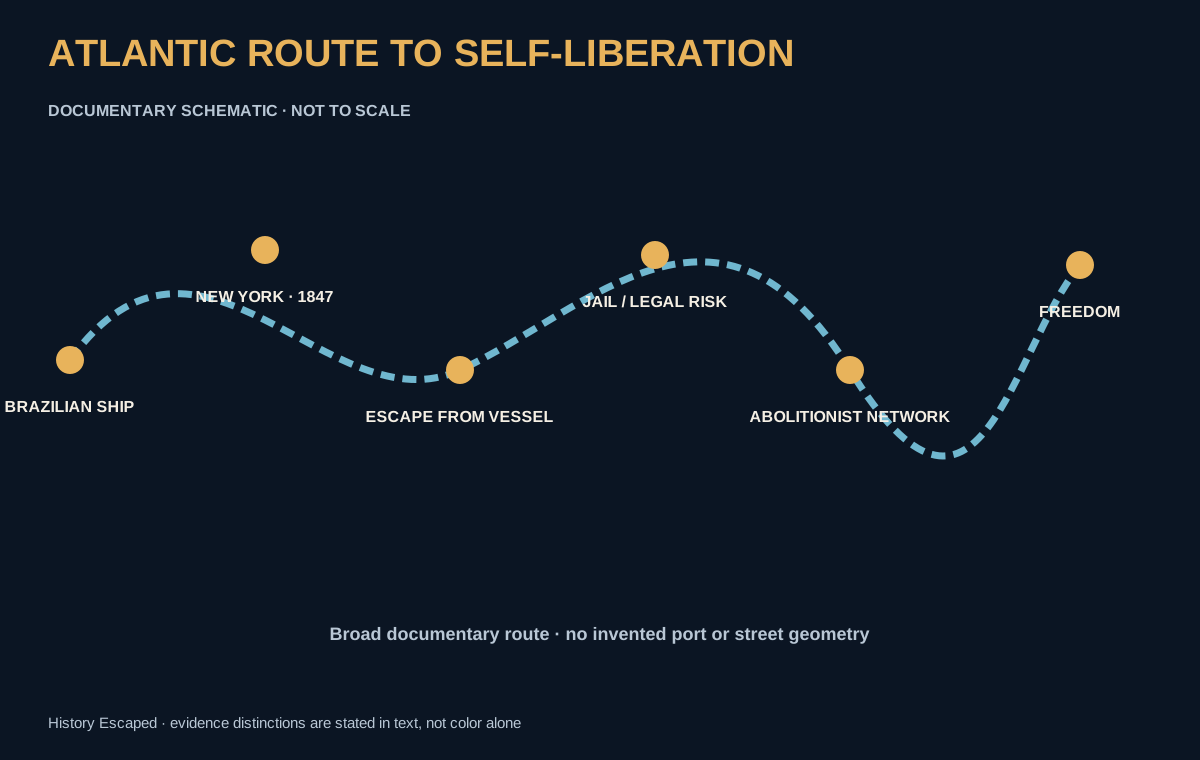
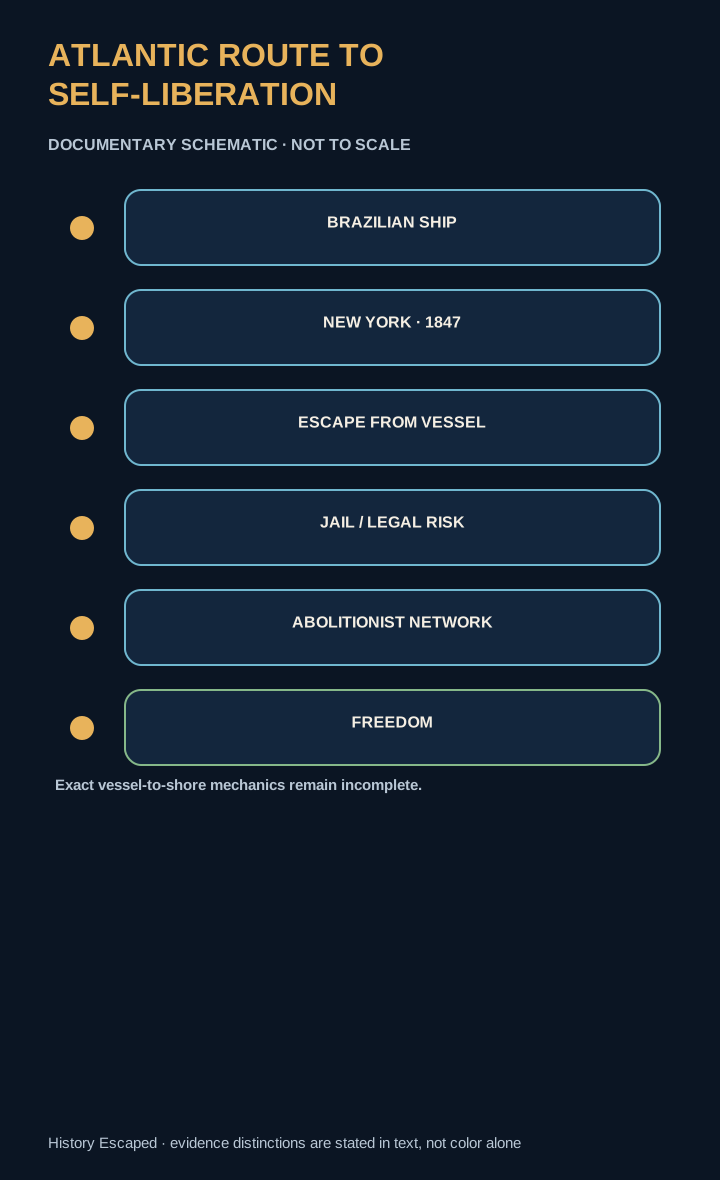
Simplified editorial reconstruction based on the cited historical record; not to scale. Uncertainty is stated directly in the visual and adjacent text.
Freedom Was Not Stability
Baquaqua did not speak Haitian Creole and struggled economically after arriving.
He eventually came into contact with Rev. William L. Judd and the American Baptist Free Mission.
The mission gave him shelter, education and a new institutional network. It also reshaped the way his life would later be recorded.
Baquaqua had grown up Muslim. In Haiti he converted to Christianity and was baptized, probably in 1848.
The mission saw in him a potential future missionary to Africa. Baquaqua himself also wanted to return home. Those interests overlapped, but they were not identical.
Returning to the United States
In late 1849, Baquaqua returned to the United States with members of Judd’s family and entered the network of radical antislavery Baptists in upstate New York. He later studied at New York Central College in McGrawville, an unusually progressive institution that admitted Black students and women. By then, the political environment had become even more dangerous.
The Fugitive Slave Act of 1850 strengthened federal power to recapture people who had escaped slavery from the American South. Baquaqua’s own legal case had occurred before that law, but his life in the United States now unfolded in the movement resisting it. He circulated among abolitionists in the United States and Canada and pursued education with the hope of returning to Africa.
The Book That Preserved the Escape
In 1854, while in Detroit, Baquaqua arranged for the publication of his life story.
The book was titled Biography of Mahommah G. Baquaqua, a Native of Zoogoo, in the Interior of Africa.
Its title page also contains one of the most important warnings about how to read it. The text was written and revised from Baquaqua’s own words by Samuel Moore. That makes the book both extraordinarily valuable and complicated.
Baquaqua’s Voice and Samuel Moore’s Hand
The first part of the book describes West African society largely in third person. The later sections, including captivity and escape, move much more strongly into Baquaqua’s first-person voice. Modern scholars have compared the text with Baquaqua’s surviving letters, Baptist mission material, Brazilian records and 1847 New York newspapers.
Their conclusion is not that Moore fabricated the story. Recent scholarship instead treats Baquaqua as the substantive authorial source while recognizing the text as heavily mediated.
Moore polished language, added literary flourishes, emphasized Christian missionary themes and sometimes misunderstood African geography or culture. The book should therefore be read as testimony filtered through collaboration.
Evidence discipline
What the record supports
Status labels distinguish secure conclusions from uncertainty and rejected claims. Color is never the only signal.
MYTH
Baquaqua became automatically free as soon as he stepped onto New York soil.
He fled the ship but was arrested, subjected to litigation and ordered returned to the vessel before escaping jail.
Sources: SRC-003, SRC-004, SRC-006MYTH
A New York court formally freed Baquaqua in 1847.
The key judicial decisions accepted the argument that Baquaqua and Rocha were crew members who could be returned under the U.S.–Brazil seamen arrangement.
Sources: SRC-003, SRC-004MYTH
The Fugitive Slave Act of 1850 governed Baquaqua's New York case.
The escape occurred in 1847. The legal dispute centered on maritime/consular obligations and the captain's claim that the men were ship crew.
Sources: SRC-003, SRC-004MYTH
Baquaqua escaped from New York alone.
José da Rocha fled both the Lembrança and the jail with him, while abolitionist allies helped the men reach Massachusetts and Boston.
Sources: SRC-003, SRC-004DISPUTED
The Eldridge Street jailer certainly collaborated with abolitionists.
Contemporary reports say the jailer fell asleep and left keys accessible. Deliberate sympathy is possible but not proven.
Sources: SRC-004UNKNOWN
Baquaqua's exact year of birth is securely known.
Modern sources place his birth at different points in the 1820s or around 1830; the newest monograph argues for the early 1820s.
Sources: SRC-002, SRC-005, SRC-006MYTH
The 1854 Biography is a verbatim transcript of Baquaqua's own written prose.
The title page states that Samuel Moore wrote down and revised the account from Baquaqua's words, and literary scholarship identifies substantial editorial shaping.
Sources: SRC-001, SRC-009, SRC-011MYTH
Because Samuel Moore edited the book, the narrative cannot be treated as Baquaqua's testimony.
Recent scholarship treats the narrative as substantially Baquaqua's autobiographical testimony while requiring careful separation of Moore's language and framing.
Sources: SRC-002, SRC-009, SRC-010DISPUTED
Baquaqua's life is definitively undocumented after 1857.
Older scholarship lost his trace in Britain after 1857, while the 2025 monograph argues that later evidence places him in West Africa, at least Liberia, by the early 1860s.
Sources: SRC-002, SRC-006Why the New York Escape Is Unusually Verifiable
The most dramatic part of Baquaqua’s life is also one of the parts historians can check most closely. The Lembrança appears in shipping records. Its arrival can be dated to 27 June 1847.
New York abolitionist newspapers reported the dispute over the “Brazilian slaves.” The habeas corpus proceedings identify the legal arguments and judges. Newspaper reports record the jail escape on the night of 9 August.
Other reports place the men moving through Massachusetts afterward. The 1854 narrative is therefore not standing alone. Independent evidence follows Baquaqua through the same crisis.
More Than a Jailbreak
If the story ended at Eldridge Street, it would miss what Baquaqua actually accomplished. He escaped a ship. Then he survived arrest.
Abolitionists used the courts to delay his return. When the courts still threatened to send him back, he escaped jail. A wider network moved him out of New York.
Then he crossed an international boundary to Haiti, where the Brazilian captain and New York court orders could no longer determine his status. Freedom was not one moment. It was a chain of decisions, allies and jurisdictions.
An Atlantic Life on Record
Baquaqua’s later movements took him through the United States, Canada and Britain.
Older scholarship lost his trail after 1857. The most recent major study argues that he eventually reached West Africa, at least as far as Liberia, by the early 1860s.
The exact end of his life remains uncertain. What survives with unusual force is the record he created before disappearing from view. Baquaqua’s 1854 book is the only known autobiographical narrative centered on a person who had been enslaved in Brazil and then personally described that experience.
It exists because in 1847, when American courts were preparing to return him to the ship that claimed him, he got out first. ---