
By February 1945, Block 20 at Mauthausen concentration camp was not an ordinary prisoner barrack. It had become a place where men marked for death under the Nazi “Bullet” system were concentrated, isolated from the rest of the camp and deprived of the conditions needed to survive. Most were Soviet officers who had already escaped or attempted to escape from German prisoner-of-war custody before being recaptured.
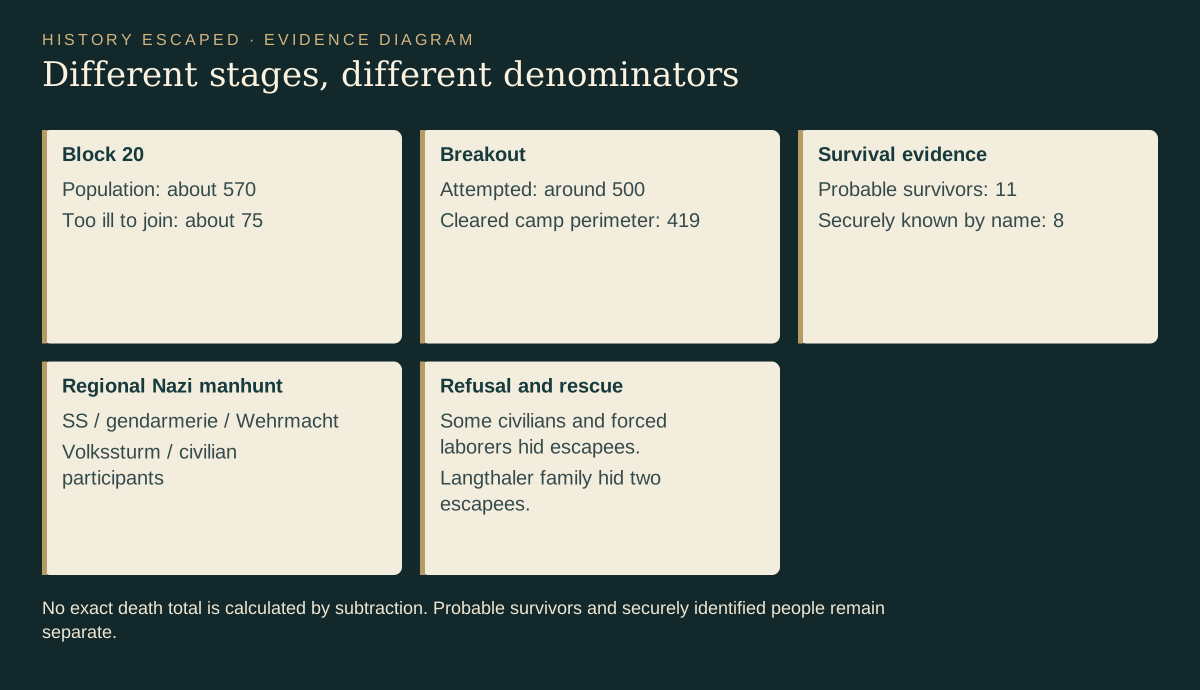
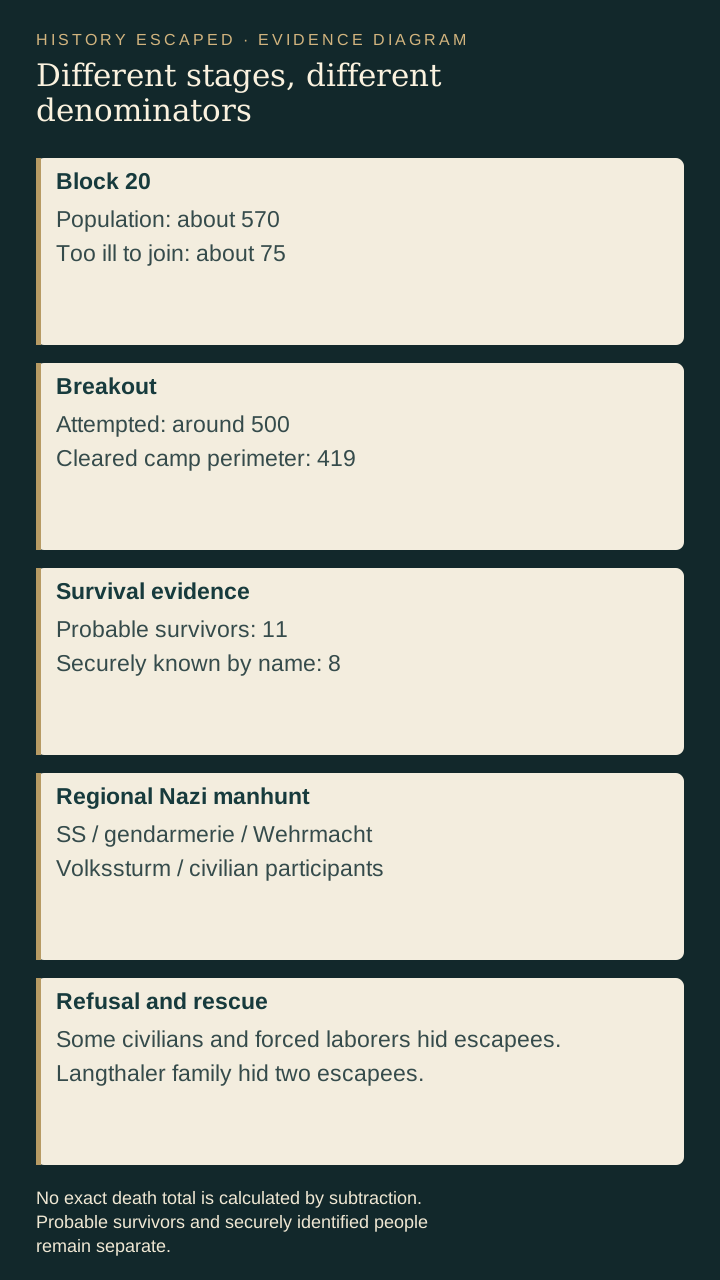
On the night of February 1–2, several hundred of those prisoners decided not to wait for the SS to kill them. Roughly 570 men were then in Block 20. About 75 were too ill to take part. Around 500 attempted the breakout, and 419 are recorded by the Mauthausen Memorial as having made it beyond the camp perimeter.
What followed was not a conventional recapture operation. The SS initiated a regional manhunt in which gendarmerie, Wehrmacht personnel, Volkssturm units and numerous civilians participated. Captured escapees were commonly killed rather than returned to lawful prisoner-of-war custody. The perpetrators and participants cynically called the operation the “Mühlviertel Hare Hunt.”
Almost no one survived it. The Mauthausen Memorial currently distinguishes between a probable total of eleven survivors and eight whose survival is securely known by name. Two of those men, Nikolaj Cemkalo and Michail Rybcinskij, lived because the Langthaler family hid them on their farm until liberation.
At a Glance
- Date: Night of February 1–2, 1945; the manhunt continued afterward.
- Place: Block 20, Mauthausen concentration camp, followed by the surrounding Mühlviertel region of Upper Austria.
- Who was imprisoned there: Predominantly Soviet prisoner-of-war officers designated as “K” prisoners after prior escape or related offenses.
- Approximate Block 20 population: About 570 shortly before the breakout.
- Too ill to participate: About 75.
- Breakout participants: Around 500.
- Known to have cleared the camp perimeter: 419.
- Outcome: Almost all were recaptured or killed; most of those caught were murdered.
- Survival count: Eleven are believed to have survived; eight are securely known by name in current Mauthausen Memorial interpretation.
- Documented rescue: The Langthaler family hid Nikolaj Cemkalo and Michail Rybcinskij until liberation.
- Why it matters: It was the largest collective resistance action inside Mauthausen and one of the most extraordinary mass breakouts from the Nazi concentration-camp system.
The men marked “K”
The origins of Block 20 lay in the Nazi treatment of recaptured prisoners of war. In March 1944, German security authorities circulated what became known as the Kugel-Erlass, or “Bullet Decree.” The surviving order directed that recaptured officer prisoners of war and certain noncommissioned officers — with British and American prisoners excepted from its automatic scope — be handed to the Security Police and SD rather than returned through the normal prisoner-of-war system.
The order was deliberately secret. Other prisoners were not to learn what had happened to the recaptured men. Mauthausen was to be notified that transfers were taking place under “Operation Bullet.”
Postwar evidence at Nuremberg showed what this language meant in practice. Men transferred under the system were sent to Mauthausen to disappear outside ordinary POW protections. Some were executed shortly after arrival. Others were later placed in Block 20, where starvation, beatings, exposure and deliberate neglect did the work more slowly.
The Mauthausen Memorial estimates that between 2,000 and 5,000 people were deported to Mauthausen as “K” prisoners. They were overwhelmingly Soviet officers by the later phase, though the designation was not exclusively Soviet and had also been used against forced laborers accused of sabotage or political activity.
This distinction matters. The Block 20 breakout belongs to the history of Nazi concentration-camp persecution and to the Holocaust era, but the escapees themselves were predominantly Soviet prisoners of war. They should not be recast as a Jewish prisoner group merely because Mauthausen was also a site in the wider Holocaust and concentration-camp system.
A barrack designed for people who were not meant to leave alive
Block 20 was physically separated from the rest of Mauthausen. The Memorial describes it as enclosed by a stone wall and electrified barbed wire. Prisoners slept on the floor, received almost no food and were kept in conditions in which long-term survival was effectively impossible.
A 2010 Mauthausen Memorial research publication reconstructs the final population more precisely than many short summaries. About 570 prisoners remained in the block before the escape. Roughly 75 were too seriously ill to join the attempt.
The desperation behind the breakout is therefore essential to understanding it. These were not healthy men making an opportunistic dash from ordinary POW custody. Many had already survived capture, prior escape attempts, transfer into SS hands and months of deliberate degradation. The question confronting them was not whether remaining in Block 20 was safer. Remaining there meant death.
Planning developed among prisoners in the final weeks of January. Later accounts contain additional details about leaders, earlier intended dates and possible betrayal of an initial plan, but those elements vary more across the source tradition than the core mechanism of the final breakout. The most secure reconstruction begins with what the Memorial can document from the successful attempt itself.
The night of February 1–2
The prisoners had almost no conventional weapons. According to the Mauthausen Memorial, they used paving stones, fire extinguishers, pieces of coal and soap, clothing and wet blankets.
The attack had two linked purposes. Men assaulted the guard positions while others used wet material against the electrified barrier to interrupt the current. Prisoners then climbed over the wall and wire under fire.
The escape came at enormous cost before anyone reached the surrounding countryside. Men weakened by starvation collapsed. Others were shot by guards. Those who were too sick to leave Block 20, along with prisoners who failed to get clear of the camp, were murdered during the same night.
The number 419 is unusually important because it measures a specific threshold. It is not the number who began the attempt and not the number who ultimately survived. It is the number the Mauthausen Memorial says succeeded in getting out of the camp.
That denominator prevents a common distortion. Saying simply that “500 escaped” makes the breakout itself appear more successful than the evidence supports. Saying only that “eleven survived” erases the fact that hundreds did initially break through the camp perimeter. The event had multiple outcome stages.
From breakout to manhunt
The SS response began immediately. Search forces spread through the Mühlviertel countryside around Mauthausen, where the escapees were trying to find concealment, food, clothing and distance from the camp.
The manhunt involved more than the camp SS. The Mauthausen Memorial identifies gendarmerie, Wehrmacht troops, Volkssturm and numerous local civilians among the participants. Other historical work adds further Nazi organizations in particular localities.
The phrase later associated with the killings — “Mühlviertler Hasenjagd,” literally the Mühlviertel hare hunt — was a dehumanizing description of human beings being hunted through fields, farms and woods. It should be retained only as a historical perpetrator-era label and not adopted as neutral narrative language.
Orders and practice turned recapture into murder. The 2010 Memorial research states that the camp command ordered that recaptured men not be brought back alive. Many were shot where they were found. Others who did reach Mauthausen alive were killed there.
The boundary between formal orders and personal choice also matters. Some men were mobilized through military, police or Volkssturm structures. Yet evidence from postwar Austrian proceedings shows that civilians and militia members also killed on their own initiative or went beyond any claimed duty to search.
Franz Jäger and the problem of “orders”
The case of Franz Jäger makes that distinction concrete. Jäger was a 44-year-old shoemaker and Volkssturm member living in Schwertberg. According to the Mauthausen Memorial’s biographical reconstruction, he was called out on the morning of February 2 to search for escaped prisoners.
At a farm, Jäger and another man found an escapee hidden in hay. Jäger tried to persuade the other searcher to shoot the prisoner. The man refused. Jäger then shot the prisoner himself.
After the war, Jäger claimed self-defense. The Vienna People’s Court rejected his account and sentenced him in 1948 to twelve years with hard labor. The Memorial notes that seven other perpetrators received substantial prison sentences in Austrian People’s Courts, while other suspects were prosecuted in Soviet proceedings.
The legal aftermath did not produce lasting punishment for everyone convicted. Jäger was pardoned and released in 1953. The official reasoning presented his offense as a military-order crime connected to Volkssturm service — a description that sits uneasily beside the court’s finding that another man at the same scene had refused to kill.
His case is valuable because it disrupts two easy collective stories. The civilian population was not uniformly murderous, but neither can participation be explained only as helpless obedience. People facing similar circumstances made different choices.
The civilians who helped kill
Numerous local inhabitants took part in the search, and some participated directly in killing escapees. That civilian dimension has remained one of the most difficult parts of Austrian memory surrounding the event.
The violence happened in farms, villages and woodland familiar to people who lived nearby. The escapees were exhausted, often poorly clothed and unfamiliar with the region. Denunciation could be fatal. A household that reported a man hiding nearby could place him back into a system in which capture commonly meant immediate death.
Postwar memory sometimes compressed the countryside into a single guilty population. The Mauthausen Memorial instead presents a spectrum of conduct: active murder, participation in the hunt, denunciation, passivity, refusal and rescue.
That spectrum does not make all choices morally equivalent. It makes responsibility more precise.
The people who refused
The Langthaler family provides the best-known documented counterexample to the killers. Maria and Johann Langthaler lived with their children on a farm near Schwertberg. Their daughter Anna, later Anna Hackl, was fourteen years old in 1945.
Two escaped Soviet officers reached the family: Michail Rybcinskij and Nikolaj Cemkalo. Maria Langthaler chose to help them.
The family hid the two men until the end of the war in May. Helping them was dangerous not only because authorities were searching for escapees but because local people had been drawn into the hunt. Discovery could have endangered the entire household.
A photograph preserved by the Mauthausen Memorial shows the Langthalers together with Cemkalo and Rybcinskij shortly after liberation. It is powerful precisely because it documents the aftermath rather than reconstructing the hiding as an invented scene.
The Langthalers were not the only helpers. The Memorial also credits agricultural forced laborers and a small number of other farming families with saving escapees. The surviving record, however, does not allow every helper or every hiding sequence to be reconstructed with equal precision.
Eleven survivors, eight securely known
The survival count is one of the most important source problems in the case.
The Mauthausen Memorial’s main event history says that eleven people are believed to have survived. Several Memorial pages repeat that formulation. Yet its educational materials also state that only eight officers are known with certainty to have survived, and a 2023 commemoration again emphasizes eight known by name.
These are not mutually exclusive numbers if the denominator is stated correctly. “Eleven” is the Memorial’s probable total. “Eight” is the securely identified or named subset.
A strong case page should preserve both rather than choose whichever number sounds cleaner. The final outcome can therefore be expressed as: eleven probably survived; eight are securely known by name in the Memorial’s current research.
Among the known survivors were Cemkalo and Rybcinskij, whose survival through the Langthaler family is exceptionally well documented. A 2010 Memorial research publication also preserves names from the postwar Soviet survivor network, including Ivan Baklanov, Vladimir Šepetja, Ivan Bitjukov, Aleksandr Micheenkov, Vladimir Sosedko and Viktor Ukrainev.
Even that list should not be treated as a complete substitute for the Memorial’s present count language. The historical record of men who had been deliberately kept outside normal camp registration was damaged by the very system designed to make them disappear.
More than 400 murdered — but no false arithmetic
It is tempting to subtract eleven from 419 and publish the result as an exact number murdered after leaving the camp. That would overstate what the evidence can prove.
Some men were killed during the breakout before clearing the perimeter. Some cleared the perimeter and were then shot or recaptured. Some prisoners remained in Block 20 because they were too ill to attempt the escape and were murdered there. The probable eleven-survivor figure itself is not an exact named census.
The strongest institutional formulation is therefore the one used by the Mauthausen Memorial: almost all escapees were recaptured; most were murdered on the spot, and the rest were killed at Mauthausen. Its biographical material describes the manhunt victims as more than 400.
Those statements establish the scale without manufacturing a precise total from incompatible categories.
What happened to the bodies and the evidence
The killings left evidence that other prisoners and local people encountered directly. Postwar testimony and memorial research describe bodies being returned to the camp and buried, while later witnesses recalled the scale of the killing.
The Nazi system had already obscured identities by keeping many “K” prisoners outside ordinary registration. This complicates retrospective victim identification. In some cases, historians can reconstruct an individual’s movement into Block 20 through transport lists, police notices or crossed-out camp entries. In others, the record disappears.
That uncertainty is not a reason to reduce the event to a statistic. It is evidence of how the system functioned.
The Nuremberg proceedings soon placed the broader “Bullet” system into the international legal record. Documents and testimony established that recaptured prisoners of war were being transferred secretly into concentration-camp custody for execution. Block 20 was therefore not an improvised local punishment. It belonged to a larger state-directed structure for killing recaptured POWs outside the laws of war.
Resistance without a victory narrative
The breakout is often described as heroic resistance, and the description is justified if heroism is not confused with success.
The prisoners organized collectively under conditions meant to extinguish organization. Hundreds broke through the camp boundary. Some survived for days or weeks in a region saturated with search forces. A very small number reached liberation.
But the event was also a massacre. Almost everyone who attempted to escape died.
The balance matters especially in Holocaust and concentration-camp history. A resistance narrative can restore prisoners’ agency after decades in which victims were portrayed as passive. It can also become distorting if agency is measured only through armed action or successful escape.
The Mauthausen Memorial itself places the Block 20 breakout within a broader history of prisoner resistance that includes much smaller acts of solidarity, concealment, identity exchange and document preservation. The mass escape was exceptional, not the only form of resistance available to prisoners.
The local memory of the manhunt
For years after 1945, Austria struggled with responsibility for Nazi crimes committed by Austrians and on Austrian territory. The Block 20 manhunt forced that issue into an unusually local form because the pursuit had moved directly into civilian communities.
Court cases created one record. Family memory created another. Literature and film later returned to the subject, most prominently the 1994–95 film commonly known in English as The Quality of Mercy, which dramatized both participation in the hunt and the Langthaler family’s aid.
Commemoration has increasingly shifted toward the victims and toward the moral choices made by people in the surrounding region. The Mauthausen Memorial continues to hold remembrance events and educational walks tracing the geography from the former camp toward Ried in der Riedmark.
The continued use of the original “hare hunt” phrase remains uncomfortable by design. It preserves evidence of how killers described the event while modern commemoration works against the dehumanization embedded in those words.
Liberation did not retroactively make the escape a success
Mauthausen was liberated by U.S. forces on May 5, 1945, roughly three months after the breakout. Cemkalo and Rybcinskij emerged from hiding with the Langthalers after surviving the interval.
That survival can make the story appear to move toward an inevitable ending. It was nothing of the kind. The men hiding on farms could not know precisely when the war would end or whether they would be discovered first.
The same is true of the escape as a whole. Allied armies were closing on Nazi Germany, but February remained lethal. Mauthausen continued to receive prisoners, force people into labor and kill inmates until the final phase of the war.
For the men in Block 20, the war being “nearly over” did not make waiting rational. Their immediate institution was designed to kill them before liberation arrived.
What the mass escape proves
The Block 20 breakout exposes several layers of the Nazi system at once.
It shows how prisoners of war could be removed from one legal category and secretly delivered into concentration-camp murder. It shows how a camp could isolate men so thoroughly that their deaths were intended to leave little administrative trace. It shows how prisoners still organized collective resistance under starvation conditions.
The aftermath shows something broader. State violence expanded outward by mobilizing police, military, militia and civilians. Murder could be ordered from above and chosen locally. Some people complied, some volunteered, some refused and some risked their own safety to save lives.
The outcome remains devastating: around 500 men made the attempt, 419 crossed the camp perimeter, and probably only eleven lived through the manhunt.
Calling that a “failed escape” would miss too much. Calling it a triumph would miss even more. It was an organized breakout from a death block followed by a regional massacre, with a handful of survivors whose existence depended on resistance both inside and outside the camp.
Evidence diagram
Different stages, different denominators
No exact death total is calculated by subtraction. Probable survivors and securely identified people remain separate.
- 01
Organize a collective breakout
Prisoners facing near-certain death in Block 20 prepared a coordinated escape involving most men physically capable of taking part. WELL-SUPPORTED. Sources: SRC-001, SRC-002.
- 02
Overwhelm parts of the immediate guard system
Prisoners used improvised objects to attack guard positions and create an opportunity to reach the camp barrier. DOCUMENTED. Sources: SRC-001, SRC-002.
- 03
Interrupt the electrified barrier
Wet blankets and clothing were used against the electrified fencing, helping prisoners get across the perimeter. DOCUMENTED. Sources: SRC-001, SRC-002.
- 04
Escape beyond the camp
419 prisoners are recorded as having made it outside the camp before dispersing into the surrounding region. DOCUMENTED. Sources: SRC-001, SRC-002.
- 05
Seek distance, concealment and civilian aid
Escapees moved through the Mühlviertel countryside while Nazi forces and civilian participants conducted a regional manhunt. WELL-SUPPORTED. Sources: SRC-001, SRC-006, SRC-008.
- 06
Survive through hiding and assistance
Only a very small number survived. Among them, Rybcinskij and Cemkalo were hidden by the Langthaler family until liberation. DOCUMENTED. Sources: SRC-006, SRC-007, SRC-009.
No exact death total is calculated by subtraction. Probable survivors and securely identified people remain separate.
Problem → response
Escape was a sequence of problems
Each response solved a practical obstacle while often creating the next one.
- 01→
Obstacle
Deliberate starvation and physical collapse
Block 20 prisoners were kept in conditions that left many too weak to run or even participate in the escape.
Response
Those still capable of acting organized collectively; about 75 seriously ill prisoners remained behind.
- 02→
Obstacle
Isolated electrified enclosure
Block 20 was separated from the rest of the camp by physical barriers and armed guards.
Response
The breakout combined an attack on guard positions with improvised disruption of the electrified barrier.
- 03→
Obstacle
Regional search mobilization
The SS mobilized police, military, Volkssturm and civilians across the surrounding countryside.
Response
Escapees dispersed, hid and relied where possible on forced laborers or civilians willing to help them.
- 04→
Obstacle
Execution rather than lawful recapture
The search was conducted under a system in which captured escapees were commonly killed instead of being returned to POW custody.
Response
Durable survival depended on avoiding detection until Nazi control collapsed.
The final accounting
Outcome
Prisoners recorded as clearing camp perimeter
This is the best-supported threshold count for those who physically escaped the camp itself.
Probable total survivors
The Mauthausen Memorial states that eleven are believed to have survived the manhunt.
Survivors securely known by name
Eight are currently described by the Memorial as securely known or named survivors.
Selected chronology
Selected chronology
Bullet Decree circulated
The Security Police circulated secret instructions implementing the transfer of specified recaptured POWs into its custody for transport to Mauthausen under Operation 'Kugel'.
Block 20 becomes the K-prisoner death block
Predominantly Soviet officers designated as K prisoners were isolated in Block 20 rather than processed as ordinary camp inmates.
Mass breakout begins
Around 500 prisoners attempt a coordinated breakout from Block 20.
419 are recorded outside the camp
Hundreds clear the camp perimeter, while other prisoners are killed during the escape or murdered after being unable to leave.
Regional manhunt and killings
SS, gendarmerie, Wehrmacht, Volkssturm and civilian participants pursue the escapees; almost all are captured and murdered.
Mauthausen is liberated
U.S. forces liberate Mauthausen; Rybcinskij and Cemkalo emerge from hiding with the Langthaler family in the final phase of the war.
Austrian People's Court sentences manhunt perpetrators
Franz Jäger receives twelve years with hard labour for murdering an escaped prisoner; other perpetrators also receive prison sentences.
Evidence discipline
What the record supports
Status labels distinguish secure conclusions from uncertainty and rejected claims. Color is never the only signal.
MYTH
Exactly 500 prisoners escaped from Mauthausen.
Around 500 took part in the attempt, but the Mauthausen Memorial gives 419 as the number who actually cleared the camp perimeter.
Sources: SRC-001, SRC-002WELL-SUPPORTED
The Block 20 population immediately before the escape was about 570.
Detailed Mauthausen Memorial research reconstructs roughly 570 men in Block 20, including about 75 too ill to participate.
Sources: SRC-002DISPUTED
Only eight men survived.
Eight are securely known by name, but the Memorial's broader historical interpretation says eleven are believed to have survived.
Sources: SRC-001, SRC-006, SRC-009MYTH
Eleven survivors are all individually established with equal certainty.
The Memorial distinguishes the probable eleven-person total from eight securely known by name.
Sources: SRC-006, SRC-009MYTH
The subsequent killings were carried out only by SS personnel.
The manhunt involved SS, gendarmerie, Wehrmacht, Volkssturm and numerous civilians; postwar cases document killings by local participants.
Sources: SRC-001, SRC-008MYTH
All civilians in the surrounding region participated in the killing.
Numerous civilians joined the hunt, but others refused or helped escapees. The Langthaler family hid two men until liberation.
Sources: SRC-006, SRC-007, SRC-008MYTH
The escapees were predominantly Jewish prisoners.
Block 20's K prisoners were predominantly Soviet POW officers in this phase. Mauthausen was part of the Nazi concentration-camp and Holocaust system, but this victim group must be identified accurately.
Sources: SRC-001, SRC-005DISPUTED
A precise total of men murdered after clearing the perimeter can be calculated by subtracting survivors from 419.
The survival total itself is probabilistic and the source record separates deaths during the breakout, murders of prisoners who remained behind, recaptures, on-the-spot killings and killings after return. A single exact subtraction would mix denominators.
Sources: SRC-001, SRC-002, SRC-009