
On 15 December 1950, ten political prisoners left Tehran’s Qasr Prison without breaking through a wall or fighting their way past the guards. The operation depended instead on making an unauthorized release look like an authorized transfer. Later scholarly reconstructions describe a Tudeh Party military-network team arriving in army dress with a military truck and forged instructions ordering the prisoners moved to Tehran’s Central Jail.
That broad mechanism is much better supported than the cinematic details sometimes attached to it. The surviving surviving evidence does not establish a tunnel, a hidden breach in Qasr’s walls, or a shootout. It also does not identify every member of the outside team or independently confirm every detail preserved in later party recollections. What can be reconstructed with confidence is an unusually effective political extraction built around deception, clandestine organization, and the state’s own forms of authority.
At a Glance
- Date: 15 December 1950
- Place: Qasr Prison, Tehran, Iran
- Escapees: Ten in total
- Core method: A false prisoner transfer using forged instructions and an apparent military escort
- Immediate result: All ten left Qasr and dispersed into clandestine safe houses
- Evidence caution: The total and date are independently well supported; the detailed mechanics rely heavily on later Tudeh accounts synthesized by historians
From Legal Politics to the Underground
The Tudeh Party had been founded in 1941 and grew into the most important organized force on the Iranian left during the 1940s. Its coalition of intellectuals, workers, trade unionists, and political organizers was never politically simple. Early party programs emphasized reform and legal political activity, while the organization also developed increasingly close ideological and political ties to the Soviet Union. Those ties, and the party’s position during the postwar Azerbaijan crisis, made it a central target of anti-communist politics in Iran.
The event that forced the party underground came on 4 February 1949. An armed man approached Mohammad Reza Shah Pahlavi during a ceremony at the University of Tehran and shot him, wounding but not killing him. The government imposed martial law, banned the Tudeh Party, closed its organizations and publications, and arrested large numbers of members and leaders.
The connection between the party and the assassination attempt was contested from the beginning and should not be treated as settled merely because the crackdown followed the shooting. A contemporary American diplomatic telegram recorded the attack and the immediate state response. By March 1951, a CIA assessment described the official evidence that the Tudeh had planned the attempt as unconvincing. Historian Ervand Abrahamian likewise concluded that the government failed to find credible links between the party and the lone gunman and dropped attempted regicide as the central charge against the detained leaders.
The prisoners were nevertheless prosecuted on other political and security charges. Among the senior figures sentenced were Mohammad Boqrati, Nur al-Din Kianuri, Ahmad Qassemi, Morteza Yazdi, Hossein Jowdat, Ali Olavi, Ali Shandramini, Abdolhossein Noshin, and others associated with the party. Khosrow Rouzbeh, a prominent figure in the clandestine military organization, was court-martialed separately.
Qasr as a Political Prison
Qasr had become one of the defining institutions of political imprisonment in modern Iran well before the Tudeh arrests. Built on the site of an earlier royal complex, it opened as a modern civil prison in the late 1920s. In its first year of operation, it held about 300 inmates, including eighteen political prisoners. By 1940 its population had expanded beyond 2,000, with roughly 200 political prisoners, and it had acquired a reputation as the country’s principal political prison.
That history matters because the December 1950 breakout was not an escape from a casual local jail. Qasr had decades of experience holding political detainees, and the state expected formal custody procedures to control movement in and out. The operation succeeded by exploiting that administrative logic rather than by defeating the prison’s physical barriers.
Nur al-Din Kianuri was particularly important to the later reconstruction. An architect as well as a senior Tudeh organizer, he had been sentenced to ten years after the 1949 crackdown and was eventually transferred to Qasr. Abrahamian writes that Kianuri’s professional connection to a hospital construction project gave him opportunities to communicate beyond the prison and helped facilitate preparations for the escape. That account is plausible and has been incorporated into later scholarship, but the precise flow of messages and the identities of everyone involved remain less securely documented than the escape date and total.
The False Transfer
The most detailed reconstruction comes through later Tudeh recollections cited by Abrahamian. According to that account, a Tudeh captain arrived at Qasr with a military truck and a group of party members dressed as soldiers. They carried forged instructions directing the prison authorities to transfer ten inmates to the Central Jail in downtown Tehran.
The decisive act was therefore not a physical breach but a false change of custody. The prison authorities accepted the apparent transfer order and surrendered the prisoners to the outside group. Once clear of Qasr, the escapees dispersed among safe houses in Tehran.
Later accounts add that the uniformed party members carried rifles and that the weapons were deliberately unloaded to avoid bloodshed. That detail should be handled more cautiously than the forged-transfer mechanism itself. It comes through retrospective party testimony rather than independent contemporary documentation, and the surviving evidence does not establish whether the weapons were loaded, who carried them, or whether prison personnel ever perceived an immediate threat.
The same caution applies to the identity of the officer leading the transfer team. Abrahamian describes him only as a Tudeh captain in the escape narrative. Later political histories discuss the party’s substantial clandestine military organization, but assigning the entire operation to a single famous officer without stronger evidence would turn a collective clandestine action into a personalized legend.
Why Some Sources Say Nine and Others Ten
The most visible numerical disagreement is not actually a contradiction once the categories are separated. Abrahamian lists ten men leaving Qasr: Morteza Yazdi, Mohammad Boqrati, Hossein Jowdat, Nur al-Din Kianuri, Abdolhossein Noshin, Ahmad Qassemi, Ali Olavi, Samad Hakimi, Ali Shandramini, and Khosrow Rouzbeh.
Sepehr Zabih’s history provides the key to the competing number. He describes “nine imprisoned Tudeh leaders” escaping on 15 December 1950 along with Rouzbeh, who was associated with the officers’ network and had been handled separately. That produces the same total of ten. An Encyclopaedia Iranica account later compressed the event to the military network “freeing nine Tudeh leaders,” while a 1951 U.S. intelligence assessment stated that the party had staged the escape of ten of its leaders from the Tehran jail.
The best-supported formulation is therefore precise about the denominator: ten people escaped in the operation. Nine belonged to the leadership-prisoner grouping used by Zabih, and Rouzbeh was the additional separately tried military-network figure. Treating “nine” and “ten” as rival totals obscures what the sources were counting.
A Party Operation, Not a Tunnel Break
The escape demonstrated the importance of the Tudeh Party’s underground military organization. Zabih described the breakout as the product of careful preparation by that network, while Encyclopaedia Iranica later called the freeing of the imprisoned leaders one of the network’s major achievements. A U.S. intelligence assessment written less than a year later also treated the ability to stage the escape as evidence of the party’s organizational capacity.
This evidence supports describing the breakout as an organized political extraction. It does not support a tunnel narrative. None of the strongest surviving sources describes digging, a wall breach, an underground passage, or an improvised route through the prison fabric. The documented concept is an apparent official transfer created through forged authority and clandestine military assistance.
That distinction changes the historical meaning of the case. The episode was not primarily a contest between prisoners and architecture. It was a contest over whether prison officials could distinguish authentic state orders from a convincing imitation of them, at a time when the outlawed party had sympathizers and organized cells inside the armed forces.
The Razmara Rumor
The escape quickly generated a more politically explosive explanation: that Prime Minister Haj Ali Razmara had secretly allowed or assisted it in order to weaken the Shah. The allegation fit a political culture saturated with suspicions of hidden patronage, foreign influence, court intrigue, and rival centers of power.
The surviving evidence does not substantiate that claim. Abrahamian records the rumor but also notes that Tudeh leader Qasem Forutan, whom he identifies as being in charge of the venture, rejected it. Forutan argued that the breakout embarrassed the military establishment as a whole and therefore made little sense as a favor arranged by the prime minister.
Forutan was himself a partisan participant in the Tudeh’s history, so his denial is not conclusive proof. But the absence of independent evidence for Razmara’s participation means the allegation should remain a disputed political rumor, not an explanation inserted into the narrative as fact. A separate 1951 CIA assessment did note that the party had enjoyed greater freedom of action during Razmara’s premiership, but that observation does not establish that Razmara helped engineer the Qasr escape.
What Happened After the Gate
The ten escapees did not emerge into open political life. They entered a clandestine structure. Abrahamian says the group separated into safe houses around Tehran, and Zabih records that six escaped members of the Tudeh executive board joined two executive-board members who had remained free, strengthening the underground leadership.
Kianuri’s later trajectory shows what “successful escape” meant in this setting. Encyclopaedia Iranica dates his Qasr escape precisely to 15 December 1950 and says it began six years of clandestine life. He remained active inside Iran through the crisis that culminated in the 1953 overthrow of Prime Minister Mohammad Mosaddeq and left the country only in early 1956.
The party itself continued to operate illegally through front organizations and underground networks. Its military organization would become especially consequential in the early 1950s, and after the 1953 coup the state eventually uncovered and crushed much of that network. The later repression should not be projected backward to make the 1950 escape seem inevitably doomed; at the time, the extraction restored important organizers to a clandestine movement that still had substantial political capacity.
Escape, Evidence, and Political Memory
The Qasr breakout lends itself easily to opposite myths. A celebratory version can turn it into a flawless revolutionary operation in which every participant, weapon, and decision is known. An anti-Tudeh version can reduce it to proof of a monolithic Soviet-controlled conspiracy penetrating the Iranian state. Neither approach is adequate.
The evidence supports a narrower but still remarkable conclusion. On 15 December 1950, an outlawed political organization with an established military network succeeded in removing ten prisoners from Iran’s best-known political prison by making their release appear to be an official transfer. The total, date, broad organizational role, and use of forged transfer authority are well supported. The identity of every outside participant, the exact internal sequence at Qasr, the condition of the weapons described in later accounts, and alleged high-level government complicity are not.
That distinction does not diminish the escape. It explains why it worked while keeping the reconstruction anchored to what the record can actually bear.
Evidence discipline
What the record supports
Status labels distinguish secure conclusions from uncertainty and rejected claims. Color is never the only signal.
DISPUTED
Only nine prisoners escaped.
The apparent nine-versus-ten conflict is a denominator issue. Zabih counts nine imprisoned Tudeh leaders plus Khosrow Rouzbeh; Abrahamian and a 1951 U.S. intelligence assessment give ten total.
Sources: SRC-001, SRC-002, SRC-004, SRC-007UNKNOWN
The escape used a tunnel.
No strong source used here documents tunneling or a wall breach. The established scholarly reconstruction instead describes a forged prisoner transfer.
Sources: SRC-001, SRC-002, SRC-004DISPUTED
Prime Minister Haj Ali Razmara secretly facilitated the escape.
Abrahamian records this as a rumor and notes that Tudeh organizer Qasem Forutan rejected it. No independent corroboration sufficient to establish Razmara’s involvement was found.
Sources: SRC-001, SRC-007LATER CLAIM
The extraction team’s rifles were deliberately unloaded.
This detail appears in the retrospective Tudeh-derived account synthesized by Abrahamian and lacks independent contemporary corroboration in the sources used here.
Sources: SRC-001DISPUTED
The Tudeh Party planned the February 1949 assassination attempt on the Shah.
The state banned the party after the attack, but later U.S. intelligence called the evidence for Tudeh planning unconvincing; scholarship also records continuing controversy over individual prior knowledge.
Sources: SRC-001, SRC-003, SRC-005, SRC-006UNKNOWN
The exact identity of the captain leading the false transfer is securely established.
The principal scholarly reconstruction used here refers to a Tudeh captain without securely identifying him in the escape passage.
Sources: SRC-001Documentary reconstruction
Ten escapees and a false prisoner transfer
A case-local editorial visual separates the secure historical sequence from uncertainty without exposing reusable modern operational detail.
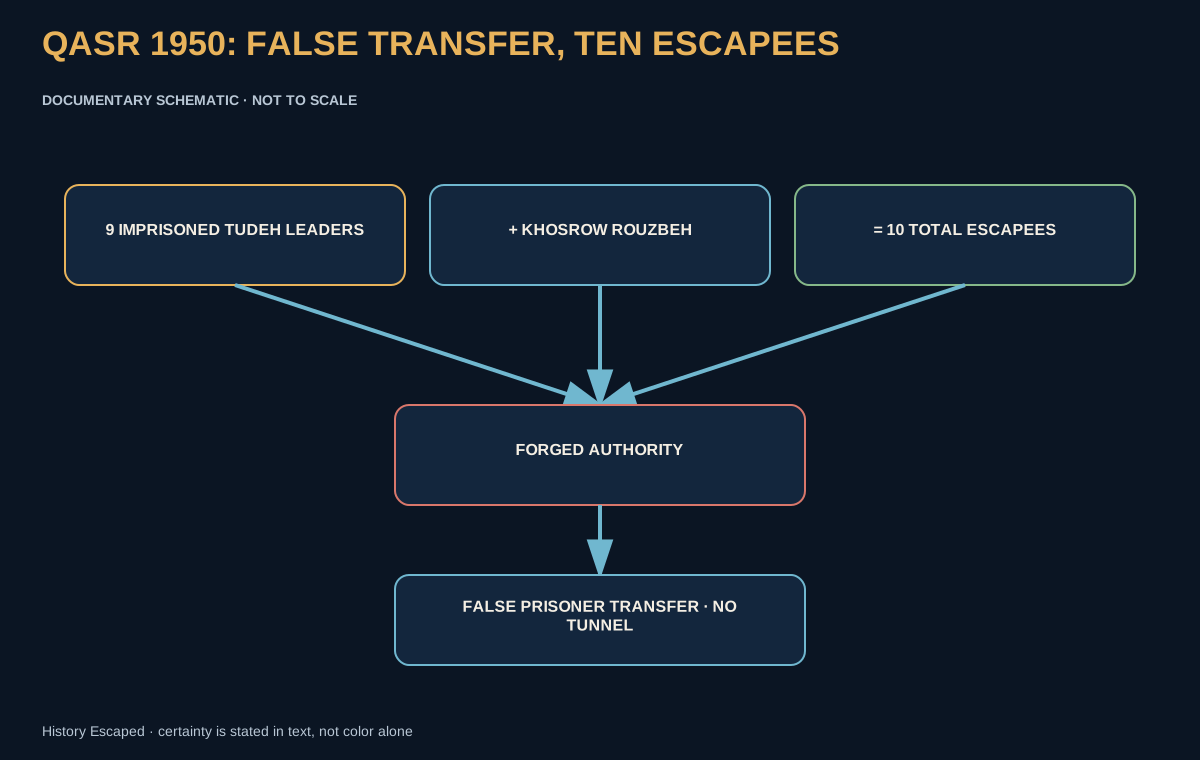
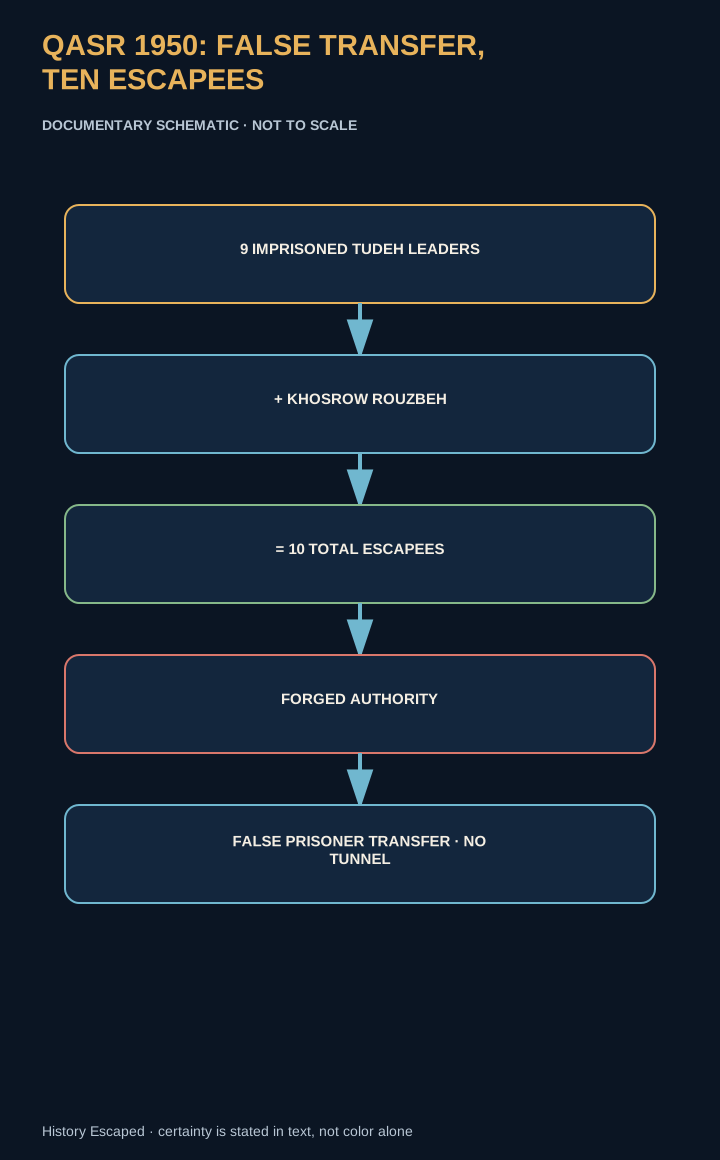
Simplified evidence-led editorial reconstruction based on the cited record; not to scale. Uncertainty is stated directly in the visual and adjacent text.
