
Operación Estrella was a mass escape from the women’s prison at Cabildo in Montevideo during the night of 30–31 July 1971. Thirty-eight women left custody through an underground route prepared with outside assistance, moved into Montevideo’s sewer network, and emerged through a house used by the organization supporting the operation.
Most of the escapees were members of the Movimiento de Liberación Nacional–Tupamaros (MLN-T), but not all of them were. Cabildo also held women from other armed or revolutionary left organizations. That distinction matters because later retellings often reduce the entire group to “38 Tupamaras,” while Uruguay’s own historical research records a more mixed political-prisoner population.
The operation has also accumulated record-breaking and cinematic language. Its strongest historical value lies elsewhere: it was a coordinated inside-and-outside escape by thirty-eight women at a moment when Uruguay’s democratic institutions, state repression, armed political violence, and the role of women within revolutionary movements were all under intense strain.
At a Glance
- Prison: Cárcel de Mujeres de Cabildo, Montevideo
- Operation: Operación Estrella
- Date: night of 30–31 July 1971
- Conventional commemorative date: 30 July 1971
- Women on the political-prisoner roll: 43
- Physically in Cabildo that night: 42; one woman was in the Military Hospital
- Escaped: 38
- Remained in the prison: 4
- Political affiliation: most were MLN-T militants, with some prisoners from other left-wing armed organizations
- Route: prison → excavated connection → sewer network → second connection to an outside house
- Aftermath: most of the women were later rearrested; some spent many additional years in prison
- Evidence warning: later participant testimony is essential for the internal preparations, while contemporary newspapers and official memory institutions are stronger for the basic count and public aftermath
Cabildo before Operación Estrella
The Cabildo women’s prison had been run by the Congregation of the Good Shepherd since the beginning of the twentieth century. By the late 1960s it was increasingly used to hold women arrested for political and guerrilla-related activity.
Uruguay was not yet under the civic-military dictatorship that began in 1973. The country was, however, already experiencing a severe political crisis. President Jorge Pacheco Areco repeatedly used emergency security measures, strikes and student protests faced repression, censorship expanded, and allegations of police torture became a major public issue.
At the same time, the MLN-T had moved from clandestine political activity into an armed urban campaign involving robberies, kidnappings, bombings, attacks, and killings. By 1971 the conflict between the state and revolutionary organizations had become one of the central facts of Uruguayan politics.
Cabildo reflected that escalation. The first large political-prisoner escape from the institution took place on 8 March 1970. Thirteen women escaped through the prison chapel in the operation remembered as the fuga de las palomas. Security afterward became substantially tighter. Policewomen joined the internal guard structure, political and common prisoners were more clearly separated, and the prison was treated as a more serious security problem.
Within months, another escape was being planned.
Planning inside and outside
Operación Estrella differed fundamentally from the 1970 breakout. The earlier escape had exploited access through the chapel. The second depended on excavation from outside the prison and coordination with women inside.
University of the Republic research based on interviews, participant accounts, contemporary newspapers, and earlier histories describes a plan involving an outside house, access to Montevideo’s sewer network, and a second excavated connection leading toward the women’s sleeping area inside Cabildo.
The excavation took months. Uruguay’s National Human Rights Institution summarizes the work as more than forty metres of tunnel dug over roughly five months, although that figure should not be mistaken for the total distance the women later travelled underground. The operation used the existing sewer network between excavated sections.
Inside Cabildo, a small group initially knew the plan. Information was deliberately restricted because family visits and ordinary prison contact created a risk that the operation would become known outside the organizing circle before the tunnels were ready.
Women inside helped with measurements and with concealing noise from excavation. Later testimony also describes preparations for the night itself, including clothing for the underground passage and figures placed in beds to delay discovery.
Those mechanics are historically significant, but exact work schedules, street-by-street tunnel geometry, and every signal used during the operation come mostly from later participant reconstruction. They do not need to be reproduced as a modern procedural blueprint.
Forty-three, forty-two, thirty-eight
The participant count looks simple until the sources are compared. University research states that 43 political prisoners were associated with Cabildo at the time. One woman, however, was away from the prison in the Military Hospital. That left 42 women physically in the political-prisoner section when the escape took place.
Of those 42, 38 escaped and four remained. Participant memories explain the decisions to remain in different ways, including recent childbirth, advanced pregnancy, or serious health conditions. Contemporary and later accounts do not always describe those individual circumstances identically, so the secure arithmetic matters more than forcing one standardized explanation onto all four women.
The result is a clean denominator: 43 on the roll → 1 hospitalized → 42 present → 38 escaped → 4 remained. That reconciliation also explains why some sources say 42 women were held while others say 43.
Who escaped
The thirty-eight were not simply anonymous members of a single organization. Among them were Alicia Rey Morales, Graciela Jorge Pansera, Yessie Macchi, Lucía Topolansky, María Elia Topolansky, Ana Casamayou, Nélida “Chela” Fontora, Sonia Mosquera, Lía Maciel, Edda Fabbri, Xenia Itté, Virginia Oliveri, and many others.
A contemporary El País report on 31 July printed all thirty-eight names and photographs. Its language—calling them “sediciosas”—reflects the polarized press vocabulary of the period, and the same item even misdated the earlier 1970 escape. It remains valuable for the roster when cross-checked against later institutional and participant records.
Most of the thirty-eight belonged to the MLN-T. University research also notes prisoners associated with FARO, OPR-33, and Movimiento 22 de Diciembre. Operación Estrella was organized by the MLN-T, but the opportunity to leave was extended more broadly among the political prisoners.
This was therefore an MLN-organized escape, not a group composed exclusively of MLN members.
The night of 30–31 July
The operation is conventionally dated 30 July 1971. Uruguay’s official memory-site descriptions, parliamentary catalog records, and much later historical writing use that date.
Participant Ana Casamayou remembered the women actually leaving in the madrugada del 31 de julio—the early hours of 31 July. A University of the Republic study, by contrast, describes the escape as occurring in the early hours of the 30th while also drawing on sources that place preparations on the night of 30 July.
The best way to avoid manufacturing a precision the source tradition does not consistently preserve is to treat Operación Estrella as unfolding during the night of 30–31 July 1971, while retaining 30 July as the conventional operation date.
The broad sequence is much firmer. Once the internal opening was completed, the women entered the underground connection from the prison. Outside members of the operation helped guide the movement through the subterranean route. The escapees were divided into smaller groups so that dozens of people did not try to move through the same narrow space at once.
They passed into the sewer network and eventually reached another excavated connection leading into a house prepared outside the prison. From there, the thirty-eight dispersed.
The outside house
The house was not simply a hiding place at the end of the tunnel. It was the interface between the prison escape and the underground political organization operating in Montevideo.
Later participant accounts describe clothes, shoes, money, vehicles, and contacts awaiting the women. Those resources mattered because emerging from the sewer did not make any of them legally free. They were fugitives who immediately had to enter clandestinity.
Accounts vary over the precise distance between Cabildo and the house, and some later stories give long sewer-route measurements that are difficult to reconcile with the shorter excavation figures in official summaries. The distinction is straightforward: excavated tunnel length and total underground travel were not the same thing.
A useful reconstruction therefore needs only three nodes: Cabildo, the sewer system, and the outside house. A street-level escape map would add false precision without improving the history.
Discovery and the public story
When the escape became known, Uruguayan newspapers gave it heavy coverage. The political vocabulary depended on the newspaper. Left-wing and right-wing publications described the women, their political identities, and the operation in markedly different language. University research on the press found that coverage of the Cabildo escapes repeatedly minimized women’s own agency by treating male Tupamaros outside the prison as the principal actors.
That framing is especially misleading for Operación Estrella. The excavation depended heavily on an outside team, but the women inside had to protect the secrecy of the plan, coordinate the internal end of the operation, prepare the group, and actually make the underground crossing.
The operation was collective across the prison boundary. The gender issue continued afterward. The September 1971 escape of more than one hundred prisoners from Punta Carretas became far more prominent in Uruguay’s public memory, while women who had escaped Cabildo later argued that their own operation was pushed into the background.
That does not require turning Operación Estrella into a competition over which prison break was more impressive. It does explain why participant memoir, photography, oral history, and later scholarship have placed so much emphasis on restoring the women to the center of their own story.
Rearrest and longer imprisonment
Operación Estrella produced real freedom, but for many women it was temporary. Uruguay’s official memory institution states that most of the thirty-eight were later detained again and that some ultimately spent more than a decade in prison. The political conflict intensified sharply after 1971, the MLN-T was largely defeated militarily in 1972, and Uruguay entered civic-military dictatorship the following year.
Individual outcomes differed widely. Some women were rearrested relatively quickly. Others remained underground longer. Some endured years of later political imprisonment and were not finally released until the democratic transition and amnesty of 1985.
Those later histories can easily overwhelm the escape itself. For this case, their role is narrower: they demonstrate that getting out of Cabildo did not end the political struggle or the state’s attempt to recapture the escapees.
Memory, testimony, and the problem of a perfect story
Two participant-centered works are especially important to the later memory of the escape. Graciela Jorge Pansera published Historia de 13 Palomas y 38 Estrellas in 1994, preserving the two Cabildo escapes from the perspective of women who experienced political imprisonment. In 2018, journalist Josefina Licitra published 38 estrellas, drawing on extensive interviews to reconstruct not only the operation but disagreements, class differences, gender expectations, motherhood, sexuality, and tensions inside the revolutionary left.
Ana Casamayou later photographed women who had participated in the escape. Nélida Fontora also wrote a memoir that includes her experience moving through the sewers.
These works are valuable precisely because contemporary official records and newspaper coverage did not capture the experience from inside the prison. They are not interchangeable with a 1971 police report. Dialogue, exact feelings, minute-by-minute sequencing, and some operational detail remain retrospective testimony unless independently corroborated.
That distinction protects the history from becoming too perfect.
What the evidence supports
Operación Estrella was a mass escape from Cabildo organized by the MLN-T in coordination with women inside the prison. Thirty-eight women escaped. Forty-two political prisoners were physically in Cabildo at the time and four remained; a forty-third woman associated with the prison population was in the Military Hospital.
The operation used excavated underground links and Montevideo’s sewer network to connect the prison with an outside house. Preparation lasted months and depended on substantial coordination both inside and outside Cabildo.
The exact calendar labeling is less tidy than the anniversary suggests. Official institutions conventionally use 30 July 1971, while a participant account places the escape in the early hours of 31 July. “Night of 30–31 July” preserves both.
The operation was neither exclusively a male-directed rescue nor the work of women acting entirely without outside help. Its defining feature was coordination across the prison boundary.
That is the part most worth preserving: thirty-eight imprisoned women entered a plan built from both sides of confinement, crossed underground through Montevideo, and emerged into clandestinity together.
Evidence discipline
What the record supports
Status labels distinguish secure conclusions from uncertainty and rejected claims. Color is never the only signal.
DISPUTED
Operación Estrella occurred on one uncontested calendar date, 30 July 1971.
Official memory institutions and most historical references use 30 July. Participant Ana Casamayou later dated the women’s exit to the early hours of 31 July. The event is therefore displayed as the night of 30–31 July.
Sources: SRC-001, SRC-003, SRC-007, SRC-009MYTH
There were contradictory totals of 42 and 43 prisoners because one source must be wrong.
The figures can be reconciled: 43 political prisoners were associated with Cabildo, one was in the Military Hospital, 42 were physically present, 38 escaped, and four remained.
Sources: SRC-001, SRC-003MYTH
All 38 escapees were members of the MLN-T.
Most were MLN-T militants, but academic research identifies women from other armed left organizations among Cabildo’s political prisoners and notes that the escape opportunity was not limited exclusively to MLN members.
Sources: SRC-003, SRC-004MYTH
Operación Estrella was simply an outside rescue of passive women prisoners.
Outside organizers performed essential excavation and logistical work, while women inside coordinated measurements, concealment, preparation, and the mass departure. The operation depended on both sides.
Sources: SRC-001, SRC-003, SRC-005DISPUTED
A single published tunnel length gives the total distance the women travelled underground.
Official and press accounts give different excavation measurements, while participant narratives describe a longer passage through the existing sewer system. Excavated tunnel length and total underground travel were different quantities.
Sources: SRC-001, SRC-003, SRC-010WELL-SUPPORTED
The contemporary press roster can be used without qualification.
The 31 July El País page is valuable for all 38 names and photographs, but its politicized wording and an error in the date of the earlier Cabildo escape show why it must be cross-checked.
Sources: SRC-010Documentary reconstruction
Forty-three associated, thirty-eight escaped
A case-local editorial visual separates the secure historical sequence from uncertainty without exposing reusable modern operational detail.
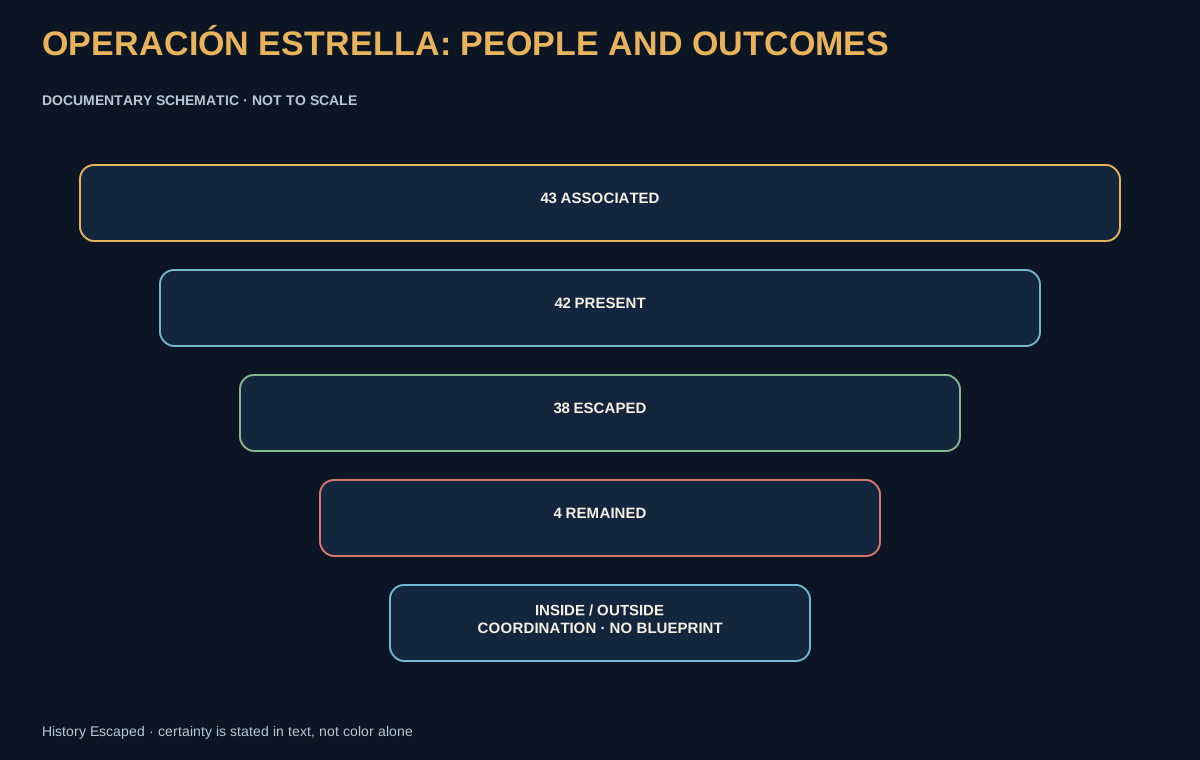
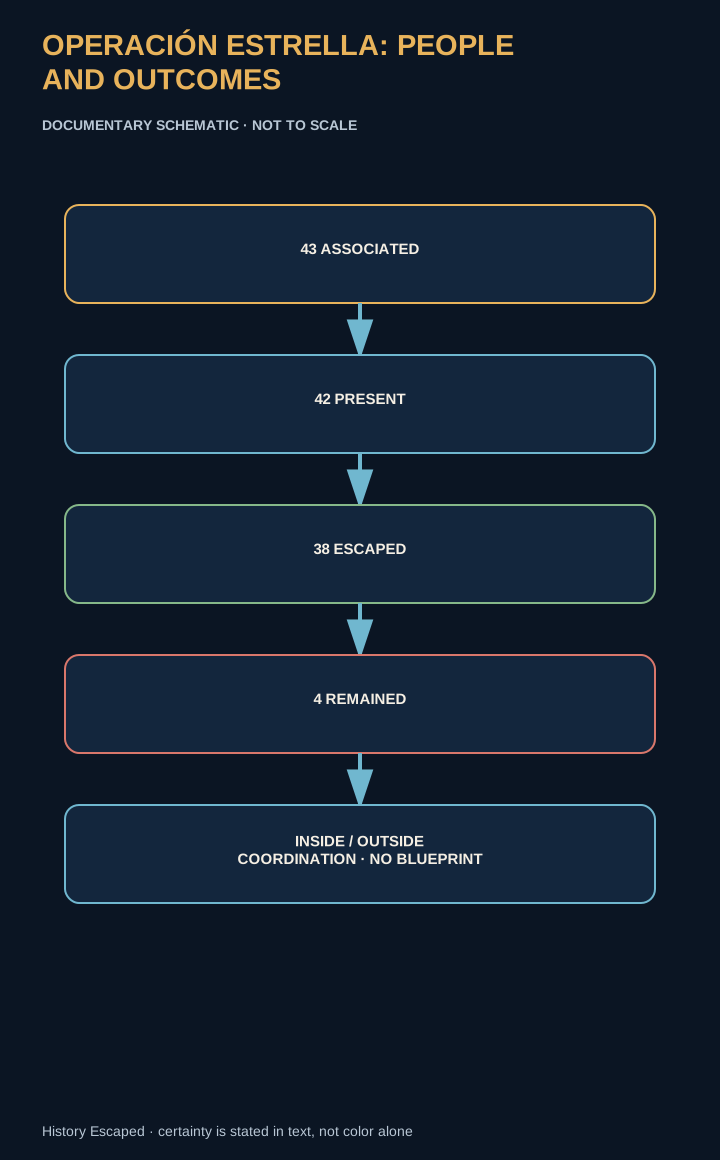
Simplified evidence-led editorial reconstruction based on the cited record; not to scale. Uncertainty is stated directly in the visual and adjacent text.