
Pemulwuy’s 1797 escape from the Parramatta hospital is securely recorded in one of the most important early colonial accounts of New South Wales. The details most often added to the story are not.
In March 1797, after years of resistance to the expanding British settlement around the Georges River, Prospect, Toongabbie and Parramatta, Pemulwuy was badly wounded in a confrontation near Parramatta. David Collins, the colony’s judge-advocate and later historian, wrote that seven pieces of buckshot struck him in the head and other parts of his body. He was taken to the hospital “extremely ill.”
By late April, Collins recorded Pemulwuy again among Aboriginal people near Botany Bay. He had recovered and, Collins wrote, had “escaped from the hospital with an iron about his leg.”
That sentence is the firm core of the escape. It does not explain how Pemulwuy got out, when exactly he left, whether anyone helped him, or what kind of restraint remained attached to him beyond a single iron on his leg. Later accounts often convert the phrase into plural “leg-irons,” a chain, or a dramatic flight from a guarded bed. Those additions go beyond Collins’s surviving description.
At a Glance
- Escapee: Pemulwuy, a Bidjigal man from the Botany Bay–Georges River region
- Context: Aboriginal resistance to British occupation and agricultural expansion around early Sydney
- Wounding: March 1797, in the confrontation commonly called the Battle of Parramatta
- Hospital: Parramatta’s colonial hospital
- Escape: after the March wounding and before a late-April sighting near Botany Bay
- Restraint: Collins recorded “an iron about his leg”
- Physical escape method: unknown
- Immediate outcome: returned to Country and remained beyond colonial custody
- Later resistance: continued for several years
- Death: shot in 1802; his head was removed and sent to Sir Joseph Banks in England
- Evidence warning: the hospital escape is documented, but later stories have added mechanics and supernatural framing that require qualification
Resistance before the hospital
Pemulwuy was already well known to colonial authorities years before his capture. He was a Bidjigal man whose Country lay around Botany Bay and the Georges River. From 1790 he appeared repeatedly in British records of frontier conflict. That year he speared Governor Arthur Phillip’s gamekeeper John McIntyre, who later died. Watkin Tench’s contemporary account recorded that other Aboriginal people identified Pemulwuy as the attacker.
The British response included punitive expeditions. Phillip initially ordered a force to kill and behead Aboriginal men in retaliation, although the operation failed to capture its intended targets.
From 1792, Pemulwuy was associated with repeated attacks on farms, stores, travellers and crops as British settlement expanded across Aboriginal land. Later Australian historical institutions describe these actions as resistance to colonisation. Collins, writing from within the colonial government, used hostile language and described Pemulwuy as a persistent danger to settlers.
Both contexts matter. Colonial sources provide much of the surviving documentary evidence, but their descriptions were written by officials involved in the dispossession and military response that Pemulwuy opposed.
The confrontation at Parramatta
By early 1797, conflict around the farms north and west of Parramatta had intensified. Collins wrote that settlers at the Northern Farms had repeatedly lost provisions and clothing to Aboriginal groups and that a man and woman had recently been killed. Armed settlers pursued a large Aboriginal group toward Parramatta. Pemulwuy then appeared with another large body of Aboriginal men.
The confrontation ended with colonial gunfire. Collins reported that five Aboriginal men were killed immediately and others wounded. Pemulwuy received seven pieces of buckshot in his head and body and was taken “extremely ill” to the hospital.
Modern scholarship commonly reconstructs the main confrontation as occurring on 22 March 1797 after events beginning the previous day. The exact dating comes from later source comparison rather than from a simple dated eyewitness battle report, so the escape page does not need to make the reconstructed day carry more certainty than it can bear.
Later casualty figures also vary dramatically. A nineteenth-century writer claimed that around fifty Aboriginal people were shot, while Collins’s account explicitly records five killed in the first volley and additional wounded. The higher number should not be treated as equivalent evidence.
For the escape, the important fact is simpler: Pemulwuy survived a serious gunshot wounding and entered colonial custody at Parramatta.
The Parramatta hospital
The hospital was not a later modern hospital building. Parramatta’s first permanent brick hospital had opened in 1792 near the river, replacing an earlier makeshift facility.
The Dictionary of Sydney describes the 1792 hospital as a clay-brick complex serving convicts and the settlement. Conditions in early colonial hospitals could be poor, and the institution was primarily a medical facility rather than a purpose-built high-security prison.
That distinction helps explain why the phrase “hospital escape” should not automatically be imagined as a breakout from a later carceral complex. What custody measures were imposed specifically on Pemulwuy are not fully recorded. Collins’s later line establishes one restraint: an iron remained on his leg when he escaped. It does not establish a pair of shackles, a chain to the building, a ball-and-chain arrangement, or continuous guard placement.
An escape with missing mechanics
No surviving account used here describes the physical act of escape. There is no secure record of Pemulwuy cutting a chain, forcing a door, climbing through a window, overpowering a guard, receiving an organized rescue, or walking out because supervision failed. The exact date is also unknown.
The chronology gives only a window. Pemulwuy was wounded in March and taken to the Parramatta hospital. By late April, Governor John Hunter’s party encountered Aboriginal groups near Botany Bay and found Pemulwuy among them.
Collins wrote that Pemulwuy had by then recovered from his wounds and had escaped while still carrying the leg iron. That makes the escape DOCUMENTED, while almost every mechanical detail remains UNKNOWN.
Modern retellings often make the feat more dramatic by saying he escaped “in leg irons.” That wording is understandable shorthand, but it changes Collins’s singular and ambiguous “an iron about his leg” into a more specific restraint system than the source establishes.
The canonical description should therefore remain precise: Pemulwuy escaped from the Parramatta hospital with an iron on or about his leg.
Seen again near Botany Bay
The next secure episode is striking because it comes from the same colonial source. During an April excursion, Hunter and other members of the colonial party encountered several groups of Aboriginal people near Botany Bay. Pemulwuy was present. Collins recorded that he spoke with one of the gentlemen and asked whether the governor was angry with him.
That encounter shows that the escape had already succeeded in its immediate purpose. Pemulwuy was no longer under colonial custody and had returned to an Aboriginal social landscape in which the government could not simply confine him at will.
The scene should not be overinterpreted as reconciliation. Collins’s own hostile commentary immediately continued to characterize Pemulwuy as dangerous, and conflict resumed in later years.
Survival and the carradhy tradition
Pemulwuy’s repeated survival from serious injuries contributed to an important part of his historical memory. The Australian Dictionary of Biography records that another Aboriginal man, Colebee, described Pemulwuy’s deliberately injured or clubbed foot as a sign that he was a carradhy, often translated as a clever man or man with spiritual powers. Collins later wrote that an idea existed among Aboriginal people that firearms could not kill Pemulwuy because he had survived repeated wounds.
Colonial writers did not fully understand the cultural meaning of such beliefs. Modern accounts should therefore be cautious about reducing carradhy status to a simple claim of magical invulnerability.
The hospital escape almost certainly strengthened Pemulwuy’s reputation: he had been shot repeatedly, captured, taken to a British medical institution, restrained, and then reappeared outside colonial custody. That historical sequence is powerful without requiring historians to declare a supernatural explanation true or false.
Resistance after the escape
Pemulwuy continued to be associated with attacks on farms and settlements after 1797. Colonial authorities increasingly treated him as a central target. In 1801 Governor Philip Gidley King issued orders permitting force against Aboriginal people in several districts and later offered substantial rewards for Pemulwuy’s capture or death.
The colonial campaign against him formed part of a wider frontier conflict over land, food sources, movement and sovereignty. Government records frequently described Aboriginal resistance as criminal plunder or murder; modern Aboriginal and Australian historical institutions place the same events within resistance to invasion and dispossession.
Neither vocabulary should be silently substituted for evidence about a specific incident. A raid on crops, a retaliatory killing, and a battle with soldiers may all belong to the same frontier conflict while still requiring separate factual treatment.
Death and the removal of his head
Pemulwuy remained beyond colonial control until 1802. He was shot dead on or shortly before 2 June. The identity of the person who fired the fatal shot is disputed in modern scholarship.
What happened afterward is better documented. His head was severed and sent to the British naturalist Sir Joseph Banks. Governor King described Pemulwuy to Banks as both a serious enemy of the colony and a “brave and independent character.”
The current location of the head is unknown. That treatment of Pemulwuy’s body is part of the violence of the colonial record and should not be presented as a macabre curiosity. Australian institutions and Indigenous communities have treated the loss and possible repatriation of his remains as an ongoing issue of dignity and historical justice.
The portrait and the problem of certainty
The best-known image associated with Pemulwuy also needs qualification. James Grant’s Narrative of a Voyage of Discovery, published in 1803–04, included an engraving titled “Pimbloy: Native of New Holland in a Canoe of that Country.” The National Museum of Australia describes it as the only contemporary image that may depict Pemulwuy. The original image on which Samuel John Neele’s engraving was based has not survived.
The State Library of New South Wales has traditionally identified “Pimbloy” as Pemulwuy and notes Grant’s statement that people who had seen the man considered the likeness strong. That makes the engraving an unusually valuable historical representation, but not the equivalent of a photograph whose identity can be independently confirmed. It is best identified cautiously as an engraving believed or traditionally identified to depict Pemulwuy.
What the escape record supports
The strongest version of the hospital escape is also the least embellished. Pemulwuy was severely wounded during the March 1797 conflict at Parramatta. Collins recorded seven pieces of buckshot in his head and body. He was taken to the Parramatta hospital.
Sometime afterward, and before a late-April encounter near Botany Bay, he escaped. Collins says he still had “an iron about his leg.”
The source does not tell us how he left. That evidentiary boundary matters because the escape became part of a larger story about Pemulwuy’s ability to survive gunfire, avoid colonial pursuit and return repeatedly to resistance. The documented feat needs no invented lock, window, guard, chain or rescue scene.
Its significance lies in the outcome: a wounded Bidjigal resistance figure entered British custody and then returned to Country, where colonial authorities would spend another five years trying to stop him.
Evidence discipline
What the record supports
Status labels distinguish secure conclusions from uncertainty and rejected claims. Color is never the only signal.
DOCUMENTED
Pemulwuy escaped from the Parramatta hospital after being wounded in 1797.
David Collins’s near-contemporary history records both the hospitalization and the later escape; modern institutional histories corroborate the sequence.
Sources: SRC-001, SRC-002, SRC-003UNKNOWN
Pemulwuy escaped while wearing a specific pair of leg-irons or a ball-and-chain restraint.
Collins says only that he escaped 'with an iron about his leg.' Later plural 'irons' and more elaborate restraint descriptions are more specific than the surviving source.
Sources: SRC-001UNKNOWN
The physical method of the hospital escape is known.
No reliable source used here identifies a window, door, chain-cutting, guard confrontation, rescue party, or other mechanism.
Sources: SRC-001, SRC-002UNKNOWN
The escape occurred on a securely known exact day.
The evidence fixes hospitalization after the March confrontation and establishes Pemulwuy outside custody by late April, but no exact escape date has been established.
Sources: SRC-001, SRC-002DISPUTED
Approximately fifty Aboriginal people were killed in the March confrontation.
That much higher figure comes from later nineteenth-century reporting. Collins explicitly records five killed immediately and additional wounded; modern sources caution against treating the higher number as equally secure.
Sources: SRC-003, SRC-005DISPUTED
The 'Pimbloy' engraving is a photographically certain portrait of Pemulwuy.
State Library and National Museum sources identify or believe the engraving to depict Pemulwuy, but the National Museum notes that it is the only contemporary image that may be of him and that Grant’s original image has not survived.
Sources: SRC-006, SRC-009Documentary reconstruction
Documented hospital escape, unknown mechanics
A case-local editorial visual separates the secure historical sequence from uncertainty without exposing reusable modern operational detail.
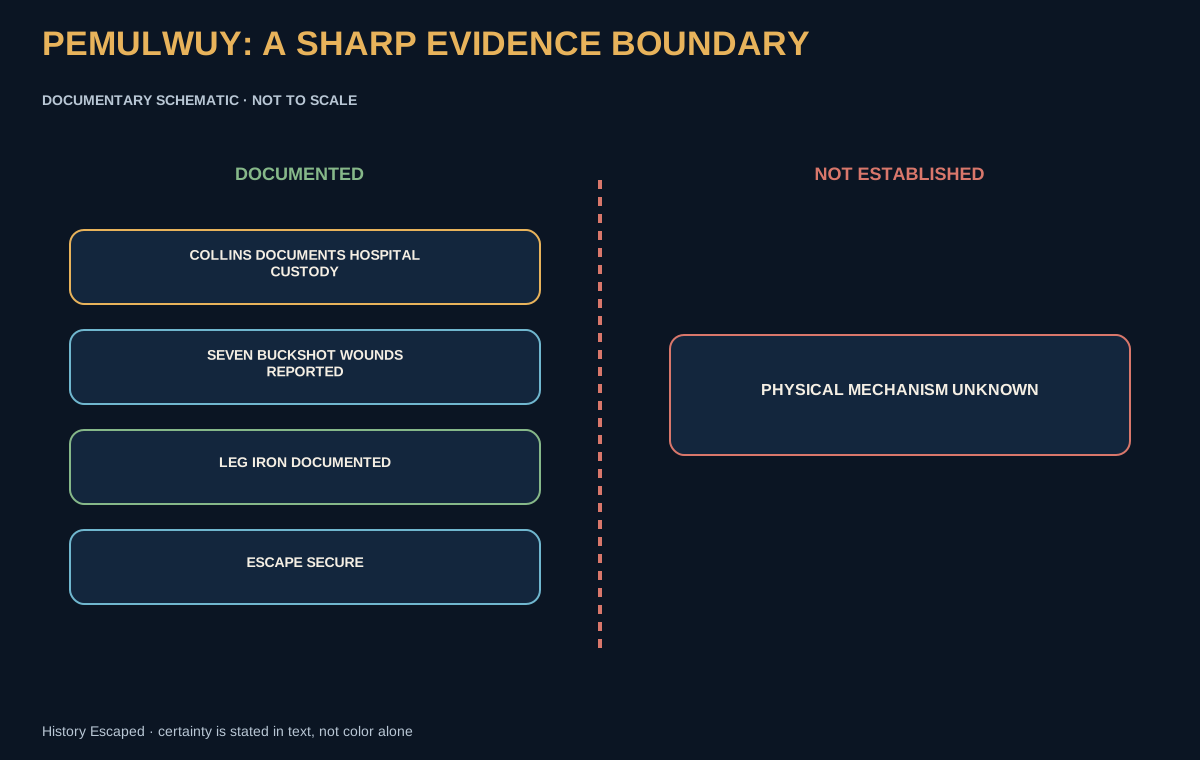
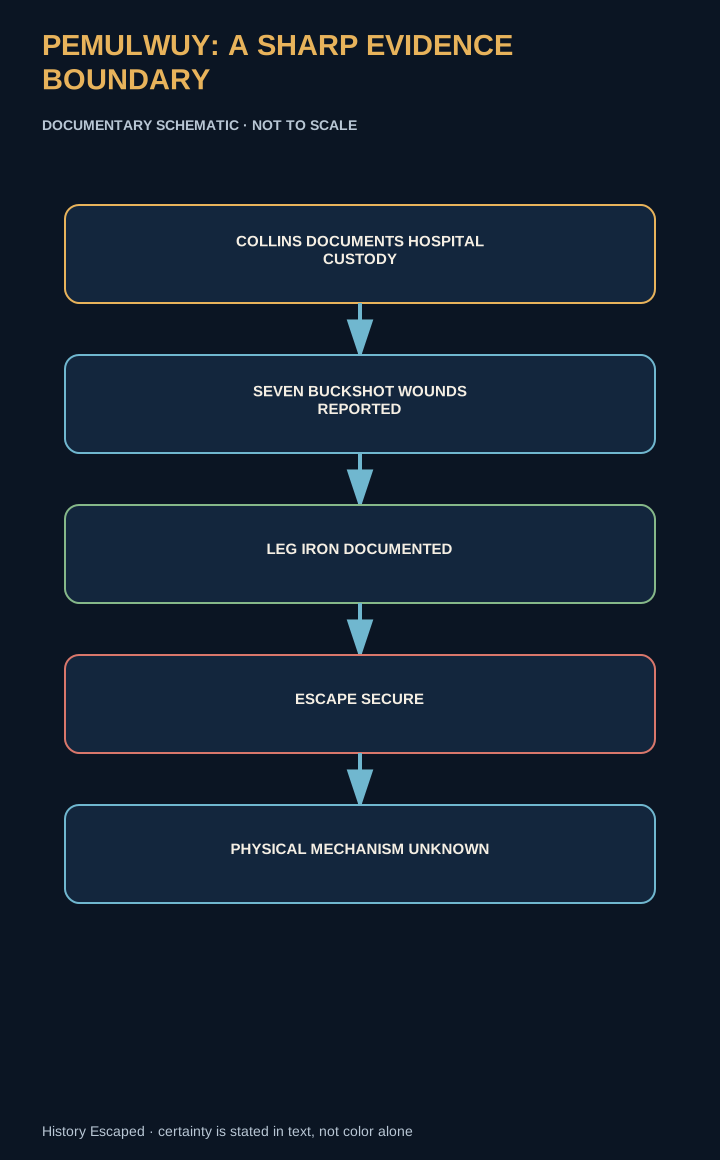
Simplified evidence-led editorial reconstruction based on the cited record; not to scale. Uncertainty is stated directly in the visual and adjacent text.