
Ted Bundy escaped from Colorado custody twice in 1977. The two events belong on the same page because the second followed directly from the first, but they did not have the same outcome.
The first escape, from the Pitkin County Courthouse in Aspen on 7 June, lasted six days and ended with Bundy back in custody. The second, from the Garfield County Jail in Glenwood Springs on the night of 30–31 December, carried him out of Colorado. While he remained a fugitive in Florida, Margaret Bowman and Lisa Levy were murdered; Kathy Kleiner, Karen Chandler, and Cheryl Thomas survived attacks; and twelve-year-old Kimberly Leach was abducted and murdered. Those consequences are essential to understanding why the second escape cannot be treated as a colorful episode of criminal ingenuity.
At a Glance
- First escape: 7 June 1977, Pitkin County Courthouse, Aspen
- First recapture: early 13 June 1977, Aspen
- Second escape: night of 30–31 December 1977, Garfield County Jail, Glenwood Springs
- Custody before the escapes: serving a Utah sentence for aggravated kidnapping while awaiting trial in Colorado for the murder of Caryn Campbell
- Second-escape discovery: around midday on 31 December
- Fugitive movement after Glenwood Springs: out of Colorado and ultimately to Tallahassee, Florida
- Final arrest: 15 February 1978, Pensacola, Florida
- Important distinction: the two breakouts are historically significant because of their consequences, not because they provide a model for defeating courthouse or jail security
Why Bundy was in Colorado
Bundy arrived in Colorado already convicted of a violent crime. In Utah, he had been found guilty of the aggravated kidnapping of Carol DaRonch, who had escaped from him in 1974. The Utah Supreme Court later upheld that conviction.
Colorado authorities separately charged Bundy with murdering Caryn Campbell. Campbell, a twenty-three-year-old nurse, disappeared while staying near Snowmass in January 1975; her body was found weeks later. Bundy was transferred from Utah to Colorado in January 1977 to face the case.
The Campbell charge is the reason the two Colorado escapes occurred at all. Bundy was being held in Glenwood Springs and transported to Aspen for court proceedings while the murder case moved toward trial. He never stood trial for Campbell’s murder because the second escape removed him from Colorado custody and his later prosecutions took place in Florida.
By June 1977 Bundy had also elected to represent himself in the Colorado proceedings. That decision affected how he was handled in court, but the escape does not require a detailed inventory of every courthouse practice that failed that morning.
The Aspen courthouse escape
On 7 June 1977, Bundy was at the Pitkin County Courthouse for pretrial proceedings. During a recess he was allowed access to the courthouse law library and was not physically restrained. At approximately 10:48 a.m., he left through a second-story window and ran from the courthouse area.
Contemporary law-enforcement records and later local reporting agree on the basic sequence. The escape triggered roadblocks and a large search around Aspen. Bundy moved into the mountainous country south of town rather than immediately escaping the region.
His time at large was not a clean flight to another state. He spent days moving through the mountains, broke into property for food and clothing, and eventually returned toward Aspen. The surviving official itinerary records thefts and burglaries committed during the six-day period, but a turn-by-turn wilderness route adds little historical value.
Early on 13 June, deputies stopped a stolen Cadillac being driven in Aspen and identified Bundy. He was back in custody roughly six days after leaving the courthouse.
The first escape therefore failed in its larger purpose. Bundy had temporarily broken custody, but he had not established durable freedom. He was returned to jail, new escape-related charges followed, and his Colorado murder case continued.
Back in Glenwood Springs
After the Aspen recapture, Bundy remained in the Garfield County Jail in Glenwood Springs while the Campbell case proceeded. The old jail has since been demolished.
Accounts of the next six months often dwell on the physical preparations Bundy made inside his cell. Some later retellings give measurements, describe tools, specify weight loss, and reconstruct the internal building spaces in detail. Those particulars are not necessary to understand what happened.
The secure historical mechanism is simpler: Bundy created or enlarged access from his cell into the space above it. On the night of 30 December, he left the cell through that overhead area, reached part of the jailer’s adjoining residential space, changed into civilian clothing, and exited the building.
The Garfield County escape was not discovered immediately. A Glenwood Post report, quoted decades later by the local Post Independent, said Bundy had escaped Friday night and that his absence was not discovered until Saturday afternoon. Contemporary wire reporting likewise said he had last been seen at about 7 p.m. Friday and was discovered missing shortly after noon Saturday.
That evidence is why the date is best expressed as the night of 30–31 December 1977. Many later FBI and popular histories call it a New Year’s Eve escape because the manhunt began on 31 December. The physical departure, however, is best placed on Friday night, 30 December.
The second escape did not end in Colorado
By the time officers knew Bundy was gone, he had a substantial head start. The FBI’s later multiagency chronology records movement from Colorado to Chicago, then through Michigan and Georgia before he reached Tallahassee in early January.
The exact travel sequence is useful only at that broad level. It establishes the central difference between the two escapes: after Aspen, Bundy remained trapped in the local search area and was caught within days; after Glenwood Springs, he crossed jurisdictions before authorities realized how far he had gone.
The FBI issued and circulated fugitive information and eventually placed Bundy on its Ten Most Wanted Fugitives list on 10 February 1978. That manhunt is part of the escape story because he was no longer merely absent from a county jail. He was a fugitive moving under false identities while multiple agencies attempted to locate him.
What happened while he was free
The consequences of the second escape are the reason it requires unusually restrained treatment.
In the early morning of 15 January 1978, an intruder entered the Chi Omega sorority house near Florida State University in Tallahassee. Margaret Bowman and Lisa Levy were killed. Kathy Kleiner and Karen Chandler survived serious attacks. Within about an hour, Cheryl Thomas was attacked in a nearby residence and survived.
Bundy was later convicted in Florida of the murders of Bowman and Levy and the attempted murders of Kleiner, Chandler, and Thomas. The Florida Supreme Court affirmed those convictions.
On 9 February, twelve-year-old Kimberly Leach disappeared from her junior high school in Lake City. Her body was found later that spring. Bundy was convicted of her kidnapping and murder, and the Florida Supreme Court affirmed that conviction as well.
These crimes should not be reduced to the phrase “what Bundy did next.” Bowman, Levy, Kleiner, Chandler, Thomas, and Leach were the people who bore the consequences of the period in which he remained outside custody. Their names belong in the escape’s aftermath because the success of the Glenwood Springs breakout created the circumstances in which those later crimes occurred.
Admiring descriptions of the escapes are historically misleading. The record shows serious custody failures in Colorado. It also shows that their consequences were borne by other people.
Final capture
Bundy remained unidentified in Florida for several weeks. On 15 February 1978, a Pensacola police officer stopped him while he was driving a stolen Volkswagen. Bundy resisted and attempted to flee but was subdued and taken into custody.
At first the officer did not know whom he had arrested. Fingerprints and fugitive information established Bundy’s identity. The second Colorado escape had lasted approximately six and a half weeks.
He did not return to Colorado to stand trial for Caryn Campbell’s murder. Florida prosecuted him for the crimes committed there, resulting in convictions and death sentences. He was executed by the State of Florida in 1989.
For this case, those later proceedings matter only insofar as they close the escape chronology and establish the outcomes of the crimes committed while he was free. They do not turn a page about two Colorado escapes into a general biography of Bundy.
Two escapes, two different outcomes
The June and December events are easy to blur together because both occurred in western Colorado within seven months.
Aspen was a courthouse escape followed by local evasion. Bundy left through a second-story window, spent six days in and around the mountains near Aspen, and was recaptured in a stolen car.
Glenwood Springs was a jail escape followed by interstate flight. Bundy left through the building’s overhead space, was not discovered missing until the next day, and moved beyond Colorado before the search caught up with him.
The second outcome is what gives this case its historical weight. It was not merely a more successful version of the first breakout. It put a convicted kidnapper and murder defendant beyond custody long enough for additional people to be killed and seriously injured.
The institutional question is therefore larger than how Bundy got out. The two 1977 escapes show what can happen when custody failures are narrated only as cleverness on the part of the prisoner. The more important historical record includes Carol DaRonch, who survived the crime for which Bundy was already imprisoned; Caryn Campbell, whose murder case brought him to Colorado; and the women and girl harmed after the second escape carried him to Florida.
Evidence discipline
What the record supports
Status labels distinguish secure conclusions from uncertainty and rejected claims. Color is never the only signal.
MYTH
The Aspen and Glenwood Springs events were one continuous escape.
They were separate events. Bundy escaped in Aspen on 7 June, was recaptured on 13 June, spent more than six months back in custody, and escaped again from Glenwood Springs at the end of December.
Sources: SRC-004, SRC-005, SRC-006DISPUTED
The second escape should be dated simply 31 December 1977.
Later FBI summaries often call it a New Year’s Eve escape, but local reporting says Bundy was last seen Friday evening, 30 December, escaped Friday night, and was discovered missing around midday Saturday, 31 December. The case therefore uses 'night of 30–31 December' while locking the physical departure to 30 December.
Sources: SRC-002, SRC-005, SRC-006MYTH
A detailed reconstruction of the Garfield County Jail’s internal vulnerabilities is necessary to understand the escape.
The historically meaningful mechanism is that Bundy left his cell into overhead building space, reached an adjoining residential area, and exited before his absence was discovered. Exact dimensions and procedural vulnerabilities are not required.
Sources: SRC-005, SRC-006MYTH
The first escape led directly to the Florida murders.
Bundy was recaptured after six days in June. The Florida crimes occurred after the separate Glenwood Springs escape at the end of December.
Sources: SRC-004, SRC-007, SRC-008MYTH
The second escape’s historical significance lies mainly in Bundy’s ability to evade custody.
Its most important consequence is that Bundy remained free long enough to commit crimes in Florida for which he was later convicted, including the murders of Margaret Bowman, Lisa Levy, and Kimberly Leach and attempted murders of Kathy Kleiner, Karen Chandler, and Cheryl Thomas.
Sources: SRC-007, SRC-008Documentary reconstruction
Two escapes, two consequence paths
A case-local editorial visual separates the documented sequence from uncertainty without implying exact modern geography or operational detail.
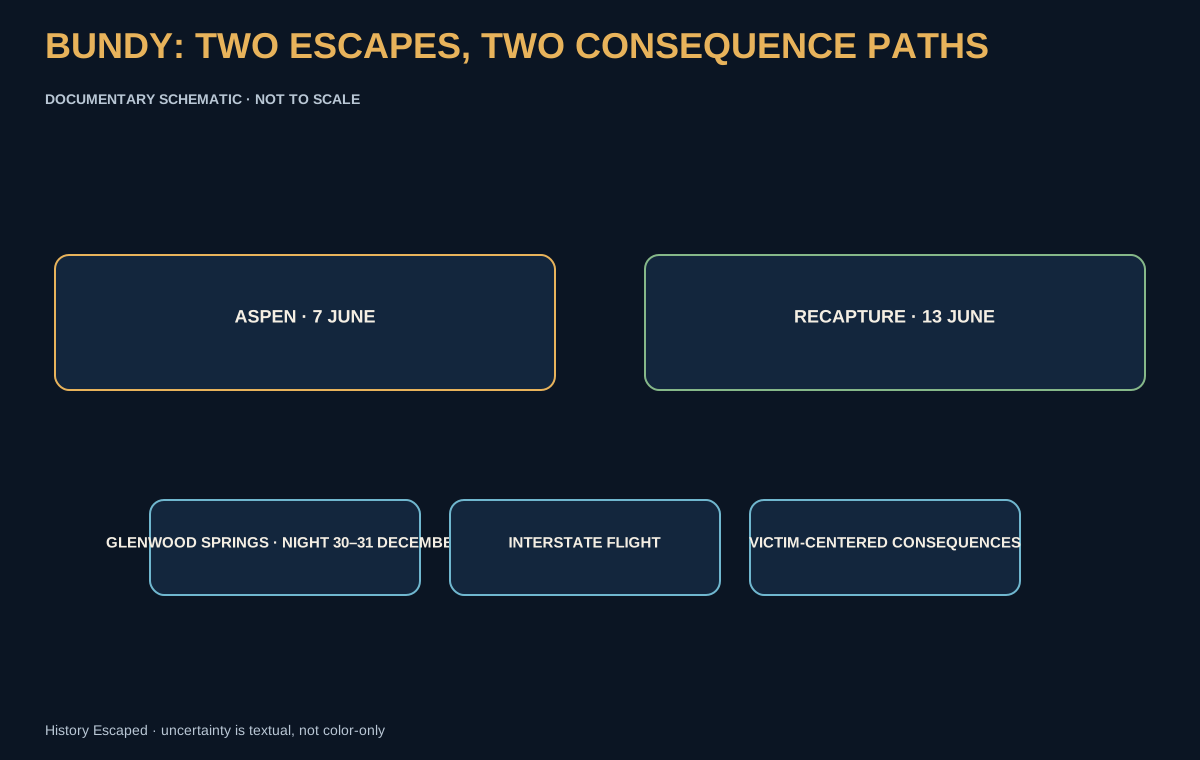
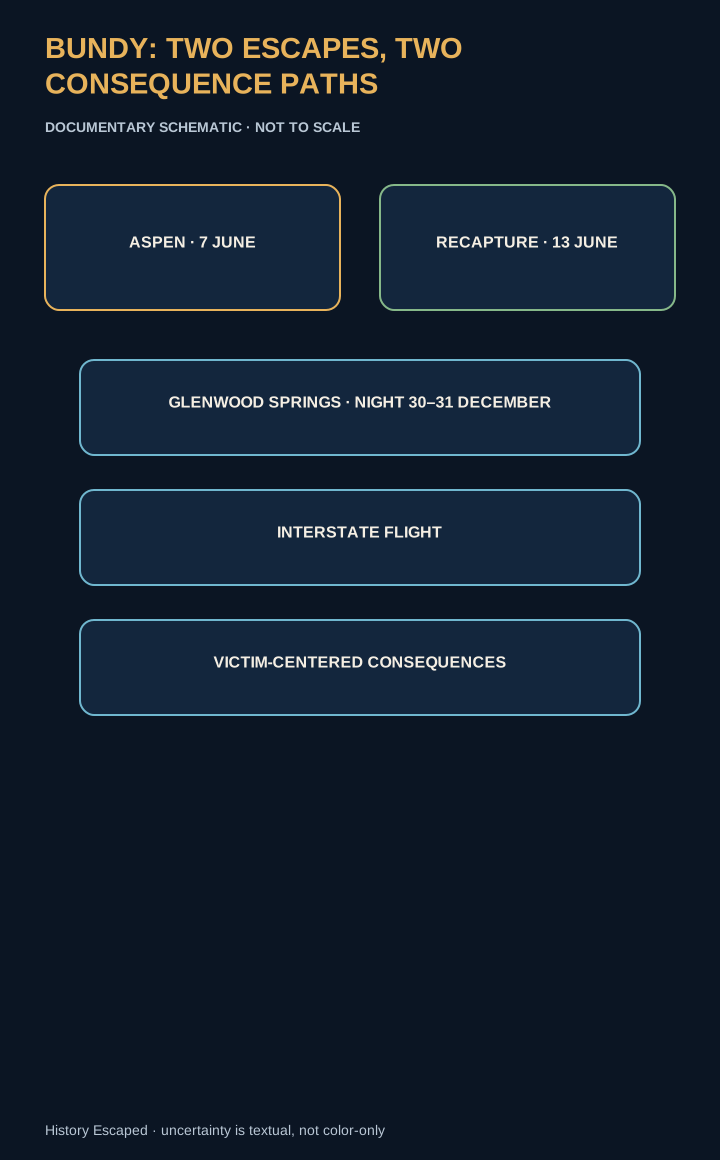
Simplified editorial reconstruction based on the cited historical record; not to scale. Uncertainty is stated directly in the visual and adjacent text.
