
Charles Sobhraj escaped from Delhi’s Tihar Jail on 16 March 1986 with six other prisoners after prison staff and inmates consumed drugged food during what was presented as a birthday celebration. The breakout took place in daylight and exposed serious failures inside one of India’s most closely watched prisons.
The event is often retold as proof of Sobhraj’s almost supernatural ability to manipulate people. That framing obscures a more useful history. The escape depended on outside help, unusual access inside Tihar, incapacitated staff, and a breakdown in ordinary control. It also produced a major investigation into possible staff complicity and prison administration.
The motive is similarly more complicated than the popular story. Sobhraj later said that he escaped because India was moving toward extraditing him to Thailand, where he faced serious criminal accusations and a possible death sentence. Later accounts go further and claim that he deliberately intended to be recaptured so that a new Indian sentence would keep him beyond the reach of the Thai case. The first claim comes directly from Sobhraj in 1986; the second is a later interpretation and should not be treated as proven fact.
At a Glance
- Prison: Tihar Jail No. 3, Delhi
- Escape date: 16 March 1986
- Time: shortly after 2 p.m. in contemporary reporting
- Prisoners who left custody: seven in total, including Sobhraj
- Outside accomplice: David Richard Hall was accused of playing a central role and was later arrested with Sobhraj
- Method: staff and prisoners were incapacitated after consuming drugged sweets, fruit and cream presented as part of a celebration
- Birthday claim: the party was a pretext; Sobhraj’s actual birthday was 6 April
- Immediate escape: contemporary police reporting later distinguished five prisoners who left in the getaway car from two others who took advantage of the disorder
- Recaptured: 6 April 1986 near Goa
- Time at large: 21 days
- Central source conflict: escaping to avoid Thai extradition is Sobhraj’s own stated motive; escaping specifically to be rearrested and extend his Indian custody remains a later claim
Why Sobhraj was still in Tihar
By 1986, Sobhraj had already spent nearly a decade in Indian custody. He had been arrested in New Delhi in 1976 after a group of French travelers became ill during an attempted drugging and robbery scheme. Indian proceedings produced convictions and acquittals across several cases, while authorities in other countries continued seeking him over separate crimes.
Thailand’s request became especially important. A 1986 answer in the Indian Parliament records that Thailand first requested Sobhraj’s extradition on 25 October 1976 and renewed the request in 1980. After an inquiry under India’s Extradition Act, Delhi’s Chief Metropolitan Magistrate reported in September 1985 that a prima facie case existed in support of extradition in two Thai cases.
Sobhraj challenged that result. The Delhi High Court dismissed his appeal on 12 December 1985. By May 1986, the Indian government told Parliament that further cases involving him were still pending before the Supreme Court and that the extradition could not yet be carried out because Indian proceedings had not been completed.
That legal position matters. Contemporary reports often said Sobhraj was simply about to be shipped to Thailand. In reality, extradition had advanced significantly, but unresolved Indian legal proceedings still stood between the Thai request and actual surrender.
Tihar and unusual access
Sobhraj’s life inside Tihar had long attracted attention.
A 1978 Supreme Court case involving his prison conditions shows that officials already regarded him as a security risk with an escape history. The Court nonetheless emphasized that security concerns did not remove a prisoner’s rights and rejected unnecessarily harsh treatment.
By the mid-1980s, later investigations suggested that Sobhraj had developed unusually broad access to people inside and outside the prison. Contemporary reporting after the escape described meetings with senior jail officials and visits by outsiders under circumstances that prompted immediate suspensions, arrests and administrative inquiry.
A later Delhi High Court judgment records that Sobhraj had been moved to Jail No. 3 in April 1985 and confirms the basic legal fact of the 16 March 1986 escape. The same judgment also shows how broad the subsequent conspiracy case became: prosecutors implicated numerous prisoners, outsiders and prison personnel.
Those accusations did not all survive judicial scrutiny. In 1995 the Delhi High Court discharged businessman Rajendra Singh Sethia from the escape conspiracy, finding insufficient evidence against him. The existence of a huge conspiracy investigation therefore cannot be converted into proof that every person charged actually helped Sobhraj.
A birthday that was not his birthday
On Sunday, 16 March, outside visitors arrived with food said to be for a prisoner’s birthday celebration.
Early UPI reports said two men were allowed into the jail area with sweets and fruit. Other contemporary reporting described grapes, fruit cream or custard, and Indian sweets. The food reached Sobhraj and prison staff.
Sobhraj’s actual birthday was 6 April, exactly three weeks later. TIME noted the coincidence when police arrested him on that date in Goa. The March event was therefore a staged or early “birthday” celebration, not a party held on his real birthday.
After eating the food, several members of the prison staff and at least two inmates lost consciousness. Contemporary counts are not perfectly consistent. UPI reported an assistant superintendent, five guards and two prisoners unconscious, while other reports referred to seven officials or guards.
Indian doctors quoted in The Indian Express identified methaqualone in at least some of the sweets. A later prosecution account concerning David Hall alleged purchases of other sedative tablets before the escape. The evidence does not justify reducing the episode to one confidently known drug mixture, and the historical point does not require a recipe.
The incapacitation created the opening.
Seven prisoners, but not necessarily one getaway group
The first reports said Sobhraj escaped with six other prisoners, for seven escapees in all. Later police reporting added an important qualification. UPI reported on 21 March that Sobhraj and four Indian prisoners left in a vehicle driven by David Hall, while two other inmates took advantage of the collapse in security and walked away independently.
A Hindustan Times reconstruction gives the six other names as Laxmi Narain, Brij Mohan, Ajai Kumar, Bhola, Dinesh and Bajrang. Their cases and outcomes differed, and not every man appears to have been part of Sobhraj’s original planning.
Dinesh Kumar illustrates the distinction. He returned to Tihar within days and was arrested. Contemporary police treated his statements cautiously because they considered parts of his account contradictory. The cleanest count is therefore: seven prisoners left custody, but the evidence does not require treating all seven as one pre-arranged escape team riding away together.
David Hall and outside assistance
David Richard Hall, a British national who had previously been held at Tihar on narcotics-related allegations, became the most important outside defendant in the escape investigation.
A Delhi court order issued one month after the breakout records prosecution allegations that Hall had regularly visited Sobhraj, obtained sedative tablets, and actively assisted the 16 March escape. Hall was later arrested beside Sobhraj in Goa.
These are strong evidence that the escape was not purely an inside improvisation, but the details need attribution. The April court order was addressing the prosecution’s case against Hall, not issuing a final historical judgment on every allegation.
Contemporary police accounts consistently place Hall in the outside logistics, including the getaway vehicle. That role is sufficiently well supported to describe him as a central alleged accomplice without reproducing every contested conspiracy detail.
Leaving Tihar
Once staff were incapacitated, the control system at Jail No. 3 effectively failed.
Contemporary reports describe prisoners moving out through gates and leaving in a waiting vehicle. Some accounts say staff were bound after losing consciousness. The broad sequence is secure; exact gate-by-gate choreography is neither necessary nor desirable.
The escape immediately became a national political embarrassment. Seven jail officials were suspended or arrested, Parliament debated the breakdown, police alerted airports and border points, and one of the largest manhunts in post-independence India began.
The investigation also focused on how outsiders had obtained such access and why senior officials had met Sobhraj shortly before the breakout. Those questions moved the story beyond one prisoner’s conduct to the institutional environment that made the escape possible.
Why did he escape?
In September 1986, after his recapture, Sobhraj told India Today that he had escaped because authorities wanted to extradite him to Thailand. He also said that before leaving he had told several men in Tihar that he expected to see them again soon.
The first part is a direct participant claim and fits the documented legal chronology. The extradition inquiry had gone against him in 1985, and the Delhi High Court had rejected his appeal. The second statement is more ambiguous. Telling prisoners he would return could suggest that permanent flight was not his objective, but it does not by itself prove a carefully designed plan to be caught.
Over time, a stronger story developed: Sobhraj allegedly escaped precisely so that recapture and a new Indian prosecution would prolong his detention until Thai legal time limits expired. Former Delhi investigator Amod Kanth later argued that the investigation convinced him Sobhraj had not intended to escape India permanently. Later journalists also repeated versions of the deliberate-recapture theory.
The eventual chronology makes the theory look plausible. Sobhraj remained caught in Indian proceedings until the 1990s, while the Thai case eventually became time-barred. But an outcome that benefited him is not proof that every later consequence had been planned in March 1986.
The evidence therefore supports separating two claims:
Sobhraj said he escaped to avoid extradition to Thailand.
The claim that he deliberately engineered recapture to extend his Indian detention remains a later interpretation.
Twenty-one days outside custody
For three weeks, police searched across India. Contemporary accounts placed Sobhraj and Hall in western India. Inspector Madhukar Zende of the Bombay Police, who had encountered Sobhraj years earlier, eventually traced him to Goa.
On the night of 6 April, police arrested Sobhraj and Hall at a restaurant in the Goa area. UPI reported that Sobhraj had a loaded revolver but did not successfully resist arrest. The Indian Express archive likewise records his capture in a Mapusa-area liquor bar after a nationwide search.
The date produced an irony that newspapers noticed immediately: 6 April was Sobhraj’s actual birthday.
The arrest came 21 days after the Tihar escape.
Back to a far tighter prison
After the recapture, authorities treated Sobhraj as an exceptional escape risk. He was returned to Delhi under heavy security. Proceedings over the jailbreak involved charges of escape, drugging staff, conspiracy and weapons offenses. Later in 1986 a court authorized continuous fettering of Sobhraj and Hall because prison officials reported concern over another possible escape.
The wider prosecution proved much more complicated than the dramatic first headlines suggested. The case extended for years, defendants challenged the evidence, and at least some conspiracy charges were later set aside.
The 1995 Delhi High Court ruling in the Sethia case is useful precisely because it resists the temptation to turn the entire affair into a legend of one man controlling everyone around him. The court accepted the obvious fact that Sobhraj had escaped from lawful custody but rejected the prosecution’s effort to link Sethia to the conspiracy without sufficient evidence.
The later extradition story
Sobhraj remained in India until 1997. By then the Thai prosecution window associated with the old extradition effort had expired, and India ultimately deported him to France rather than surrendering him to Thailand. That result gave enormous retrospective power to the theory that the 1986 escape had been a deliberate legal maneuver.
It is possible that Sobhraj anticipated exactly that chain of events. He later encouraged versions of his life story that emphasized manipulation and strategic calculation.
The contemporary record supports a narrower conclusion with greater confidence. He knew extradition to Thailand was a serious threat. He said in 1986 that the threat motivated the escape. He apparently expected to return to prison at some point, or at least told fellow inmates that he would.
Whether he planned the exact timing of recapture, prosecution delays and the expiration of Thai legal exposure is not documented at the same level.
What the evidence supports
Charles Sobhraj escaped Tihar Jail No. 3 on 16 March 1986. Drugged food presented during a false or premature birthday celebration incapacitated multiple prison staff and inmates. Outside assistance was involved. Seven prisoners left custody, although later police accounts distinguish Sobhraj and four others leaving in Hall’s vehicle from two prisoners who exploited the disorder separately.
The escape triggered suspensions, arrests, a parliamentary controversy and a sprawling conspiracy investigation. Not all of the allegations against supposed collaborators survived later judicial scrutiny.
Sobhraj remained free for 21 days. Police arrested him with David Hall in Goa on 6 April.
His own explanation was that he wanted to avoid extradition to Thailand. The more elaborate claim—that he escaped specifically to be recaptured and manipulate the calendar of extradition—is plausible, influential and impossible to separate from the escape’s later legend, but it remains less securely documented than the breakout itself.
That distinction keeps the case focused where the evidence is strongest: not on the mythology of an untouchable criminal mastermind, but on a documented prison-security collapse, outside assistance, institutional failures and a three-week fugitive period that ended back in Indian custody.
Evidence diagram
Documented event, disputed strategy
Exact drug mixture and staff totals vary across sources. No drug preparation, gate layout or security procedure is reconstructed.
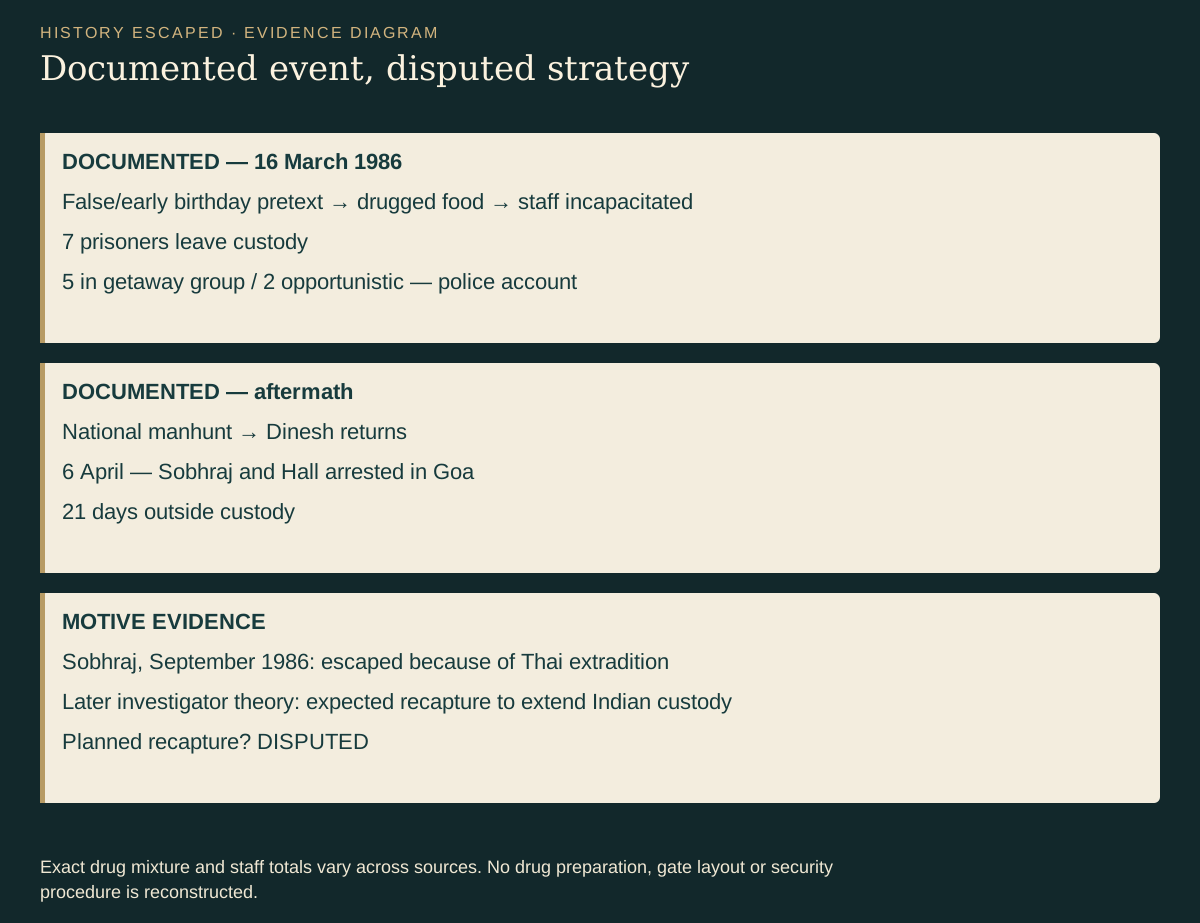
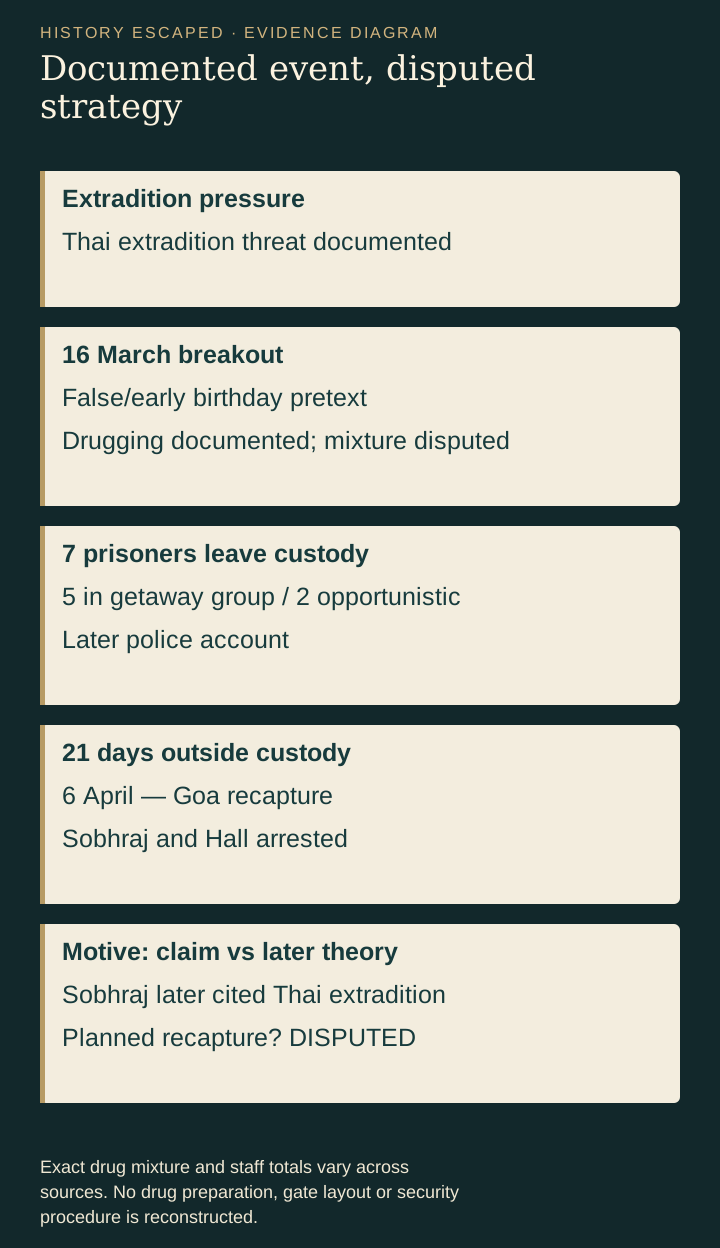
Exact drug mixture and staff totals vary across sources. No drug preparation, gate layout or security procedure is reconstructed.
Selected chronology
Selected chronology
Magistrate supports Thai extradition request
Delhi’s Chief Metropolitan Magistrate found a prima facie case in two matters supporting Thailand’s extradition requisition.
Delhi High Court dismisses extradition appeal
Sobhraj’s challenge to the magistrate’s extradition report was rejected, although further Indian proceedings remained pending.
Tihar escape
Sobhraj and six other inmates left custody after prison staff and prisoners consumed drugged food.
National manhunt and prison inquiry
Police alerted transport and border points, jail officials were suspended or arrested, and Parliament debated the escape.
Drug evidence reported
Doctors treating prison staff told The Indian Express that methaqualone had been identified in at least some of the consumed sweets.
Sobhraj and Hall recaptured
Police arrested both men at a restaurant in the Goa area, ending Sobhraj’s 21 days outside custody.
Government explains extradition status
India’s government told Parliament that extradition to Thailand could not yet be effected because legal proceedings remained pending in India.
Sobhraj states his motive
He told India Today that he escaped because authorities wanted to extradite him to Thailand and claimed he had told inmates he expected to return.
Evidence discipline
What the record supports
Status labels distinguish secure conclusions from uncertainty and rejected claims. Color is never the only signal.
MYTH
The 16 March celebration was held on Sobhraj’s actual birthday.
Sobhraj’s birthday was 6 April, the day he was recaptured. The 16 March event was a false or premature birthday celebration used as a pretext.
Sources: SRC-001, SRC-012DISPUTED
All seven prisoners escaped together in the same car as one pre-planned team.
Initial reports grouped all seven escapees together. A later police account said Sobhraj and four Indian prisoners left in Hall’s car while two other inmates exploited the disruption and walked away separately.
Sources: SRC-001, SRC-009DISPUTED
The precise drug mixture used in the food is securely established by all sources.
The Indian Express reported doctors identifying methaqualone in petha; later prosecution allegations involving Hall referred to purchases of other sedative tablets. The public reconstruction therefore avoids a single detailed formula.
Sources: SRC-003, SRC-005MYTH
Every person charged in the broad jailbreak conspiracy was proven to have helped Sobhraj.
The investigation implicated many people, but the Delhi High Court later discharged Rajendra Singh Sethia after finding insufficient evidence linking him to the conspiracy.
Sources: SRC-010LATER CLAIM
Sobhraj escaped because he feared extradition to Thailand.
Sobhraj himself gave this explanation to India Today in September 1986. The documented extradition chronology makes the claim plausible, but it remains his statement of motive.
Sources: SRC-006, SRC-011DISPUTED
Sobhraj deliberately planned to be recaptured so a new Indian sentence would outlast Thailand’s ability to prosecute him.
Later investigators and journalists advanced this interpretation, and the eventual legal chronology benefited Sobhraj. Contemporary evidence securely establishes fear of extradition, but not every step of a planned-recapture strategy.
Sources: SRC-011, SRC-015MYTH
Sobhraj was not in lawful custody when he escaped.
A later Delhi High Court judgment rejected an argument that his State Prisoner status placed the escape outside the law and stated that he was in lawful custody.
Sources: SRC-010