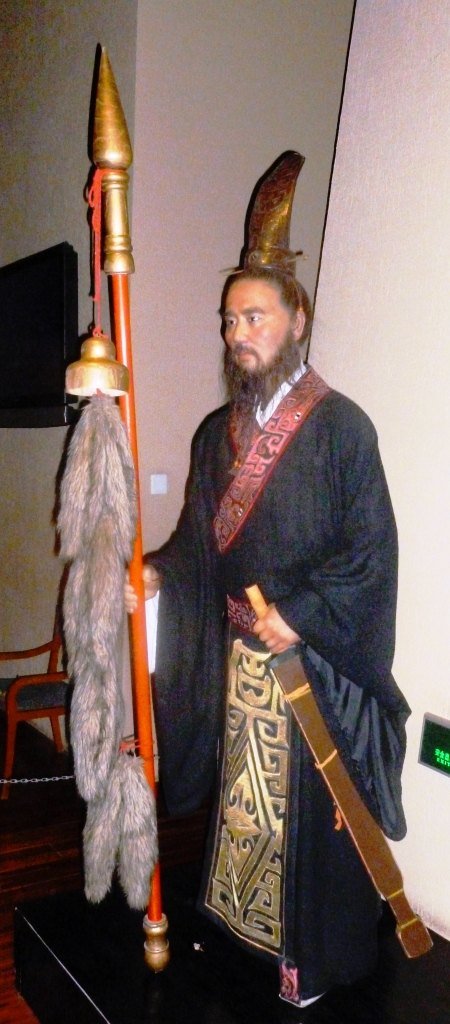
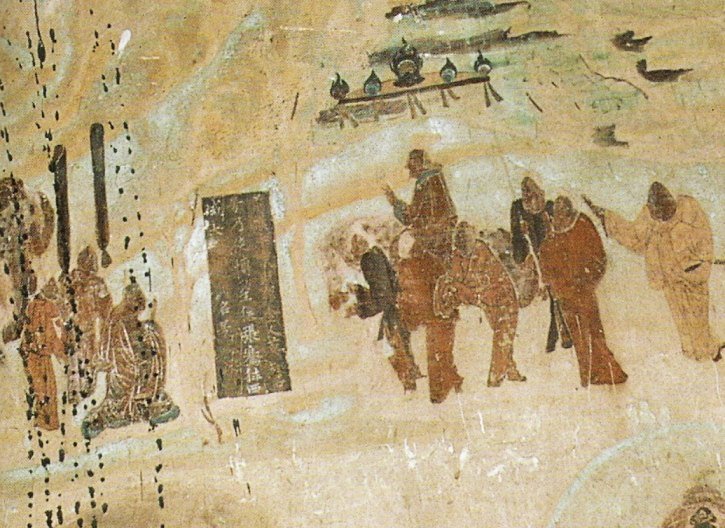
Zhang Qian left the Han empire as an envoy and disappeared into Xiongnu-controlled territory for more than a decade. When he finally emerged, he did not turn east toward home. He continued west.
That decision is what makes his first escape from Xiongnu captivity more than an episode in a famous diplomatic journey. The Han court had sent Zhang to find the Yuezhi and persuade them to join an alliance against the Xiongnu. Capture had interrupted the mission almost as soon as it began. After years in Xiongnu territory, with a wife and at least one child there, Zhang escaped and resumed the assignment he had been given before his captivity.
The ancient sources are unusually vivid about the broad sequence and unusually silent about the mechanics. They do not tell us that Zhang bribed a guard, stole a horse, disguised himself, escaped at night, or followed a route that can be plotted precisely on a modern map. They say that his restrictions had eased, that he fled with members of his party, and that after travelling west for several tens of days he reached Dayuan. The famous date of about 129 BCE is itself a reconstruction rather than a day or even a year supplied by the earliest accounts.
The result was one of the most consequential failed diplomatic missions in ancient Eurasian history. Zhang did not obtain the anti-Xiongnu alliance he had been sent to secure. He did, however, reach Central Asian states that the Han court knew only imperfectly, return with a much larger body of geographic and political information, and help create the conditions for sustained Han diplomacy across the regions later associated with the Silk Roads.
At a Glance
- Mission departure: conventionally 139 or 138 BCE; the early narrative itself places it within Emperor Wu's Jianyuan era rather than supplying the modern absolute date
- Captors: the Xiongnu confederation
- First captivity: more than ten years according to both the Shiji and Book of Han
- First escape: approximately 129 BCE, sometimes reconstructed as 129/128 BCE
- Escape mechanics: largely unknown; the sources say restrictions had loosened and Zhang fled west with members of his party
- Destination after escape: Dayuan, then Kangju, the Yuezhi and Daxia
- Diplomatic outcome: the Yuezhi declined the alliance Zhang had been sent to negotiate
- Return attempt: Zhang was captured by the Xiongnu a second time
- Final escape and return: about 126 BCE, amid Xiongnu succession disorder
- Original expedition: more than one hundred people; only Zhang Qian and his companion Ganfu/Tangyi Fu are counted by the early histories as original members who returned thirteen years later
Why the Han Sent Him West
The mission began in the strategic rivalry between the Han dynasty and the Xiongnu. Emperor Wu's court learned from people who had defected from the Xiongnu that the Yuezhi had been defeated and driven west. The Han hoped that a people with reason to resent the Xiongnu might become a useful ally.
The problem was geography and power. Any envoy trying to reach the Yuezhi from Han territory had to pass through lands dominated by the Xiongnu. Zhang Qian, then serving as a court attendant, volunteered for the mission. The Shiji names among his companions a man called Ganfu, associated with the Tangyi household; later passages call him Tangyi Fu. He was a non-Han man and an accomplished archer who would become the best-attested surviving companion of the expedition.
Modern summaries often give the departure as 138 BCE. Other chronological reconstructions use 139 BCE, partly because later annalistic chronology places Zhang's return in 126 and the ancient histories say he had been away thirteen years. The disagreement does not change the central chronology, but it matters when assigning an exact year to the first escape. The earliest narrative does not say, “In 129 BCE Zhang escaped.” It gives durations from which later historians work backward.
Soon after entering Xiongnu-controlled territory, the mission was intercepted. Zhang and his companions were brought before the chanyu, the supreme Xiongnu ruler. The logic attributed to the chanyu in the Shiji is straightforward: if the Han would not tolerate a Xiongnu embassy passing through Han lands to reach a distant people, why should the Xiongnu permit a Han embassy to cross theirs?
The mission stopped there.
More Than Ten Years in Xiongnu Territory
The Shiji, composed by Sima Qian within living memory of Zhang's career, says the Xiongnu detained him for more than ten years. The later Book of Han repeats the same basic duration. Both also preserve a striking personal detail: Zhang was given or took a wife in Xiongnu territory and had a child or children.
Those lines are frequently retold as evidence that Zhang simply “became trusted” by the Xiongnu. The sources support something narrower. They indicate long residence, family formation and eventually looser supervision. They do not tell us what legal or social status Zhang held throughout those years, how much freedom he had at different stages, whether the marriage was coerced, arranged, voluntary or some combination impossible to recover, or where exactly he lived.
The same restraint is necessary with the most famous symbol of his loyalty. The early histories say Zhang retained the Han envoy's staff or credentials during captivity. That detail belongs to the oldest surviving narrative tradition and may well preserve a genuine memory of the mission, but there is no independent Xiongnu archive against which to test it. It should be read as strong early testimony, not as a scene whose daily circumstances can be reconstructed.
The most important change came when his confinement became less strict. Sima Qian's account says, in effect, that conditions had grown more relaxed. Zhang then fled with members of his party in the direction of the Yuezhi.
That is almost everything the primary narrative tells us about the escape itself.
What We Do Not Know About the First Escape
The absence of mechanics is easy to miss because later biographies often fill the space with smooth travel narrative. The ancient accounts do not provide an exact camp, town or coordinate for the escape. They do not identify a guard who was deceived, a gate that was crossed, an animal that was stolen, a disguise, a weapon, a time of day or a prearranged signal.
They also do not give a participant count for the breakout. The phrase translated as Zhang fleeing “with his party” or “with his subordinates” establishes that he was not necessarily alone, but it does not tell us how many people left Xiongnu custody with him. Ganfu/Tangyi Fu is securely tied to the expedition and to the eventual return. The fate of most of the original delegation disappears from the narrative.
One especially common retelling goes further than the evidence by sending Zhang's Xiongnu wife and son west with him during this first escape. The oldest accounts do not clearly say that. They mention the wife and child during the first captivity, describe Zhang escaping west with his subordinates, and later specify that after a second Xiongnu detention he fled back to Han with his Xiongnu wife and Tangyi Fu. The son is not named among those who returned.
It is therefore possible that Zhang's wife accompanied some or all of the western journey, but the surviving narrative does not establish that sequence. The son's later fate is unknown in the surviving accounts. Combining every family reference into one dramatic escape party creates a cleaner story than the evidence allows.
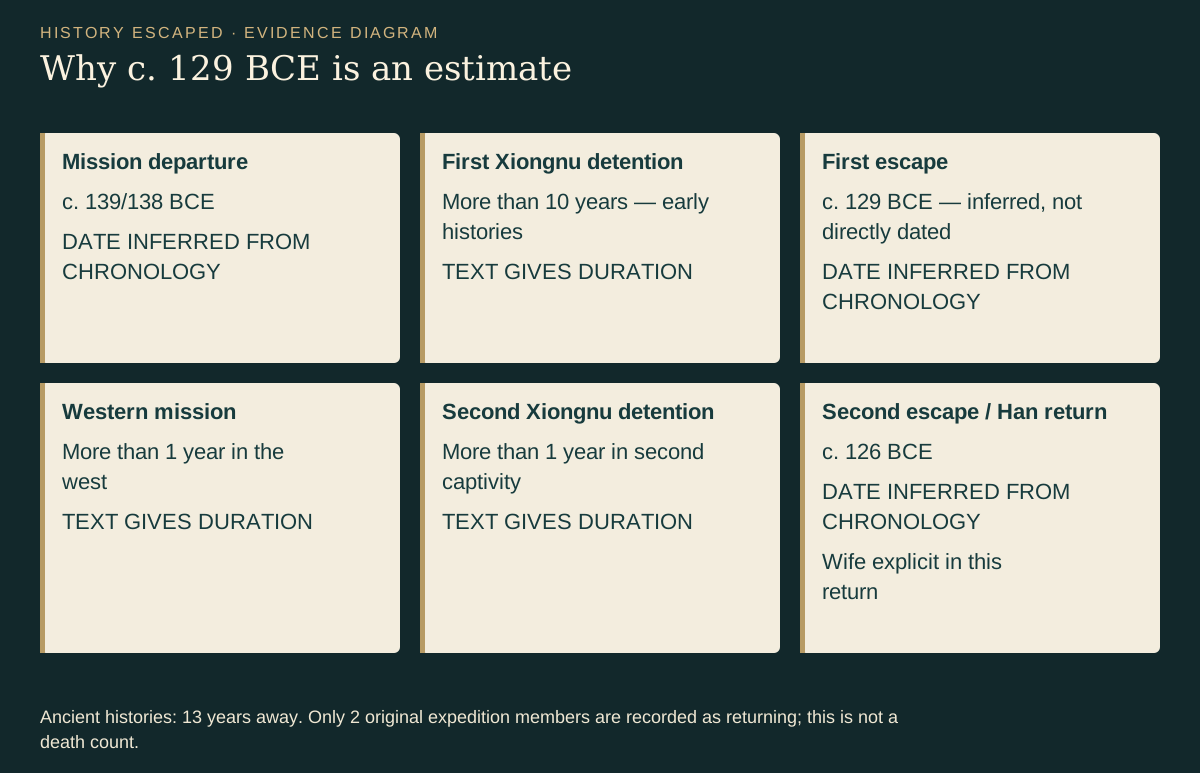
The date requires the same caution. If Zhang departed around 139/138 BCE, spent more than ten years in his first captivity, spent more than a year among the Yuezhi and neighboring regions, then spent more than a year in a second Xiongnu captivity before returning around 126 BCE, the first escape falls around 129 BCE. Some scholarly reconstructions allow 129/128 BCE. “Circa 129 BCE” is therefore a useful historical label, not a documented timestamp.
West Instead of Home
After escaping, Zhang travelled west for what the Shiji calls several tens of days before reaching Dayuan, usually identified with the Ferghana region. Dayuan already had some knowledge of the wealth of the Han and was receptive to an envoy who promised that successful assistance might lead to rewards and contact.
From there Zhang was helped onward to Kangju and then to the Great Yuezhi. The precise route between these political zones cannot be recovered from the short narrative with enough confidence to justify a detailed line on a modern map. Identifications such as Ferghana, Sogdiana and Bactria are useful regional anchors, but a modern road itinerary would imply knowledge the sources do not provide.
The diplomatic objective failed. The Yuezhi had moved far from their old homeland and established themselves in a comparatively prosperous region. According to the Han accounts, they were no longer interested in launching the revenge war that Emperor Wu had hoped to encourage.
Zhang nevertheless remained in the region for more than a year. He personally reached Dayuan, Kangju, the Yuezhi and Daxia and gathered reports about additional states beyond them. The information later attributed to him described economies, political relationships, agricultural practices, horses, cities and long-distance connections unfamiliar to the Han court in such detail.
This is why the escape cannot be separated from the mission's later historical importance. Freedom did not merely allow Zhang to survive. It allowed him to continue travelling in the direction his captors had blocked and to reach the states he had been ordered to find.
A Second Capture
Eventually Zhang turned east. Rather than retracing exactly the same approach, the early accounts say he followed the Southern Mountains and intended to return through Qiang territory. This was an attempt to get back to Han lands without simply submitting himself to the same Xiongnu-controlled passage that had trapped the expedition the first time.
It failed. The Xiongnu captured him again.
The second detention lasted more than a year according to the Shiji and Book of Han. Here the chronology becomes more securely tied to a political event. The chanyu died, a succession struggle followed, and the resulting disorder created an opportunity to flee.
Later chronology identifies the dead ruler as Junchen Chanyu, who died in 126 BCE. Yizhixie displaced Junchen's heir during the succession struggle. In that turmoil, Zhang escaped again.
This time the early text specifies the companions in the flight back to Han: his Xiongnu wife and Tangyi Fu. The wife therefore belongs securely to the final escape and return, even though her name and later life are not preserved. Ganfu/Tangyi Fu also returned and received an official appointment.
The child mentioned during the first captivity is not included in the return sentence. It is not sound to infer death, abandonment, continued residence among the Xiongnu, or return under another description. The surviving account simply does not tell us.
More Than One Hundred Set Out; Two Original Members Returned
The Shiji closes this phase of the story with a stark count. More than one hundred people had set out on the original mission. Thirteen years later, only two of those original expedition members returned.
Those two were Zhang Qian and Tangyi Fu. The count does not contradict the statement that Zhang's Xiongnu wife returned with them, because she was not part of the original Han delegation when it departed.
What happened to the other members is mostly unrecorded. The sources do not give a complete death list, recapture list, desertion list or settlement list. It would be an error to convert “only two returned” into “everyone else died.” It tells us the endpoint of the original delegation, not every individual fate along the way.
That denominator discipline matters in a case where the numbers are frequently simplified. “A hundred men left and two survived” is more dramatic than the source. The better formulation is that the mission began with more than one hundred people, and after thirteen years only two original members are said to have returned to Han. Survival and return are not interchangeable categories.
The Mission Failed—and Changed Han Strategy
Emperor Wu had sent Zhang to secure a specific alliance. He came back without it. On that narrow measure, the mission failed.
Yet the intelligence gathered after the first escape gave the Han court a much clearer picture of the political world to its west. Zhang's reports described Dayuan, Daxia, Kangju, the Yuezhi and states known indirectly beyond them. He also reported seeing Chinese goods in Bactria that had apparently reached the region through other channels, evidence that long-distance exchange did not begin with his journey.
That point corrects another persistent myth. Zhang Qian did not “discover the Silk Road” in the sense of finding an empty route that no one had used before. Archaeology and historical scholarship show that exchange networks across Eurasia predated his embassy. Even UNESCO's broader Silk Roads framing describes a network of routes rather than a single road invented by one traveller.
What Zhang did was different and still historically enormous. His journey created a new level of official Han knowledge and diplomatic engagement with Central Asian states. Subsequent embassies, military expansion and trade intensified connections across routes that later generations grouped under the name Silk Roads. His later mission to the Wusun and the envoys sent onward from it broadened those state-to-state contacts further.
The distinction between “invented the Silk Road” and “helped open sustained Han diplomatic contact across existing Eurasian networks” is not pedantic. It changes Zhang from a mythic discoverer into something more historically interesting: an envoy whose failed alliance mission became a major intelligence and diplomatic breakthrough.
Why the First Escape Matters
The first escape around 129 BCE did not bring Zhang home. It did not end his exposure to Xiongnu power, and it did not even prevent a second capture. In conventional escape-story terms, it was incomplete.
Historically, that incompleteness is exactly what makes it distinctive. Zhang escaped not toward safety but toward the objective that had caused his captivity. He used the regained freedom to continue an embassy that the Xiongnu had spent more than a decade preventing.
The surviving record gives us the decision but not the cinematic mechanics. Restrictions loosened. Zhang and members of his party fled west. After several tens of days they reached Dayuan. Everything more precise must be justified separately, and much of it cannot be.
The second escape, amid the Xiongnu succession crisis around 126 BCE, finally carried him back to Han territory. Together the two escapes bookend a thirteen-year mission in which captivity consumed most of the time but did not erase the original purpose.
Zhang's later reputation became larger than the evidence of the escape itself. Tang-period Buddhist art recast his western mission into a story about the arrival of Buddhist knowledge. Later Chinese and Japanese art turned him into a legendary traveller associated with celestial journeys and the source of the Yellow River. Modern accounts often make him the solitary founder of the Silk Road.
The older historical core is both plainer and more remarkable. A Han envoy was held for more than ten years, formed a family in captivity, escaped when supervision eased, continued west to find the people he had been sent to reach, failed to win their alliance, gathered information across Central Asia, was captured again, escaped again during political disorder, and returned with only one other member of the original delegation.
That is enough without adding a disguise, a midnight dash or a perfect route line the sources never supplied.
Evidence diagram
Why c. 129 BCE is an estimate
Ancient histories: 13 years away. Only 2 original expedition members are recorded as returning; this is not a death count.
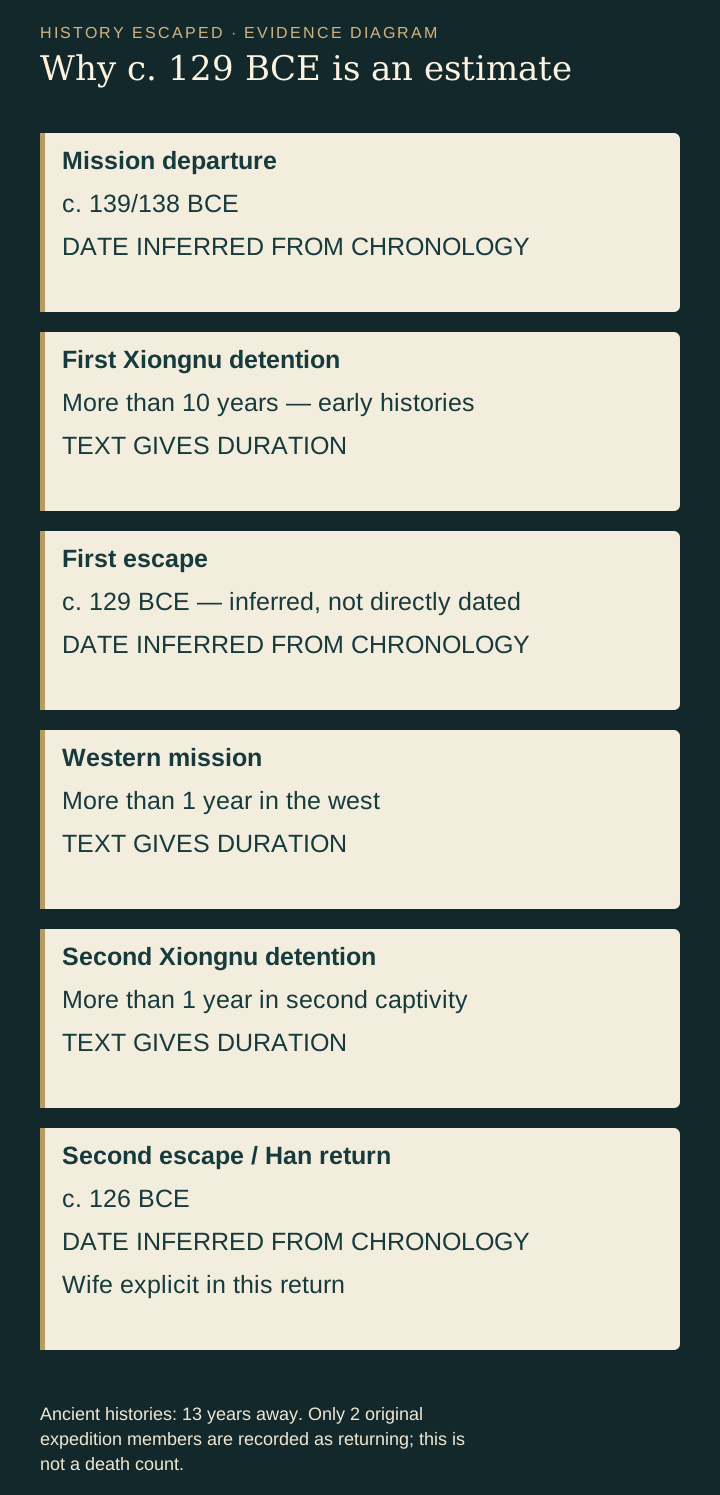
Ancient histories: 13 years away. Only 2 original expedition members are recorded as returning; this is not a death count.
Problem → response
Escape was a sequence of problems
Each response solved a practical obstacle while often creating the next one.
- 01→
Obstacle
Xiongnu control of the westward route
The Han mission could not reach the Yuezhi without entering territory under Xiongnu power.
Response
After the first detention loosened, Zhang Qian escaped west and continued through Dayuan toward the Yuezhi rather than abandoning the assignment.
- 02→
Obstacle
Loss of most of the original mission
More than one hundred people began the mission, but only two original members are recorded as returning thirteen years later.
Response
Zhang Qian and Tangyi Fu continued the mission and eventually returned; the individual fates of most other members are not preserved.
- 03→
Obstacle
Second Xiongnu capture
The attempt to return by a southern route still ended in recapture and another detention lasting more than a year.
Response
Xiongnu succession disorder after the chanyu's death created the opportunity for a second escape back to Han.
The final accounting
Outcome
First escape
Successfully ended the first long Xiongnu detention and allowed Zhang Qian to resume the westward mission.
Second capture
Zhang Qian was recaptured by the Xiongnu during the return journey.
Final escape
A second escape during Xiongnu political disorder allowed Zhang Qian, his wife and Tangyi Fu to return to Han.
Original expedition members recorded as returning
Zhang Qian and Tangyi Fu were the two returning members of the original delegation; this does not count Zhang's Xiongnu wife because she joined his life after departure.
Selected chronology
Selected chronology
Mission departs Han territory
Zhang Qian volunteers to seek the Yuezhi and leaves with more than one hundred people; modern reconstructions differ between 139 and 138 BCE.
Captured by the Xiongnu
The mission is intercepted while passing through Xiongnu-controlled territory and Zhang Qian is detained.
First escape
After more than ten years, Zhang Qian escapes west with members of his party. The year is inferred from the wider chronology and is sometimes given as 129/128 BCE.
Dayuan, Kangju and the Yuezhi
Zhang Qian reaches Dayuan, receives assistance westward, and eventually reaches the Yuezhi and Daxia but fails to secure the desired alliance.
Return journey and second capture
Zhang Qian attempts to return by a southern route but is captured again by the Xiongnu and held for more than a year.
Second escape and return to Han
Following the chanyu's death and Xiongnu succession disorder, Zhang Qian escapes with his Xiongnu wife and Tangyi Fu and returns to Han territory.
Later western mission
Zhang Qian leads another major embassy toward the Wusun and sends deputies to multiple Central Asian states, expanding direct Han diplomatic contact.
Evidence discipline
What the record supports
Status labels distinguish secure conclusions from uncertainty and rejected claims. Color is never the only signal.
WELL-SUPPORTED
Zhang Qian escaped from his first Xiongnu captivity around 129 BCE.
Circa 129 BCE is the conventional reconstruction from a departure around 139/138, a first detention of more than ten years, more than a year in the west, a second detention of more than a year, and a return around 126. The early narrative does not itself give 129 as the escape year.
Sources: SRC-001, SRC-004, SRC-005MYTH
The first Xiongnu captivity lasted exactly ten years.
Both major early historical accounts say more than ten years, not exactly ten.
Sources: SRC-001, SRC-002UNKNOWN
Zhang Qian's first escape used a known disguise, bribery scheme, stolen horse or precisely mapped route.
The early histories say his confinement had loosened and he fled west with members of his party; they do not preserve these mechanics.
Sources: SRC-001, SRC-002UNKNOWN
Zhang Qian's Xiongnu wife and son both escaped west with him during the first breakout.
The early texts mention a wife and child during captivity, describe the first flight with Zhang's subordinates, and explicitly name the wife and Tangyi Fu in the second escape back to Han. They do not securely establish that the wife and child accompanied the first westward escape, and the child's later fate is not given.
Sources: SRC-001, SRC-002DISPUTED
Only two people survived from the original expedition.
The source says only two original expedition members returned after thirteen years. That is not the same as proving that every other original member died.
Sources: SRC-001, SRC-002MYTH
Zhang Qian discovered or invented the Silk Road.
Long-distance exchange routes and movement predated his mission. His historically defensible importance is that his reports and later embassies greatly expanded official Han knowledge and sustained diplomatic engagement with Central Asian states.
Sources: SRC-006, SRC-007, SRC-008WELL-SUPPORTED
Zhang Qian retained his Han envoy credentials throughout his first captivity.
This is explicitly preserved in both the Shiji and Book of Han narrative traditions, though no independent Xiongnu record survives to corroborate the detail.
Sources: SRC-001, SRC-002