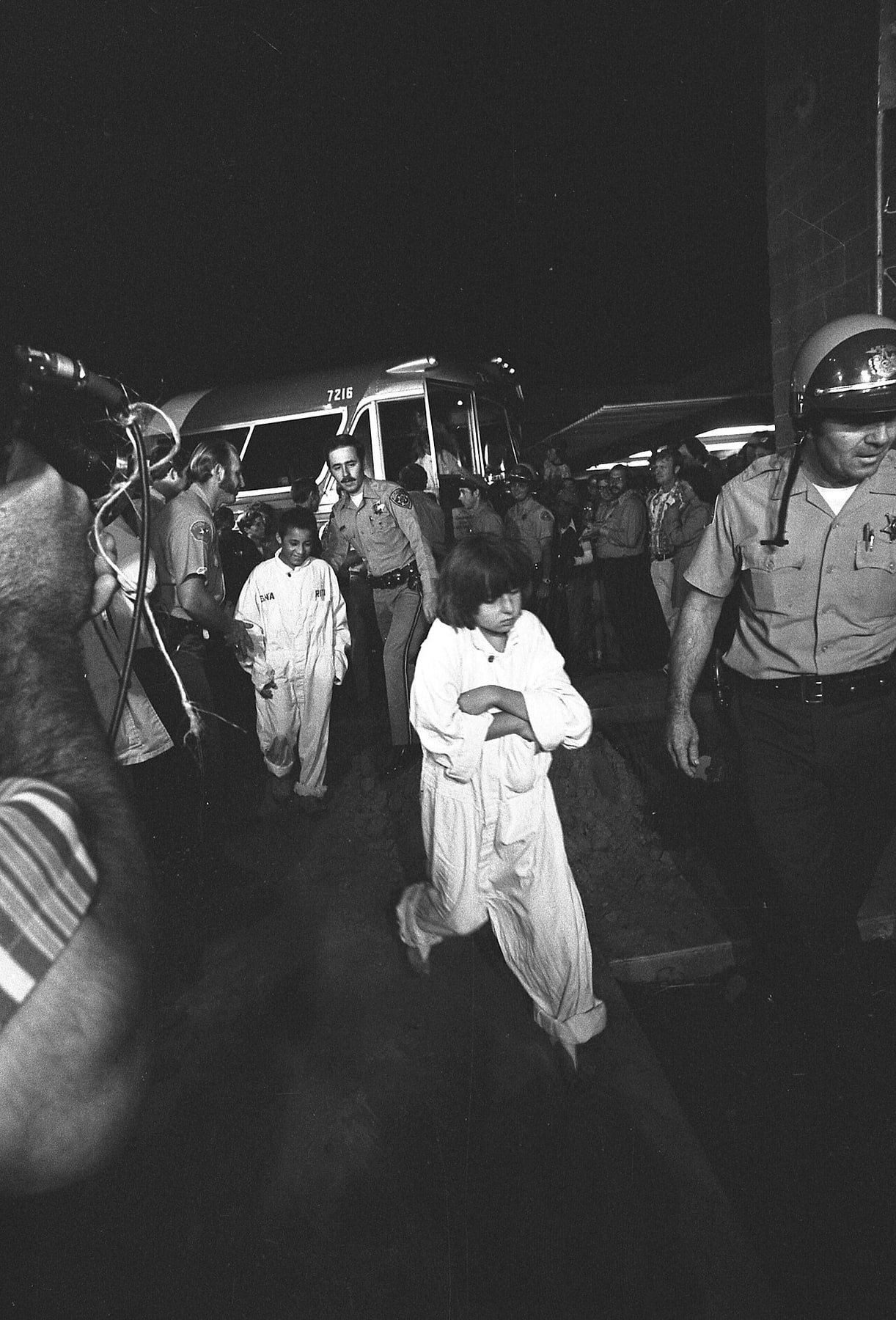
The Chowchilla kidnapping ended because the 27 people hidden underground did not wait for their captors to come back. On the afternoon of 15 July 1976, three armed men stopped a Dairyland Union School bus near Chowchilla, California. Bus driver Frank Edward “Ed” Ray Jr. and 26 children, ages five to fourteen, were forced from the bus, transferred into other vehicles, and driven for hours to a rock quarry near Livermore. There, the kidnappers placed them inside a furniture van that had previously been buried underground.
The school bus itself was never buried. For roughly sixteen hours, the children and Ray remained in the underground van. Eventually Ray and older children worked on the only practical way out: the overhead entrance through which they had been put inside. Court records credit Ray, aided by two older children, with devising and carrying out the escape effort. Later survivor accounts identify fourteen-year-old Michael Marshall as one of the central participants and the first person to reach the surface.
By about 8 p.m. on 16 July, all 27 captives were out.
A Summer-School Bus Disappears
The bus was carrying children home from a summer-school outing when a vehicle blocked the road outside Chowchilla at about 4 p.m. The kidnappers were Frederick Newhall Woods IV and brothers James and Richard Schoenfeld. Wearing masks and carrying firearms, they seized the bus, moved it away from the main road, and transferred Ray and the children into two vans.
The empty school bus was later discovered hidden in a dry slough. Its discovery transformed a local missing-bus report into a mass-kidnapping emergency.
The children ranged from five to fourteen. There were 19 girls and seven boys. Ray was 55.
The kidnappers’ motive was ransom. Court records describe a plan for a $5 million payment, though the scheme never reached a successful ransom exchange.
The Long Drive
The captives were transported from Madera County to a quarry near Livermore, more than one hundred miles away. The California Court of Appeal later described the drive in detail because the physical conditions of confinement became relevant to sentencing. Ray and a large group of the children spent the trip crowded inside one of the vans without normal opportunities to stop, drink, or use a restroom.
The drive lasted about eleven hours. They reached the quarry in the early morning of 16 July. After another delay, the captives were moved underground into the previously buried furniture van.
The appellate court’s language is useful because later shorthand often changes the object. It was not the yellow school bus. It was not an ordinary room dug into the ground. The court called it a “previously buried furniture van.” “Buried van” is the clearest public description.
Underground
The captors told the group they would remain underground for a limited period and left some food and water. The van was dark, crowded, humid, and frightening. The children did not know whether the kidnappers would return as promised. Some became sick, fainted, suffered nosebleeds, or complained of stomach distress during the broader ordeal.
The court record later became unusually precise about these symptoms because California’s kidnapping statute imposed a more severe penalty when a victim suffered legally defined “bodily harm.” That later legal debate should not obscure the lived experience.
The captives had been abducted at gunpoint, transported for hours, put underground, and left without knowing whether they would be released. The physical injuries ultimately documented in court were generally minor. The fear was not.
Deciding to Get Out
As the hours passed, the group became increasingly unwilling to depend on the kidnappers’ return. The appellate opinion says Ray “contrived a plan of escape” with the aid of two older children. They used materials already inside the van to get high enough to work on the overhead entrance.
The history does not require reproducing the container’s construction as an engineering problem. The historically important point is that the captives had to overcome an exit that had been closed and covered from outside.
Later survivor accounts give Michael Marshall a particularly prominent role. Marshall was fourteen, the oldest child on the bus. In later interviews, he remembered deciding that if the group was going to die, they should at least die trying to escape. Contemporary and retrospective reporting describes Marshall working beside Ray and other older children until they created enough space for someone to reach the surface.
Different accounts distribute the physical credit somewhat differently. The court emphasizes Ray, aided by two older children. Later news coverage often pairs Ray and Marshall. Survivor recollections describe a group effort involving older children as well as the driver. The most defensible conclusion is shared credit: Ray provided adult leadership, Marshall was a central physical participant, and other older children assisted.
Breaking Through
The escape effort took hours. Ray and the older children worked upward from inside. Eventually the covering over the entrance shifted enough for the group to clear a passage.
Marshall later recalled reaching the surface first and looking around to see whether any kidnappers were nearby. No one was waiting for them.
One by one, the children were helped out. Ray assisted the younger children through the opening. By approximately 8 p.m. on 16 July—about sixteen hours after they had been placed underground—the entire group had escaped.
All 27 were alive. They then made contact with quarry personnel, and law enforcement took control of the scene.
Medical Examination and Return Home
Authorities transported the group to the nearby Santa Rita facility, where medical personnel examined them and investigators began taking statements. The court later concluded that the physical injuries relevant to the criminal statute were limited. Ray had minor cuts from the escape effort; several children had minor abrasions or transient symptoms. The appellate court eventually ruled that the evidence did not meet the legal definition required for the enhanced “bodily harm” punishment.
That ruling is sometimes misread as a finding that the children were unharmed. It was not.
The court was deciding a narrow question about the statutory meaning of bodily harm and a mandatory sentencing enhancement. It did not conclude that abduction, confinement, fear, and psychological trauma had no consequences.
After examinations and questioning, the children and Ray were returned to Chowchilla. The community received them before dawn on 17 July.
How the Kidnappers Were Identified
Once the victims were safe, the investigation moved rapidly. The quarry belonged to the family of Frederick Woods, giving investigators a direct connection to the site. Evidence found during the investigation linked Woods and the Schoenfeld brothers to the kidnapping and to the ransom plan.
Richard Schoenfeld surrendered on 23 July. Woods was arrested in Vancouver later that month, and James Schoenfeld was also taken into custody.
The legal case did not depend on identifying a mysterious unknown perpetrator for long. The larger issue became how California law would punish a kidnapping in which all 27 victims survived but had been subjected to an extraordinary ordeal.
The Guilty Pleas and Sentences
In July 1977, all three defendants pleaded guilty to 27 counts of kidnapping for ransom. The trial court later found that three child victims had suffered the statutory level of bodily harm and imposed life-without-parole consequences on those counts, alongside life sentences for the kidnappings.
In 1980, the California Court of Appeal reversed the bodily-harm findings. The judges concluded that the documented physical symptoms did not satisfy the legal standard then required for that enhancement.
The life sentences for kidnapping remained. That distinction is important. The appeal did not overturn the kidnapping convictions. It changed the punishment by removing the findings that made several counts parole-ineligible.
Over the following decades, parole proceedings repeatedly brought the case back into public attention. Richard Schoenfeld was released in 2012, James Schoenfeld in 2015, and Frederick Woods was paroled in 2022.
The Trauma the Court Could Not Measure
The most important long-term research on the children came from psychiatrist Lenore Terr. Terr studied 23 of the kidnapped children five to thirteen months after the event. In a 1981 paper in the American Journal of Psychiatry, she reported post-traumatic emotional effects in every child she examined. These included recurring fears, dreams, reenactment, changes in behavior, and fear that another kidnapping might occur.
Her later follow-up, published in 1983, examined 25 of the victims several years after the crime, along with one child who had narrowly missed the bus. Again, the study found persistent post-traumatic effects across the children studied.
The terminology used for childhood trauma has evolved since the 1970s and early 1980s, but the Chowchilla studies became important precisely because the event offered clinicians a rare opportunity to follow a group of children exposed to the same sudden threat. The findings make the narrow 1980 appellate ruling easier to understand correctly. “Insufficient bodily harm” for one sentencing statute did not mean “no lasting harm.”
Ed Ray and Michael Marshall
Public memory often searches for one hero. Chowchilla’s own civic history emphasizes Ed Ray, who remained calm, cared for the children, and took responsibility for helping them escape. The city later named its largest park for him.
That recognition is deserved. But survivor accounts also make clear that the escape was not a one-man act. Michael Marshall’s role was central, and other older children participated in the work that opened the exit and got the younger children out.
Marshall was fourteen. The case is stronger when that shared effort is preserved rather than simplified into a single heroic figure.
What the Record Supports
The strongest factual core comes from the California appellate record. Twenty-six children and one bus driver were abducted on 15 July 1976. They were transported to a Livermore-area quarry and confined for roughly sixteen hours in a previously buried furniture van. Ray, assisted by older children, organized an escape through the overhead entrance. Later survivor testimony identifies Michael Marshall as a central participant and the first person out.
Every captive escaped alive. The school bus was not buried. The escape was not a police rescue. The kidnappers did not voluntarily release the group.
And the absence of catastrophic physical injury did not make the event psychologically minor. The Chowchilla story is ultimately a case of collective self-rescue: one adult, 26 children, and a decision not to wait underground for the people who had put them there.
Evidence discipline
What the record supports
Status labels distinguish secure conclusions from uncertainty and rejected claims. Color is never the only signal.
MYTH
The kidnappers buried the school bus underground.
The bus was abandoned and camouflaged elsewhere. The victims were ultimately confined in a previously buried furniture van at the Livermore-area quarry.
Sources: SRC-001, SRC-002MYTH
Ed Ray alone physically carried out the escape.
The appellate court credits Ray but explicitly says he was aided by two older children. Later survivor reporting identifies fourteen-year-old Michael Marshall as a central participant and the first person to reach the surface.
Sources: SRC-001, SRC-004, SRC-007MYTH
Michael Marshall alone rescued the entire group.
Marshall played a central role, but court and survivor accounts describe a collaborative effort involving Ray and other older children.
Sources: SRC-001, SRC-004MYTH
The victims were physically unharmed, so the kidnapping caused no lasting injury.
The appellate court found the documented physical injuries insufficient for a specific statutory bodily-harm enhancement. Psychiatric follow-up documented substantial and persistent post-traumatic effects among the children studied.
Sources: SRC-001, SRC-005, SRC-006MYTH
The captors voluntarily released the victims.
The victims escaped from the underground van on their own before any planned release occurred.
Sources: SRC-001, SRC-002DOCUMENTED
The victims spent roughly sixteen hours underground.
The appellate record gives about sixteen hours of underground confinement, ending around 8 p.m. on 16 July.
Sources: SRC-001