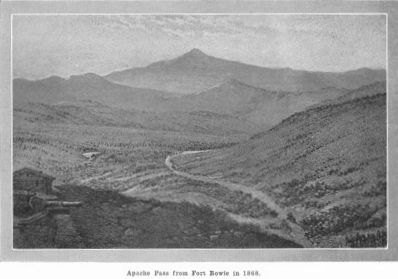
Cochise came to the U.S. Army camp at Apache Pass in February 1861 as a political and military leader, not as a convicted prisoner. He left it as a fugitive.
Second Lieutenant George N. Bascom had entered the pass with fifty-four soldiers after a raid on John Ward's ranch in the Sonoita Valley. Livestock had been stolen and Ward's young stepson, Felix, had been carried away. Ward and the Army blamed Cochise's Chokonen band of Chiricahua Apaches. That accusation was wrong. Modern National Park Service history identifies the raiders as belonging to another Apache group, while Bascom's own later report recorded Cochise insisting that the crime had been committed by "Coyoterros."
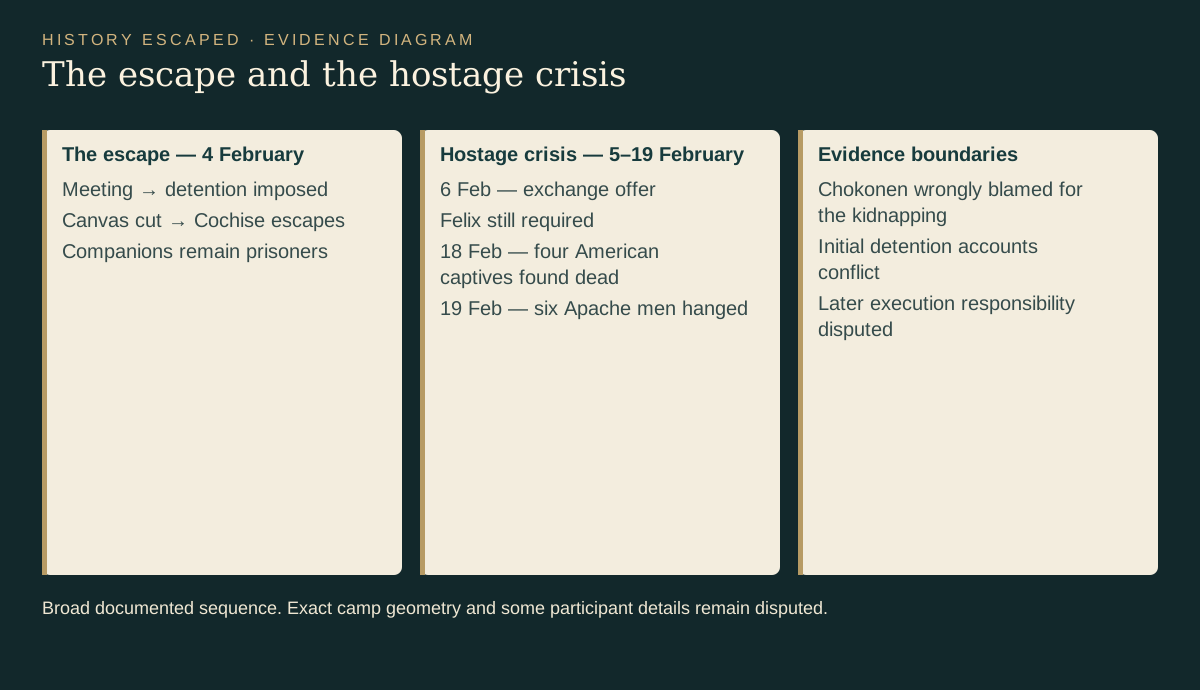
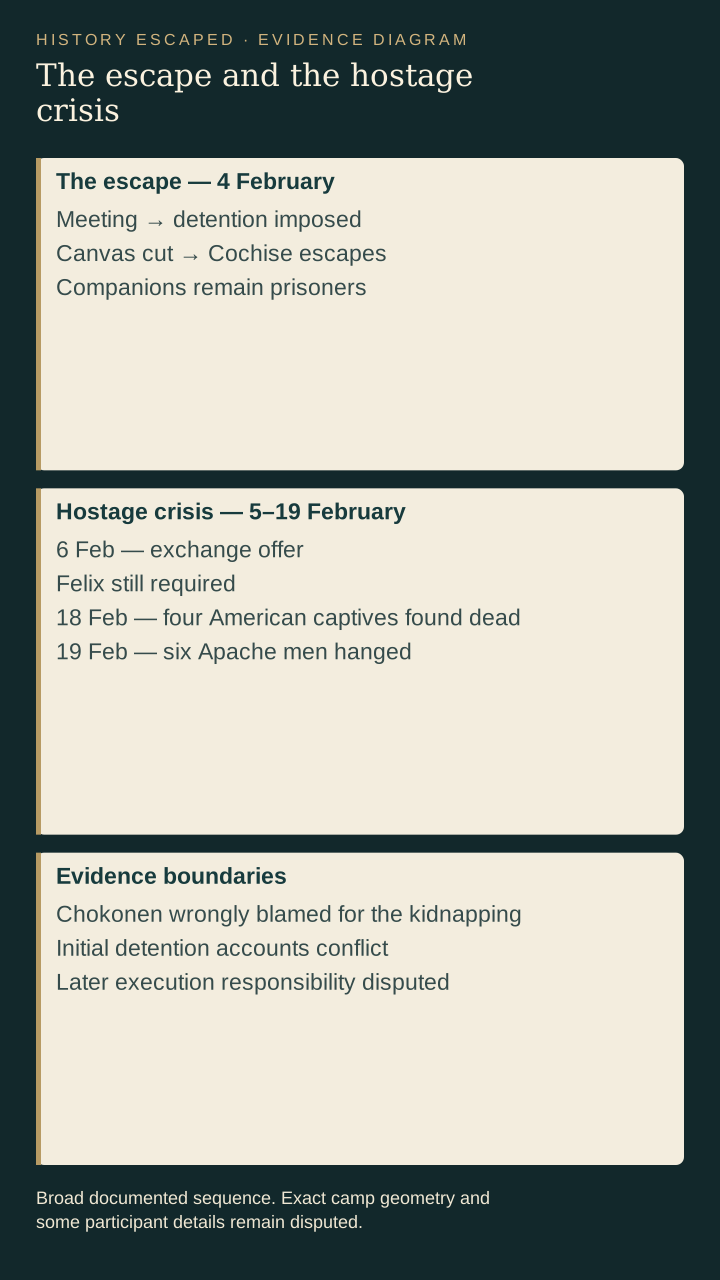
On 4 February, Cochise and six companions entered Bascom's camp expecting a meeting. Bascom then tried to hold them until the missing boy and livestock were returned. Cochise cut through the wall of the tent and escaped under gunfire. His relatives and companions remained in American custody. What followed turned an attempted detention into a hostage crisis, reciprocal killings, and a major rupture in relations between the Chiricahua Apaches and the United States.
At a Glance
- Escape: 4 February 1861
- Place: Apache Pass, then New Mexico Territory, in present-day southeastern Arizona
- Escapee: Cochise, leader of the Chokonen band of Chiricahua Apaches
- Detaining officer: Second Lieutenant George N. Bascom, 7th U.S. Infantry
- Immediate cause: Bascom's demand for the return of Felix Ward and stolen livestock
- Central mechanism: Cochise cut through the canvas of the tent in which the detention was being imposed and fled
- Companions left behind: Six people are identified in strong later reconstructions as Cochise's brother, two nephews, a woman, and two children; exact kinship labels vary across retellings
- Immediate outcome: Cochise escaped; his companions remained hostages
- Larger outcome: Failed exchanges, hostage killings, U.S. executions of Apache prisoners, and a prolonged period of warfare
- Evidence problem: Bascom's official report compresses or omits crucial parts of the initial detention, while later U.S. recollections and Apache oral memory differ over sequence, responsibility, and participant identities
The accusation that brought Bascom to Apache Pass
The confrontation began with a raid far from Cochise's camp. In January 1861, Apaches attacked John Ward's ranch, took livestock, and carried away Ward's stepson Felix, a boy of about twelve who would later become known as Mickey Free. Ward followed the raiders' trail and concluded that it led toward Chiricahua country.
The U.S. Army acted on that conclusion. Lieutenant Colonel Pitcairn Morrison at Fort Buchanan sent Bascom with fifty-four men of Company C, 7th Infantry, to recover the boy and stock. Bascom left the post at the end of January and reached Apache Pass on 3 February.
Current National Park Service interpretation is explicit that Cochise's Chokonen were not the raiders. One NPS reconstruction attributes the attack to Arivaipa Apaches; Bascom's own report says Cochise told him that Coyotero Apaches had taken the boy. Those labels do not need to be forced into one retrospective identification. The important point is that the accusation against Cochise himself was mistaken.
Apache Pass was not enemy ground in the simple sense later warfare might suggest. The Butterfield Overland Mail route passed through it, and Cochise's people had interacted with station employees. The 1861 meeting therefore occurred against a background of prior contact that made a parley plausible.
A meeting becomes detention
On 4 February, Cochise came to Bascom's camp with six companions. National Park Service and federal historical reconstructions describe the group as including his brother, two nephews, a woman, and two children. Some later accounts call the woman his wife and identify the children as sons; because participant labels vary, the broader composition is more secure than every family relationship.
Cochise denied taking Felix or Ward's livestock. He offered to help recover the boy from the Apache group he believed responsible. Bascom did not accept the denial as sufficient.
Here the source record becomes especially important. Bascom's detailed report of 25 February says that he was confident "they had the boy," that he captured six Apaches, and that he told Cochise he would hold them as hostages until the boy was produced. Bascom also claimed that Cochise offered to bring Felix in within ten days and that Bascom consented.
That official version does not explain why Cochise then needed to escape. Later American witnesses and historians reconstruct a more coercive sequence: soldiers positioned themselves around the meeting place, Bascom announced that Cochise and his party would be detained, and Cochise reacted immediately. Historian Edwin Sweeney has argued that Bascom's claim to have accepted the ten-day offer conflicts with the larger body of American recollections.
The discrepancy does not require turning Bascom's report into deliberate fiction. It does require recognizing it as an interested official account written after the confrontation had become a military disaster.
Cutting through the tent
The broad escape mechanism is among the most consistent elements in the tradition. Cochise drew a knife, cut through the canvas tent, and ran.
Federal historical summaries describe soldiers outside firing as he fled up the side of the canyon. Several later accounts say he suffered a minor leg wound, but the wound is not established as securely as the escape itself and should not be essential to the reconstruction.
Cochise's six companions did not get away. The surviving American accounts differ slightly over whether another Apache initially tried to follow him, and later narratives add dramatic details such as a fallen relative, dozens of missed shots, or even a coffee cup still in Cochise's hand. Those details belong to later reconstruction, not to the secure core.
Apache memory preserved the incident under a name more direct than "Bascom Affair": "Cut Through the Tent." Jason Betzinez, a Chiricahua Apache who dictated his recollections decades later, used that phrase for the event. Geronimo's 1906 life story likewise remembered an attack on Apache leaders in a tent as a decisive wrong.
Those Apache sources are indispensable for understanding memory and meaning, but they are not error-free transcripts of February 1861. Geronimo's account, recorded more than four decades later through interpreters and an editor, confuses some participant identities and associates Mangas Coloradas with the tent episode. It is primary evidence for how the affair was remembered among Apaches, not automatic proof of every name and sequence it gives.
Escape did not end the crisis
Cochise's immediate problem after reaching the hills was the people he had left behind. On the following day he returned with a much larger Apache force and attempted another negotiation under a white flag.
Bascom's official report says Cochise appeared with a Coyotero leader named Francisco and hundreds of warriors. A confrontation around the flag-of-truce meeting led to the capture of Butterfield employee James Wallace and gunfire in which another station employee was killed and one wounded.
Cochise then acquired more prisoners. Three American teamsters—Sam Whitfield, William Sanders, and Frank Brunner—were taken after an attack on a freight train. Mexican members of the train were killed. Cochise now possessed hostages who could potentially be traded for the people Bascom held.
On 6 February, Bascom reported that Cochise offered Wallace and sixteen government mules for the Apache prisoners. Bascom refused unless Felix Ward was included. That demand made an exchange extremely difficult if, as the evidence indicates, Cochise did not control the boy's captors.
The standoff escalated again on 8 February when Apache forces attacked around the spring and stage station and drove away Army animals but failed to release the prisoners. Cochise's group then withdrew from the immediate pass.
Killings on both sides
The most sensitive part of the affair occurred after the escape and must be kept distinct from it.
The four American hostages—Wallace, Whitfield, Sanders, and Brunner—were killed. Their bodies were found on 18 February. Bascom's official report described them as murdered; later Army recollections described the remains in graphic terms. Those details are unnecessary for understanding the outcome.
The Army then executed six adult Apache male prisoners by hanging on 19 February. Three had originally been associated with Cochise's detained group and three others had been captured by Assistant Surgeon Bernard J. D. Irwin while he was traveling to reinforce Bascom. Cochise's brother was among those executed. A woman and two boys in U.S. custody were not hanged and were later released.
Responsibility for the execution decision is itself a source conflict. Irwin later claimed that he proposed hanging the prisoners and that Bascom initially objected before acquiescing. Bascom's February 25 official report, however, took responsibility for ordering the six men bound and hanged after the American bodies were found.
The contradiction should remain visible. Whatever the internal decision-making, U.S. forces deliberately executed prisoners who had not been shown to be the perpetrators of the Ward kidnapping or the killings of the American hostages.
Was Bascom solely responsible for the war?
For generations the Bascom Affair was often summarized as the mistake that single-handedly created a decade of war: an inexperienced lieutenant falsely accused a peaceful chief, violated a parley, and transformed Cochise into an enemy.
There is truth in that structure, but it can become too neat. Bascom did act on an incorrect accusation, and the attempt to hold Cochise and his family produced a crisis that might otherwise not have occurred. The detention and later executions became enduring grievances.
At the same time, relations across the borderlands were already violent. Apache groups raided in Mexico and the United States; miners, settlers, Mexican forces, and American troops had killed Apaches; and pressure on Chiricahua homelands was increasing. The Arizona Historical Society explicitly cautions that some details remain disputed because important Army records are missing and later accounts diverge.
Even participants disagreed about Bascom. Irwin's later defense portrayed him as an officer who resorted to hostages only after persuasion failed. Bascom's critics emphasized that Cochise came to the meeting without expecting detention and was punished for a raid he had not committed. Sweeney's reconstruction argues that Bascom's report minimized the coercive nature of the first confrontation.
The most defensible conclusion is that the Bascom Affair was a catalytic rupture rather than the sole origin of Apache-American violence.
What happened to Felix Ward
The boy at the center of the affair did not return during the standoff. He survived among Apaches and later became known as Mickey Free.
As an adult he worked as an Army scout, guide, and interpreter. His later career is a reminder of how badly the 1861 confrontation failed at its stated purpose. Bascom's mission was to recover Felix; instead, the Army detained the wrong Apache leader, Felix remained beyond its reach, and the confrontation helped produce years of retaliatory violence.
The fact that Felix survived also matters for source criticism. Later knowledge of his life confirmed that Cochise's denial at Apache Pass was not simply the self-serving statement Bascom assumed it to be. The exact group responsible for the original kidnapping has been described differently in the historical literature, but Cochise's Chokonen band is no longer treated by the National Park Service as the guilty party.
The memory of betrayal
The affair remained powerful in Chiricahua memory long after the immediate participants were gone. Geronimo's later narrative grouped the tent episode with other moments when Apaches believed U.S. officials had used meetings or custody dishonestly. Betzinez remembered the event by the act that made escape possible: cutting the tent.
For U.S. military writers, the same affair became a case study in disputed responsibility. Bascom died in the Civil War in 1862 and never produced a later memoir. Irwin defended him decades afterward. Historians then had to reconstruct the opening confrontation from reports, recollections, military records, and Apache oral testimony that did not agree in every detail.
That makes Cochise's escape unusually instructive. The physical act itself is simple and well supported: an attempted detention inside a tent, a knife through canvas, a successful flight into Apache Pass. The consequences are anything but simple. The people left behind became bargaining pieces, bargaining became violence, and violence became execution and retaliation.
Cochise escaped Bascom's custody on 4 February 1861. No equally clean escape existed from what the failed detention set in motion.
Evidence diagram
The escape and the hostage crisis
Broad documented sequence. Exact camp geometry and some participant details remain disputed.
- 01
Enter the meeting
Cochise and six companions entered Bascom's camp for a parley concerning the Ward raid and missing boy. WELL-SUPPORTED. Sources: SRC-001, SRC-003, SRC-007.
- 02
Reject the accusation
Cochise denied responsibility and said another Apache group had the boy, offering to help recover him. DOCUMENTED. Sources: SRC-001, SRC-002, SRC-003.
- 03
Detention is imposed
Bascom attempted to hold Cochise and his party as leverage until Felix and the stolen livestock were returned. His later official report compresses the initial detention sequence. WELL-SUPPORTED. Sources: SRC-001, SRC-002, SRC-003, SRC-007.
- 04
Cut through the tent
Cochise used a knife to cut through the canvas and fled while soldiers fired after him. WELL-SUPPORTED. Sources: SRC-001, SRC-003, SRC-004, SRC-007.
- 05
Reach the surrounding terrain
Cochise successfully got beyond the soldiers and into the Apache Pass hills, while his companions remained in U.S. custody. WELL-SUPPORTED. Sources: SRC-001, SRC-003, SRC-007.
Broad documented sequence. Exact camp geometry and some participant details remain disputed.
Material evidence
Tools of Escape
The objects used in an escape reveal how a plan worked under constraint.
- 01Central to the physical escape; no specialized tool or elaborate preparation was required.
Knife
The broad historical tradition agrees that Cochise used a knife to cut through the canvas tent.
Problem → response
Escape was a sequence of problems
Each response solved a practical obstacle while often creating the next one.
- 01→
Obstacle
Soldiers positioned around the meeting
Later American reconstructions describe troops positioned to enforce Bascom's decision to hold Cochise and his party.
Response
Cochise created an exit through the tent wall rather than attempting to leave through the controlled opening.
- 02→
Obstacle
Gunfire during flight
Federal and later historical accounts say soldiers fired as Cochise escaped.
Response
Cochise continued into the surrounding hills and got beyond immediate pursuit.
- 03→
Obstacle
Companions held behind
Cochise escaped individually while relatives and other companions remained prisoners.
Response
He returned with allies and attempted negotiation and hostage exchange, escalating the crisis beyond the physical escape.
The final accounting
Outcome
Cochise escaped
Cochise successfully broke the attempted detention and reached the surrounding terrain.
Original companions remained in U.S. custody
The companions who did not escape became hostages in the ensuing negotiations; exact later disposition depends on participant category and is reconciled separately.
American hostages killed
Four American captives taken during the subsequent standoff were later found dead.
Apache male prisoners executed
Six adult male Apache prisoners, including Cochise's brother, were hanged by U.S. forces in retaliation.
Selected chronology
Selected chronology
Ward ranch raided
Apaches take livestock and carry away Felix Ward; responsibility is subsequently misassigned to Cochise's people.
Bascom leaves Fort Buchanan
Bascom departs with fifty-four soldiers under orders to recover the boy and livestock.
Army reaches Apache Pass
Bascom's detachment arrives and establishes itself near the Butterfield station.
Cochise escapes detention
After Bascom attempts to hold the meeting party, Cochise cuts through the tent and escapes; his companions remain prisoners.
White-flag negotiations fail
Cochise returns with a larger force. A second parley collapses into hostage-taking and gunfire.
Prisoner exchange proposed
Bascom reports that Cochise offers James Wallace and government mules for the Apache prisoners; Bascom insists Felix must also be returned.
Attack around Apache Pass
Apache forces seize Army animals but fail to free the prisoners; the hostage crisis remains unresolved.
American hostages found dead
U.S. troops locate the bodies of Wallace, Whitfield, Sanders, and Brunner.
Six Apache prisoners executed
U.S. forces hang six adult Apache male prisoners in retaliation; a woman and two boys remain alive in custody.
Evidence discipline
What the record supports
Status labels distinguish secure conclusions from uncertainty and rejected claims. Color is never the only signal.
MYTH
Cochise's Chokonen band carried out the Ward ranch raid and kidnapped Felix.
Current National Park Service interpretation says another Apache group committed the raid. Cochise denied responsibility at the time and Bascom's own report records him assigning responsibility elsewhere.
Sources: SRC-001, SRC-002, SRC-004WELL-SUPPORTED
Cochise cut through the canvas tent and escaped on 4 February 1861.
The mechanism appears consistently in federal histories, later eyewitness reconstructions, Apache memory, and modern scholarship. Bascom's own report does not narrate the cut in detail.
Sources: SRC-001, SRC-003, SRC-004, SRC-007DISPUTED
Bascom accepted Cochise's offer to recover the boy within ten days before the confrontation escalated.
Bascom asserted this in his February 25 official report. Other American recollections and later source-critical scholarship reconstruct an immediate detention attempt inconsistent with a settled ten-day agreement.
Sources: SRC-002, SRC-003, SRC-006, SRC-007DISPUTED
Cochise was definitely wounded in the leg during the tent escape.
Several later institutional and popular historical accounts report a minor leg wound, but the injury is less securely documented than the tent-cutting and successful flight.
Sources: SRC-004, SRC-007DISPUTED
Bascom personally and unilaterally decided to hang all six Apache male prisoners.
Bascom's official report assumes responsibility for the hangings. Irwin later said he proposed the executions and Bascom initially protested before acquiescing.
Sources: SRC-002, SRC-003DISPUTED
The Bascom Affair alone created all subsequent Apache-American warfare.
The affair was a major catalytic rupture, but violence, raiding, territorial pressure, and mutual distrust predated February 1861. Arizona Historical Society explicitly notes disagreement over whether the affair began the war or intensified an existing conflict.
Sources: SRC-001, SRC-005, SRC-006MYTH
Geronimo's 1906 version is a precise eyewitness account of Cochise's 1861 escape.
Geronimo's account is valuable Apache retrospective testimony, but it was recorded decades later and confuses some participants and details. It documents memory and grievance rather than providing a verbatim eyewitness reconstruction.
Sources: SRC-008