
On 19 April 1987, four members of the Oufkir family emerged from a tunnel at Bir-Jdid, a secret detention site south of Casablanca. Malika Oufkir, her brothers Raouf and Abdellatif, and her sister Maria-Inan had spent roughly fifteen years under state confinement and about a decade at Bir-Jdid. Their mother, two sisters, and cousin remained behind.
The four did not reach another country. Within days Moroccan security forces recaptured them in Tangier. In the narrow sense, the escape failed.
But the five days outside Bir-Jdid changed the family’s situation. The fugitives managed to contact Radio France Internationale and French lawyers, making it far harder for the Moroccan authorities to deny or conceal the family’s existence. After their recapture, all eight detainees were moved into less severe confinement near Marrakesh. They were officially released in 1991, although restrictions on foreign travel continued for years.
That outcome makes the episode more than an unsuccessful prison break. The Oufkir siblings escaped long enough to turn a secret detention case into an international human-rights issue.
At a Glance
- Escape date: 19 April 1987
- Place: secret detention farm at Bir-Jdid, south of Casablanca, Morocco
- Escaped: Malika, Raouf, Maria-Inan, and Abdellatif Oufkir
- Family members who remained confined: Fatima Oufkir, Myriam Oufkir, Soukaïna Oufkir, and cousin Achoura Chenna
- Time under coercive confinement before the escape: about fifteen years
- Bir-Jdid confinement: 1977–1987
- Method: a tunnel dug from the detention compound; detailed tool and construction accounts come chiefly from later family testimony
- Public contact: RFI on 22 April 1987; French lawyers were also alerted
- Recapture: Tangier, reported as 23 or 24 April depending on the source
- Official release: February 1991
- Full ability to leave Morocco: remained restricted until 1996
A family punished after a coup
The Oufkir family’s detention followed the failed attempt to overthrow King Hassan II in August 1972. General Mohamed Oufkir, then Morocco’s defense minister and one of the kingdom’s most powerful officials, was implicated in the plot. He died immediately afterward in circumstances that remain disputed: the official account described suicide, while later human-rights and journalistic sources treated execution as a serious or likely alternative.
His own political record was controversial. Oufkir had served at the center of Hassan II’s security system and was associated with severe repression before turning against the monarchy. None of that supplied a legal basis for imprisoning his children.
Human Rights Watch later described the treatment of his widow, six children, and a cousin as indefinite secret detention imposed for no apparent reason other than their relationship to the general. Amnesty International likewise recorded that the family was never brought into an ordinary criminal process for the father’s alleged actions.
The beginning of the family’s confinement is reported in two ways that can be reconciled. Amnesty summaries sometimes date their detention to August 1972, shortly after Mohamed Oufkir’s death. More detailed family and journalistic chronologies describe an initial period of guarded house arrest in Rabat, followed by removal into secret detention in late December. Le Monde dates that removal to 23 December; Malika Oufkir’s memoir chronology begins its first desert-imprisonment section on 25 December.
The useful distinction is between the start of coercive confinement and the start of disappearance into remote detention. By the end of December 1972, the family had been taken away without trial or public notice.
From one hidden site to another
The family did not spend the next fifteen years in a single prison. They were moved through a series of remote sites in southern Morocco before being transferred in February 1977 to Bir-Jdid, an isolated former farm south of Casablanca.
By then the group consisted of Fatima Oufkir; her six children Malika, Raouf, Myriam, Maria-Inan, Soukaïna, and Abdellatif; and Fatima’s cousin Achoura Chenna. Amnesty International later counted eight detained family members in all.
At Bir-Jdid, the detention became especially severe. Amnesty’s retrospective investigation describes members of the family held in individual windowless cells without access to ordinary medical care. Their location was not publicly acknowledged. For years, outside organizations could not obtain reliable information about where they were or even whether all of them were alive.
Malika Oufkir’s later memoir adds the texture of daily survival: prolonged separation, hunger, illness, efforts to communicate between cells, and repeated periods of despair. Those recollections are essential testimony, but they are also retrospective. The broad facts of secret detention and harsh conditions are independently corroborated by Amnesty International, Human Rights Watch, U.S. government reporting, and later French journalism.
The tunnel
By early 1987, some members of the family had concluded that waiting for release offered little hope. They began digging.
The tunnel itself is independently supported by later press accounts and human-rights reporting. The detailed construction story comes mainly from Malika Oufkir’s memoir and later interviews based on it. She described an improvised excavation carried out over several months with extremely limited implements, with the work concealed between inspections.
Those details explain the family’s circumstances, but they do not need to be converted into a technical diagram. Bir-Jdid was a secret detention farm built for a particular political purpose, not a model for contemporary prison security.
The family also had to decide who would leave. The plan was not for every detainee to attempt the tunnel at once. Four of the children—Malika, Raouf, Maria-Inan, and Abdellatif—were selected to go outside and seek help for everyone else.
That roster matters because later summaries sometimes get it wrong. Some secondary accounts substitute Soukaïna for Maria-Inan, or say that Malika escaped with four siblings rather than three. Le Monde’s detailed chronology, the memoir’s chapter structure, and later interviews consistently support four escapees in total: Malika, Raouf, Maria-Inan, and Abdellatif.
19 April 1987
The four left Bir-Jdid on Sunday, 19 April.
Their first problem was no longer the wall of the detention site but the fact that they had been absent from ordinary society for fifteen years. They needed transport, clothing, information, and people willing to help individuals whose surname remained politically dangerous.
Their movements carried them through Morocco toward Casablanca, Rabat, and eventually Tangier. Family testimony describes former acquaintances refusing assistance out of fear. The precise sequence of every ride, hotel, and attempted contact belongs mainly to retrospective memoir and does not need to be reconstructed minute by minute.
What mattered was reaching someone outside the Moroccan system.
On 22 April, the escapees contacted Radio France Internationale. Alain de Chalvron, then an RFI editor, later recalled receiving a call from Maria Oufkir in Tangier. He recorded her account, arranged for a local correspondent to verify the group’s identity, and contacted lawyer Georges Kiejman. A colleague of Kiejman then traveled to Morocco.
The call created something the authorities had denied the family for years: an external record made while members of the family were physically outside detention.
Recaptured, but no longer invisible
Moroccan security forces found the four in Tangier before they could leave the country.
Sources differ by a day on the arrest. A Le Monde chronology gives 23 April 1987, while the newspaper’s longer 1996 reconstruction and the memoir’s chapter chronology extend the fugitive period through 24 April. The difference does not affect the central sequence. The four had been outside Bir-Jdid for only a few days.
Ordinarily, recapture might have restored the previous conditions. This time, the family’s story had already crossed the border.
RFI possessed a recorded account. French lawyers knew the case. Human-rights organizations and journalists began raising it publicly. Le Monde reported on the failed escape in early May, describing the family as people held without judicial cause because of their relationship to Mohamed Oufkir.
The escaped siblings were returned to state control, but the authorities did not simply restore the old Bir-Jdid arrangement. By the end of June or beginning of July, the whole family had been transferred to a villa in the Marrakesh area. Amnesty later described the new confinement as still incommunicado but materially less severe: they had better living conditions, some medical access, limited visits, and more freedom within the property.
The physical escape had failed. The effort to make the detention publicly undeniable had not.
1991 was release, not complete freedom
In February 1991, after more than eighteen years of coercive confinement, the Oufkir family was officially released.
Amnesty International treated their release as part of a broader period in which long-term “disappeared” prisoners in Morocco began to re-emerge. Human Rights Watch described the Oufkir case as one of the clearest examples of personalized, arbitrary punishment during Hassan II’s rule.
Release did not immediately restore every right. The family remained under surveillance and was prevented from traveling abroad. Human-rights reporting in the early 1990s continued to note that they could not obtain normal freedom of movement outside Morocco.
That restriction lasted until 1996. Maria-Inan reached Europe via Spain in June of that year, drawing renewed attention to the family. Soon afterward other family members were able to obtain travel documents and leave Morocco.
The result creates three separate endpoints that should not be collapsed into one date: the 1987 escape from Bir-Jdid, the 1991 end of formal confinement, and the 1996 end of the family’s effective inability to leave the country.
What the memoir can—and cannot—prove
Malika Oufkir and Michèle Fitoussi published La Prisonnière in 1999, later translated into English as Stolen Lives: Twenty Years in a Desert Jail. It became the most widely read account of the family’s imprisonment.
The memoir is indispensable, particularly for experiences that only the prisoners themselves could describe. It also appeared more than a decade after the tunnel escape and more than two decades after the earliest confinement. Specific dialogue, emotions, measurements, exact tool use, and moment-by-moment travel details belong to a retrospective witness account unless independently corroborated.
The broad architecture of the story is much stronger than the memoir alone. Amnesty International was documenting the family’s disappearance before their release. Human Rights Watch, U.S. government reports, contemporary French coverage, and the 1987 RFI contact independently support the central facts: prolonged detention without trial, Bir-Jdid, four escapees in 1987, recapture, improved confinement, and eventual release.
That evidence also corrects a recurring distortion in popular retellings. The entire Oufkir family did not tunnel out together. Four siblings escaped in order to seek help for the rest.
Why the escape mattered
The Oufkir case sits inside the period Moroccans later called the “Years of Lead,” when political opponents, suspected opponents, and in some cases relatives of opponents could be held outside ordinary legal processes. Morocco’s later Equity and Reconciliation Commission examined thousands of claims arising from that era, though it did not produce criminal accountability for perpetrators.
The Oufkir siblings’ escape did not end their family’s confinement on 19 April 1987. It ended something else: the state’s ability to keep the family entirely hidden.
For fifteen years, their location and condition had been controlled by the same authorities that confined them. During a few days in April, four siblings reached journalists and lawyers beyond that system. They were caught before they could cross an international border, yet the information they carried had already done so.
That is the escape’s durable outcome. The tunnel created only a brief period of physical freedom. The contact made during that period changed the political cost of returning the family to silence.
Evidence discipline
What the record supports
Status labels distinguish secure conclusions from uncertainty and rejected claims. Color is never the only signal.
MYTH
The entire Oufkir family escaped from Bir-Jdid in 1987.
Four siblings escaped: Malika, Raouf, Maria-Inan, and Abdellatif. Fatima, Myriam, Soukaïna, and Achoura remained confined.
Sources: SRC-004, SRC-005, SRC-008DISPUTED
The Oufkir family’s secret detention began on one uncontested date in August 1972.
Amnesty summaries date detention from shortly after Mohamed Oufkir’s August death, while detailed chronologies describe initial guarded house arrest and removal to remote secret detention in late December. The evidence distinguishes the start of coercive confinement from the family’s later disappearance into remote secret detention.
Sources: SRC-001, SRC-004, SRC-008DOCUMENTED
The tunnel escape occurred on 19 April 1987.
The date is supported by Le Monde’s chronology and the chapter chronology of Malika Oufkir’s memoir.
Sources: SRC-005, SRC-008LATER CLAIM
Every detailed tunnel mechanic is independently corroborated.
The existence and use of a tunnel are independently supported. Specific implements, construction techniques, and work routines derive primarily from Malika Oufkir’s later memoir and interviews based on it.
Sources: SRC-001, SRC-008, SRC-009DISPUTED
The four escapees were recaptured on a single securely established date.
Some chronologies give 23 April; a longer Le Monde reconstruction and the memoir chronology extend the escape through 24 April.
Sources: SRC-004, SRC-005, SRC-008DISPUTED
The 1987 escape was a complete failure because the siblings were recaptured.
It failed to produce durable physical freedom, but the fugitives reached RFI and lawyers, publicized a previously concealed detention case, and were followed by a transfer of the entire family to less severe confinement.
Sources: SRC-002, SRC-004, SRC-007MYTH
The family became fully free when formal confinement ended in 1991.
Formal detention ended in 1991, but surveillance and restrictions on foreign travel continued until 1996.
Sources: SRC-003, SRC-010, SRC-011Documentary reconstruction
Secret detention, escape, recapture and exposure
A case-local editorial visual separates the secure historical sequence from uncertainty without exposing reusable modern operational detail.
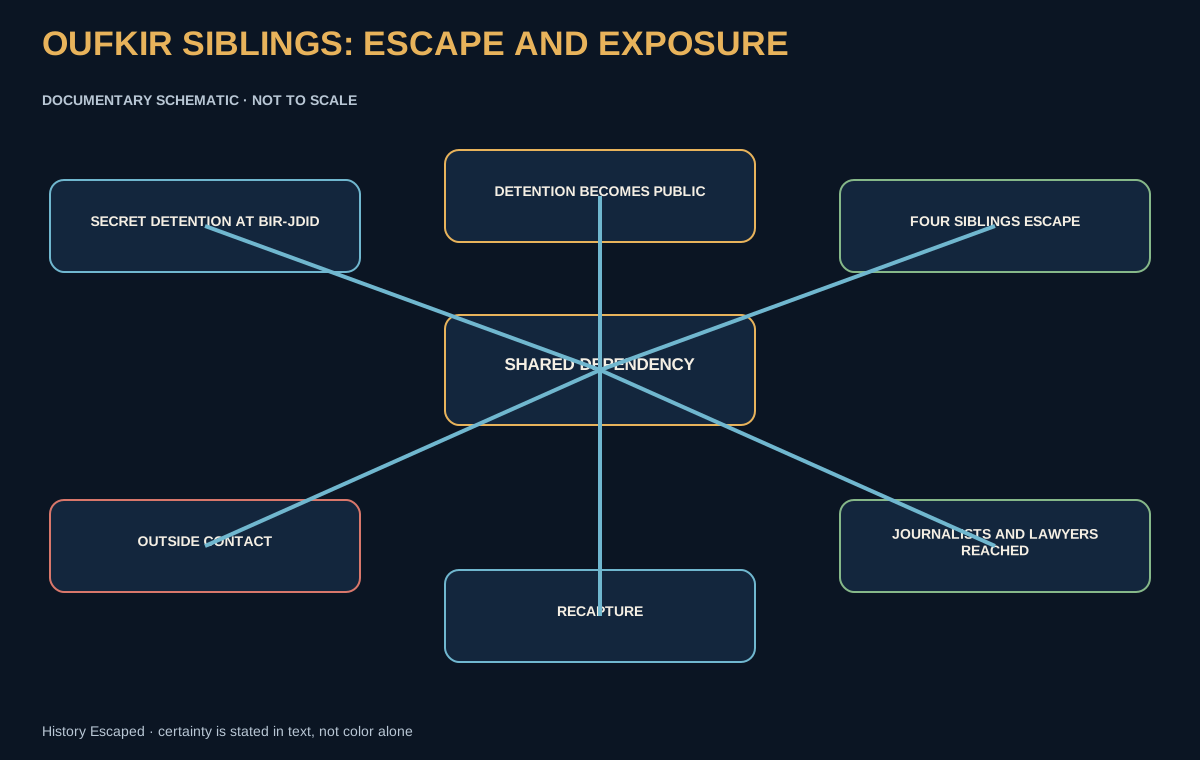
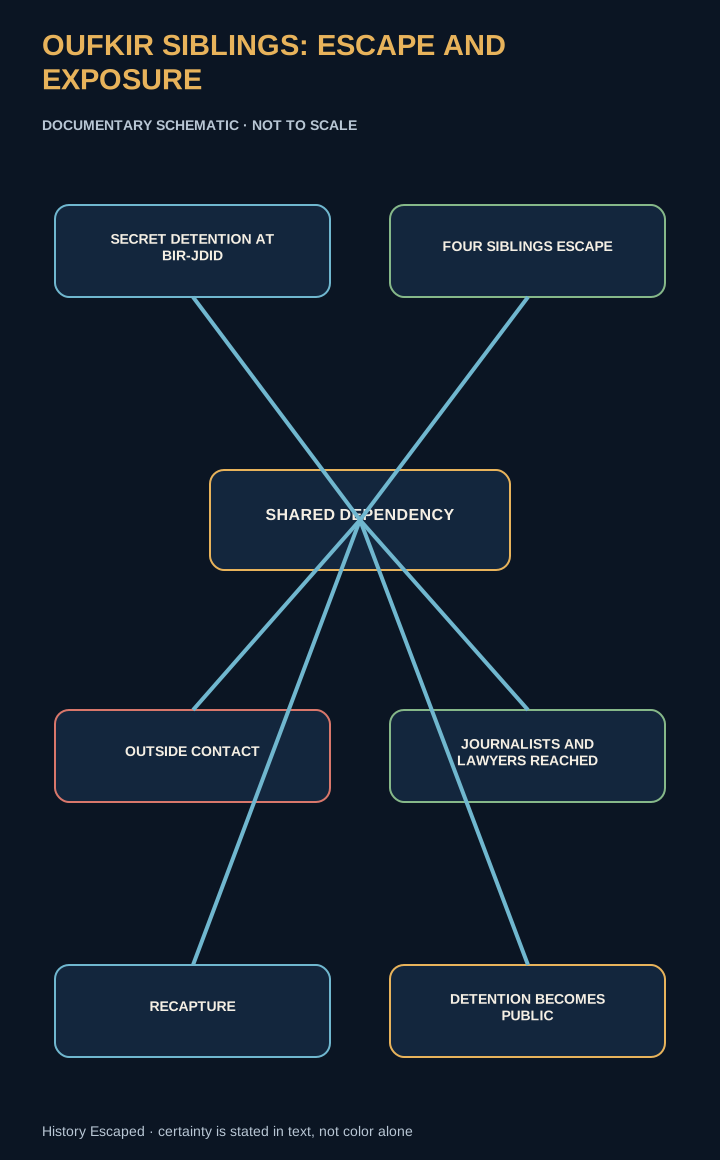
Simplified evidence-led editorial reconstruction based on the cited record; not to scale. Uncertainty is stated directly in the visual and adjacent text.