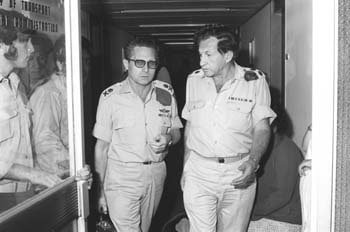
Sabena Flight 571 was supposed to be the final leg of an ordinary Brussels–Vienna–Tel Aviv service. Twenty minutes after the Boeing 707 left Vienna on May 8, 1972, four members of Black September seized the aircraft with pistols, grenades and explosive devices and forced Captain Reginald Levy to continue toward Israel under their control.
The plane landed at Lod Airport, later renamed Ben Gurion International Airport. The hijackers demanded the release of Palestinian prisoners held by Israel and threatened to destroy the aircraft if their demands were rejected.
For almost a day, Israeli officials negotiated while secretly preparing an assault. The rescue plan depended on persuading the hijackers that the aircraft could not depart without maintenance. On the afternoon of May 9, Sayeret Matkal commandos approached in white coveralls posing as technicians.
Within minutes, the two male hijackers were dead and the two women had been captured. The rescue is often summarized as a clean success in which every hostage was saved. That is too simple. Everyone was removed alive from the aircraft, but passenger Miriam Holtzberg had been critically wounded in the firefight and died days later. Other passengers, one surviving hijacker and Israeli commandos were also wounded.
Even the number of hostages is less settled than most retellings imply. Contemporary reporting repeatedly described 90 passengers and ten crew members — 100 hostages. Aviation and later Israeli records instead imply 90 ordinary passengers and seven crew, or 97 hostages, with the four hijackers included in a 101-person total aboard.
The stable number is not 97 or 100. It is 90 ordinary passengers.
At a Glance
- Hijacking: May 8, 1972, shortly after Flight 571 departed Vienna for Tel Aviv.
- Rescue: Afternoon of May 9 at Lod Airport, Israel.
- Aircraft: Sabena Boeing 707-329, registration OO-SJG.
- Hijackers: Four Black September members — two men and two women.
- Stable passenger count: 90 ordinary passengers.
- Crew-count conflict: Contemporary JTA reports 10 crew; aviation and later Israeli records support 7.
- Hostage total: Roughly 100 hostages; exact denominator disputed between 97 and 100.
- Commonly stated initial demand: Release of approximately 315 Palestinian prisoners, although contemporary reports show the number changing or being reported differently during negotiations.
- Rescue force: Sayeret Matkal, commanded by Ehud Barak; Danny Yatom is identified by the Israeli Defense Ministry archive as his deputy.
- Modern IDF force count: 16 commandos; contemporary JTA later reported 18 paratroopers.
- Hijacker outcome: Two male hijackers killed; Rima Tannous and Therese Halsa captured.
- Hostage deaths: No hostage died at the aircraft, but Miriam Holtzberg later died from wounds sustained during the assault.
- Major aftermath dispute: The International Committee of the Red Cross protested that Israel had abused its mediation role; Israeli officials rejected that accusation.
Black September and a Belgian aircraft
The hijacking came during an era in which Palestinian armed organizations increasingly used international aviation to force political demands into global view. Black September took its name from the September 1970 fighting in Jordan between the Jordanian state and Palestinian guerrilla organizations. The clandestine group became associated with attacks against Israeli and international targets and would become far more widely known after the Munich Olympic attack later in 1972.
Flight 571 was operated by Sabena, Belgium's national airline. The aircraft had begun its journey in Brussels and stopped in Vienna. The four hijackers posed as two couples and boarded using false documents, according to later reconstructions and the surviving hijacker Therese Halsa.
About twenty minutes after the Vienna departure, they moved against the cockpit and cabin. Captain Reginald Levy remained in command of the aircraft but no longer controlled the flight politically. The hijackers directed him toward Lod, the airport they intended to use as the site of their prisoner demand. They were taking their hostages directly into the state they were trying to coerce.
Captain Levy's private hostage
One of the most remarkable details was unknown to the hijackers. Levy's wife, Dora, was among the passengers.
The flight coincided with the captain's fiftieth birthday, and the couple had planned to celebrate in Israel. Levy later told contemporary reporters that he deliberately concealed their relationship because he feared the hijackers would use her as a specially valuable hostage.
This was not merely a dramatic personal detail. Levy became the principal human link between the cockpit, the hijackers and Israeli authorities. He had to relay demands while avoiding anything that might increase the danger to his passengers — including his own wife.
Later Israeli accounts elevated him into the mythology of the rescue, sometimes polishing his dialogue and calm into near-perfect heroism. Contemporary reporting does support the basic picture: he remained composed, communicated continuously and eventually provided information that materially helped the rescue planners.
But his role also reveals how much uncertainty remained inside the aircraft. The officials outside were making decisions based partly on what one captain could safely tell them while armed people stood nearby.
How many hostages?
The denominator problem begins with a simple question: how many people were being held? Contemporary Jewish Telegraphic Agency dispatches repeatedly reported 90 passengers and 10 crew members, or 100 hostages. Therese Halsa gave the same 90-plus-10 figure decades later in an interview with The Guardian.
Aviation records use a different accounting system. The Aviation Safety Network tradition gives 94 passengers and seven crew, for 101 occupants. The four hijackers are included among those 94 passengers. Remove them, and the number of ordinary passengers returns to the same stable figure: 90.
That leaves the crew total as the disputed element. Under the aviation denominator: 90 ordinary passengers + 7 crew = 97 hostages, plus four hijackers = 101 people aboard.
Under the contemporary JTA denominator: 90 passengers + 10 crew = 100 hostages, plus four hijackers = 104 people aboard. The difference probably reflects how airline operating personnel or other staff were categorized in early reporting, but the reviewed source base does not resolve it securely enough to choose one explanation.
The evidence therefore does not support treating “100 hostages” as an uncontested manifest number. “Roughly 100 hostages” is more responsible, while the stable 90-passenger count and the 7-versus-10 crew conflict remain separate.
A demand whose number moved
The prisoner demand has a similar problem. Modern Israeli institutional accounts commonly state that the hijackers demanded the release of 315 Palestinians held in Israeli prisons. The Defense Ministry's released operations log also describes a list of 315.
Contemporary sources were less stable. Early JTA reporting said the hijackers demanded approximately 300 prisoners and later reduced the number to 100. Other contemporary reporting used still different numbers at different stages.
This does not necessarily mean the sources are describing entirely different demands. Lists, bargaining positions and press summaries can change over a long negotiation.
The stable point is political rather than arithmetic: the four hijackers threatened the passengers unless Israel released a large group of Palestinian prisoners. Using “315” as the commonly stated initial figure is reasonable. Treating 315 as the unchanged demand for every hour of the standoff is not.
Lod becomes the center of the crisis
Flight 571 landed at Lod on May 8. Defense Minister Moshe Dayan, IDF Chief of Staff David Elazar, Transport Minister Shimon Peres and other senior officials gathered around the airport response. Belgian representatives were also present because the aircraft, crew and many passengers belonged to a Belgian national airline.
The hijackers demanded fuel and the prisoner release. Israeli officials bought time.
The Defense Ministry operations log released fifty years later shows officials repeatedly insisting that the aircraft required mechanical attention before it could leave. The hijackers were told that technicians would have to approach.
This gradually created the opening on which Operation Isotope depended. The rescue was therefore not simply a sudden commando assault. It emerged from a long interaction among negotiation, deception, technical delay and intelligence gathering.
Negotiation and force were being prepared together
Israeli leaders debated whether to exchange prisoners or seize the aircraft. The declassified operations log is valuable because it preserves disagreement rather than presenting the operation as inevitable from the beginning. Elazar pushed for a takeover opportunity. Dayan discussed the risks with Prime Minister Golda Meir. Peres opposed the assault at one stage but did not veto it.
By about 2:10 a.m. on May 9, the log records explicit planning for a forceful takeover under cover of repairs. The hijackers still believed negotiations were continuing.
This overlap later became ethically significant because the International Committee of the Red Cross was acting as an intermediary. For the Israeli planners, negotiation was also buying the time required to create a rescue opportunity. Those two interpretations of the same hours would collide after the operation.
Levy leaves the aircraft
Around midday, the hijackers allowed Captain Levy to leave the plane temporarily. The ostensible purpose was to communicate about negotiations and the threatened explosives. Levy carried out a sample or information connected to the explosive threat and spoke directly with Israeli officials.
Later Israeli accounts say he described the hijackers, their general positions and the condition of the aircraft exits. That information improved the planners' understanding of the cabin.
The exact intelligence he provided varies in later retellings, and a tactical map is unnecessary. Its historical significance is straightforward: the captain who had spent the entire crisis inside was briefly able to speak to the people preparing the intervention.
He then returned to the aircraft. That return helped preserve the impression that negotiations and servicing were still moving forward normally.
The mechanics ruse
The deception at the center of Operation Isotope was visually simple. Men in white maintenance coveralls approached the Sabena aircraft as a technical crew.
The IDF's later public history says the assault team contained 16 Sayeret Matkal commandos. Contemporary JTA reporting later called them 18 paratroopers disguised as maintenance men. The Defense Ministry operations log told the hijackers at one point that 17 mechanics were on their way.
These are different categories and different sources, not numbers that should be averaged. The most sensible structured choice is to use 16 as the modern official assault-team count, while flagging the contemporary 18-man report as a conflict and recognizing that the 17 announced to the hijackers was part of the deception rather than necessarily the force's actual strength.
Ehud Barak commanded Sayeret Matkal and led the operation. The Defense Ministry archive identifies Danny Yatom as his deputy.
Benjamin Netanyahu participated as a junior team leader. He did not command the rescue. That correction matters because later political fame has often reordered the cast in popular memory.
The assault
The commandos reached the aircraft in the late afternoon on May 9. The released Israeli operations log places the disguised force under the aircraft around 4:20 p.m. and records gunfire moments later.
The fight inside was brief. The two male hijackers were killed. The two women, Rima Tannous and Therese Halsa, survived and were captured.
Hostages moved out of the aircraft during and immediately after the fighting. Modern IDF histories describe the takeover as completed within about ten minutes. That is useful as a broad duration, not as an invitation to reconstruct the assault second by second.
The operation succeeded in preventing the threatened destruction of the aircraft and removing the surviving hostages from captivity. It did not do so without casualties.
Miriam Holtzberg
Early reports celebrated that the passengers had been saved. One passenger remained in critical condition.
She was initially misidentified in contemporary dispatches before being correctly named as Miriam Holtzberg, a 22-year-old Israeli passenger. Holtzberg suffered a severe head wound during the firefight. Contemporary reports initially attributed the shot to a hijacker, but the surviving evidence reviewed here is not strong enough to lock the shooter as historical fact.
She remained hospitalized for more than a week. On May 19, she died.
She was the only passenger to die from injuries sustained in the rescue. That distinction should remain explicit. Saying “all hostages survived” is false. Saying “one hostage was killed during the assault” is also imprecise, because she was removed alive and died later. The accurate outcome is that every hostage was taken off the aircraft alive, but Holtzberg later died of her wounds.
Other wounded passengers
At least three passengers were reported wounded by gunfire in the immediate aftermath. One was Vilfred or Wilfred Kordovski, whose surname also appears in variant transliterations. Contemporary JTA reporting said he sustained serious abdominal wounds.
Later reporting based on his own account stated that Israeli soldiers had fired on him after mistaking him for a hijacker as he ran after one of the armed women. Paula and Nahum Rubin were also reported slightly injured while leaving the aircraft.
These overlapping categories are one reason a single clean “injuries” number is difficult. Aviation summaries often give only the most serious injuries, while newspaper accounts include minor evacuation injuries as well. The evidence therefore supports distinguishing serious gunshot wounds from additional minor injuries rather than forcing every person into one unstable total.
Therese Halsa and Benjamin Netanyahu
Therese Halsa was seriously wounded and survived. A much later reconstruction in The Guardian, drawing on Halsa and Israeli participants, describes an accidental discharge during the struggle. The bullet passed through Halsa and struck Benjamin Netanyahu in the arm.
The broad fact that Netanyahu was wounded is independently supported by Israeli archival photographs showing his arm bandaged days later. The precise shared-bullet mechanism comes from later recollection and should be treated accordingly.
That distinction is useful because Operation Isotope has become deeply entangled with later Israeli political biography. Ehud Barak and Benjamin Netanyahu both became prime ministers. Shimon Peres later became prime minister and president.
The importance of the rescue does not need those later careers to make it dramatic. In 1972, Barak was the unit commander and Netanyahu was one of the commandos under his command.
The Red Cross objection
The aftermath produced a dispute that is often omitted from triumphal accounts of the operation. The International Committee of the Red Cross had been brought into the hostage crisis as a neutral intermediary.
After the rescue, an ICRC spokesman told JTA that the organization intended to protest what it regarded as an abuse of confidence and breach of an oral understanding. The complaint was that Red Cross mediation had helped create the impression that a prisoner exchange and servicing process was continuing while Israel was preparing armed force.
Israeli officials rejected the accusation. They argued that the ICRC had not been duped and that Israel could not surrender its responsibility to protect the hostages merely because Red Cross delegates were helping mediate.
The disagreement cannot be resolved simply by choosing one side's later institutional memory.
What is secure is that the dispute existed and that it exposed a real tension in hostage negotiations: deception that may help a rescue can also damage the credibility of a neutral intermediary whose usefulness depends on all parties believing it is not part of the deception.
Belgium's position
Belgium was placed in an unusually difficult position.
Sabena was the national airline. Belgian citizens and crew were hostages. Yet the aircraft was on Israeli territory and the rescue decision belonged to Israel.
Belgian Prime Minister Gaston Eyskens later said his government had not been informed in advance of Israel's military intentions and was not a party to the assault.
Belgian officials emphasized that their priority had been the safety of the passengers and crew.
At the same time, Belgium faced difficult questions about aviation security. The hijackers had managed to board an international flight with weapons and explosives.
Belgian pilots and politicians subsequently demanded tighter controls.
Operation Isotope therefore ended one crisis while opening another debate over how such a heavily armed group had reached the aircraft at all.
The two surviving hijackers
Rima Tannous and Therese Halsa survived the assault and were tried before an Israeli military tribunal.
In August 1972, both received life sentences after conviction on weapons-related and organizational charges. They were acquitted on one count involving the planting of a bomb.
Both were eventually released in prisoner exchanges.
Their survival makes Sabena Flight 571 unusually rich in competing retrospective testimony. Halsa spoke publicly decades later and rejected the Israeli heroic interpretation of the event.
Her testimony is historically valuable precisely because it is partisan.
The same is true of military memoir and institutional commemoration. Read beside contemporary reporting and the declassified operations log, those traditions preserve useful evidence without allowing any one side to become the entire story.
What Operation Isotope established
The operation became a model in Israeli counter-hijacking history.
Its most famous feature was the technician disguise, but the deeper pattern was the integration of intelligence, negotiation, deception and a specialized assault force. That history has to be handled carefully.
Entry points, weapons placement, exact team routes and aircraft vulnerabilities are unnecessary to explain why the rescue worked. Reproducing them would turn historical explanation into tactical instruction without improving understanding.
The strategic lesson is already visible at a safer level.
Israeli officials kept the plane on the ground, extended negotiations, obtained information from the captain, convinced the hijackers to accept maintenance personnel and used that acceptance to place a rescue force close to the aircraft. The deception created proximity.
The assault converted proximity into control.
Success, with a cost
Sabena Flight 571 is remembered because the threatened mass killing did not happen.
The aircraft did not explode. The prisoner demand was not met. Two hijackers were captured alive. Almost every hostage survived.
But “almost” matters.
Miriam Holtzberg died.
Other passengers were shot or injured. Therese Halsa was seriously wounded. Israeli commandos were also hurt.
The operation also left behind disputes over the Red Cross, Belgian knowledge, the exact hostage count and the details later political figures remembered about their own roles.
Those complications do not erase the rescue's success. They make the history more accurate.
The most defensible summary is simple: four Black September members seized a Sabena aircraft carrying 90 ordinary passengers and a disputed number of crew. Israel used negotiations and a maintenance ruse to create an assault opportunity. Sayeret Matkal killed the two male hijackers, captured the two women and ended the hostage-taking.
Every hostage came off the aircraft alive.
One of them did not survive her wounds.
Evidence discipline
What the record supports
Status labels distinguish secure conclusions from uncertainty and rejected claims. Color is never the only signal.
DISPUTED
There were exactly 100 hostages aboard Sabena Flight 571.
Contemporary JTA repeatedly reported 90 passengers plus 10 crew, while aviation records give 94 passengers including the four hijackers plus 7 crew — equivalent to 90 ordinary passengers plus 7 crew, or 97 hostages.
Sources: SRC-004, SRC-005, SRC-015WELL-SUPPORTED
There were 90 ordinary passengers.
This figure survives both the 90-plus-10 contemporary count and the aviation record's 94 passengers including four hijackers.
Sources: SRC-004, SRC-015DISPUTED
The hijackers demanded exactly 315 prisoners throughout the crisis.
315 is the modern Israeli institutional figure and appears in the released operations-log tradition, but contemporary reporting recorded 300, 100 and other numbers as negotiations evolved.
Sources: SRC-002, SRC-003, SRC-005DOCUMENTED
Ehud Barak commanded Operation Isotope.
The Israeli Defense Ministry archive identifies Barak as Sayeret Matkal commander and operation leader, with Danny Yatom as deputy.
Sources: SRC-001, SRC-014MYTH
Benjamin Netanyahu commanded the rescue.
Netanyahu participated as a commando/team leader under Barak; Barak commanded the unit and rescue.
Sources: SRC-001, SRC-003MYTH
Every hostage survived the hijacking and rescue.
Every hostage was removed alive from the aircraft, but Miriam Holtzberg later died from wounds suffered during the assault.
Sources: SRC-008, SRC-009WELL-SUPPORTED
The assault force contained exactly 16 commandos.
Modern IDF institutional history gives 16. Contemporary JTA later reported 18 paratroopers, and the deception message announced 17 mechanics. The modern official unit count controls while the conflict is retained.
Sources: SRC-003, SRC-016, SRC-002MYTH
The ICRC accepted Israel's use of its mediation role as part of the assault deception.
The ICRC protested that Israel had abused its confidence and an oral understanding. Israeli officials rejected the allegation.
Sources: SRC-017, SRC-018LATER CLAIM
Therese Halsa and Benjamin Netanyahu were wounded by the same accidental bullet.
A later Guardian reconstruction based on participants gives this mechanism. Netanyahu's wound is independently corroborated, but the exact shared-bullet sequence is retrospective.
Sources: SRC-013, SRC-002Evidence diagram
Hostage and force counts in Operation Isotope
Count reconciliation is separated from the high-level rescue sequence without tactical aircraft geometry.
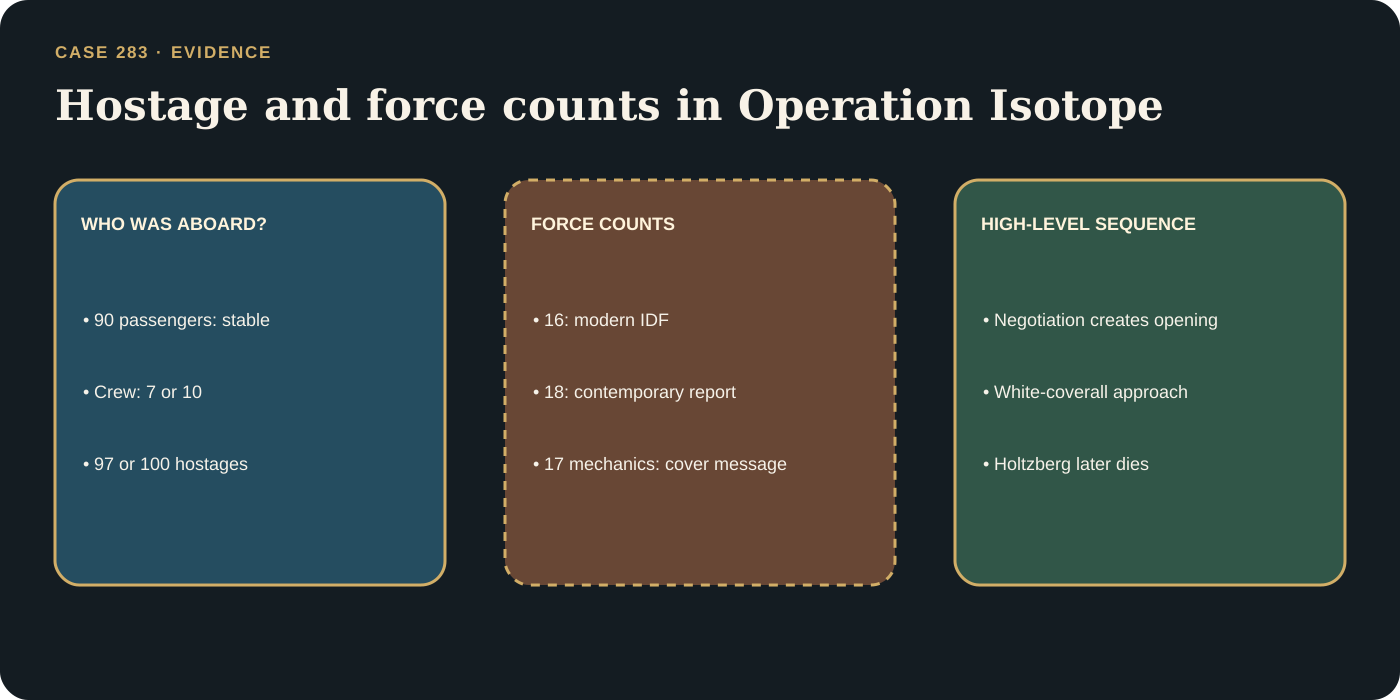
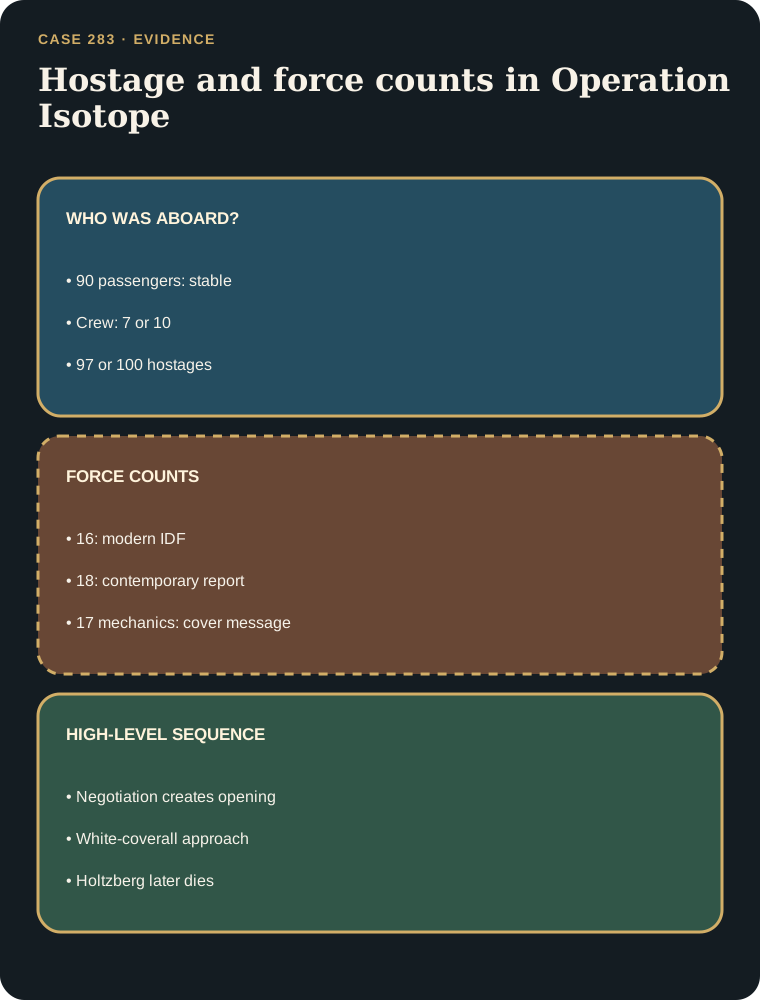
Count reconciliation is separated from the high-level rescue sequence without tactical aircraft geometry.