
On 3 January 1960, ten political prisoners escaped from the prison inside the Fortress of Peniche on Portugal’s Atlantic coast. Álvaro Cunhal was the best-known member of the group, but the operation was collective from beginning to end: prisoners organized inside the fortress, Portuguese Communist Party activists prepared transport and hiding places outside, and a National Republican Guard sentinel assigned to the prison perimeter cooperated with the plan.
The escape became one of the most damaging security failures of António de Oliveira Salazar’s Estado Novo. Its importance did not rest on a spectacular chase or a violent assault. The prisoners exploited coordination, secrecy, outside support, and the assistance of a man inside the security system. The surviving record is unusually good on the identities and political consequences, but less secure on some of the fine mechanics later repeated in party memoirs.
Ten Prisoners, Not One
Cunhal had been arrested on 25 March 1949 during a broad period of repression against the Portuguese Communist Party, which operated illegally under the Estado Novo. He was tried, convicted, and spent the 1950s in prison. Party records and his surviving Peniche prisoner card place his transfer from Lisbon Penitentiary to the Fortress of Peniche on 27 July 1956.
Peniche was not simply an old coastal fort with cells improvised inside it. By the late 1950s it had become a central part of the regime’s political-prison system. The National Museum of Resistance and Freedom, which now occupies the site, describes a reorganized prison in which blocks and floors were separated to restrict communication. The third floor of Block C formed a high-security wing for prisoners the authorities considered especially dangerous. The collective escape of 1960 began from that part of the institution.
Cunhal’s prominence has often caused the event to be remembered as “his” escape, but the official and institutional record consistently identifies ten prisoners: Álvaro Cunhal, Carlos Costa, Francisco Martins Rodrigues, Francisco Miguel Duarte, Guilherme da Costa Carvalho, Jaime Serra, Joaquim Gomes dos Santos, José Carlos, Pedro dos Santos Soares, and Rogério Rodrigues de Carvalho.
That denominator should remain fixed. There were ten escaping prisoners. José Augusto Jorge Alves, a National Republican Guard sentinel who helped the operation, was an eleventh person who left with the escape network, not an eleventh prisoner.
Planning on Both Sides of the Walls
The escape depended on communication between the prisoners and the clandestine PCP organization outside Peniche. Later participant testimony gives the clearest account of how responsibilities were divided.
António Dias Lourenço, one of the outside organizers, later wrote that the party leadership assigned Joaquim Pires Jorge to arrange accommodation for the fugitives, Octávio Pato to handle transport from Peniche, and Dias Lourenço himself to maintain contact with the cooperating GNR sentinel and the prisoners’ internal organization. The Aljube Museum independently names Pires Jorge and Dias Lourenço as outside planners, assisted by Pato and Rui Perdigão.
These accounts come from institutions closely connected to the history of opposition to the dictatorship, and Dias Lourenço was himself a PCP leader. His recollection is therefore valuable participant evidence rather than a neutral contemporary report. Its broad structure is nevertheless consistent with the event as preserved by the Peniche municipality, the Aljube Museum, the national museum at the fortress, and state archival holdings.
The indispensable inside collaborator was José Alves. The Peniche municipality identifies him as a GNR corporal in the force responsible for external security at the prison. The national museum explains the division of responsibility: prison guards watched the internal wards, while the GNR guarded the fortress perimeter and the PIDE maintained control over access to the prison.
Later stories disagree about why Alves cooperated and whether money was decisive. Some accounts describe political sympathy or resentment toward his superiors; others give conflicting figures for a payment. The accessible official and institutional record securely establishes his collaboration, but not a single uncontested motive or payment amount. Those later explanations should not be folded into the escape as settled fact.
The Signal from Outside
At about 4:00 p.m. on 3 January, actor Rogério Paulo drove a car into the square in front of the fortress and stopped with its trunk open. The Aljube Museum records this as the agreed signal that the outside operation was ready.
The distinction between signal and escape matters. Four o’clock marked the activation of the plan, not necessarily the moment when ten men cleared the prison walls. Later reconstructions place the prisoners’ physical movement after the evening routine had begun.
Dias Lourenço later said Paulo had not been told the true purpose of the maneuver beforehand, an example of the compartmentalization surrounding the operation. That claim comes from participant recollection and cannot be independently checked against a contemporary statement by Paulo in the surviving record.
Inside, the prisoners had to move from the controlled high-security area toward the outer fortress. Later participant and journalistic accounts agree that a prison guard on duty was incapacitated during this stage. Dias Lourenço specifically described chloroform and even recalled that the organizers had taken precautions intended to keep the guard from suffocating. The detail is striking, but it belongs to a later participant account. The surviving state archival catalogue confirms that an official prison report and a diagram of the escape exist, yet the accessible catalogue description alone does not independently verify every medical or procedural detail in Dias Lourenço’s recollection.
The broad historical conclusion is narrower: a prison guard was neutralized as the group began moving through the institution; chloroform is a well-established later account of how that was done, not a detail that can be presented as if directly witnessed by the accessible archive.
Across the Fortress
Once the group was moving, Alves’s cooperation helped the prisoners pass the most exposed part of the route toward the outer fortifications. Municipal and museum histories emphasize the length and difficulty of the movement from the cells to the exterior wall, while later participant narratives describe the escapees descending from one level of the prison complex and eventually lowering themselves beyond the fortress wall with an improvised rope.
The broad sequence is secure enough to reconstruct: the group left the high-security prison area, passed through a zone where the cooperating GNR sentinel mattered, reached the outer fortification, descended beyond it, and connected with transportation arranged outside.
The exact geometry is less important than the coordination. Later renovations changed the prison, and many published route descriptions ultimately derive from participant memory. A modern visitor can walk through spaces associated with the escape, but that does not make every present wall, doorway, or sightline an exact 1960 security diagram.
All ten prisoners made it out. Alves also left the fortress system with them.
The escape then changed character. It was no longer a problem of prison architecture but of clandestine movement.
Cars, Safe Houses, and Disappearance
Outside organizers had prepared transportation and places where the fugitives could be separated and concealed. Party recollections describe a deliberately compartmentalized system in which some drivers and helpers knew only the task immediately in front of them.
The fugitives were moved away from Peniche rather than remaining together as a conspicuous group. Cunhal returned to clandestine political activity in Portugal before later going abroad. He became secretary-general of the PCP in 1961 and spent much of the dictatorship’s remaining years outside Portugal. He returned on 30 April 1974, five days after the military overthrow of the Estado Novo.
For the PCP, recovering Cunhal and nine other experienced members was an organizational gain as well as a symbolic one. Contemporary foreign intelligence reached a similar conclusion from the opposite political perspective. A CIA weekly assessment dated 14 January 1960 described the escape of ten communist leaders as a source of concern to the Salazar government, both because of the renewed opposition activity it might enable and because it raised questions about the reliability of parts of the security apparatus.
That document is useful precisely because it was not written to celebrate the escape. It shows that, within days, outside observers also understood the event as more than an embarrassing prison break.
The State’s Response
Portuguese state records show immediate official attention.
The National Archive of Torre do Tombo preserves a Peniche prison report to the director of the PIDE dated 4 January, the day after the escape. It also lists a confidential PIDE circular distributed to police bodies with the identities of the fugitives and guidance intended to help recapture them. A separate archival item records censorship of newspaper reporting about the escape on 5 and 6 January.
Salazar’s own diary entry for 5 January included the Peniche escape among matters discussed with the Minister of the Presidency.
Those records are more useful than later claims that the dictatorship simply tried to pretend nothing had happened. The authorities investigated, circulated information, pursued the fugitives, and restricted reporting. They also faced a public fact that could not be permanently concealed: ten prominent political prisoners had escaped a prison designed to isolate precisely such people.
The archive also preserves the case file of José Augusto Jorge Alves. What it does not do, at least in the accessible exhibition catalogue, is resolve every later story about his motive, compensation, or personal expectations. Those questions remain separate from the securely documented fact of his collaboration.
How Much of the Famous Story Is Secure?
The Peniche escape accumulated a heroic vocabulary in PCP memory and an equally dramatic vocabulary in hostile accounts. Both can obscure the evidence.
The date is secure. The ten names are secure. The existence of internal and external organization is secure. Alves’s collaboration is secure. The external readiness signal involving Rogério Paulo is strongly supported by the Aljube Museum and later participant testimony. The prisoners’ successful passage from the prison wing to the outside of the fortress is beyond dispute.
Several finer points deserve labels rather than certainty. The exact moment each prisoner left the building is not established by the surviving record. The 4:00 p.m. time belongs to the signal outside, not necessarily the final breakout. Chloroform appears in detailed participant testimony but is not independently demonstrated here through the text of the contemporary prison report. The exact amount allegedly paid to Alves varies sharply in later accounts, and his motivation is contested. Stories that spectators in Peniche watched without informing the authorities appear in commemorative histories, but the number of observers and what each understood at the time cannot be reconstructed confidently.
There is also no need to credit the escape to Cunhal alone. Participant testimony assigns planning roles across an internal prison organization and an external party network. Cunhal was central politically and personally, but the operation’s defining feature was collective coordination.
What Peniche Changed
The immediate success was complete in the narrow prison sense: all ten designated prisoners got out, and the Estado Novo failed to recapture them during the escape itself.
The longer political meaning is harder to reduce to a single slogan. PCP commemorations have treated Peniche as a major victory in the struggle against the dictatorship. That is an understandable partisan interpretation, but the event did not by itself bring down the Estado Novo, which survived for another fourteen years.
Its concrete effects are easier to defend. The PCP recovered a group of experienced leaders. Cunhal returned to active leadership and became secretary-general the following year. The escape exposed a vulnerability created not simply by walls or locks but by the possibility that a member of the security force would cooperate with prisoners. Contemporary intelligence recognized the political significance almost immediately, and Portuguese archival records show the regime responding with investigation, police circulation, and censorship.
Peniche became famous because all of those layers met in one operation: a high-security political prison, clandestine organization on both sides of its walls, a cooperating sentinel, ten prisoners moving together, and a dictatorship suddenly forced to hunt men it had spent years isolating.
The escape belongs to Cunhal’s biography, but it was never his alone.
Evidence discipline
What the record supports
Status labels distinguish secure conclusions from uncertainty and rejected claims. Color is never the only signal.
MYTH
The Peniche breakout was Álvaro Cunhal’s solo escape.
Cunhal was the most famous participant, but ten political prisoners escaped in a coordinated collective operation involving multiple inside and outside organizers.
Sources: SRC-001, SRC-003, SRC-004, SRC-007DISPUTED
The prisoners physically escaped at exactly 4:00 p.m.
The Aljube Museum places the external readiness signal at about 4:00 p.m. Later reconstructions place the prisoners’ actual movement later in the evening; the available evidence does not justify converting the signal time into an exact wall-crossing time.
Sources: SRC-004, SRC-006LATER CLAIM
A prison guard was incapacitated with chloroform.
António Dias Lourenço’s participant account gives this mechanism in detail and later journalism repeats it. The accessible state-archive catalogue confirms an official escape report and diagram but does not itself reproduce text independently proving the anesthetic detail.
Sources: SRC-001, SRC-005, SRC-006DISPUTED
José Alves helped because he was paid a specific agreed sum.
Later accounts give different payment figures and different explanations for Alves’s motives. The secure fact is his collaboration; no single motive or payment amount is treated here as established.
Sources: SRC-003, SRC-005, SRC-006MYTH
The escape immediately brought down the Estado Novo.
It embarrassed the regime and restored important cadres to the clandestine PCP, but the dictatorship remained in power until April 1974.
Sources: SRC-001, SRC-007, SRC-008MYTH
The Estado Novo ignored or successfully concealed the escape.
Archival records document a prison report, a PIDE circular, press censorship, and discussion of the escape in Salazar’s diary within days.
Sources: SRC-001Documentary reconstruction
The inside-outside Peniche escape network
A case-local editorial visual clarifies the evidence structure without adding false precision or reusable operational detail.
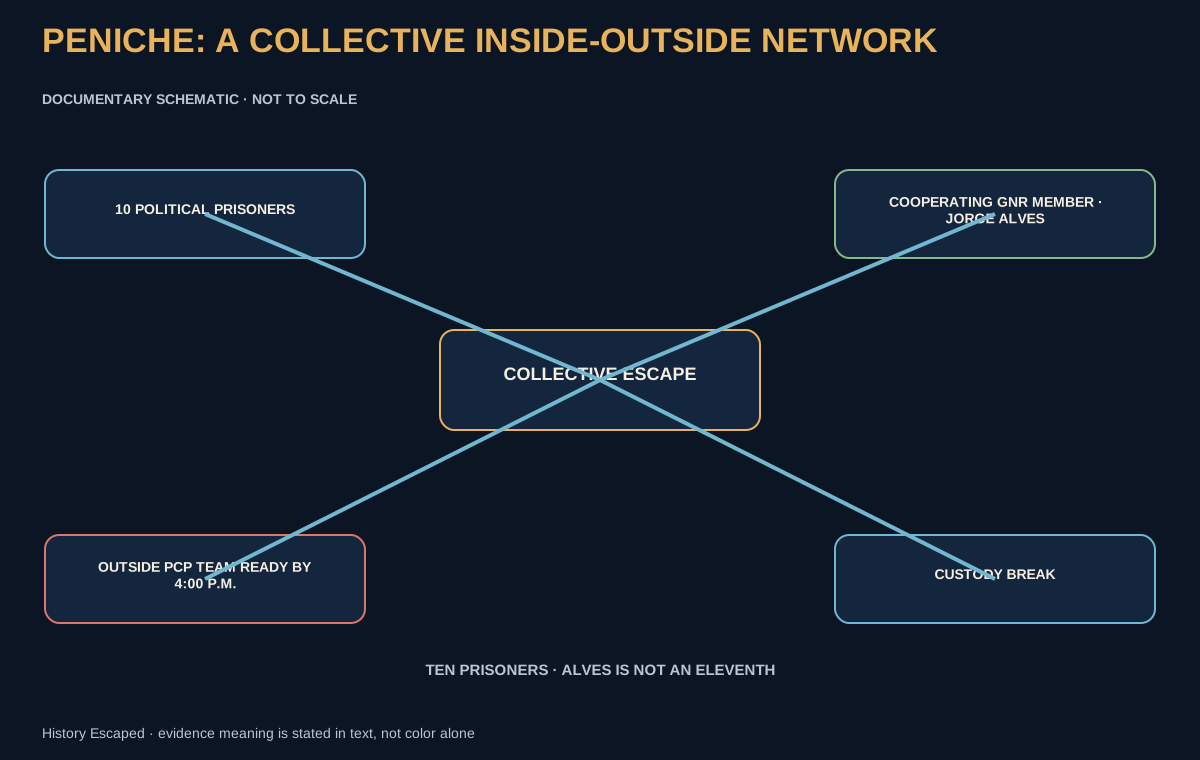
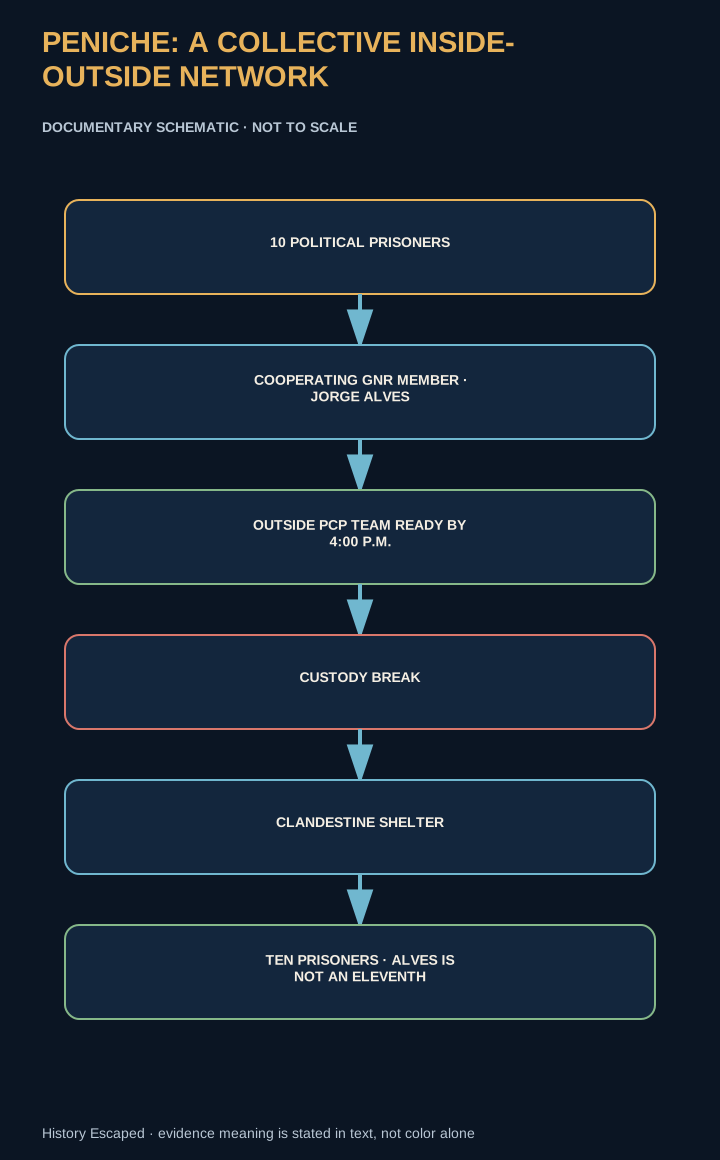
Simplified evidence-led editorial reconstruction based on the cited record; not to scale. Uncertainty is stated directly in the visual and adjacent text.

