
On 25 April 799, Pope Leo III was attacked in the streets of Rome during one of the city’s major religious processions. His assailants dragged him from his horse, stripped him, beat him, and tried to destroy the organs that symbolized his ability to govern: his eyes and his tongue.
Within hours, Leo was a captive. By the following night, he was out of his captors’ hands. Loyalists removed him from a guarded monastery, brought him to St. Peter’s, and placed him under the protection of Duke Winigis of Spoleto. From there the pope left Rome entirely and ultimately crossed the Alps to meet Charlemagne at Paderborn.
The episode is often remembered because of the spectacular medieval claim that Leo’s attackers successfully blinded him and cut out his tongue, only for both to be miraculously restored. The evidence is less certain. The attempted mutilation is secure; the completed mutilation is not.
At a Glance
Who: Pope Leo III, elected in 795.
Attack: 25 April 799, during the Greater Litany procession in Rome.
Attackers: A conspiracy led by senior papal officials Paschal and Campulus, supported by elements of the Roman aristocracy.
Captivity: Leo was confined after the attack and transferred during the night to the monastery of St. Erasmus on the Caelian Hill.
Escape: Loyal supporters led by the chamberlain Albinus got Leo out during the night of 25–26 April and brought him to St. Peter’s.
Protection: Duke Winigis of Spoleto then removed Leo from Rome.
Destination: Leo eventually traveled under Frankish protection to Charlemagne at Paderborn, arriving in July 799.
Source conflict: Medieval accounts disagree over whether Leo was actually blinded and had his tongue cut out or whether the attackers merely tried and failed.
A Pope with Powerful Enemies
Leo had become pope only a few years earlier, after the long pontificate of Hadrian I. His election changed the balance of power inside the Roman church and city government. Leo strengthened papal administration and emphasized his political relationship with Charlemagne, king of the Franks and patrician of the Romans. That alliance gave the pope a powerful external protector, but it did not eliminate opposition in Rome.
Paolo Delogu’s modern biography of Leo emphasizes that the exact causes of the hostility are difficult to reconstruct. What is clear is that important members of the Roman aristocracy opposed him.
Two senior officials became central to the conspiracy: Paschal, the primicerius of the notaries, and Campulus, another high-ranking Lateran official. Both were tied to the political and familial world of Hadrian I.
Later sources sometimes reduce the dispute to jealousy by relatives of the previous pope. That may have been part of the environment, but it is too simple as a complete explanation. The struggle involved papal government, aristocratic influence, property, office, and the increasingly important role Charlemagne exercised in Roman affairs.
25 April 799
The attack came during the Greater Litany. Leo was traveling toward San Lorenzo in Lucina when the conspirators struck near the monastery of San Silvestro in Capite. The crowd around him scattered.
The attackers pulled Leo from his horse and stripped away his papal clothing. They attacked his face and tried to blind him and mutilate his tongue.
The purpose is not difficult to understand. A pope deprived of sight and speech could be presented as physically incapable of carrying out his office. Mutilation could accomplish politically what assassination might complicate.
The surviving accounts agree that Leo was badly beaten. They do not agree about how completely the attackers achieved their intended mutilation. He was dragged into the nearby religious complex and attacked again before being confined.
Was Leo Actually Blinded?
The most famous version says yes. The papal biographical tradition claimed that Leo’s eyes were torn out and his tongue mutilated, and that divine intervention restored both his sight and speech. The story transformed an attempted political deposition into a sign that God had vindicated the legitimate pope. Frankish accounts are less consistent.
One version transmitted in the annal tradition says Leo’s eyes had been put out “as some would have it” and his tongue cut. Other medieval writers describe attempted blinding rather than a successfully completed operation.
Modern reconstructions are correspondingly cautious. Delogu describes repeated attempts to gouge out Leo’s eyes and cut his tongue but notes that when his supporters reached him, he was in possession of both sight and speech. Modern scholarship on the attack has repeatedly identified the mutilation story as one of its hardest source problems. The strongest conclusion is narrower: Leo’s attackers intended to mutilate him and seriously injured him, but the claim that both organs were physically destroyed and then miraculously restored cannot be treated as secure historical fact.
From San Silvestro to St. Erasmus
The first confinement did not satisfy the conspirators. During the night they transferred Leo to the monastery of St. Erasmus on the Caelian Hill. Delogu suggests that they probably regarded it as a more secure place in which to keep him away from supporters. This is the moment when the case becomes an escape story rather than only an assassination attempt.
Leo was no longer simply lying injured after an assault. He had been moved and guarded by men who were trying to prevent his political restoration. The captivity did not last long.
Albinus and the Night Escape
Leo’s chamberlain Albinus organized the crucial intervention. The modern Treccani biography, drawing on the Liber Pontificalis tradition, says Albinus entered St. Erasmus that same night with a group of loyal supporters. They found Leo alive, able to see and able to speak, and removed him from the monastery. A Frankish annal tradition gives a more dramatic physical mechanism: Albinus lowered the pope over a wall at night.
That detail is plausible and early, but it should not become more precise than its evidence. The source does not give a modern floorplan, wall location, rope length, or timed sequence. What matters is that Leo did not simply stroll away after his captors lost interest. His supporters actively extracted him from confinement.
They took him to St. Peter’s.
There the political balance changed. Clergy and loyalists gathered around the pope, and the conspirators did not attempt another immediate seizure.
From St. Peter’s to Spoleto
Safety inside St. Peter’s was still not the same as control of Rome.
The attack had demonstrated how deeply divided the city was. The conspirators retained aristocratic support, and their allies retaliated by plundering property belonging to Leo and Albinus. The external protector was Duke Winigis of Spoleto.
Winigis was a Frankish-aligned ruler whose responsibilities placed him in a position to intervene in Roman affairs. After hearing of the attack, he came to Rome, took Leo under protection, and brought him out of the city to Spoleto. This was the second stage of the escape.
Albinus and the Roman loyalists got Leo out of his immediate prison. Winigis got him beyond the city in which the conspiracy had occurred.
At Spoleto, Leo had a defensible base and Frankish protection.
Why Paderborn Mattered
Leo did not remain in Spoleto.
The Roman crisis could not be settled simply by surviving it. His opponents still challenged his legitimacy and accused him of serious misconduct, including adultery and perjury.
Leo therefore sought the one ruler powerful enough to alter the balance.
Charlemagne was campaigning north of the Alps. Escorted by Frankish officials, Leo traveled to meet him at Paderborn in Saxony.
Treccani dates Leo’s arrival to July 799. The Royal Frankish Annals independently record Charlemagne receiving the pope there with high honors.
The meeting was not a simple scene of Charlemagne instantly vindicating an innocent victim. Leo’s enemies also sent representatives and accusations to the Frankish court. Charlemagne treated the Roman crisis as something requiring investigation.
Leo had escaped his captors, but he had not escaped the political case against him.
Return Under Frankish Protection
Charlemagne did not permanently keep Leo in the north.
The king ordered him back to Rome accompanied by Frankish bishops and counts who would investigate the dispute and protect his return.
Leo arrived back before the end of 799. Delogu gives 29 November for the formal reception at the Milvian Bridge, where clergy, officials, soldiers, aristocrats, ordinary Romans, and foreign communities met him with banners and ceremonial honors.
He resumed control of the Lateran.
His opponents were questioned, and the conflict continued into the following year. Charlemagne himself came to Rome in 800. Leo eventually swore publicly to his innocence of the accusations against him.
On Christmas Day 800, Leo crowned Charlemagne emperor.
Escape and the Imperial Coronation
It is tempting to draw a straight line from the attack to the imperial crown.
The connection is real, but the politics were not automatic.
Leo’s escape and flight to Paderborn made Charlemagne’s protective role in Rome impossible to ignore. The Roman aristocratic revolt had raised questions about who could investigate charges against a pope, who possessed coercive authority in Rome, and what legal standing Charlemagne had when intervening.
Those issues contributed to the political environment in which the imperial title became useful.
They were not the only issues. Carolingian power, Byzantine politics, Roman traditions, and developing ideas of Christian rulership all mattered.
The escape therefore belongs in the prehistory of the coronation without being reduced to a one-step cause of it.
What the Sources Actually Establish
The central sequence is unusually strong for an event from 799.
Leo was attacked on 25 April. Paschal and Campulus were leading figures in the conspiracy. The attackers intended to disable him by attacking his eyes and tongue. He was confined and transferred to St. Erasmus. His supporters got him out. He reached St. Peter’s, entered Winigis’s protection, went to Spoleto, and then traveled to Charlemagne at Paderborn.
The uncertainties cluster around the most dramatic details.
We cannot establish that Leo’s eyes were fully gouged out and then miraculously restored. We cannot reconstruct the monastery escape as a measured physical route. Even the rope-over-the-wall detail comes through one Frankish narrative tradition rather than a neutral contemporary incident report.
Nor can the conspirators’ motives be reduced to one emotion. Leo had enemies among the Roman elite, but the attack emerged from a larger struggle over papal government and political authority.
The best reconstruction is therefore both dramatic and restrained.
A pope was ambushed, beaten, and taken captive in his own city. His enemies tried to make him physically unfit to rule. Loyalists penetrated his place of confinement and removed him during the night. Frankish power then carried him beyond Rome and ultimately to the king whose intervention would restore his position.
Leo III escaped captivity. The larger question of who now had the power to govern Rome followed him all the way to Paderborn.
Evidence discipline
What the record supports
Status labels distinguish secure conclusions from uncertainty and rejected claims. Color is never the only signal.
DOCUMENTED
Leo III was attacked on 25 April 799.
The date and procession context are consistently preserved across papal, Frankish, and modern scholarly traditions.
Sources: SRC-001, SRC-002, SRC-003WELL-SUPPORTED
The attackers tried to blind Leo and mutilate his tongue to make him unfit for office.
This intention appears across multiple traditions and fits the political logic of the assault.
Sources: SRC-001, SRC-002, SRC-004DISPUTED
Leo’s eyes were fully gouged out and his tongue cut off, then miraculously restored.
The papal biography developed a miracle narrative; other medieval accounts qualify the mutilation, and modern scholarship commonly treats the complete physical mutilation as uncertain.
Sources: SRC-001, SRC-004, SRC-007MYTH
Leo escaped entirely by his own efforts.
The strongest traditions make Albinus and other loyal supporters central to getting Leo out of St. Erasmus and into safety.
Sources: SRC-001, SRC-002, SRC-004WELL-SUPPORTED
Albinus lowered Leo over a monastery wall at night.
The Frankish annal tradition preserves this specific mechanism, while the papal tradition more generally describes supporter-led rescue. The wall detail is plausible but not independently detailed.
Sources: SRC-004MYTH
Leo immediately fled directly from St. Erasmus to Paderborn.
The sequence ran through St. Peter’s and Spoleto before Leo traveled north under Frankish protection.
Sources: SRC-001, SRC-004UNKNOWN
The accusations of adultery and perjury made against Leo were proven.
The accusations became central to the political dispute but were not substantiated in the surviving proceedings described by the record.
Sources: SRC-001, SRC-006MYTH
The 799 escape directly and inevitably caused Charlemagne’s imperial coronation.
The crisis helped intensify questions of Frankish authority in Rome, but the coronation emerged from a wider Carolingian, Roman, ecclesiastical, and Byzantine political context.
Sources: SRC-001, SRC-006Evidence diagram
Attack, captivity, escape, and protection
The secure sequence leads from the Roman attack to confinement, supporter intervention, and Frankish protection without inventing the extraction mechanics.
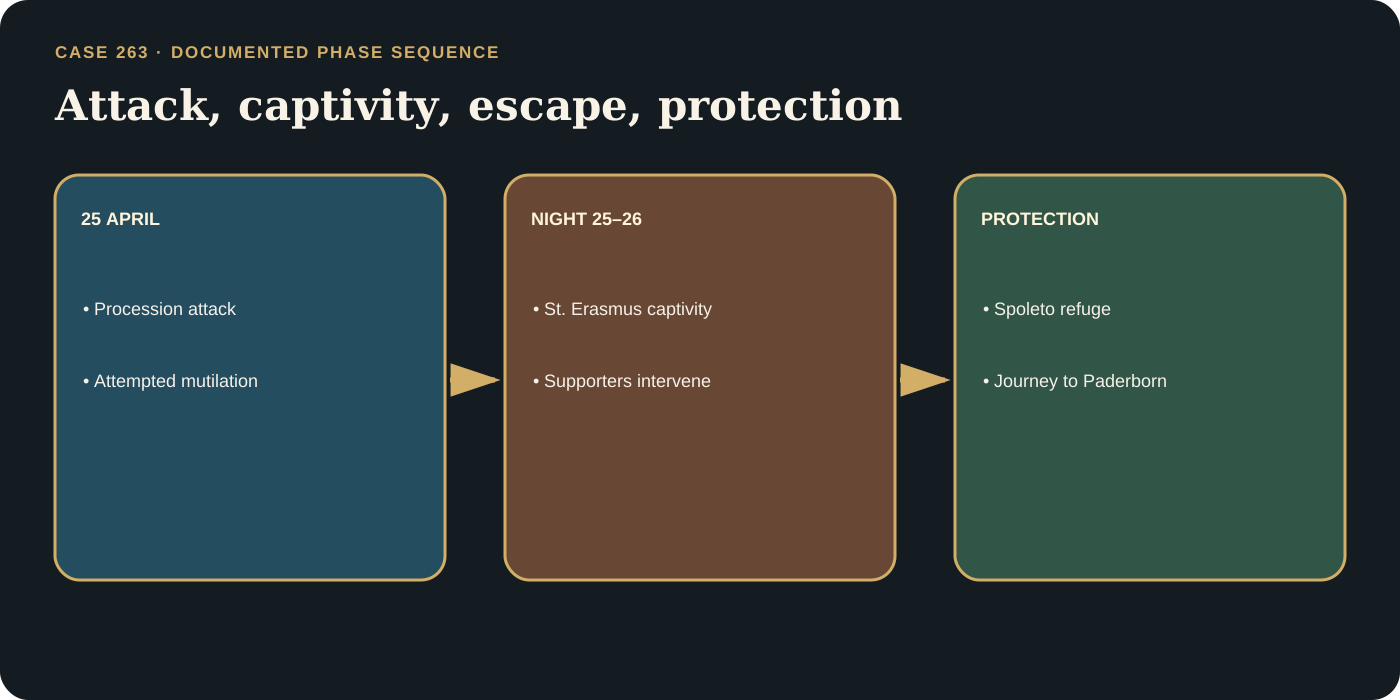
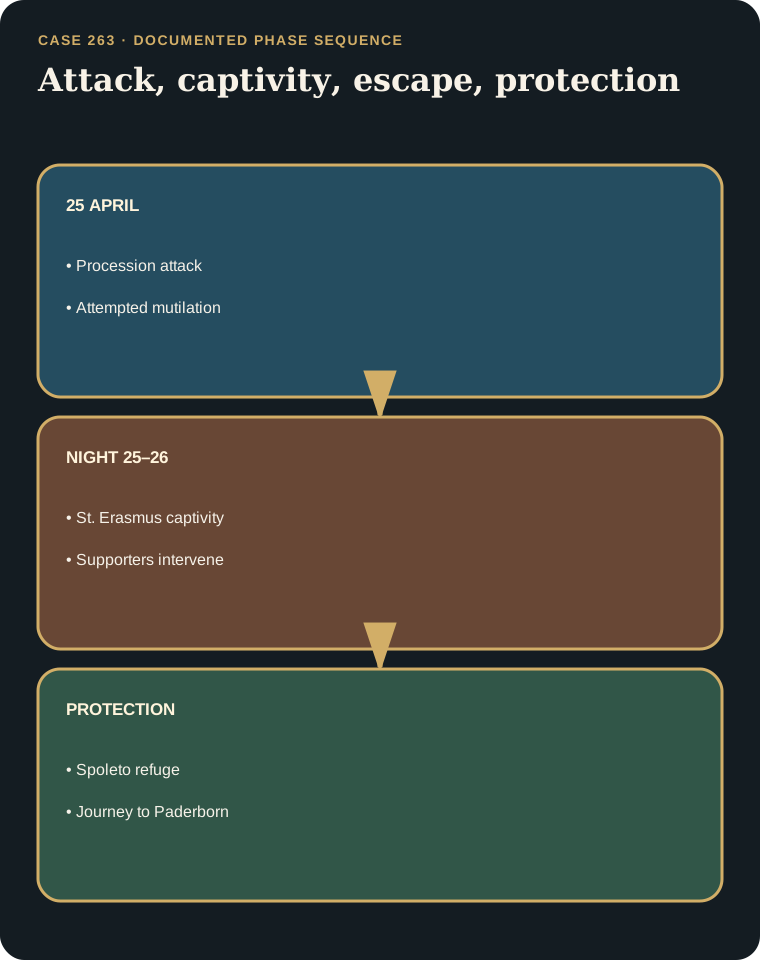
The secure sequence leads from the Roman attack to confinement, supporter intervention, and Frankish protection without inventing the extraction mechanics.