
Peter II of Alexandria fled his city in 373 only weeks after succeeding Athanasius as bishop. The reason was not an ordinary criminal charge. Emperor Valens supported an Arian rival, Lucius, and the imperial governor Palladius moved against the Nicene church in Alexandria with soldiers, political pressure, and the threat of exile.
The ancient sources agree that Peter escaped the takeover and reached Rome, where Bishop Damasus received him. They do not agree on one crucial point: was Peter actually imprisoned before he escaped, or did he secretly withdraw before the authorities could seize him?
Socrates Scholasticus and Sozomen say Peter escaped from prison. Theodoret, drawing heavily on Peter's own letter about the persecution, says Peter secretly withdrew from the besieged church and boarded a ship for Rome. That conflict cannot be solved by simply choosing the more dramatic version. The strongest common-ground reconstruction is therefore a documented flight from Arian-backed imperial persecution, with a disputed prison-break element.
At a Glance
- Succession: May 373, after the death of Athanasius
- City: Alexandria, Roman Egypt
- Persecuting government: Eastern emperor Valens and his provincial officials
- Rival bishop: Lucius, backed by the Arian party and imperial force
- Escape/flight: 373
- Destination: Rome
- Roman protector: Damasus I
- Core source conflict: Socrates and Sozomen say Peter escaped prison; Theodoret says he secretly withdrew before a threatened exile and sailed away
- Time away: Approximately five years
- Return: 378, after Valens's position weakened and the Alexandrian Nicene population expelled Lucius
- Outcome: Peter resumed the Alexandrian see and remained bishop until his death around 380–381
Athanasius's successor
Peter inherited one of the most contested bishoprics in the Roman Empire. Athanasius had spent decades fighting imperial efforts to impose rival bishops and theological settlements on Alexandria. His defense of Nicene Christianity made the Alexandrian see a center of resistance to emperors and churchmen who favored various forms of Arian or anti-Nicene theology.
Athanasius died on 2 May 373. Basil of Caesarea's surviving letter to Peter confirms that Peter succeeded him in May. Basil called Peter a disciple and long-time associate of Athanasius and urged him to continue his predecessor's work.
The succession was therefore not neutral. For the Nicene community, Peter represented continuity. For the Arian party and Emperor Valens, he stood in the way of installing a more compliant Alexandrian bishop. That conflict began almost immediately.
Palladius and Lucius
Theodoret's account describes the provincial governor Palladius moving against the church with force. Peter's own surviving letter, quoted by Theodoret, accuses Palladius of joining the Arian campaign against the Alexandrian churches. Soldiers and hostile crowds were used to seize church buildings, clergy and religious women were abused, and the Nicene community was driven from property it considered its own.
Lucius was then installed as the rival bishop. This was not simply a theological debate conducted through sermons.
Imperial authority determined who could occupy buildings, who could be expelled, and which bishop could function publicly. The conflict over doctrine became a conflict over physical control. Peter was at the center of that contest.
Theodoret: secret withdrawal before arrest
Theodoret gives the earliest surviving narrative that describes Peter's departure as a clandestine flight before the authorities physically secured him. According to his account, the governor surrounded the church and ordered Peter to come out, threatening exile if he refused.
Peter saw the danger and secretly withdrew. He then boarded a ship bound for Rome.
This version is compelling because Theodoret preserved substantial material from Peter's own letter about the persecution and because it fits the immediate political sequence: threatened removal, clandestine departure, and installation of Lucius. It does not describe a prison. If Theodoret is followed literally, the case is an escape from encirclement and impending exile rather than a prison break.
Socrates and Sozomen: escape from prison
Socrates Scholasticus gives a more dramatic version. He says Peter wrote to the churches after escaping from prison, and that having managed the escape he fled to Damasus at Rome.
Sozomen similarly says Peter escaped from prison, boarded a ship, and proceeded to Rome. These are not obscure modern retellings. Socrates and Sozomen are major fifth-century church historians, writing substantially closer to the events than medieval hagiographers.
Their agreement means the prison tradition cannot simply be dismissed. But they are also later than the events and may share source material or a common interpretive tradition. Theodoret's account, meanwhile, is embedded in a detailed persecution narrative that explicitly says Peter withdrew secretly before the threatened exile could be enforced. The evidence therefore supports a source conflict, not a clean verdict.
Can both versions be true?
It is possible to imagine a sequence in which Peter was briefly detained and then escaped, while another source compressed the event into a secret withdrawal. It is equally possible that "escaped from prison" in Socrates and Sozomen reflects a later misunderstanding of Peter's removal from a besieged or controlled church environment.
No surviving source gives enough operational detail to reconcile the accounts confidently. There is no secure cell, jail location, guard list, tunnel, disguise, or escape mechanism.
That absence is historically useful. It means the case should not be illustrated or narrated as an ancient prison break simply because that version is more dramatic. The documented core is stronger: Peter evaded Arian-backed imperial control in Alexandria and reached Rome.
Flight by sea
All major narrative traditions converge on the destination. Peter left Egypt by ship and went to Rome.
The route itself is not preserved in detail. No surviving ancient source gives a departure harbor, intermediate ports, ship name, or exact arrival date.
Rome mattered politically. Damasus I was a leading western supporter of Nicene Christianity. Peter's presence there created an alliance between the exiled Alexandrian bishop and the Roman see and gave Peter a secure base from which to defend his legitimacy.
The Catholic Encyclopedia summarizes the episode simply: Peter was forced to seek refuge in Rome from Arian persecution. That is a useful neutral formulation.
Damasus and the western connection
Peter remained in Rome for several years. A source tradition about Damasus says he welcomed Peter from roughly 373 to 378. Peter participated in the western Nicene network and appears in the wider theological disputes of the period, including opposition to Apollinarianism.
His exile also had symbolic value. Alexandria's Nicene bishop was physically absent while Lucius occupied the see under imperial protection. Rome recognized the exiled Peter instead.
The dispute therefore involved competing claims to legitimate episcopal authority backed by different political and ecclesiastical networks. Peter's survival prevented the imperial installation from becoming uncontested.
What happened in Alexandria after he left
Lucius's occupation did not create peace. The church historians describe continued violence against Nicene Christians, clergy, monks, and religious women. Some were imprisoned, expelled, or sent into exile.
Peter's own letter became one of the sources through which later historians knew of the persecution. That detail matters to the escape story.
Peter did not merely flee and disappear from the historical record. From safety, he wrote about what had happened in Alexandria and continued to assert his claim to the see. Flight preserved his ability to act as bishop in exile.
The return
The political situation changed in the later 370s. Valens became consumed by the Gothic crisis, and the imperial support that had sustained Arian control in Alexandria weakened.
Socrates says that after Valens left Antioch, persecuted Nicene communities regained confidence. Peter returned from Rome carrying letters from Damasus confirming Nicene faith and recognizing his ordination.
The Alexandrian population then expelled Lucius. Modern chronology generally places Peter's restoration in 378, with some scholarship giving the spring or 30 May.
The exact day is less important than the reversal. Five years earlier Peter had fled the city while imperial force installed his rival. Now he returned with western ecclesiastical support and resumed the see. Lucius left for Constantinople.
Why this is an escape case
Peter's story sits at the boundary between exile, political flight, and prison escape. If Socrates and Sozomen are correct, Peter literally escaped imprisonment.
If Theodoret is correct, he evaded capture or forced exile by secretly withdrawing from a surrounded church and immediately leaving by sea. Either version involves a meaningful escape from coercive state power.
The danger comes from overstating the mechanism. The evidence is strong enough to establish that Peter's departure was clandestine and compelled by persecution. It is not strong enough to reconstruct an exact prison breakout.
Because imprisonment itself is disputed, a title centered on flight to Rome is more accurate than one centered on a prison break. "Flight from Alexandria to Rome under Arian Persecution" captures what all the major sources agree happened.
The politics of the word "Arian"
The ancient writers are openly partisan. Socrates, Sozomen, and Theodoret wrote from Nicene perspectives and frequently use moral language against Arian opponents. The later Coptic patriarchal tradition is equally confessional.
Modern narration should not reproduce those polemics as neutral fact. The historical dispute involved theology, but it also involved imperial patronage, control of church property, episcopal legitimacy, and the use of provincial force.
Lucius was not merely a theological abstraction. He was a rival bishop whose claim was supported by the government of Valens.
Peter was not merely a passive victim. His flight preserved a competing claim and allowed him to build external support until the political balance changed.
What can be stated securely
Peter II succeeded Athanasius in May 373. Soon afterward, imperial officials backed Lucius and moved against Peter's Nicene supporters in Alexandria. Peter escaped the takeover and reached Rome, where Damasus supported him.
The exact mechanism is disputed. Theodoret says Peter secretly withdrew before threatened exile and sailed away. Socrates and Sozomen say he escaped from prison before fleeing to Rome.
No source securely preserves how a prison escape, if there was one, physically occurred. Peter remained away for approximately five years and returned in 378 after imperial conditions changed. Lucius was expelled and Peter resumed his position.
The case is historically sound only if it preserves the ancient disagreement. Its most interesting feature is not a lost set of lockpicks or a hidden passage. It is that three major late-antique historians remembered the same political flight differently—and that the secure reconstruction lies in the ground they share.
Evidence diagram
Peter II: two ancient accounts of flight
Ancient sources agree on Peter’s flight to Rome but disagree on whether he had first been imprisoned.
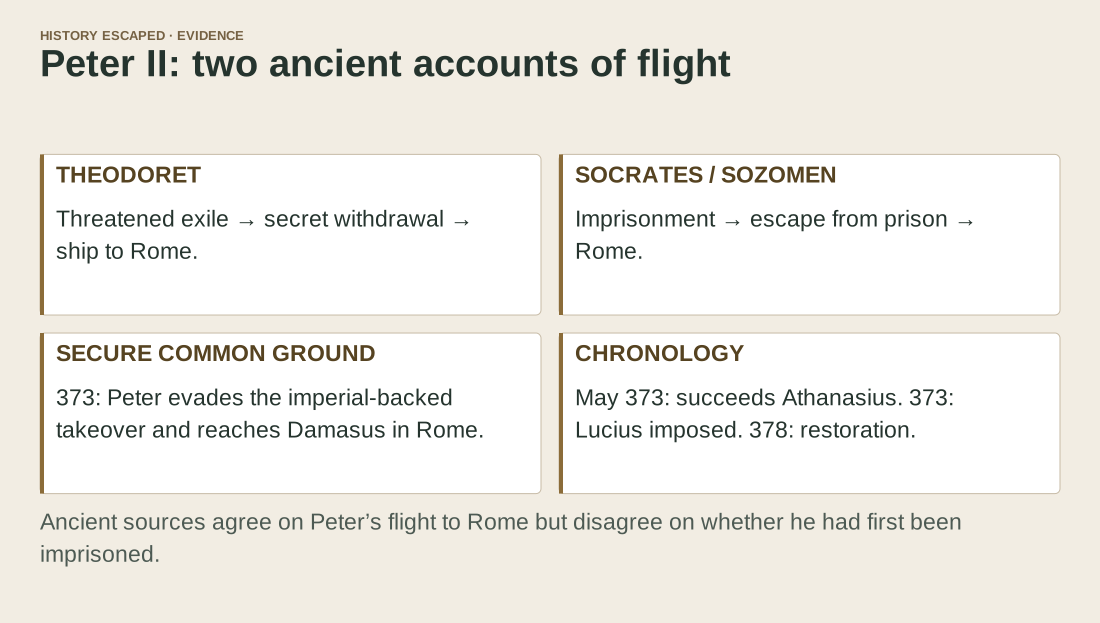
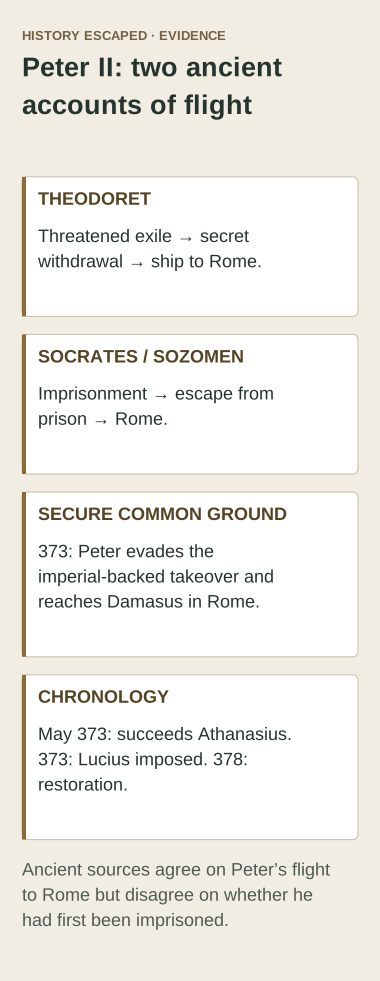
Ancient sources agree on Peter’s flight to Rome but disagree on whether he had first been imprisoned.
Problem → response
Escape was a sequence of problems
Each response solved a practical obstacle while often creating the next one.
- 01→
Obstacle
Imperial-backed rival bishop
Lucius's claim was supported by the government of Valens and enforced through provincial authority.
Response
Peter refused to accept the takeover and removed himself from the government's immediate control.
- 02→
Obstacle
Possible imprisonment or church encirclement
Ancient sources conflict over whether Peter had already been imprisoned or was still inside a threatened church complex.
Response
In either version, he escaped before imperial authorities could neutralize his claim permanently.
- 03→
Obstacle
Loss of the Alexandrian see
Flight preserved Peter's life but left Lucius in physical control of the churches.
Response
Peter used exile in Rome to maintain external recognition until conditions allowed his return.
The final accounting
Outcome
Peter reaches Rome
The bishop escapes Alexandrian coercion and gains refuge with Damasus.
Lucius controls Alexandrian churches temporarily
The rival bishop occupies the see under imperial support during Peter's exile.
Peter restored
Peter returns in 378 and resumes the Alexandrian see after Lucius is expelled.
Selected chronology
Selected chronology
Athanasius dies
The long-serving bishop of Alexandria dies after decades of Nicene-Arian conflict.
Peter succeeds Athanasius
Peter becomes bishop of Alexandria; Basil of Caesarea writes to him as Athanasius's successor and disciple.
Imperial-backed takeover
Palladius and supporters of Lucius move against Peter's Nicene church in Alexandria.
Peter flees to Rome
Peter escapes the Alexandrian crackdown and reaches Damasus in Rome; prison status is disputed among ancient sources.
Exile in Rome
Peter remains under western ecclesiastical protection while Lucius occupies the Alexandrian see.
Peter returns to Alexandria
Peter returns with letters from Damasus; the Alexandrian Nicene population expels Lucius and restores Peter.
Peter dies after restoration
Peter survives his restoration only a short period and is succeeded by Timothy I.
Evidence discipline
What the record supports
Status labels distinguish secure conclusions from uncertainty and rejected claims. Color is never the only signal.
DISPUTED
Peter II certainly escaped from a conventional prison cell in Alexandria.
Socrates and Sozomen explicitly say he escaped prison, but Theodoret says he secretly withdrew from a threatened church before exile and then sailed to Rome.
Sources: SRC-001, SRC-002, SRC-003DOCUMENTED
Peter's flight to Rome in 373 is historically secure.
All major narrative traditions and later institutional histories agree that he fled the Alexandrian Arian takeover and reached Damasus in Rome.
Sources: SRC-001, SRC-002, SRC-003, SRC-006UNKNOWN
The exact physical escape mechanism can be reconstructed.
No surviving source gives a reliable prison location, cell, guards, route through Alexandria, ship, or departure harbor.
Sources: SRC-001, SRC-002, SRC-003DISPUTED
Theodoret's secret-withdrawal account proves Socrates and Sozomen wrong.
The traditions may reflect different source chains or compressions of the same crisis. The evidence does not allow the prison tradition to be eliminated confidently.
Sources: SRC-001, SRC-002, SRC-003MYTH
The conflict was only an abstract theological disagreement.
Ancient sources describe seizure of churches, violence, imprisonment, exile, and use of provincial power in the struggle over the Alexandrian see.
Sources: SRC-001, SRC-004MYTH
Peter remained permanently in Rome after fleeing Alexandria.
He returned to Alexandria in 378 and resumed his episcopal position.
Sources: SRC-003, SRC-007