
Ponary was not a conventional prison. It was a mass-killing site. In the forest southwest of Vilnius, pits originally excavated for Soviet fuel storage were turned after the German invasion into places of mass shooting. Tens of thousands of people were murdered there between 1941 and 1944, predominantly Jews from Vilnius and the surrounding region, alongside Polish victims, Soviet prisoners of war, Roma and others.
Late in the occupation, the site acquired another function. The Nazis were trying to destroy physical evidence of the killings before the advance of the Red Army. Prisoners were forced to reopen graves, remove the remains of victims and burn them as part of the wider concealment program known as Sonderaktion 1005.
The prisoners assigned to that work understood the implication. Once the evidence had been destroyed, they themselves remained witnesses. Their route out began underground.
At a Glance
- Place: Ponary / Paneriai, outside Vilnius
- Date of breakout: night of 15 April 1944
- Context: Sonderaktion 1005 evidence-destruction forced labor
- Burning Brigade: about 80 prisoners
- Composition: Jews of Vilnius and Soviet prisoners of war; current memorial interpretation also records 76 men and 4 women
- Tunnel excavation: roughly 76 days
- Tunnel length: about 32–35 meters, depending on reconstruction method
- Tunnel size: only about 70 cm wide and 60 cm high in the current memorial reconstruction
- Current detailed memorial count leaving the pit: 22
- Older scholarly count crawling through the tunnel: about 40
- Current simplified museum / archaeological successful-escape count: 12
- Best-supported end-of-war survivor count: 11
- Count warning: older and current sources count different thresholds and do not agree on every intermediate number
- Physical confirmation: tunnel entrance identified in 2004; continuation mapped non-invasively in 2016 and published in peer-reviewed research
Paneriai had already become a killing site
The place appears in sources under several names. Ponary is the Polish form familiar from much Holocaust literature, while Paneriai is the modern Lithuanian name. Vilna, Wilno and Vilnius likewise reflect the city's Yiddish, Polish and Lithuanian histories.
Before the German occupation, Soviet authorities had begun excavating large circular pits for fuel installations near the railway southwest of Vilnius. The fuel project was unfinished when German forces entered Lithuania in 1941. The existing pits then became useful to German security forces and their local collaborators for mass shooting and burial.
German SS, security-police and Einsatzkommando personnel directed the killing operation. Members of the Lithuanian Ypatingasis būrys carried out a large share of the shootings under German command. The victims were overwhelmingly Jewish, especially Jews from Vilnius and nearby communities, but Ponary also became a killing place for Polish civilians and resistance figures, Soviet prisoners of war, Roma and other victims.
The total number murdered is not one settled figure
Older Soviet investigation and many postwar memorial accounts used a figure of more than 100,000 murdered at Ponary, often with approximately 70,000 Jewish victims. Later historical and archaeological work has revised or questioned parts of that total. The current Paneriai Memorial presents lower modern estimates for the entire site while still emphasizing the enormous Jewish death toll.
Those differences do not change the nature of the site, but they matter for precise historical writing. No single universal massacre total commands complete agreement across current scholarship. A cautious description is that tens of thousands of people were murdered at Ponary, predominantly Jews.
Sonderaktion 1005 changed the prisoners' role
As Germany's military position deteriorated, the SS expanded a program designed to remove forensic evidence from mass-killing sites. Sonderaktion 1005, directed at the broader level by SS officer Paul Blobel, forced prisoners to reopen graves and destroy human remains at killing centers and mass-shooting sites across occupied eastern Europe. Ponary was one of those sites.
The people later remembered as the Burning Brigade were not crematorium workers in a conventional camp system. They were prisoners compelled to participate in the destruction of evidence from an open-air killing site. The work itself was a continuation of the crime.
About eighty prisoners were held in the detention pit
The current Paneriai Memorial describes a forced-labor detachment of about eighty prisoners drawn from Jews of Vilnius and Soviet prisoners of war. Another memorial description specifies seventy-six men and four women. The prisoners were confined in a large pit that differed from the mass-killing pits around it. It was adapted as a guarded living space, with a covered section, bunks, a small kitchen and pantry, and ladders that guards could control.
Four Jewish women in the group performed cooking and domestic work inside the detention area. The men's labor was divided among exhumation, movement of remains, tending the burning sites, processing ash and other assigned tasks. The word “brigade” can make the group sound organized on its own terms. It was not. It was a coercive labor unit created by the people responsible for the killings.
Isaac Dogim encountered his own murdered family
One of the most frequently preserved survivor memories belongs to Isaac Dogim. During the forced work, Dogim later testified that he recognized members of his own family among the remains. The Paneriai Memorial records his memory of identifying his wife through a medallion he had given her.
That testimony should not be used as a dramatic set piece. Its historical importance is more fundamental: the people forced to erase the evidence were not detached witnesses to an anonymous atrocity. In some cases they were handling the remains of their own relatives and communities. Any account of the tunnel that begins only with “ingenious prisoners dug with spoons” strips away the reason the tunnel existed.
The prisoners expected that they would also be killed
The logic of Aktion 1005 made their position especially precarious. Across occupied eastern Europe, prisoners used to destroy evidence were commonly murdered after their work was completed. Their knowledge itself made them dangerous witnesses.
At Ponary, the Burning Brigade had no realistic reason to believe that finishing the assignment would produce release. The tunnel plan was therefore not an attempt to improve prison conditions or shorten a sentence. It was an attempt to escape an operation whose purpose included eliminating traces—and potentially eliminating the people who had seen those traces.
Abraham Blazer is credited with proposing the tunnel
The current Paneriai Memorial credits Abraham Blazer with suggesting an underground escape. Blazer had survived earlier encounters with the killing system and, according to the museum's reconstruction, had prior tunneling experience. Mordechai Zeidel and Isaac Dogim were among those who actively helped develop the plan.
Yuri Farber, a Soviet prisoner of war, also became central to later accounts of the tunnel. Different survivor narratives naturally emphasize different participants. The evidence supports treating the tunnel as collective work rather than assigning it to one mastermind.
Leadership mattered. So did the repeated labor of many prisoners who dug, moved sand, acquired material, guarded secrecy and prepared to use the passage.
The excavation began in late January or early February
The present memorial reconstruction places the beginning of digging near the end of January 1944. Other accounts simplify the start to February. The difference is small compared with the larger point: the tunnel was created over weeks, not in a sudden burst on the night of escape.
Current interpretation gives approximately seventy-six days of work. The prisoners were already physically exhausted by forced labor when they returned to the detention pit. The tunnel added a second hidden shift to the day.
The soil was both useful and dangerous
Paneriai's sandy ground could be worked with small improvised tools, but loose sand also made collapse a constant problem. The memorial reconstruction describes the prisoners using hands, boards, spoons and other available implements. As the passage lengthened, they reinforced the roof and sides with wood.
Modern geophysical research is important here because it does not merely repeat the memory of a tunnel. The physical surveys detected a subsurface feature in the expected position, aligned with the entrance uncovered earlier and consistent with the route described in testimony. The evidence now comes from both people and ground.
The tunnel was extremely small
The current Paneriai Memorial describes the finished passage as approximately thirty-two meters long, about seventy centimeters wide and sixty centimeters high. Peer-reviewed geophysical work gives a route in the same general range, with mapped features extending more than thirty meters from the entrance. These measurements matter because they clarify the physical condition of escape without needing to romanticize it.
A person could not simply walk through. The passage required crawling through a narrow space cut into unstable soil after weeks of forced labor and inadequate food. The tunnel was a route, but it was also another extreme physical ordeal.
Concealing the sand may have been as difficult as digging
Every meter of tunnel produced material that had to go somewhere. A visible spoil heap would have exposed the plan immediately. The current memorial estimates roughly twenty cubic meters of sand were removed and dispersed within the detention area.
Survivor-based accounts describe sand being spread across the floor, hidden around the bunker structure and worked into places where guards would not notice a sudden accumulation. The point is not the exact disposal method. It is that tunnel construction had two parallel tasks: create a void underground and make the removed earth disappear above it.
A hidden entrance protected the project
Accounts describe the tunnel beginning from the covered portion of the detention pit near the pantry or storeroom. The entrance was concealed behind an interior partition or false wall. That allowed the prisoners to work on a passage inside a space the guards already regarded as part of the prisoners' living area.
The concealment had to survive repeated inspections and the ordinary movement of people within the pit. A tunnel tens of meters long could be ruined by a few centimeters of unexplained fresh earth or one misplaced board. Its survival for more than two months is evidence of collective discipline as much as improvisation.
The prisoners even brought electricity into the passage
As the tunnel lengthened, ordinary flame became difficult to use. Survivor testimony describes Isaac Dogim and others arranging an electrical cable and light inside the passage. The current memorial notes that a cable and bulb formed part of the tunnel system, and modern investigation of the entrance area supports elements of the historical description.
This detail is often used to make the tunnel sound technically spectacular. A more useful interpretation is that the prisoners adapted whatever resources existed inside the forced-labor site to keep a concealed route usable. They were solving a problem created by darkness and distance underground.
The tunnel ended beyond the detention pit, not beyond all danger
Completing the tunnel did not mean the prisoners had dug directly into safety. The exit opened outside the detention pit but still within or near a guarded landscape of perimeter wire, armed guards, open ground and forest. The escapees still had to emerge without being seen, cross or cut barriers, survive gunfire and then move far enough through the woods to escape organized pursuit.
The tunnel solved the first layer of confinement. It did not solve the entire escape.
Why 15 April mattered
The breakout took place on the night of 15 April 1944, during Passover. Current memorial interpretation places the start at roughly 10 to 11 p.m. The timing has often encouraged symbolic retellings that frame the escape as a direct Passover reenactment.
The calendar connection is real. The prisoners' motivations, however, did not require symbolism to be urgent. They believed the window for survival was closing and that the forced evidence-destruction work would end with their own deaths.
The tunnel had reached a usable exit. Waiting carried its own lethal risk.
Zeidel described opening the exit
Mordechai Zeidel later gave a vivid account of the final moments inside the passage. He remembered struggling for air, opening holes toward the surface and eventually seeing the night sky. He also remembered seeing German guards nearby.
The testimony is valuable because it destroys the image of a tunnel that emerged into an empty forest. Freedom was visible, but so were the people assigned to prevent it. The escapees had created a passage underneath the guard system. They still had to survive the world above it.
Detection came quickly
Survivor accounts differ over the exact sound or movement that alerted the guards. A snapped branch appears in some reconstructions. Others emphasize visible movement or the general noise of multiple people emerging and crawling toward the perimeter.
The precise trigger is less secure than the outcome. The guards realized an escape was underway and opened fire. Once that happened, the careful collective plan became a series of individual and small-group flights through darkness.
This is where the counts begin to diverge
The number eighty is comparatively stable. What happens after the first prisoners enter the tunnel is not. One peer-reviewed historical mapping study says about forty prisoners crawled through the narrow passage before the escape was fully disrupted.
The current detailed Paneriai Memorial page instead says twenty-two prisoners managed to escape the detention pit. Its simpler history page says twelve members of the Burning Brigade escaped and eleven reached Soviet partisans. A later peer-reviewed geophysical study likewise says survivor testimony supports twelve prisoners escaping through the tunnel and evading capture, with eleven surviving to the end of the war.
These figures cannot all represent the same threshold. They probably do not.
Forty is best treated as a tunnel-throughput figure
The 2020 study Mapping Ponar (Paneriai): a reassessment preserves a reconstruction in which roughly forty prisoners crawled through the tunnel. It then narrows the group to about fifteen who got through or beyond the perimeter and eleven who reached partisan forces and survived the war. That is a coherent nested sequence:
about 80 in the brigade → about 40 through the tunnel → about 15 beyond immediate site barriers → 11 surviving.
But the newer detailed museum interpretation does not use those same middle numbers. It gives twenty-two leaving the pit, then eleven or thirteen reaching the partisan units depending on the source. The difference should remain visible.
Twenty-two is the current detailed memorial's pit-escape figure
The current Paneriai Memorial's most detailed page says twenty-two prisoners managed to escape the pit after emerging from the tunnel. That wording matters. “Escaped the pit” is not necessarily identical to “crawled through the tunnel,” “cleared the perimeter,” “escaped the search,” “reached the forest,” or “survived the war.”
A historian can therefore preserve the figure without treating it as a contradiction that must be mathematically forced into the older forty-person account. Different witnesses and later historians may have been counting different moments in a chaotic nighttime breakout. The source conflict itself is part of the evidence.
Twelve is the current simplified successful-escape count
The Paneriai Memorial's broader history page simplifies the event further. It says twelve members of the Burning Brigade escaped on 15 April and eleven reached Soviet partisans. The 2022 geophysical article uses a closely related formulation: based on survivor testimony, twelve prisoners are thought to have escaped through the tunnel and evaded capture, while eleven survived until the end of the war.
Smithsonian's 2016 report on the archaeological discovery repeated the same general twelve-to-eleven sequence. This is why twelve is a useful number only when the verb is precise. It is not the brigade total.
It is not necessarily the number who entered the tunnel. It is a later reconstruction of those who successfully escaped immediate recapture.
Eleven Is the Best-Supported Final Survivor Count
Across the current museum history, the 2020 mapping study, the geophysical literature and the Fortunoff testimony synthesis, eleven repeatedly appears as the number who ultimately survived or reached partisan safety. That makes eleven the strongest headline survivor count. It is still not entirely uncontested.
The detailed Paneriai Memorial page explicitly says eleven—or thirteen according to other sources—reached the Soviet partisan units. An older Yad Vashem encyclopedia entry says fifteen successfully fled to the partisans. A deeply researched 2024 history, Chris Heath's No Road Leading Back, reconstructs a dozen escapees and emphasizes how postwar retelling altered the story.
The evidence does not support “exactly eleven, end of discussion.” Eleven is the best-supported final-survivor figure, while intermediate and even some endpoint counts remain source-sensitive.
The people who did not escape faced immediate killing
The escape did not liberate the whole forced-labor detachment. Many prisoners were shot during the breakout or pursuit. Those who remained at the site were in extreme danger, and later prisoner groups continued the evidence-destruction work as the German occupation approached its end.
Some older reconstructions assign exact numbers to those shot during the escape and to those killed afterward. Because the intermediate escape count itself is unstable, a precise casualty subtraction from eighty is not supportable. Only a small minority survived the escape and the war.
The forest was another stage, not an automatic sanctuary
Survivors who cleared the immediate site still had to move through country controlled or contested by German forces and their auxiliaries. The Rūdininkai forest south of Vilnius contained Soviet and Jewish partisan groups. Reaching those groups could convert flight into a more sustainable form of survival.
Zeidel, Dogim and others eventually reached partisan forces. Rachela Margolis, herself a Vilna Ghetto survivor and partisan, later remembered the arrival of men from Ponary and the physical condition in which they appeared. Their escape therefore ended not at the tunnel mouth, but only after they had moved far enough into a resistance network to avoid immediate recapture.
Survival created witnesses
The survivors carried more than the story of their own tunnel. They had seen the mass graves reopened. They had been forced to handle evidence of the killings.
They had watched the Nazi attempt to turn a murder site into a landscape from which physical proof had been removed. Their later testimony became evidence about both phases of the crime: murder and concealment. This is one reason the tunnel matters historically even though only a small group survived. The escape allowed witnesses targeted for elimination to carry information beyond the site.
Shlomo Gol later testified
Shlomo Gol became one of the early public witnesses associated with the Burning Brigade. His later testimony and writing helped preserve evidence of the forced-labor operation. Mordechai Zeidel and Isaac Dogim also gave extensive postwar testimony.
Yuri Farber's account became especially important to written reconstructions of the tunnel. Like all testimony recorded under different circumstances and across decades, the accounts do not align perfectly. That is not a reason to discard them. It is a reason to distinguish what multiple accounts corroborate from what belongs to one remembered sequence.
The tunnel was never merely a rumor
News coverage of the 2016 archaeological work sometimes suggested that scientists had finally proven a story previously existing only as legend. That overstates the problem. The escape had long been known through survivor testimony.
In 2004, Lithuanian archaeologist Vytautas Urbanavičius had already uncovered the entrance area in the detention pit. What remained uncertain was the tunnel's full physical course. The 2016 work answered that narrower question without excavating through a Holocaust mass-grave landscape.
Non-invasive archaeology mattered ethically as well as scientifically
Ordinary excavation at Paneriai is not a neutral research choice. The ground contains the remains and ashes of mass-murder victims, and Jewish religious concerns place strong limits on disturbing human remains. The research team therefore relied heavily on geophysical techniques capable of detecting subsurface anomalies without opening the ground.
Electrical-resistivity tomography measures how strongly different parts of the subsurface resist electrical current. A former tunnel can retain moisture and sediment differently from undisturbed sandy ground. Those contrasts made it possible to identify sections of the passage.
The 2016 survey found the tunnel where testimony said it should be
The research team began with an entrance already identified archaeologically. It then ran non-invasive surveys across the expected route. The results detected anomalies consistent with a continuation of the tunnel more than thirty meters from the entrance.
Later peer-reviewed publication described a mapped segment roughly thirty-three to thirty-eight meters from the entrance and linked that physical result with historic plans, aerial photographs and testimony. The scientific evidence did not replace survivor memory. It intersected with it. That is the stronger historical point.
The archaeological confirmation also exposed how much the site had changed
Postwar memorial construction, Soviet-era landscaping, vegetation and military use altered Paneriai. Features visible in 1944 were moved, filled, reconstructed or obscured. The 2020 mapping project compared aerial reconnaissance photography, Soviet investigation plans, perpetrator-era sketches, survivor testimony and modern geophysics to reconstruct the wartime site.
That work is especially important because today's memorial landscape is not a frozen version of April 1944. The visible pit is real, but some walls and structures around it are later reconstruction, and the current ladder structure is explicitly a replica.
The tunnel survives in different layers of evidence
Not every meter of the 1944 route is directly observable. Three evidence layers overlap: survivor testimony documents the concealed starting area, narrow passage, reinforcement, lighting, emergence and gunfire; archaeology and geophysics physically identify the entrance and subsurface sections; and the continuous route between those points remains partly reconstructed. The distinction matters because the tunnel's history is strongest when testimony and physical evidence are allowed to corroborate one another without claiming more precision than either can provide alone.
The terminology needs care
The phrase “Burning Brigade” is now established in museum and historical writing, but it can sound almost organizational or military. The prisoners did not volunteer for the work. “Sonderkommando” can also cause confusion because the term was used by the Nazis for different special detachments, including prisoner units at killing centers and German operational units.
At Ponary, the prisoners were forced laborers within the wider Sonderaktion 1005 evidence-destruction system. They should not be linguistically merged with the German and Lithuanian personnel who committed or guarded the killings. The distinctions are moral as well as administrative.
The perpetrators were German and Lithuanian
A careful account must also avoid vague phrasing such as “the Nazis killed people at Ponary” if it erases the local structure of the crime. German SS and security-police personnel directed the killing operation. The Ypatingasis būrys, composed largely of Lithuanian personnel under German authority, carried out many of the shootings and other site duties.
This does not transfer collective guilt to Lithuanians as a people. It identifies the documented units and command relationships involved in the crime. The same precision should apply to the 1944 escape, where guards are described by role and evidence rather than by generalized nationality.
Passover symbolism remains secondary
The escape occurred during Passover, a festival whose narrative centers liberation from bondage. That coincidence has understandably shaped memory of the event. It can be acknowledged without turning the historical actors into symbols.
The prisoners were not characters inside an allegory. They were exhausted people trapped at a murder site and attempting to survive. Passover adds a layer of historical memory. It should not displace the material reality of the forced-labor unit, the tunnel, the guards and the pursuit.
The tunnel is not a celebration of technique
Its dimensions and construction are historically important, but admiring the tunnel in isolation distorts the context. The digging happened after days spent destroying evidence of mass murder. The tools were improvised because the prisoners possessed almost nothing.
The secrecy was necessary because discovery would likely mean death. The narrow dimensions reflected scarcity and danger, not optimization. The tunnel was a survival route created under coercion, not an engineering stunt.
Why this case is different from the Ninth Fort
The Ninth Fort Burning Brigade escape in 1943 is the closest internal comparison. Both involved prisoners forced into Aktion 1005 evidence destruction at major killing sites in Lithuania. Both groups understood that survival required escaping before the concealment work ended.
But the mechanics differ. The Ponary case centers on a long underground passage dug from a detention pit, while the Ninth Fort escape used a different sequence of internal movement and breakout. The two events are historically related without being mechanically identical.
Sobibor and Treblinka are different again
Sobibor and Treblinka were killing centers where prisoner uprisings developed into mass breakouts. Ponary was an open-air mass-shooting site later turned into a place of forced evidence destruction. The escape was not a camp uprising designed to overwhelm the entire killing apparatus.
It was a clandestine exit from a specific forced-labor enclosure. The outcome was also smaller. Only a fraction of the approximately eighty prisoners reached safety. Those differences matter more than the generic label “Holocaust escape.”
The tunnel's rediscovery changed public memory
Before 2016, the story was known mainly through survivor testimony, specialist history and local memorial interpretation. The non-invasive survey gave the escape a new physical visibility. International reporting suddenly showed viewers a line beneath the forest where the passage had run.
That visibility helped correct a common misconception about Holocaust victims as uniformly passive. But it also created a new risk: converting a site of mass murder into an uplifting “escape tunnel” destination. The memorial context must remain larger than the tunnel.
The memorial today preserves both crime and resistance
Paneriai Memorial includes mass-killing pits, monuments to different victim groups, the detention pit of the Burning Brigade and interpretive material explaining the evidence-destruction operation. The visible environment is therefore a layered memorial landscape. A visitor can stand near the place where prisoners were confined and where the tunnel began.
Modern walls, markers and replicas are not untouched wartime structures. Distinguishing what is original, reconstructed or commemorative is essential to understanding the site as it exists today.
The counts form a funnel, not a single number
The most honest summary is not “eleven escaped” or “forty escaped.” It is a funnel:
About 80 prisoners were held.
A larger group entered or passed through the tunnel; one peer-reviewed reconstruction says about 40.
The current detailed memorial says 22 escaped the pit.
Current simplified museum and archaeological accounts use 12 for those who escaped immediate capture.
Eleven is the best-supported number for those who reached durable partisan safety or survived the war, while other sources give 13 or 15 at intermediate endpoints.
This is not uncertainty that needs to be hidden. It is the result of counting a chaotic event from different moments.
Why eleven remains the best final number
The attraction of fifteen is understandable because it appears in older Yad Vashem material. The attraction of twelve is also understandable because modern archaeological reporting often says twelve escaped. But if a headline needs one final-survivor figure, eleven has the strongest cross-source support.
The current Paneriai history page says eleven reached Soviet partisans. The 2020 peer-reviewed mapping study says eleven reached partisan forces and survived the war. The 2022 geophysical article says twelve escaped capture but only eleven survived to the end of the war.
The Fortunoff testimony synthesis likewise states that eleven of the Burning Brigade survived. That convergence is strong enough to use, provided the article keeps the contrary counts visible.
Escape did not erase what had happened at Ponary
The men who survived could leave the site. The people already murdered there could not. The tunnel's historical significance therefore cannot be reduced to a victorious ending.
It is to reconstruct one act of resistance inside an exterminatory system. The survivors' route mattered because they lived. It also mattered because they could speak. Their testimony and the later physical survey meet in the same narrow strip of ground.
What the Evidence Supports
About eighty prisoners were forced to destroy evidence of mass murder at Ponary. Over roughly seventy-six days, members of the group dug a narrow tunnel from their guarded detention pit toward the forest. On the night of 15 April 1944, they attempted to use it as a collective escape route.
Guards detected the breakout and opened fire. Different sources count different numbers at the tunnel, pit, fence, forest and partisan stages. A small group survived.
Eleven is the best-supported end-of-war count. More than seventy years later, non-invasive geophysics traced the physical passage and confirmed that the escape route remembered by survivors still existed beneath the memorial landscape. The tunnel did not make Ponary less a place of mass murder. It preserved the path by which some of the people forced to erase that murder survived to testify about it.
Evidence discipline
What the record supports
Status labels distinguish secure conclusions from uncertainty and rejected claims. Color is never the only signal.
MYTH
The Burning Brigade was simply eighty Jewish men.
Current memorial interpretation describes Jews of Vilnius and Soviet POWs and elsewhere specifies 76 men and 4 women.
Sources: SRC-001, SRC-002DISPUTED
Exactly forty prisoners escaped successfully.
The 2020 study says about 40 crawled through the tunnel; the current detailed memorial says 22 escaped the pit and later museum/archaeological summaries use 12 successful escapees.
Sources: SRC-001, SRC-005, SRC-006DISPUTED
Exactly fifteen reached the partisans.
Older Yad Vashem and the 2020 study preserve a 15-person intermediate account; current Paneriai interpretation gives 11 or 13, and its simpler history page gives 11.
Sources: SRC-001, SRC-002, SRC-003, SRC-005WELL-SUPPORTED
Eleven survived the war after the tunnel escape.
Eleven is repeatedly supported by current Paneriai material, the 2020 mapping study, geophysical scholarship and testimony synthesis, but recent scholarship preserves a twelve-person endpoint tradition. Use eleven as safest, not absolute.
Sources: SRC-002, SRC-005, SRC-006, SRC-009, SRC-012MYTH
The tunnel was only a legend until 2016.
Survivor testimony long described it and the entrance was uncovered in 2004. The 2016 work mapped the continuation non-invasively.
Sources: SRC-001, SRC-005, SRC-006, SRC-008MYTH
Modern archaeologists excavated through the tunnel and mass graves.
The major 2016 work relied on non-invasive geophysics to avoid disturbing human remains.
Sources: SRC-006, SRC-019MYTH
The tunnel was dug in a single night.
Current interpretation describes roughly 76 days of excavation.
Sources: SRC-001, SRC-007MYTH
Completing the tunnel guaranteed freedom.
The tunnel exited the detention pit, but guards, perimeter barriers and pursuit still killed many prisoners.
Sources: SRC-001, SRC-005, SRC-007DISPUTED
Ponary's victim total is exactly 100,000 and uncontested.
Older Soviet-era and some scholarly reconstructions reached or exceeded 100,000, while current memorial interpretation gives lower modern estimates. Use 'tens of thousands, predominantly Jews' unless citing a specific estimate.
Sources: SRC-002, SRC-005, SRC-015MYTH
The Burning Brigade's work was ordinary burial labor.
It was part of Sonderaktion 1005, a systematic Nazi program to destroy evidence of mass murder.
Sources: SRC-004, SRC-017MYTH
The escape can be understood apart from survivor testimony about Ponary.
Survival mattered because witnesses later testified about both mass murder and evidence destruction.
Sources: SRC-005, SRC-007, SRC-009Documentary reconstruction
Escape counts and the tunnel evidence
A case-local editorial visual separates the documented sequence from uncertainty without implying exact modern geography or operational detail.
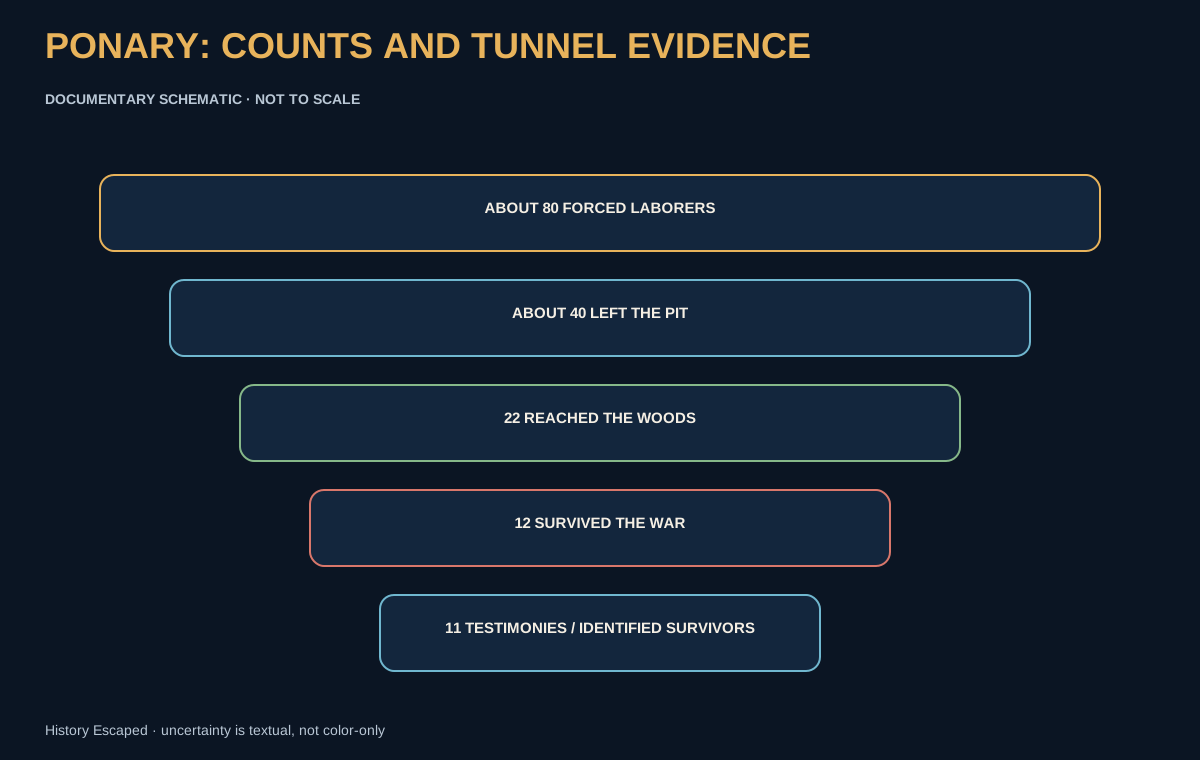
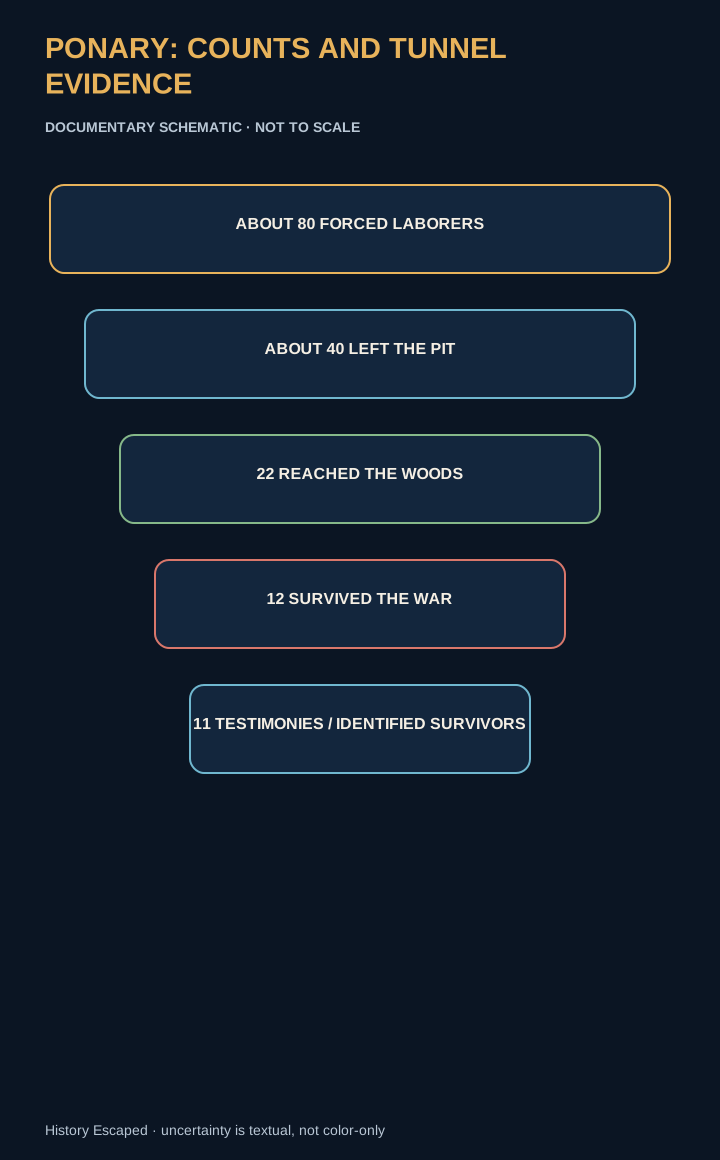
Simplified editorial reconstruction based on the cited historical record; not to scale. Uncertainty is stated directly in the visual and adjacent text.