
At a Glance
- Date: Night of 25–26 December 1943
- Place: Ninth Fort, Kaunas, German-occupied Lithuania
- Captivity type: Holocaust forced labor under Operation 1005
- Initial labor cohort: 72 people
- Killed before the breakout: 8
- Final escape group: 64
- Escaped the fort: 64
- Reached shelter: 28 in the strongest scholarly reconstruction
- Commonly cited survivors to war's end: 11
- Outcome: Successful mass breakout followed by an intensive manhunt and heavy losses
The Ninth Fort escape is sometimes reduced to a single dramatic number: sixty-four prisoners got out on Christmas night in 1943. That number is correct, but by itself it hides what happened before and after the breakout.
The Germans had initially assembled seventy-two people for forced labor connected to the destruction of evidence of mass murder. Eight were killed before Christmas, leaving sixty-four. All sixty-four escaped the fort during the night of 25–26 December. Only twenty-eight, according to the strongest archival reconstruction, reached shelter. Lithuanian heritage sources commonly give eleven as the number who survived until the end of the war.
Those are different stages of the same story. They should not be collapsed into one survival statistic.
The Ninth Fort before the escape
The Ninth Fort stood outside Kaunas as part of the old Russian imperial fortress system. Under Nazi occupation it became one of the principal sites of mass murder in Lithuania. Jews from the Kovno ghetto were killed there, as were Jews deported from elsewhere in Europe, Soviet prisoners of war, political prisoners, and other victims.
By late 1943 Germany's military position had deteriorated, and Nazi authorities were increasingly concerned that the physical evidence of mass murder would fall into enemy hands. Across occupied eastern Europe, Operation 1005 sought to destroy that evidence by reopening mass graves and burning the remains.
At the Ninth Fort, the Security Police and SD reorganized the site for this purpose. The prisoners forced to do the work became witnesses to both the killings and the attempt to erase their traces. Their survival was therefore never a reasonable assumption.
Seventy-two people were assembled
The most important count source was written immediately after the breakout. On 26 December 1943, eleven escapees in Kovno drew up a protocol describing what they had seen and how the forced-labor group had been formed. They stated that the Gestapo had collected 72 people at the fort at the end of October and beginning of November.
The protocol divided them by prisoner status: 34 Soviet prisoners of war, 14 Jewish partisans, three local Russians arrested for sabotage, four women—three Jewish and one Polish—and 17 Jews from the Kovno ghetto. Those categories overlap with ethnicity and should not be converted into a simple ethnic total.
The document also records what happened before the group could escape. A Jewish prisoner from the ghetto who became seriously ill was shot on 5 November. Seven older or disabled prisoners of war were shot on 13 November.
That left 64 people. A later archival study by historian Aya Ben-Naftali describes those final sixty-four as sixty Jews and four non-Jews.
Forced to erase the evidence
The prisoners were compelled to work at the mass graves and destroy the remains of people who had been murdered at the Ninth Fort. The immediate protocol makes clear that the prisoners understood the logic of their assignment. The work was hidden from the surrounding population, and the people carrying it out were not expected to leave the site as living witnesses.
This knowledge gave the escape a different character from an ordinary attempt to get away from prison. The prisoners were not merely serving sentences and looking for an opening. They believed that remaining until the evidence-destruction operation was complete meant death.
The phrase “burning brigade” is useful shorthand, though sources also use terms such as Operation 1005 labor unit or Sonderkommando. The latter can cause confusion with prisoner units in extermination camps, so the more specific Operation 1005 terminology is clearer here.
Planning inside the fort
The escape required cooperation among prisoners with different backgrounds. Ben-Naftali's study emphasizes the connection between members of the Kovno ghetto underground and Soviet prisoners of war. A planning group worked for more than three weeks on a route through the barriers between their confinement area and the fort's internal passage system.
The surviving physical site helps explain the problem. The fort contained underground corridors and heavy internal doors rather than a single conventional cell block surrounded only by an exterior fence. The prisoners had to create a path through locked and barred sections before they could use those existing passages to reach an exit.
Later accounts give extremely precise descriptions of how particular barriers were weakened. The important historical fact is simpler: preparation was concealed over weeks, and the wider group was not fully informed until the attempt was close. Compartmenting the plan reduced the risk that one frightened prisoner, an interrogation, or an accidental discovery would expose everyone.
Why Christmas night
The escape was planned for the Christmas period because the prisoners expected guard attention to be weaker than usual. The Kaunas Ninth Fort Museum dates the breakout to 25 December 1943. The escapees' own protocol is even more precise, saying they left during the night from the 25th to the 26th.
This resolves another small confusion in later retellings, which sometimes call it a Christmas Eve escape. The immediate document points instead to Christmas night.
Once the attempt began, the objective was to move the entire remaining labor unit through the prepared route before the guards discovered what was happening. All sixty-four got out of the fort.
Sixty-four escaped—but that was only the first threshold
Calling all sixty-four “successful escapees” is accurate if success means leaving the Ninth Fort. It is misleading if it means reaching lasting safety.
Outside the fort, the group scattered. Snow, darkness, unfamiliar routes, German searches, and the danger of denunciation or capture turned the breakout into a second struggle.
Ben-Naftali's reconstruction says only 28 of the 64 managed to reach shelter. The rest were captured by German forces or Lithuanian collaborators during the manhunt as they tried to reach safer areas or the forests.
That figure is one of the most useful numbers in the case because it separates the physical breakout from immediate survival. The escape route through the building had worked for everyone. The landscape beyond the fort did not.
Nineteen reached the Kovno ghetto
A community history preserved in Pinkas Hakehillot Lita gives a further breakdown. It states that 19 escapees reached the Kovno ghetto, several kilometers away.
Returning to the ghetto might appear counterintuitive. It was itself a place of confinement and mortal danger. Yet it also contained an underground organization, trusted contacts, hiding places, and people capable of helping fugitives move onward.
Ben-Naftali describes members of the underground hiding a conspicuous group of escapees with help from figures in the Jewish council and police and later assisting movement toward the forest. The same community history says 11 of those who had reached the ghetto later left to join the partisans. That is one of several places where the number eleven appears in the story.
The eleven who wrote the protocol
The day after the escape, eleven fugitives signed the protocol that survives as one of the case's strongest primary sources.
They were J. L. Vaslenitzki or Vasilenko, A. Diskant, A. Faitelson, M. Gelbtrunk, P. Krakinowski, M. Daitz, A. Wilenczuk, T. Pilownik, Gempel, Sh. Idelson, and A. Menaiski.
Their document was more than an escape statement. It described the Nazi effort to conceal mass murder and recorded the composition of the forced-labor unit before memories could be reshaped by years of later retelling.
Ben-Naftali writes that two copies were made in the ghetto. One was kept in the underground archive. Another was sent toward partisan headquarters in the Rudninkai forest and ultimately reached Moscow, where its information was broadcast.
The escape therefore helped defeat part of Operation 1005's purpose. The Nazis were destroying evidence to eliminate witnesses; witnesses escaped and produced a record almost immediately.
Eleven signatories does not automatically mean eleven survivors
The number eleven appears so often in later summaries that it can create false certainty. One source tradition says 11 of the fugitives who reached the ghetto later went toward the partisan units. Separately, 11 men signed the 26 December protocol. Lithuanian Jewish heritage and tourism sources commonly state that 11 of the 64 escapees survived to the end of the war.
Those statements may overlap heavily at the level of individual people, but they are not the same historical category. The reviewed scholarly account does not provide a name-by-name table proving that the protocol signatories, the partisan-bound group, and the final eleven survivors were identical. The Kaunas Ninth Fort Museum itself uses the less precise formulation that only “a few” survived. For that reason, eleven is best treated as a well-supported end-of-war survivor count, not as a perfectly reconciled nominal roster.
Alex Faitelson and the memory of the escape
Among the best-known escapees was Alex, or Alter, Faitelson.
He appears among the eleven signatories of the immediate protocol and later wrote extensively about Jewish resistance and the Ninth Fort escape. His later testimony became central to how the event was reconstructed.
Other signatories also carried the story forward. Michael Gelbtrunk, also known as Michael Yitzhaki in later testimony, is cited in scholarly work on the escape. Berl Gempel survived and left another testimony tradition. Israel Vaslenitzki, or Vasilenko, appears in later testimony as an important Soviet prisoner-of-war figure in the preparations.
The escape should not be reduced to a single mastermind, however. The strongest scholarship emphasizes collaboration between prisoners from the Kovno ghetto underground and Soviet POWs.
Its success depended on a group maintaining trust under conditions designed to destroy it.
The manhunt
The morning after the breakout, German authorities discovered that the forced-labor unit was gone.
The response was immediate. Search operations spread across the area around Kaunas and toward the forests. Many fugitives were recaptured; some were killed during or after attempts to avoid capture.
Later accounts disagree on some of the intermediate totals. That is one reason the number 28 reaching shelter is preferable to a falsely precise day-by-day capture ledger unless a nominal list is available.
The broader outcome is not in doubt. A majority of the sixty-four who escaped the fort did not survive the wider flight to safety.
Yet enough did survive to preserve testimony, and the December 26 protocol already existed before the manhunt could silence everyone.
What the breakout exposed
Operation 1005 was meant to conceal crime by destroying physical evidence and eliminating witnesses.
At the Ninth Fort, it failed at both aims.
The prisoners' testimony described the reopening of graves and destruction of remains. Their escape showed that the evidence-clearing operation itself had living witnesses. The memorandum moved from the ghetto underground toward partisan networks and beyond occupied Lithuania.
This did not stop the killings at the Ninth Fort. Murder continued there in 1944. Nor did the escape prevent the Germans from continuing efforts to destroy evidence.
Its importance was different: the Nazi authorities could no longer count on complete silence from the labor unit that had been forced to participate in the concealment process.
Resistance under extreme constraint
The Ninth Fort escape is sometimes described simply as an act of heroic resistance. That is true, but it is important to understand what resistance meant in this setting.
The prisoners had almost no safe options. They were guarded, isolated, forced into brutal labor, and aware that their knowledge made them disposable. Escape risked immediate death and exposed anyone who sheltered them to danger.
Planning also required cooperation across distinctions of origin, military status, political background, and language. The final brigade included Jews from several prisoner categories and four non-Jews.
The decision to escape was therefore collective resistance under conditions in which the alternative was not ordinary continued imprisonment but expected liquidation.
The count that best explains the story
No single number can summarize the Ninth Fort breakout.
72 explains the original forced-labor cohort. 8 explains the killings that reduced it before Christmas.
64 explains both the final brigade and the number that physically escaped the fort.
28 explains how sharply success narrowed once the fugitives were outside. 19 identifies the group reported to have reached the Kovno ghetto.
11 appears in three different ways: protocol signatories, a later partisan-bound group, and the commonly cited number who survived the war.
Keeping those categories separate makes the escape more—not less—remarkable.
Every member of the remaining forced-labor brigade got out of the Ninth Fort. Most still did not live to see the end of the war. A small number did, and their testimony ensured that the people forced to destroy evidence of mass murder became some of the people who preserved evidence of it.
Evidence discipline
What the record supports
Status labels distinguish secure conclusions from uncertainty and rejected claims. Color is never the only signal.
MYTH
The burning brigade always consisted of 64 prisoners.
The immediate 26 December protocol says 72 people were initially assembled. Eight were killed before the breakout, leaving the 64-person final unit.
Sources: SRC-001MYTH
Only 28 prisoners escaped from the Ninth Fort.
All 64 left the fort. Twenty-eight is the number Ben-Naftali gives for those who subsequently reached shelter.
Sources: SRC-002, SRC-003UNKNOWN
The eleven protocol signatories, the eleven who later went toward partisan units, and the eleven commonly cited war survivors were demonstrably the identical eleven people.
The sources reviewed establish each of these counts in different contexts but do not provide a fully reconciled person-by-person table proving the sets are identical.
Sources: SRC-001, SRC-006, SRC-007MYTH
The escape was simply a newly excavated tunnel dug out from the prisoners' cell.
The prisoners prepared a route through internal barriers into the Ninth Fort's existing underground passage system. Later shorthand that calls it a tunnel escape can obscure that distinction.
Sources: SRC-002, SRC-010MYTH
The prisoners' testimony about Operation 1005 was produced only years after the war.
Eleven fugitives produced a protocol in Kovno on 26 December 1943, the day after the breakout.
Sources: SRC-001, SRC-002MYTH
The escape eliminated Nazi killing or evidence-destruction activity at the Ninth Fort.
The breakout preserved witnesses but did not end the site's murderous function; killings continued in 1944.
Sources: SRC-002, SRC-005Documentary reconstruction
Reconciling the escape counts
A case-local editorial visual separates the documented sequence from uncertainty without implying exact modern geography or operational detail.
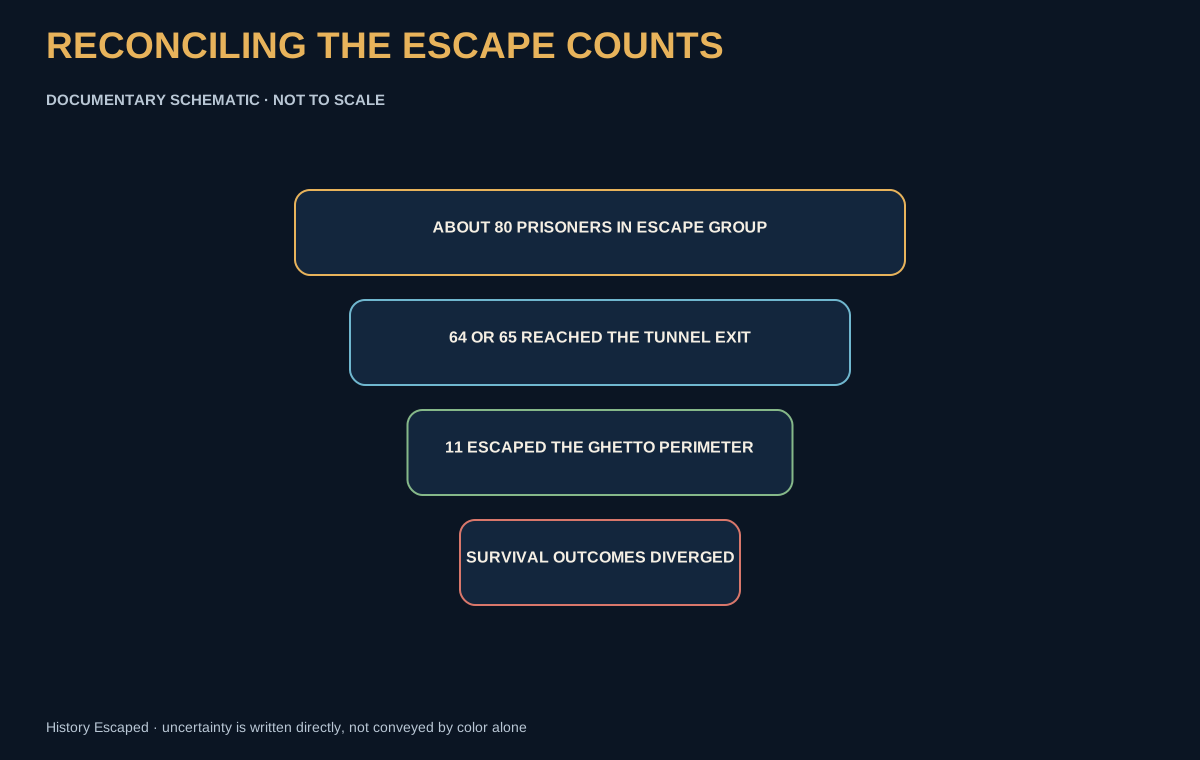
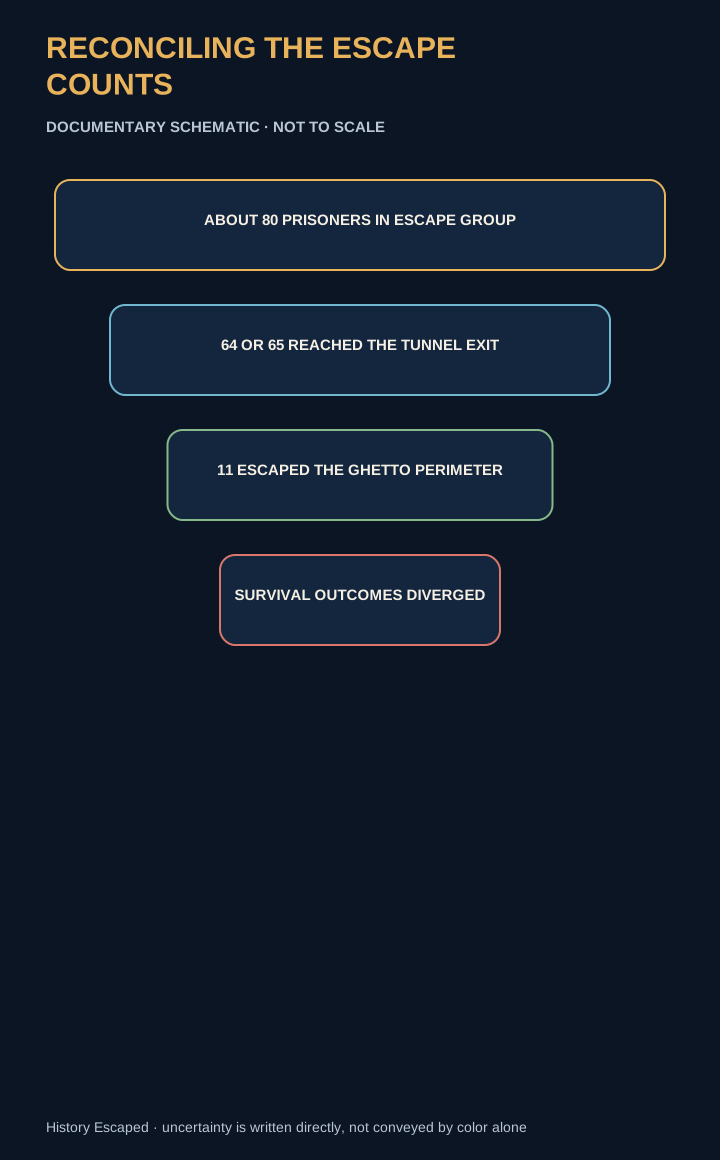
Simplified editorial reconstruction based on the cited historical record; not to scale. Uncertainty is stated directly in the visual and adjacent text.