
Kavad I’s escape from the Sasanian “Prison of Oblivion” is one of the most memorable royal escape stories of late antiquity, but the physical details are much less secure than the political outcome.
The chronology is firm at its edges. Kavad was deposed by a coalition of nobles and Zoroastrian clergy in 496, or possibly very early 497, and replaced by his brother Jamasp. Instead of killing a member of the royal house, the victors confined him in a fortified state prison in Khuzestan. Sometime before his restoration in 498/9, Kavad got out, fled east to the Hephthalites, secured their support, and returned strongly enough to recover the throne.
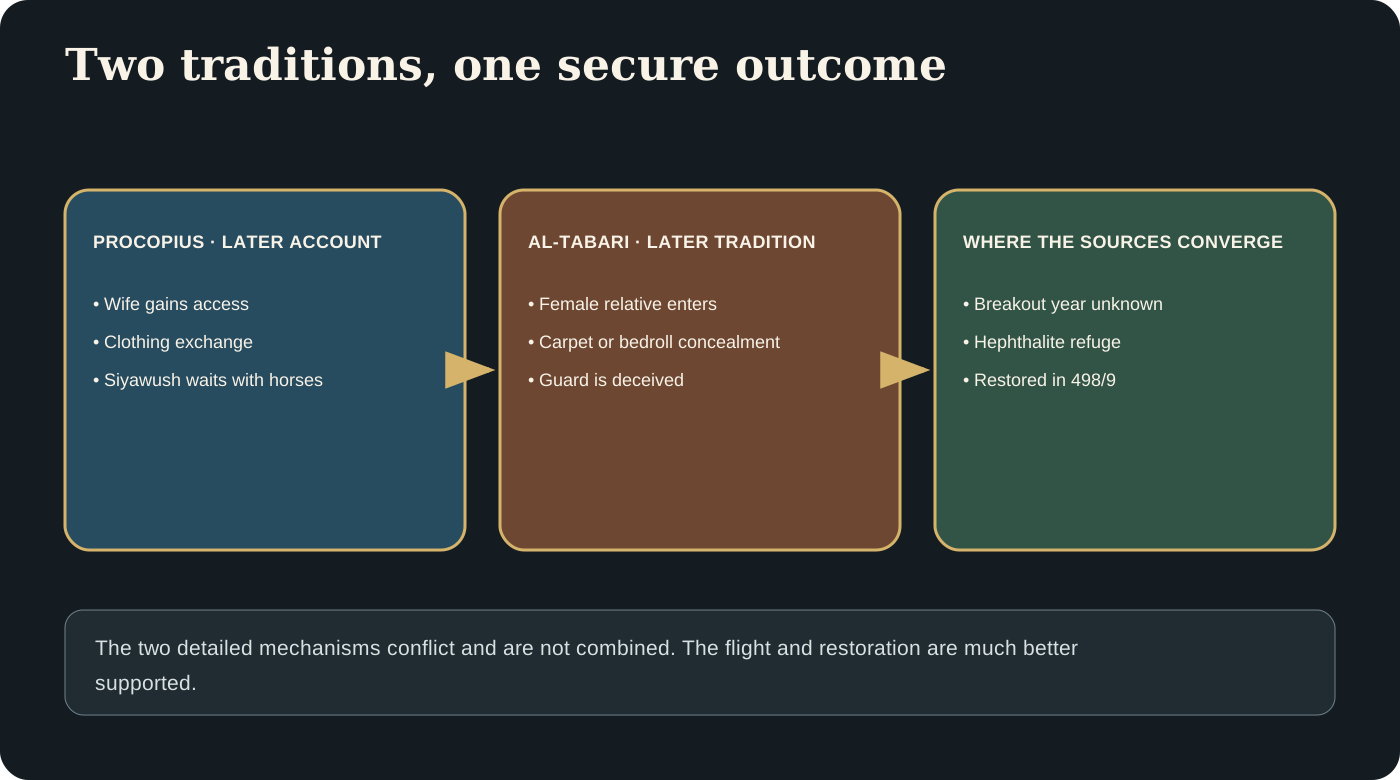
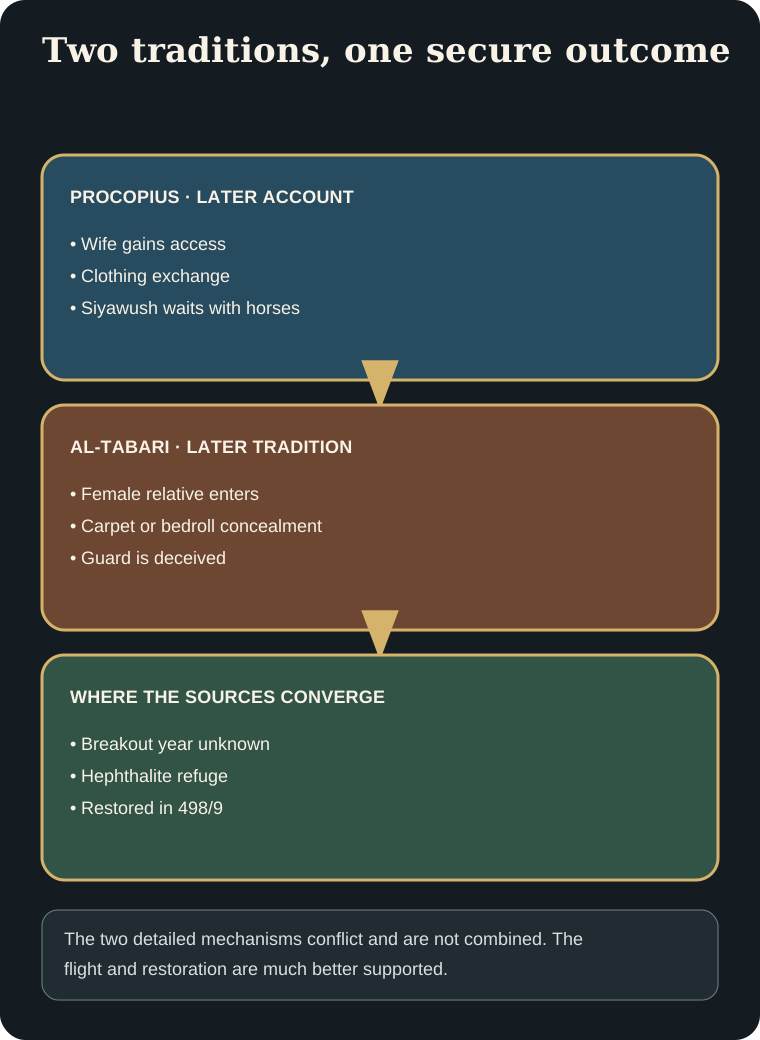
The famous breakout mechanisms come from later and conflicting traditions. Procopius says Kavad exchanged clothes with his wife and walked past the guards disguised as her while she remained behind. The Persian tradition preserved by al-Tabari instead has a female relative smuggle him out concealed in a carpet or bedroll. Near-contemporary Joshua the Stylite confirms the decisive political sequence—flight to the Hephthalites and return with their backing—but does not confirm either colorful prison-break story.
At a Glance
- Escapee: Kavad I, Sasanian king of kings
- Deposed: 496, with some scholarship allowing early 497
- Replacement ruler: his brother Jamasp
- Prison: the fortress traditionally called the Prison or Fortress of Oblivion
- Region: Khuzestan / ancient Susiana in southwestern Iran
- Exact escape date: unknown
- Secure escape window: after deposition and before restoration in 498/9
- Destination: the Hephthalite court to the east
- Probable elite helper: Siyawush, called Seoses by Procopius
- Breakout mechanism: disputed
- Outcome: Kavad returned with Hephthalite support and recovered the Sasanian throne
A vulnerable Sasanian monarchy
Kavad first became king in 488 after the deposition of his uncle Walash. He inherited a monarchy weakened by military disaster, fiscal pressure, aristocratic power and conflict with the Hephthalites. His father Peroz had died fighting the Hephthalites in 484, leaving the eastern balance of power badly damaged.
The surviving sources also connect Kavad’s first reign with a social and religious movement later associated with Mazdak. Exactly what Kavad supported, when he supported it, and how directly the later figure Mazdak belongs to the politics of the 490s remain disputed. Hostile Christian and later Persian sources often wrote about these events through ideological lenses of their own.
What is clear is that Kavad alienated powerful members of the nobility and religious establishment. By 496 they were strong enough to remove him.
Imprisonment instead of execution
Procopius preserves a dramatic account of the nobles debating Kavad’s fate. One aristocrat, Gousanastades, allegedly argued that the safest solution was immediate execution and warned that leaving Kavad alive might later require an army to stop him.
The nobles chose imprisonment instead. Jamasp, another son of Peroz, became king while Kavad was confined in a fortress used for high-ranking political prisoners.
Procopius calls the place the “Prison of Oblivion.” He explains the name by claiming that once a man entered, even speaking his name was forbidden on pain of death. Modern linguistic scholarship complicates that explanation: the celebrated name may reflect a later Greek or Armenian reinterpretation of a Middle Persian expression reconstructed as anōš bard, something closer to “immortal” or “imperishable fortress.”
The broad location is firmer than the name’s etymology. Sources place the prison in Khuzestan, ancient Susiana, in southwestern Iran. Later geographical traditions associate it with the region around Gundeshapur and a fortress called Giligerda, but no exact archaeological site should be treated as proven.
Procopius’s escape story
Procopius gives the fullest surviving physical reconstruction.
According to him, Kavad’s wife was permitted to bring food to her imprisoned husband. The prison keeper became sexually interested in her, and Procopius says Kavad told her to submit to the keeper’s demands. After that, she was allegedly allowed to enter and leave with less scrutiny.
A loyal Persian noble named Seoses—usually identified with Siyawush—waited near the prison with men and horses. Procopius then says Kavad and his wife exchanged clothing. She remained where Kavad normally sat while he left dressed in her garments, passing guards who mistook him for the woman they had become accustomed to admitting.
Procopius also admits that he could not establish what happened to Kavad’s wife afterward because Persian accounts disagreed. That admission matters: even the fullest surviving narrative was built from traditions circulating decades after the event, not from an eyewitness report.
The carpet tradition
The Persian historical tradition preserved by al-Tabari tells a different story. Here, the central woman is described as Kavad’s sister or female relative rather than his wife.
She gains access to the prison, and Kavad is concealed inside a rolled carpet or bedroll carried by a servant. When a guard asks about it, she explains that the bedding has been contaminated by menstrual blood and is being taken out for purification. The guard declines to inspect it.
The two stories cannot simply be combined. One has Kavad walking out in women’s clothing while his wife stays behind; the other has him physically carried out while concealed in bedding.
They do share a broader motif: a woman close to Kavad gains privileged access, gendered assumptions reduce scrutiny, and Kavad gets through the prison controls. That common structure may preserve some historical memory, but it is not enough to establish which woman helped or how the breakout physically happened.
Modern historian Michael Bonner treats the detailed disguise story skeptically and emphasizes that elite assistance is a more defensible historical core than the literary mechanism itself.
Siyawush and the escape network
The strongest candidate for an important helper is Siyawush.
Procopius calls him Seoses and says he waited near the prison with men and horses ready for Kavad’s flight. Modern Encyclopaedia Iranica scholarship also treats Siyawush as instrumental in freeing Kavad.
Later Persian tradition gives another aristocrat, Zarmehr, son of the powerful noble Sukhra, a role in Kavad’s flight. These traditions need not describe exactly the same moment, and the evidence is not strong enough to merge them into a fixed helper roster.
What they show more reliably is that escape required more than passing a prison guard. A deposed king needed transport, trusted followers, political cover and a route to a foreign court capable of protecting him.
What Joshua the Stylite confirms
Joshua the Stylite is especially valuable because his Syriac chronicle was written very close to Kavad’s lifetime.
Joshua does not describe a clothing exchange, carpet, prison keeper or fortress breakout. He compresses the crisis so heavily that Kavad appears to flee when he learns of the nobles’ plot against him.
That omission weakens confidence in later attempts to reconstruct the prison episode step by step. At the same time, Joshua strongly confirms the politically important phase that followed: Kavad reached the Hephthalite ruler, established a dynastic relationship there, repeatedly sought military support, and returned with an army.
The precise prison mechanics remain uncertain. The successful flight east and the restoration campaign do not.
Refuge with the Hephthalites
Kavad’s relationship with the Hephthalites was complicated. His father had died fighting them, and Joshua preserves a tradition that Kavad himself had earlier spent time among them as a hostage.
After his deposition, the Hephthalite court became his refuge. Joshua says Kavad married the daughter of the Hephthalite king, who was also connected to the Sasanian royal family through a princess captured after Peroz’s defeat. Other sources agree broadly that a marriage alliance strengthened his position, although the exact family relationships in the traditions are not perfectly consistent.
Kavad then obtained troops for his return to Iran.
The political transformation was extraordinary. The nobles had imprisoned a defeated king; the man who returned from the east had foreign military backing from the same power that had already demonstrated its ability to destroy a Sasanian army.
When did he actually escape?
The sources do not support a precise breakout date.
Jamasp’s accession belongs to 496, with some scholarship allowing early 497. His known coinage reaches regnal year three. Kavad’s restored coinage resumes with his own regnal year eleven in 498/9.
That numismatic sequence gives the most reliable outer framework. Kavad was out of power after 496 and back on the throne by 498/9.
It does not tell us how much of that interval he spent imprisoned, travelling east, living at the Hephthalite court, or preparing his return. The escape should therefore be dated c. 496–498, not assigned an invented month or even a confidently fixed single year.
Return and restoration
Kavad returned west with Hephthalite military support. Jamasp and the ruling elite did not produce the prolonged civil war that might have followed from a disputed restoration.
By 498/9, Kavad was king again.
Sources differ over Jamasp’s later fate. Some present him as stepping aside; Procopius preserves a harsher tradition. Those questions belong to the restoration’s aftermath rather than the escape itself.
Gousanastades, the noble who had supposedly argued that Kavad should be killed instead of imprisoned, did not survive the restored king’s return to power. Procopius’s warning therefore became an effective literary prophecy: the captive whom the nobles spared eventually came back with an army.
What “Prison of Oblivion” means for the story
The prison’s famous name gives the case a mythic quality before the escape narrative even begins.
That makes source discipline particularly important. The fortress was part of a Sasanian tradition of confining politically dangerous high-status captives, and Kavad’s imprisonment belongs securely to the historical tradition. The explanation that prisoners became legally “forgotten,” however, may reflect later interpretation of a Persian name rather than the institution’s original literal title.
The same problem affects the breakout story. The wife’s clothing exchange and the sister’s carpet are vivid because they are memorable, not because one has been independently verified.
A responsible reconstruction therefore keeps the political sequence firm and the physical mechanism open.
What the evidence supports
Kavad I was overthrown by powerful nobles and religious authorities in 496, or possibly early 497, and Jamasp replaced him as king. Kavad was confined in a fortified state prison in Khuzestan remembered in later sources as the Prison of Oblivion.
He subsequently escaped, although the exact year and method are unknown.
Procopius preserves a story in which Kavad’s wife exchanged clothing with him while Siyawush waited outside with horses. Al-Tabari preserves a different Iranian tradition in which a female relative smuggled Kavad out inside a carpet or bedroll. Neither mechanism can be treated as fully documented.
The broader outcome has much stronger support. Kavad reached the Hephthalites, secured dynastic and military backing, returned to Iran, and recovered the throne by 498/9.
That reversal is the case’s historical center. The nobles chose imprisonment because they did not want royal blood on their hands. Their captive then escaped the empire, found an army beyond its frontier, and returned powerful enough to undo the settlement that had put him away.
Evidence discipline
What the record supports
Status labels distinguish secure conclusions from uncertainty and rejected claims. Color is never the only signal.
UNKNOWN
The exact year of Kavad’s prison escape is securely known.
The deposition belongs to 496 or possibly early 497, and restoration is fixed to 498/9. Surviving sources do not securely date the breakout within that interval.
Sources: SRC-002, SRC-004LATER CLAIM
Kavad escaped by exchanging clothes with his wife.
Procopius gives this detailed version decades after the event, but other traditions preserve a different mechanism and near-contemporary Joshua does not corroborate it.
Sources: SRC-001, SRC-003, SRC-006LATER CLAIM
Kavad escaped hidden inside a carpet with help from his sister.
This is the distinct Persian tradition preserved by al-Tabari and conflicts with Procopius’s clothing-exchange version.
Sources: SRC-005, SRC-006DISPUTED
A female relative probably had some role in the escape.
Both major detailed traditions give a woman close to Kavad a central role, but they disagree over her identity and actions.
Sources: SRC-001, SRC-005, SRC-006WELL-SUPPORTED
Siyawush was important in Kavad’s escape and flight.
Procopius describes Seoses waiting with men and horses, and modern Iranica scholarship treats Siyawush as instrumental in freeing Kavad.
Sources: SRC-001, SRC-002WELL-SUPPORTED
Kavad reached the Hephthalites and returned with their support.
The broad sequence is independently supported by Procopius, Joshua the Stylite, and modern numismatic chronology.
Sources: SRC-001, SRC-002, SRC-003DISPUTED
The fortress’s original Persian name literally meant 'Prison of Oblivion.'
Procopius gives the prohibition story, while modern linguistic scholarship argues that the famous name may be a later reinterpretation of a Middle Persian expression meaning 'immortal' or 'imperishable fortress.'
Sources: SRC-001, SRC-007Evidence diagram
Competing breakout traditions and a secure political outcome
The detailed prison stories conflict, but Kavad’s flight to the Hephthalites and restoration are far better supported.
The detailed prison stories conflict, but Kavad’s flight to the Hephthalites and restoration are far better supported.